|
CONTENTS
OF THIS SECTION
|
| "...The
Paris Peace talks, which opened on May 10, continue to be plagued by
procedural questions that impeded any meaningful progress. South Vietnamese
Premier Nguyen Cao Ky refused to consent to any permanent seating plan that
would place the National Liberation Front (NLF) on an equal footing with Saigon.
North Vietnam and the NLF likewise balked at any arrangement that would
effectively recognize the Saigon as the legitimate government of South Vietnam.
Prolonged discussions over the shape of the negotiating table was finally
resolved by the placement of two square tables separated by a round table. Chief
US negotiator Averell Harriman proposed this arrangement so that NLF
representatives could join the North Vietnamese team without having to be
acknowledged by Saigon's delegates; similarly, South Vietnamese negotiators
could sit with their American allies without having to be acknowledged by the
North Vietnamese and the NLF representatives."
History for Today, 12 December 1968(see also
in Lyndon Baines Johnson Library Oral History Collection) |
|
| விடுதலையின் வாசலில்
- At Freedom's Entrance...
Thousands of
Tamils greet LTTE Delegation to Geneva Talks on 25 February 2006 |
|
Speeches in Tamil by -
 LTTE
Political Wing Leader,
S.P Thamilchelvan,
Col.Jeyam, LTTE
Political Wing Leader,
S.P Thamilchelvan,
Col.Jeyam,
Nahulan,
and
Ilanthiraiyan |
|
|
|
LTTE Delegation
arrives in Geneva, Switzerland for Talks on Ceasefire Implementation |
|
Kasra Naji, Australian Broadcasting
Corporation (ABC), reports from the Vanni on Talks in Switzerland |
|
1. Opening Remarks
by Urs Ziswiler, Swiss Federal Department of Foreign Affairs, 22 February
2006
2. Statement by Anton Balasingham, Head of LTTE
Delegation, 22 February 2006
3. Statement by Minister Nimal Siripala de
Silva, Head of Sri Lanka Delegation, 22 February 2006
4.
Statement by LTTE Political Wing
Leader, S. P Tamilselvan, 22 February 2006
5.
Concluding Statement released by Norwegian Facilitator, 23 February 2006
6.
LTTE
Political Wing Leader Interview in Tamil with IBC at conclusion of Talks, 24
February 2006
7. Swiss Government welcomes positive
outcome of Geneva talks, 24 February 2004
8. Report on
Talks in Sri Lanka State Controlled Daily News, 25 February 2006
9. Balasingham's interview with Sunday
Leader after Geneva Talks, 26 February 2006
"... I told the delegation that I have come with a specific mandate from Mr.
Pirapaharan to only talk about the implementation of the CFA. I said we will
walk out if anybody raises anything or starts discussing constitutional or legal
problems pertaining to this document. I said the moment you claim the CFA is
incorrect, then you are coming out of the CFA. That means you are giving two
weeks notice for the resumption of hostilities. You better think very carefully,
I said. So they kept quiet..."
10.
Senior
Member of LTTE, V.Balakumaran in Tamil National Television on the Geneva Talks-
தமிழீழ தேசிய தொலைக்காட்சியில் ஒளிபரப்பாகிய - நிலவரம்,
27 February 2006
|
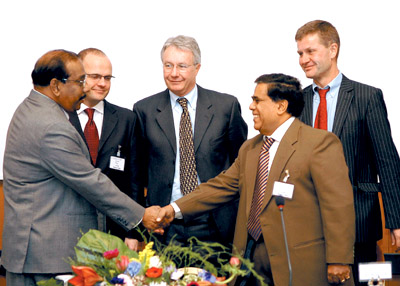
Anton Balasingham and Siripala de Silva
|
|
 Opening Remarks by Urs
Ziswiler, Political Affairs Director, Swiss Federal Department of Foreign
Affairs, 22 February 2006
Opening Remarks by Urs
Ziswiler, Political Affairs Director, Swiss Federal Department of Foreign
Affairs, 22 February 2006 |
|
Heads of Delegations, Delegates, Advisors, Ladies and Gentlemen,
First of all let me welcome you here to Château Bossey. We are happy that the
Government of Sri Lanka and the LTTE have decided to hold talks on strengthening
the implementation of the Cease Fire Agreement at a moment when political
violence in Sri Lanka has been putting it under great strain. I would also like
to express our gratitude to the facilitator of the peace process, the Norwegian
Government, and to Minister Solheim in particular, as well as to the Sri Lanka
Monitoring Mission for their tireless efforts to support the peace process.
The decision to hold these talks has in itself already been a much appreciated
confidence building measure, as a result of which the violence in Sri Lanka has
substantially decreased since the end of January this year. Other such measures
have followed in the last few days. I hope that the coming two days will see
more confidence building – on concrete foundations that will help secure the
implementation of the Cease Fire Agreement. This is first and foremost the
responsibility of the Government of Sri Lanka and the LTTE. I also hope that in
this way the peace process will, in time, gain new life because, as we have seen
in the last four years, the stronger the implementation of the Cease Fire
Agreement, the better life is for ordinary people in Sri Lanka. In this context,
let me mention the particular importance of respect for human rights in the
peace process. Opportunities to become more active in this field exist for
instance in the provisions of the Cease Fire Agreement itself, as well as in the
proposals of the international advisor on human rights to the peace process in
Sri Lanka.
We are very pleased that, finally, you decided to meet in Switzerland, following
considerable discussion on the venue of the talks. Our offer to host these
“Geneva Talks” came in the framework of our continuing efforts to support the
peace process, human rights and development, as well as post-conflict and
post-tsunami reconstruction. With these activities Switzerland aims at providing
impartial support for conflict transformation in Sri Lanka.
It is exactly four years ago today since the Cease Fire Agreement was signed. In
the meantime the conditions of life of the people of Sri Lanka have certainly
improved in comparison with those during the war. But we still have a
no-war-no-peace situation in Sri Lanka. Let me ask the question: How will things
look in February 2010, in another four years from now? Because in the end, this
must be the crucial goal: to jointly ensure the human security of ordinary
Sinhalese, Tamil and Muslim people in Sri Lanka and their prospects to live
"free from fear" in freedom, peace and with the chance to determine and develop
their lives according to their wishes within a multi-ethnic, multi-cultural and
multi-religious Sri Lanka.
We hope that the spirit of Geneva will be conducive to your work in the coming
two days as well as in the months ahead. Switzerland is, and will always be
available to support the peace process if the need arises.
|
|
Statement by Anton Balasingham, Head of
LTTE Delegation
|
|
The most constructive achievement of the Norwegian facilitated
peace process has been the signing of the
Ceasefire Agreement between the Government of Sri Lanka and the Liberation
Tigers of Tamil Eelam (LTTE), exactly four years ago today, on the 22 February
2002. The event brought an end to the bloody ethnic war that lasted more than
two decades, causing massive scale death and destruction. Though the truce
agreement has been subjected to enormous strains, particularly during the latter
part of 2005, it still holds, having prevented the parties in conflict from
embarking on major armed confrontations. I should say that it is the truce
agreement that has helped to avert the out-beak of an all-out war and created
the present environment where both the parties could engage in a dialogue to
enhance the conditions of peace and normalcy in the war affected northeast.
The Ceasefire Agreement was not formulated in haste to the advantage of one
party, as some critics have argued, but rather, given careful and meticulous
scrutiny to all aspects - terms, conditions and obligations - of the truce by
both parties, with the skilled assistance of the Norwegian facilitators. The
Ceasefire Agreement is a well crafted, valid instrument of peace, devised for
the purpose of brining an end to hostilities and to create a positive
environment conducive for meaningful negotiations. Therefore, the Ceasefire
Agreement should be viewed as an effective mechanism that can facilitate and
promote the peace process.
We are of the opinion that the Ceasefire Agreement is the foundation upon which
the peace process has to be built. It is true that in recent times the truce
accord has been severely undermined as a consequence of the rapid escalation of
violence in the northeast, particularly during the latter part of last year and
in January this year, when it turned into an ugly form of a shadow or subversive
war. This violent phenomenon has been characterised by
arbitrary killings, abductions and disappearances of Tamil civilians in the
northeast.

Note by News Watch:
Disappearances, Abductions & Extra Judicial Killings of Eelam Tamils
include the following
-
...Ramanathan
Ratheeskumar,
Thanuskodi Premini,
Kasinather Ganesalingam,
Thangarasa,
Shanmuganathan Sujendram,Thambiraja
Vasantharajan,
Kailayapillai Ravindran,
Arunesarasa Satheesharan,
Thambiah Jeyarajah,
Major Kapilan,
Thambipillai Selvarajah,
Ramalingam Suntheralingam,
Kandasamy Vaikunthan,
Anthonippillai Soosainather, Thevasahayampillai Jeyakumar Soosainather,
Subramaniam Sugirtharajan,
Chandrakanthan Vijayatharson.
Chandragajan Krishnagobi,
Illayathamby Ramakrishnan,
Thurairajah Ravichandran,
Kanapathy Murugesu,
Mariyanayagam Maruthanayagam,
Suppiah Murugan,
Sithambari Ganesaratnam,
Visuvar Krishnan,
Bojan Renuka,
Bojan Shanuka,
Bojan Arthanageswary,
Tharmarasan Tharmaseelan,
N Kandeepan ,T
Tharmasri,
Soosaithas K Marinthiran,
Sebastiampillai P Ruban,
Selvarajah Uthayarajah,
S. Thanabalasingham,
Balakrishnan Rajeevmohan,
Parimalarajah Robinson,
Iyathurai Baskaran,
Thangathurai Sivanantha,
Logithasan Rohanth,
Shanmugarajah Sajeenthiran, Manoharan
Rajeehar,
Yogarajah Hemachandran,
Thambirajah Arulajanthan,
Joseph Pararajasingham,
Jude Sugathy (Theresa) Croos ,
Jude Arokiyathass Fernando,
Emmani Croos,
Emmani Anthonikkam Croos,
Nadararajah Sivakadadcham ,
Dharmaretnam Sivaram,
Aiyathurai Nadesan,
Kumaravel Thambaiah...
ஓ....எங்கள் குரல் கேட்கிறதா ? |
According to authentic records, 109 Tamil civilians have been
arbitrarily killed by the Sri Lankan armed forces with the active assistance of
the Tamil paramilitaries. Forty eight civilians have disappeared after being
arrested or abducted by the Sri Lanka military. This horrendous violence was
unleashed against Tamil civilians, particularly in Jaffna, with the sinister
objective of terrorising the Tamil civilian population. This terrorisation of
our people was intended as collective punishment against the whole Tamil
population for the many soldiers killed in the
subversive war.
Our delegation will submit, for your scrutiny, comprehensive reports providing
detailed information about the nature of violence committed against Tamil
civilians by the Sri Lankan armed forces since the new government took office on
19 November 2005. We will also submit detailed reports about civilians killed
and injured by the Sri Lankan armed forces and Tamil paramilitaries during the
entire ceasefire period of the last four years. Similarly, we suppose that your
government is going to submit detailed reports of acts of ceasefire violations,
allegedly committed by the Liberation Tigers.
Your government has already released statistics accusing the LTTE of committing
5464 violations of ceasefire during the last four years. We cannot accept such
exaggerated figures as authentic acts of ceasefire violations. A huge majority
of those figures are attributed to recruitment. These are cases of under aged
youth said to be joining the LTTE. Your government, as well as the SLMM, have
accused the LTTE of under aged recruitment, without taking into consideration
the complex child rights issues in the northeast
and the number of children released by the LTTE under the Action Plan for
the War affected Children undertaken in association with UNICEF. Mr Tamilselvan
will give you a briefing later on the child rights situation in the northeast.
In this context I wish to point out that the government as well as the SLMM have
conveniently ignored the vast number of ceasefire violations committed by the
Tamil paramilitaries in the form of arbitrary killings of civilians, political
assassinations, abductions, harassment, extortion, intimidation, assault,
torture and forced conscription of children. Most of these crimes committed by
paramilitaries are blamed on the LTTE.
I am sorry to say that
it is only recently that the SLMM has realised the negative consequences of
the violence of the Tamil paramilitaries and expressed serious concern that such
'armed elements' are posing a serious threat to peace. Since the criminal
violence of Tamil paramilitaries has become a critical issue in the
implementation process of the truce agreement, the government should give
serious thought to containing such forces in order to stabilise the conditions
of peace.
The main topic for discussion at this negotiating table is the
Ceasefire Agreement. As the parties in conflict who entered into this peace
accord, we must endeavour to seek practical ways of implementing the Ceasefire
Agreement effectively, so that the truce becomes constructive, productive and
meaningful. We are of the view that the recent escalation of violence, that
brought the parties to the brink of an all-out war, was primarily due to the
non-implementation of the obligations of the truce.
The implementation of the confidence building measures, as enunciated in the
articles of the Ceasefire Agreement, are extremely crucial to the process of the
de-escalation and normalisation. The following are the key elements of the
Ceasefire Agreement stipulated as confidence building measures that are vital to
create conditions of normalcy in the northeast.
*Clause 1.2. Neither party shall engage in any offensive
military operations.
*Clause 1.8. Tamil paramilitary groups shall be disarmed by the GOSL by
D-day 30 at the latest. The GOSL shall offer to integrate individuals in these
units under the command and disciplinary structure of the GOSL armed forces for
service away from the Northern and Eastern Province.
*Clause 1.13. As of
D-day 90, all unarmed LTTE members shall be permitted freedom of movement in the
North and East.
*Clause 2.1. The Parties shall in accordance with
international law abstain from hostile acts against the civilian population.
*Clause 2.2., 2.3., 2.4. stipulate places of worship, school premises and public
buildings 'occupied by either party shall be vacated and returned to the
intended use'. *Clause 2.5. The Parties shall review the security measures and
the set-up of checkpoints, particularly in densely populated cities and towns,
in order to introduce systems that will prevent harassment of the civilian
population.
*Clause 2.11. A gradual easing of fishing restrictions shall
take place starting from D-day. As of D-day 90, all restrictions on day and
night fishing shall be removed subject to certain exceptions.
*Clause
2.12. The Parties agree that search operations and arrests under the Prevention
of Terrorism Act shall not take place.
Ever since the truce agreement was signed the Government of Sri
Lanka has failed to implement these key clauses. The LTTE has repeatedly
appealed to the government to fulfil its obligations under the peace accord. We
have also taken up the issue of the non-implementation of the terms and
conditions of the Ceasefire Agreement during our peace talks with Mr Ranil
Wickremasinghe's government. All our genuine efforts to ensure the full
implementation of the key elements of the Agreement became futile. The
co-habitation conflict, or rather, the power struggle between the Wickremasinghe
government and President Kumaratunga became a serious impediment to advance the
peace process and to secure proper implementation of the ceasefire.
With the termination of the peace talks, the security situation
in the north east began to deteriorate. The violence of the Tamil paramilitaries
intensified in the form of a dirty subversive war directed against our cadres
and supporters, a shadow war in which the Sri Lanka armed forces actively
colluded with the Tamil armed groups. We will submit for your examination a
comprehensive report on Tamil paramilitary organisations operating in the
northeast and in Colombo. The report provides ample evidence on the existence of
the main paramilitary groups, their leadership, the command structure, the
location of their camps and their close relationship with the Sri Lanka armed
forces, particularly with the Sri Lanka military intelligence.
The existence of Tamil armed paramilitary groups is an indisputable fact. Since
these Tamil armed organisations are sustained, supported and controlled by the
Sri Lanka military, we categorise them as paramilitaries. They are not simply
'armed elements' functioning independently in a political vacuum, as some people
assume. They are well organised militant forces, properly trained and armed in
subversive warfare and function covertly in connivance with the Sri Lanka armed
forces. Some of the armed organisations have a long history, extending to more
than two decades. Originally they took arms for a political cause, but later,
with the Indian intervention in Sri Lanka, they abandoned their political ideals
and became mercenary armed groups under the Indian Peace Keeping Forces to fight
against the LTTE.
Following the withdrawal of the IPKF, these armed organisations
changed their loyalty and allegiance to 'new masters', that is, the Sri Lanka
state and its military and intelligence apparatus, in the war against the LTTE.
Though these armed groups registered themselves as political parties and claimed
to have entered the democratic political mainstream, they have not dismantled
their military units nor have they abandoned armed violence. We have, in our
report, listed several incidences of armed violence committed by these Tamil
paramilitary groups in which several leaders and cadres of our organisation, as
well as prominent parliamentarians, journalists, educationists and civilian
supporters, were executed in cold blood. We will provide maps in our report
indicating the close proximity of paramilitary camps of the EPDP and other
groups to Sri Lankan army camps and police stations.
You are well aware that Clause 1.8 of the Ceasefire Agreement specifically
stipulates that the Tamil paramilitaries should be disarmed by the GOSL. Yet,
the Sri Lanka government, to date, has failed to honour this crucial obligation,
which is vital for strengthening the conditions of peace and normalcy. The SLMM
has also warned that the peace environment is seriously threatened by the
violence of these Tamil armed groups. The international community, represented
by the Co-Chairs, have also made statements calling upon your government to
disarm the paramilitaries and to put an end to their violent activities. In a
recent statement President Rajapkse has pledged that he would rein in the Tamil
armed organisations and would not allow them to function in the government
controlled areas.
There are five major paramilitary groups operating in the northeast and in
Colombo. They are known as Karuna group, EPDP group, PLOTE group, EPRLF
(Varaithar) group and a Muslim Paramilitary group called Jihad group. In our
report we have given detailed information about each group, the names of leaders
and area operational commanders functioning in various districts and in the
capital. We are certain that the Sri Lankan military hierarchy, particularly the
Sri Lanka military intelligence, is well aware of the existence and activities
of the Tamil armed paramilitaries. Nevertheless, we are also providing you with
detailed factual information to reinforce our argument.
It is the considered view of our liberation organisation, as well as the general
opinion of the Tamil people, that the armed violence of the Tamil paramilitaries
is posing a grave threat to peace and stability in Tamil areas and endangering
the Ceasefire Agreement. Therefore, we call upon the Government of Sri Lanka to
disarm these Tamil paramilitary organisations, fulfilling a crucial obligation
of the truce agreement.
One of the crucial confidence building measures laid down in the Ceasefire
Agreement is that the parties, in accordance with international law, should
abstain from hostile acts against the civilian population. Clauses 2.2, 2.3 and
2.4 stipulate that the Sri Lankan armed forces, within a limited time frame,
should vacate places of worship, schools and public buildings.
In defiance of these truce obligations and in grave violation of international
humanitarian law, the government's security forces, for more than a decade,
continue to occupy schools and public buildings and made places of worship
inaccessible to the Tamil civilian population. Several places of worship made
inaccessible are Hindu sacred shrines of historical and cultural importance, so
dear to our people. In Jaffna alone 35 prominent schools were forced to close
down and 201 Hindu and Christian places of worship have been made inaccessible
to our people. This vicious type of military occupation has seriously offended
the cultural and religious sensitivities of the Tamil people, an activity
specifically forbidden by the Ceasefire Agreement.
The creation of High Security Zones (HSZ) by the Sri Lankan armed forces in the
militarily occupied territories of the northeast, particularly in the densely
populated Jaffna Peninsula, has caused immense suffering to the Tamil civilian
population. To facilitate the occupation of a huge number of troops, amounting
to fifty thousand, the so-called High Security Zones were established by
forcefully evicting several thousands of Tamil families from their homes. The
worst affected region is the Jaffna Peninsula where entire villages were evicted
with the civilian population and thousands of houses forcefully usurped and our
people denied access to farmlands, fishing coasts, schools and places of
worship. This is a grave injustice committed against the Tamil people by the
invasion forces, destroying their social and cultural life.
We will submit to you a document on, 'The Human Costs of the High Security
Zones', which provides comprehensive information about the nature of Sinhala
military occupation of the Tamil region and its implications on the life of our
people. Our statistics on HSZ shows that 28,830 house owners in Jaffna have been
forcefully evicted from their homes and nearly 13,000 acres of fertile farmlands
made inaccessible to them. The creation of High Security Zones has reduced
20,000 families to conditions of destitution and they have been languishing in
refugee camps and welfare centres for over a decade. The forceful usurpation of
public property to the extent of 30 percent of the landmass of Jaffna under the
claim of High Security Zones, and denying our people their right to return to
their homes and property is a blatant violation of human rights. This forced
eviction of people by the state under the pretext of national security is
condemned by several UN Human Rights instruments as gross violations of human
rights. These UN instruments characterise this practice of forced evictions by
states as serious crimes inflicting grave and serious harm to the basic civil,
political, economic, social and cultural rights of large numbers of people, both
individual and collective (The issue is best explained in the United Nations
High Commission on Human Rights Fact Sheet 25 on 'Forced Evictions').
The displacement of several thousands of families and their pathetic plight in
subnormal conditions in the refugee camps has become a formidable humanitarian
tragedy. Yet the Sri Lankan state and the military hierarchy continue to deny,
on security grounds, the basic rights of our people to return to their homes and
property. We wish to point out that the Sri Lankan government should no longer
ignore this grave humanitarian issue under the pretext of 'security'. The
problem of the HSZ has to be resolved without further delay, facilitating the
resettlement of the internally displaced persons. The resolution of this issue
is extremely crucial for the restoration of peace and normalisation of civilian
life in Tamil areas.
In this brief statement I have touched on a few of the crucial issues to be
addressed for the effective implementation of the Ceasefire Agreement. The other
most important issue to be addressed is the severe restrictions imposed on
fishing and the enormous suffering of the people as a consequence. We have given
comprehensive information in our documents in regards to the suffering of the
Tamil fishing community. We will take up the issue on the restrictions on
fishing during the course of our discussions.
The other important matter we wish to raise is the freedom of movement of our
political cadres in the government controlled areas. You are aware that the LTTE
leadership withdrew our political cadres from the government controlled Tamil
areas as a consequence of the violent activities of the paramilitaries, who, on
several occasions attacked our unarmed cadres and bombed our political offices.
Our political cadres can only function in government controlled areas if the
paramilitaries are disarmed and normalcy returns to Tamil areas.
In concluding I wish to say that we do agree that there have been serious
breaches of the Ceasefire Agreement, for which the parties in conflict, as well
as the Tamil paramilitaries, should bear culpability. Nevertheless, I wish to
point out that it would serve no meaningful purpose if we enter into a
recriminatory debate, making accusations and counter accusations against each
other over the abuses of the truce. Instead of engaging in acrimonious bickering
that might poison the atmosphere of goodwill, it would be prudent to engage in a
constructive discussion, exploring ways and means to stabilise and strengthen
the Ceasefire Agreement. You will certainly agree with me that consolidating the
Ceasefire Agreement is the only practical way open to the parties in conflict to
stabilise the conditions of peace and normalcy, which are essential and crucial
to take the peace process forward.
|
|
Minister
Nimal Siripala de Silva, Head of Sri Lanka Delegation |
|
On behalf of H.E. the President of the Republic of Sri Lanka
Mahinda Rajapaksa and the Government of Sri Lanka, I am pleased to make these
preliminary comments at the commencement of the talks between the Government of
Sri Lanka and the LTTE, facilitated by the Royal Norwegian Government and hosted
by the Government of Switzerland. At the outset, let me thank all the parties,
including the Co-Chairs, who have worked tirelessly to make this event a
reality.
At this stage, I would also like to express the hope of the Government and the
People of Sri Lanka that these discussions will mark a significant chapter in
the dialogue between the Government of Sri Lanka andthe LTTE. It is also our
wish that this dialogue would form the basis of a meaningful ceasefire where the
beneficiaries of it would be all the People of Sri Lanka.
An analysis of successful negotiations worldwide would perhaps
establish the fact that successes have resulted on occasions where parties to
the conflict have had the courage, dedication and determination to pursue a
solution through a continuous process of dialogue with sincerity.
We should keep in mind that no issue is insurmountable, if the
interests of the People and the Country are kept uppermost in our minds.
Accordingly, it is our desire to express our views in a frank and forthright
manner, rather than to make vague and ambiguous statements that would serve no
useful purpose, although they may appear more acceptable on the surface.
As we all know, H.E. the President Mahinda Rajapaksa was elected on a platform
of seeking an 'honorable peace.' On that basis, our delegation affirms
andemphasizes the position of the Government of Sri Lanka that
the Ceasefire Agreement
entered into between the then Prime Minister Ranil Wickremesinghe and Mr.
V.Prabhakaran, the leader of the LTTE on the 22nd February 2002 is contrary to
our Constitution and law. Furthermore, it is prejudicial to the sovereignty and
the territorial integrity of the Republic of SriLanka. Nevertheless, we
acknowledge that certain benefits flowed to the People from the observance of
the ceasefire, which resulted in our strong determination and desire to preserve
the ceasefire. We also consider the ceasefire as a first step to arrive at a
negotiated settlement to the ongoing conflict and we propose to rectify certain
grave anomalies arising from the agreement.
Since assuming office, our President has at various times and occasions extended
invitations to begin a dialogue with the LTTE. Furthermore, our Government has
been keen that the overall process of discussion and dialogue should be of an
inclusive nature since it affects the whole Nation. We take pride in the fact
that the Government's participation at these talks in Geneva is with the support
and goodwill of all the democratically elected political parties in Sri Lanka.
The discussions at the All Parties Conference held over the past few weeks
resulted in the consensus that we initiate this dialogue with the LTTE. These
discussions also served to prepare a common platform for the dialogue that we
are commencing today with renewed hopes and expectations. This fact is
significant since it is the first time in the history of this conflict that such
a consensus has been reached. Therefore, I am privileged and honored to lead the
Government's delegation that is in Geneva today with the strong support from the
Peoples' representatives of Sri Lanka.
II. A Fresh Approach
H.E. President Mahinda Rajapaksa was elected to office on 17th November 2005
with a mandate from the Nation to work towards the achievement of an honourable
peace. The Mahinda Chintana, which encapsulates the President's vision for the
country, makes it clear that the President has recognized the need for a direct
dialogue with the LTTE, in the pursuit of such a goal. He has even stated that
he is prepared to meet with the Leader of the LTTE and other representatives for
such discussions. Notwithstanding the clear enunciation of such a position, it
was unfortunate that upon assumption of office, H.E. the President was
confronted with a number of acts which would easily qualify as being highly
provocative. Such acts had the potential to disturb and deflect us from the path
of dialogue and discussion. However, our President with his deep commitment to
peace, reacted with patience and restraint to contain the tension that resulted
from these acts of provocation and hostilities.
This enlightened response was certainly not a sign of weakness, but a display of
our firm commitment to peace. We are therefore thankful to the international
community for their steadfast encouragement for the commencement of these
discussions. It is also our considered view that in the event such provocations
had continued unabated, the repercussions may have been extremely dangerous with
further loss of lives and the ceasefire becoming totally meaningless and leading
to its eventual collapse.
Let me at this stage assure all, that it is the desire of H.E. President
Rajapaksa to look at issues from a fresh perspective to find a sustainable
solution to the conflict that engulfs our country. Let me also re-iterate that
our Government is committed to talk, listen and think afresh.
III. Democracy and Human Rights
Sri Lanka is one of Asia's
most long-standing democracies. The people have enjoyed uninterrupted
universal franchise since 1931, long before gaining independence in 1948. For
over 65 years, our people have elected their own representatives to Parliament,
from all ethnic groups. Both within the confines of Parliament and beyond, the
right to criticize both the Government and the Opposition is
an integral part of the freedom of expression. We must therefore ensure that
all citizens of our country, wherever they may live, are free to exercise their
franchise at free and fair elections, whether they be Sinhala, Tamil, Muslim,
Malay, Burgher or any other group however small in numbers. The democratic
process must prevail. Accordingly, no community or any section of a community
should be deprived and denied their right to vote freely and to exercise
their right to elect the representatives of their choice to whom they would
entrust leadership.
It was a sad day for democracy in our country when at the Presidential Elections
of November 2005,
the LTTE forced the people in certain districts to observe a boycott of
elections through coercion and general intimidation. It was a gross
violation of democratic rights. In addition,
the
widespread rigging and corrupt election practices in many parts of the North
at the general elections in April 2004 which was confirmed by the international
election monitors could also be cited as further evidence of the LTTE's
disregard for democracy. It is in that context that the Government of Sri Lanka
sincerely hopes that with a meaningful ceasefire, the people in the North could
participate freely in the democratic process. We are confident that these
sentiments will also be endorsed by the international community where such
democratic norms prevail.
Mindful of the respective rights of the ethnic and religious groupings as
enshrined in the Constitution, our Government is committed to maintaining the
multi-ethnic, multi-religious and pluralist character of Sri Lanka. All
persons irrespective of their race, religion, caste or gender are equal before
our law. All our people whichever part of Sri Lanka they live in, are
protected by these
basic fundamental rights. These rights must not be truncated in any part of
Sri Lanka, thereby depriving those persons of equality before the law. It is
unfortunate that the LTTE has unlawfully deprived the Tamils, Muslims and
Sinhalese of these fundamental and human rights, recognized in our law and in
international law, in particular in Killinochchi and Mullaitivu districts in the
North of Sri Lanka.
As we all know, as a result of the ceasefire that has been in effect since
February 2002, the LTTE has been able to engage itself in political activity. At
that time, it was the intention that other political parties, too, should also
be permitted to engage themselves in political activity in the North and East
without hindrance. However,
it is
regrettable that this aim could not be achieved due to the LTTE's hostile
acts, including the assassination and abduction of political activists, which
has obstructed the legitimate political activity of others. It is our hope that
we would be able to move towards the restoration of the
democratic values which are so important in a civilized society.
IV. Ceasefire Violations
As set out in the preamble of the Agreement on a Ceasefire between the then
Prime Minister Hon. Ranil Wickremesinghe and the LTTE, entered into on 22nd
February 2002, four years to the day today, the importance of bringing the end
to hostilities and improving the living conditions of all persons affected by
the conflict was recognized. An end to hostilities was also seen as a means of
establishing a positive atmosphere in which further steps towards a lasting
solution could be taken.
However, the available evidence suggests that the
LTTE had taken undue and unfair advantage of the ceasefire to
strengthen its
military capability. Repeated calls by the Government of Sri Lanka, the
SLMM, and the international community to the LTTE to desist from such behavior
has unfortunately not been heeded. This has resulted in a large number of
significant violations which has seriously undermined the spirit of the
ceasefire and threatened its termination.
The number of ruled violations by the LTTE as determined by the Sri Lanka
Monitoring Mission (SLMM) since the beginning of the ceasefire up to the end of
last month is a massive 3519. In comparison, the SLMM has determined that the
GOSL has violated the agreement on 163 occasions. This shows that 96% of all
violations have been committed by the LTTE. The violent incidents committed by
the LTTE include assassinations, child recruitment and kidnappings, abductions
of adults, suicide missions, killings of military and civilian persons,
harassment of students and political workers, and destruction of property. Such
incidents have seriously undermined the sustainability of the ceasefire and
disturbed the return to normalcy for civilians in Sri Lanka, particularly in the
North and East.
At this moment, we also wish to pay tribute to one of the great statesmen of our
times, the late Hon. Lakshman Kadirgamar, President's Counsel, the former
Minister of Foreign Affairs of Sri Lanka. Hon. Lakshman Kadirgamar was
internationally respected, widely acclaimed and highly honored. As the Minister
of Foreign Affairs, he toiled hard pursuing a solution to our conflict. The fact
that such a person was assassinated by the LTTE when the ceasefire was in force
demonstrates the disregard with which the agreement had been treated and also
highlights the significant deficiencies of the current ceasefire.
These circumstances underscore the inherent weaknesses in the
existing ceasefire agreement as well as the lacuna in setting out norms for its
effective implementation. These also show that the lack of sanctions being
attached to violations when there are clear determinations made by the SLMM, is
a very serious shortcoming that needs to be addressed in the interest of all
concerned.
In expressing its views about the ceasefire, the Government of
Sri Lanka must take into account the concerns of all of the people of Sri Lanka.
The Government takes this obligation seriously and has engaged in consultations
with representatives of all ethnic communities in preparing for these talks. In
this context, we also wish to raise some of the concerns of the Muslim community
with regard to the ceasefire.
As we all know, almost the entire
Muslim
community in the North was forcibly expelled by the LTTE during the time of
the conflict. Families were ordered to leave their homes with only the
possessions they could carry in their hands, on a few hours notice. Lives were
lost, homes abandoned, and businesses forced to shut down. It was the hope of
the Muslim people that the ceasefire would create the conditions that would
enable them to feel secure to return to their homes and re-establish their
lives. Unfortunately, most of these internally displaced people still linger in
refugee camps or have been resettled elsewhere. Muslim people also face serious
challenges to their security in the East, where incidents of violence threaten
the civilian population at regular intervals.
It is the belief of the Government of Sri Lanka that the dialogue about the
ceasefire would take into account the urgent concerns of the Muslim community.
Accordingly, these issues and interests must be adequately addressed for the
ceasefire to be meaningful.
V. Children Affected by the Armed Conflict
The Government of Sri Lanka has always endeavored to respect the rights of
children. We have demonstrated this commitment by becoming a party to the major
international human rights conventions, including the International Convention
on the Rights of the Child. This convention casts upon the Government, the
obligation to protect the rights of all Sri Lankan children including children
affected by armed conflict.
Well before assuming office as President, H.E. President Mahinda Rajapaksa had
earned himself an outstanding reputation as a champion of human rights and as an
ardent advocate for safeguarding the rights of children. It was therefore not
surprising that as soon as he was elected as President, he established a new
ministry for children to provide for the legal and social conditions to protect
all children and ensure their welfare. Naturally therefore, we are seriously
concerned whenever the denial of these rights takes place within the territory
of Sri Lanka as it is contrary to our law, international obligations and the
basic fundamentals of a civilised society.
In the context of the Government of Sri Lanka's overall commitment toward
children and the obligations it has undertaken under international law,
we
find the violations of the rights of children committed by the LTTE as being
totally unacceptable and deeply distressing.
The use of children by the LTTE in combat has been extensively documented by the
SLMM, UNICEF, and other international agencies. According to UNICEF
documentation, 5368 children are known by UNICEF to have been recruited by the
LTTE, a figure that UNICEF acknowledges is under-representative of the actual
number. Since the beginning of the ceasefire through 30 January 2006, the SLMM
has ruled 2,011 violations against the LTTE for incidents of child recruitment
and abduction; this number represents 55% of the total violations of the
Ceasefire Agreement. UNICEF has also reported that child recruitment and
kidnapping is continuing unabated as per their latest report of January 2006.
Notwithstanding the concerns of almost the entire world community, it is sad
that the LTTE has continued to demonstrate their disregard for the rights of
children. The recent incident where three Government police officers associated
with the National Child Protection Agency were abducted by the LTTE while the
officers were in pursuit of a known pedophile is a clear illustration of this
unfortunate situation.
The importance and urgency of addressing the issue of child soldiers has been
recognized by the United Nations Security Council, which in its recently passed
Resolution 1612 urged strong action to be taken against parties that recruit and
abduct underage children into their ranks. The LTTE has been identified as such
a violating party in a Report submitted to the Security Council by the
Secretary-General of the United Nations. However, despite repeated international
condemnations of the incidents of recruitment and abduction of children, the
violations continue to occur. It is the Government of Sri Lanka's fervent hope
that a dialogue on this issue could contribute to creating a meaningful
ceasefire, one in which all children of Sri Lanka are free to blossom and
develop themselves into healthy and productive members of society.
VI. Law and Order
One of the cornerstones of a democracy is an environment of security. Without
law and order and its enforcement, individuals are not free to exercise the full
range of rights they are entitled to. Freedom of speech and the right to engage
in political activities are meaningless if the exercise of these rights could
lead to abduction or death. A state of ceasefire does not override the existing
law and order mechanisms in society. For this reason, the Government of Sri
Lanka deplores the large number of killings of Sri Lankans of various ethnic
groups after the ceasefire of February 2002. These killings have seriously
undermined the ceasefire. The Government expresses its grave displeasure and
disappointment that deficiencies in the ceasefire agreement have been exploited
in this manner, leading to serious strains being placed on the enforcement
machinery of our system of law and order.
The Government of
President Mahinda Rajapaksa is committed to maintaining law and order
without discrimination in every part of our country. His new administration
initiated a program that extensively cracked down on organized criminals,
underworld gangs, armed groups and narcotics dealers. This program is continuing
with great intensity today. Criminals, whichever part of the country they
operate in, are subject to this crack-down as the scope of this program covers
the entire country. On that basis, the Government has already taken all
necessary action to bring the perpetrators of certain recent crimes to justice
in accordance with the due process of law. The
murders of youth in Trincomalee, the reported
abductions of members of the Tamil Rehabilitation Organization, TRO, the
assassination of Parliamentarian Joseph Pararajasingham and all
other
reported incidents are being
diligently investigated by our law enforcement authorities and we are taking
all necessary action to bring the perpetrators of these crimes to justice.
It is also clear that certain parties with vested interests are attempting to
accuse and discredit the Government of Sri Lanka for various alleged incidents.
A critical examination of some of the recent allegations indicates that the
media had been informed of some incidents well before such incidents have even
been brought to the notice of the law enforcement authorities. In some cases,
evidence has not been freely forthcoming and hardly any cooperation has been
extended by the complainants. Such behaviour casts serious doubt on the
reliability and authenticity of the complaints themselves. These facts seem to
suggest that some of these allegations may have been cleverly stage managed and
hence we wish to inform the international community that such incidents would
have to be more extensively investigated prior to opinions being expressed about
the veracity of the claims.
VII. Economic development
From the first day of his election to the office of President, the Government of
H.E. the President Mahinda Rajapaksa has demonstrated its unwavering commitment
to achieve substantial and sustainable economic development in all parts of the
country. It is our stated goal to bring prosperity to all citizens of Sri Lanka.
It is with that objective in mind that the Government has invested heavily in
provincial development. In particular, the Government recognizes that the
Northern and the Eastern provinces should be accorded special attention so as to
enable these areas to expeditiously recover from the devastation of the conflict
and the tsunami.
It is in this context that the Mahinda Chintana has enumerated a series of
development projects to expeditiously solve the problems of the people living in
the Northern and Eastern provinces. These proposals have been given life through
appropriations in the budget that was presented by H.E. the President. As a
Government, we are committed towards implementing these projects so as to
restore accelerated economic activity.
The Government is also fully aware that the people of the North and the East
have suffered tremendously in the wake of the tsunami that struck our country in
December 2004. We have already implemented many schemes to provide relief to the
tsunami affected people with the consultation and participation of the affected
communities.
In our view, certain violations of the ceasefire have resulted in serious
economic hardships being caused to farmers, fishermen, and others involved in
economic pursuit in the Northern and Eastern provinces. For example, in the
Jaffna district, monetary surcharges are imposed on farmers and they also
undergo tremendous difficulties in the transportation of their produce. Such
factors result in lowering the prices that they could command for their produce.
Consequently, their earnings are reduced considerably. The Government of Sri
Lanka is concerned about the plight of these farmers and others whose living
standards have declined as a result of the restrictive practices imposed by the
LTTE. We believe these issues too, should be resolved so as to restore normalcy
in the economic conditions in the North and the East. The Government sincerely
believes that taking steps towards establishing a meaningful and effective
ceasefire would be one of the most important initiatives to provide for the
improvement of the economic conditions of the people in the North and the East.
It is our earnest hope that our discussions would pave the way for the
realization of such a ceasefire, which would thereby lead to a peaceful
environment that is so important for economic development and investment. |
|
Statement by LTTE Political Wing Leader,
S. P Tamilselvan , 22 February 2006 |
|
Even after four years of CFA
there is an
absence of normalcy in people’s life following the two decades of war.
Children have lost their parents, were killed and maimed in thousands, and their
schools and places of worship were destroyed by bombing. The GoSL delegation
that is talking about children’s welfare will understand the real situation only
if they visit the areas and see it for themselves.
Recently
five young students were brutally shot and killed by GoSL armed forces. A
fifteen year old boy sleeping with his parents was dragged out from his sleep
screaming and shot dead by GoSL forces.
University students and teachers were attacked. We like to point out that as
a result of the ethnic violence let loose by your government thousands of
children were killed.
Children come to our areas for refuge due to the SLA occupation of our homeland
and the ensuing fear. Our organization takes care of these children in thousands
in children’s homes and ensure that their educational other needs are taken care
of.
GoSL, instead of trying to improve these conditions in which children are
growing up, is more interested in spreading stories about under-age youths
joining our organization. We are working with UNICEF to promote and protect
children’s rights. We have setup a special committee within the LTTE Peace
Secretariat to develop this further. We have pointed out on several occasions
about the errors in UNICEF numbers on under-age youths in LTTE. We have also
continued to release youths who are identified as under-age back to their
families. We have pointed out this error to UNICEF and it has accepted it.
With the peace dividends not reaching the children they are suffering from
poverty, loss of parents, lack of educational and employment opportunities, and
inability to return to their own homes. Children going to schools in GoSL
occupied areas are put through checking and long delays. This also creates fear
in the children’s minds. Many have sought refuge in our areas.
Most of the accusations about under-age youths joining LTTE came from the East.
More than 2000 under-age youths recruited against the orders of our leadership
by Karuna, who was later expelled from our organization for his misconduct, were
returned to their parents. This shows that our organization respects the
international standards in this regard.
Many 14, 15, and 16 year olds who were abducted by the Karuna group which is now
working with the SLA forces have exposed the truth that they were trained in SLA
camps.
There is an urgent need to be concerned about the welfare of the children
affected by war and take right actions to ensure that their nutrition, education
and their parents living standards are adequate. It is wrong to turn the
problems faced by the children into a political issue to gain political
advantage.
Given that
there is no clause in CFA that prohibits recruitment this is not an
issue that comes under the SLMM mandate. Rather it is best to submit the
complaints received by SLMM to the organizations that directly deal with it
which are our organization and to UNICEF.
Those who are truly concerned about the welfare of children must
refrain from selecting NorthEast and LTTE as their subject and instead turn
their attention to the serious child abuse and child slavery that is going on in
large scale in the south. |
|
Concluding Statement released by the
Norwegian Facilitator |
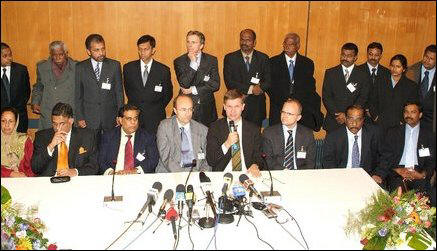
The concluding statement released by the Norwegian Facilitator
Sri Lanka Talks
22-23 February 2006, Geneva, Switzerland
The Government of Sri Lanka (GOSL) and the Liberation Tigers of Tamil Eelam
(LTTE) met in Geneva 22-23 February 2006 for talks on the Ceasefire Agreement.
The parties discussed issues related to the ceasefire, including the concerns of
the Muslim, Sinhalese, and Tamil civilians.
The GOSL and the LTTE are committed to respecting and upholding
the Ceasefire Agreement, and
reconfirmed their commitment to fully cooperate with and respect
the rulings of the Sri Lanka Monitoring Mission (SLMM).
The GOSL and the LTTE are committed to taking all necessary measures to ensure
that there will be no intimidation, acts of violence, abductions or killings.
The LTTE is committed to taking all necessary measures to ensure that there will
be no acts of violence against the security forces and police. The GOSL is
committed to taking all necessary measures in accordance with the Ceasefire
Agreement to ensure that no armed group or person other than Government security
forces will carry arms or conduct armed operations.
The GOSL and the LTTE discussed all issues concerning the welfare of children in
the North East, including the recruitment of children.
The SLMM will report on implementation on the above agreements at the next
session of talks.
The parties requested the Swiss Government to host the next round of talks in
Geneva on 19-21 April 2006.
|
|
Swiss Government welcomes
positive outcome of Geneva talks, 24 February 2004 |
|
The Federal Department of Foreign Affairs (DFA) welcomes the
positive outcome of the talks between the Government of Sri Lanka and the
Liberation Tigers of Tamil Eelam (LTTE), which took place on 22 and 23 February
in Geneva. It voices the expectation that the parties to the conflict will
respect the agreement they have concluded.
Under Norway's mediation, the Government of Sri Lanka and the LTTE met in Geneva
on 22 and 23 February to hold talks on the implementation of the cease-fire
agreement, which was signed exactly four years ago.
In particular, the DFA welcomes the fact that the parties have agreed to respect
the cease-fire agreement, and to take all necessary measures to avoid any acts
of violence, intimidation, abductions or killings.
The DFA expects the parties to comply conscientiously with the obligations they
have undertaken as a building-confidence measure.
The DFA also takes note of the wish of the parties to organise a further round
of talks on 19 to 21 April in Geneva. Switzerland regards this as a mark of
trust and will examine the request favourably within the framework of its
commitment to Sri Lanka.
|
|
Report on Talks in
Sri Lanka State Controlled Daily News, 25 February 2006 |
|
Truce talks end on successful note - Another round in April
Bandula Jayasekara
CELIGNY: Truce talks between the Government and the LTTE ended successfully in
Celigny, Switzerland yesterday, with both sides agreeing to meet again in
mid-April for another round. According to a statement issued by the two sides at
the end of the talks, the next round of negotiations will take place for three
days - from April 19 to 21 in Geneva. "The LTTE is committed to taking all
necessary measures to ensure that there will be no acts of violence against the
Security Forces and the Police," the statement said. It said the Government of
Sri lanka is also committed to take all necessary measures in accordance with
the CFA to ensure that no armed group other than Government Security Forces will
carry arms. The Government and the LTTE discussed all issues concerning the
welfare of children in the North including recruitment of children.
The Sri Lanka Monitoring Mission (SLMM) will report on the implementation of the
above agreements at the next session of talks. Both sides committed to
respecting and upholding the Ceasefire Agreement and pledged to take all
necessary means to ensure that there will be no intimidation, acts of violence,
abductions or killings.
They described the truce talks as a confidence building measure. Minister
Rohitha Bogollagama said that the talks were successful. "Sri Lankans should be
happy. This is a positive stand for peace and proves that President Mahinda
Rajapakse is a man of peace. This would deescalate violence and create a smooth
process for peace."
He also thanked the LTTE delegation.
Norwegian International Development Minister Erik Solheim appreciated the
determination of both sides to uphold the Ceasefire Agreement. Solheim said
there should be no more violence. The SLMM will also operate freely in the LTTE
dominated areas. The two sides met on Wednesday after a lapse of three years.
The talks also coincided with the fourth anniversary of the ceasefire.
Negotiations continued yesterday, the second and final day, at the Chateau de
Bossey. Norway facilitated the talks, with the assistance of Switzerland. SLMM
representatives attended the talks. The two sides, led by Minister Nimal
Siripala de Silva and Anton Balasingham respectively, discussed a gamut of
issues covering the ceasefire. Other members in the Government delegation
included Minister Bogollagama, Jeyaraj Fernandopulle and Ferial Ashraff.
Minister Ashraff has pointed out to the LTTE delegation that Muslims should be
recognised as one of the principal stake holders in the peace process for a
lasting resolution of the ethnic conflict, the Housing and Construction Industry
Ministry said in a news release.
The Muslim community has been adversely affected by this ethnic conflict both
before and after the CFA although they were neither a party to the war nor a
party to the CFA, she said.
She noted the Muslims were
ethnically cleansed from the North by the LTTE 16 years ago. Their economy,
education, cultivation, fishing and all means of livelihood in the Northern and
Eastern provinces have been affected tremendously.
She said the Government, LTTE, co-chairs and the international community should
acknowledge the Muslim factor at all stages of the peace process.
Unless the Muslim concerns are adequately and effectively addressed no normality
could be restored and no lasting solution could be reached, she stressed.
|
|
Balasingham's interview with Sunday
Leader after Geneva Talks, 25 February 2006 |
|
LTTE Chief Negotiator Anton Balasingham in an interview with Lasantha
Wickrematunge, of The Sunday Leader at the conclusion of the Geneva talks,
explained the circumstances in which the talks were held, the issues discussed
and the way forward for the parties.
Sunday Leader: Could you first of all tell us your assessment of the talks after
two days of deliberations?
Balasingham: Even though talks ended on a positive note it has been a very
tough, difficult dialogue I should say frankly because the government came with
a different agenda.
The LTTE from the very start, from the day Mr. Erik Solheim met Mr. Pirapaharan,
we were making statements that the agenda for talks will be the effective or
rather the smooth implementation of the terms and conditions of the Cease Fire
Agreement. But we were disappointed to note from what Norway came and told us
that the government had ideas of coming out with certain amendments and with the
aim of revising the entire document.
Then I insisted we will not discuss anything about revision or reworking of the
cease fire document because our agenda is that we should stick to the letter and
spirit of the agreement and only see how we could implement the terms and
conditions of the Cease Fire Agreement.
So with all that when the peace talks started I made my initial opening address
with the purpose of articulating our point of view. Our objective in coming for
the talks as you would have observed from my address was that the talks should
be confined to the implementation of the Cease Fire Agreement.
Sunday Leader: As you point out in the first paragraph of your opening statement
itself you said the most important achievement of the Norwegian facilitation of
the peace process has been the signing of the Cease Fire Agreement between the
government and the LTTE. You also said the CFA was not finalised in haste to the
advantage of one party as argued by some critics but to be the foundation on
which the peace process can be built. Was that the position you maintained right
throughout the deliberations?
Balasingham: Exactly. Absolutely. I’m also one of the architects of the CFA
document and we spent months. Specific attention was given to each clause and
both the parties were consulted with our military experts and Mr. Pirapaharan
and from the government side Ranil Wickremesinghe was also informed of the
various terms, conditions, obligations and finally both the parties agreed and
both parties signed the ceasefire agreement.
So it was not worked out in haste to the advantage of one party. Both parties
were given quite a lot of time to work out various formations. So what happened
after my initial opening speech, I was disappointed to note chief negotiator of
the government side, Mr. Nimal Siripala de Silva, insisting there were serious
flaws in the CFA and that there should be amendments, revisions and it had to be
reworked.
Sunday Leader: Mr. De Silva said in his opening statement that the CFA in its
present form, signed by Ranil Wickremesinghe and Velupillai Pirapaharan was
unconstitutional, and against the laws of Sri Lanka. Is that the position he
maintained during the two days of deliberations?
Balasingham: Not two days. Later on they had to give it up. After the first day,
their legal expert, H. L. de Silva, he came out with the proposition that
certain clauses in the ceasefire document contravened the constitution and that
it was not endorsed by the President who had executive authority, so on and so
forth. I challenged their contention saying that it was signed by both the
parties with international assistance.
It was not the LTTE and the government of Sri Lanka only who were involved. The
Norwegian government was also involved in this agreement and also five Nordic
countries. So it was an international agreement and also we know that it is
determined by the Supreme Court in the P-TOMS case where the Supreme Court ruled
the CFA did not contravene the constitution, therefore we argued and said it is
not a question of legal or constitutional validity of the document that is in
question.
We have come here with the objective of analysing and arguing that each term,
condition and obligation must be implemented and I read out what the main
clauses that the government of Sri Lanka has failed to implement.
Sunday Leader: But wouldn’t you say the government also had a moral obligation
to seek a revision because President Rajapakse had signed an agreement with the
JVP wherein he said there were clauses in the CFA, which were not only
unconstitutional but also leading to separation and compromising national
security. He pledged to redo and revise the CFA. Did you therefore expect the
government to sit and discuss the implementation of an agreement, which it
claimed was unconstitutional and paved the way for separation?
Balasingham: We are fully aware of Mahinda Rajapakse’s manifesto, his position
with regard to the CFA, and we know that the government delegation brought a
team of legal experts to question the legal and constitutional validity of the
CFA. But we took up the position and argued there with the Sri Lankan delegation
and Norwegians that the LTTE will not discuss any issues pertaining to the
revision or the rewording of the agreement. That is not the mandate given to me
by Pirapaharan, I said.
In front of me Pirapaharan told Erik Solheim that the LTTE will only participate
in the peace negotiations to fully and effectively implement the clauses and
terms of the ceasefire document.
So I told the delegation that I have come with a specific mandate from Mr.
Pirapaharan to only talk about the implementation of the CFA. I said we will
walk out if anybody raises anything or starts discussing constitutional or legal
problems pertaining to this document.
I said the moment you claim the CFA is incorrect, then you are coming out of the
CFA. That means you are giving two weeks notice for the resumption of
hostilities. You better think very carefully, I said. So they kept quiet. Then
after that they have been discussing among them and the Norwegians also. Erik
Solheim openly said that the agenda for the talks according to Mr. Pirapaharan
is to discuss the implementation of the CFA and not about changing the structure
or coming out with amendments, so they kept quiet. They agreed.
Matters pertaining to implementation were taken up on the second day. The most
contentious issue that was discussed on the second day was the disarming of the
paramilitary groups. I took up Clause 1.8 of the CFA.
Sunday Leader: Does that mean even when the next round of talks comes in April
or even thereafter that the issue of amending, revising or rewording the CFA
will not arise? That it is now only the implementation of the CFA that will be
discussed? That the government has accepted the CFA?
Balasingham: Of course, the government has openly issued a joint statement
reaffirming its commitment to the CFA. What does that mean? That they have
accepted the meaning and content of this document.
Sunday Leader: Are you saying then in the future the issue of bringing any
amendment to the CFA is shut out for good?
Balasingham: That is absolutely correct. I can assure you the LTTE will not
permit even in the future any suggestions for amendments or rewording of the
CFA.
Sunday Leader: Are you saying the understanding at the end of the two days of
talks is that the government of Sri Lanka and that of President Mahinda
Rajapakse have in fact accepted this CFA, every word, every comma, every
full-stop?
Balasingham: Yes.
Sunday Leader: You were talking about the paramilitary issues…
Balasingham: That is very important. There when we raise the issue of
paramilitaries, it is very clearly stated in Clause 1.8 that Tamil armed
paramilitaries will be disarmed by the government of Sri Lanka and should be
offered the opportunity of being fully integrated with the Sri Lanka military
structure if they want to. That matter was taken up and I argued at length the
violence cause by the paramilitaries.
We also provided the government with ample information, documents stating the
entire paramilitary groups, how they operate, the location of their camps, the
commanding officers of the various districts, how they are working in collusion
with the Sri Lankan armed forced and particularly the Sri Lanka military
intelligence.
Sunday Leader: Did the government team dispute those charges?
Balasingham: Wait. We have given documentary proof. Of course the government
says no. Mr. Nimal Siripala de Silva said, ‘I wish to dispute the arguments and
say there is no connection between the Sri Lanka military and the
paramilitaries.’ We know they will say that but I insisted there is a
connection.
Mr. H.L. De Silva said the concept of paramilitaries does not apply because it
entails, he said, quoting me regarding the definition I tabled of
paramilitaries, that is paramilitary groups are ancillary forces who work in
collusion with the regular forces. So we said these armed groups are working
with the army and since they are working with the army under the control of the
army, they are being supported and sustained and given sanction by the armed
forces. They are undeniably paramilitary forces. I said, ‘Don’t bring any legal
arguments, Mr. Silva, because this is the ground reality I am talking about.’
I said, you have no idea what the ground reality is. Because I have been working
with the leaders of these paramilitary groups for the last 30 years. Some of
them were my disciples. So I know who they are and how they operate and why they
operate.
Then I explained the history of these paramilitaries and how they originally
took up arms for the Tamil cause, how they joined the IPKF as mercenary groups,
then when the Indians left they joined the so-called democratic mainstream as
political parties and changed their masters. Their masters are now the Sri Lanka
government and military intelligence. So this is the true history of these
people.
The IGP, Chandra Fernando came out with a list of killings from various times. I
told him it is not the question of individual killings that we are discussing
here. It is a question of an armed conflict coming down for the last 25 years.
Of course, the LTTE has killed several soldiers. There have been communal riots.
And the army has killed a lot of civilians. So if we go through the history of
the entire armed conflict I can say 70,000 Tamils have been killed by the
security forces. We also killed. Our cadres – 20,000 – were also killed in
battle. Therefore I said don’t pick up individual cases and say Alfred
Duraiappah was killed, Amirthalingam was killed, etc. Then they said okay, that
is in the past but after the CFA we have killed so many people.
Sunday Leader: Did the government raise the issue of Lakshman Kadirgamar?
Balasingham: Yes. I said the government has no evidence to prove the LTTE killed
him. They say so because everybody thought Kadirgamar was a target and the LTTE
was angry with him. And it is an assumption. Assumptions cannot be a direct
argument to accuse somebody unless you can prove. ‘Have you got any proof?’ I
asked.
Sunday Leader: Did the government furnish the proof?
Balasingham: No, no. Nothing at all.
Then the question they raised was that recently, in the last few months there
has been intense violence in the north -east in which 80 or 90 soldiers were
killed and civilians were killed and there were assassinations. Even those
killings cannot be categorised as individual assassinations or political
killings.
This is a phenomena we call shadow war. A subversive war because some of these
paramilitary groups, particularly the Karuna group has launched a dirty war in
collusion with Sri Lankan intelligence against the LTTE cadres and we have
listed out the various people who were killed— Pararajasingham, Nehru, important
journalists like Sivaram, so on and so forth.These are killings done in the
context of a subversive war launched against the LTTE by paramilitaries.
So it cannot be categorised as intensified violence but action against the LTTE
Sunday Leader: You stated that the LTTE conceded to the government the non
inclusion of the word ‘paramilitary’ in the joint statement. Were you really
being magnanimous or as some people describe you as being a cunning fox got it
incorporated through the play of words and trapped the government into accepting
the disbanding of paramilitary groups through the joint statement
Balasingham: Yes, there is no need to use the concept of paramilitary if you
study the text of the joint statement because it specifically states that in
accordance with the ceasefire agreement, that these armed groups will not be
able to function.When we say in accordance with the CFA, there is a specific
clause which is 1.8, which says these armed groups are none other than the
paramilitaries. So the paramilitaries are specifically included in an undefined
form.
Sunday Leader: In the joint statement it says the government is committed to
take all necessary measures in accordance with the CFA to ensure no armed groups
other than the security forces will conduct armed operations or carry arms. Now
the government in the same statement says it is committed to upholding the CFA.
Now the moment you commit the government to upholding the CFA, Article 1.8 comes
into play. Are you now expecting the government on the strength of the joint
statement to disband all paramilitary groups including Karuna?
Balasingham: Of course they should because they are bound by this statement.And
also by the obligations of the CFA they have to disarm the para military
groups.We have also requested the government that if our political cadres are to
go back to Batticaloa and Jaffna this should be done.You know that a few months
back we withdrew our political cadres because of the violent activities of the
paramilitaries.
Now we have told the government, you better start disarming these groups and put
an end to their armed military operations so that we could send our cadres to
the north and east.We are ready to do that.And if anything happens to them, it
will constitue a very very serious violation of the joint statement issued by
both the parties.
Sunday Leader: Through this joint statement and the deliberations over two days,
you have placed the government and President Rajapakse in a very vulnerable
situation in that the President who said the CFA was unconstitutional and will
pave the way for separatism,has now agreed to uphold and implement it.The
President has thus been put in the position of intentionally violating Sri
Lanka’s constitution which is an impeachable offence.Now you have put him into
that position.You have also got him committed to disbanding the paramilitaries.
Now did the government realise when issuing the joint statement that they were
committing to disbanding the para militaries and what have you given in return
for all these concessions by the government?
Balasingham: I dont want to go into the constitutional complexities because most
probably President Rajapakse would have made this statement in his manifesto
without considering the serious implications of the CFA. As far as we are
concerned the CFA is signed by two parties, the GOSL and LTTE and endorsed by
international monitors including Norway and Nordic countries. It is an
international instrument. I also told you we know the Supreme Court has made a
ruling that the CFA does not contravene your constitution. We have no problem in
maintaining our position that the CFA has to be accepted and implemented without
any amendments.
But the problem of Mr. Rajapakse, whether he has made any mistakes or faces
political difficulties or whatever is not a matter for me to comment.
Sunday Leader: Once talks on the CFA ends and political issues are gone into.
are you expecting the government to start from where the talks stalled, that is
with the ISGA or would you expect a fresh approach given the President’s
position the ISGA will not be a basis for discussion?
Balasingham: Because we are going to talk about various other obligations under
the CFA. Only we discussed in detail two issues, about under aged recruitment
and the disarming of the paramilitaries. We have given an undertaking of putting
an end to recruitment of underage children. Secondly so has the
paramilitaries.There is a two month space for it.We have to see whether the
government is going to disarm these groups.And if they are disarmed and made
disfunctional and their operations halted then we will send our political cadres
into Jaffna and Batticaloa. That is one issue.
Second time we are going to take up the issue of High Security Zones.It is a
very sensitive and critical issue because it is concerning the security of your
country and your military in the north-east and as far as we are concerned it is
a fundamentally humanitarian problem.Thousands and thousands of people are
thrown out of their houses, their villages,from their farm lands and languishing
in refugee camps. So this is a very very important problem. For the last 10-15
years people are suffering
Time has come for the government to take some action because we will definitely
come out with some proposals for the government. We are not asking the
government to withdraw its troops from the north-east.At least there must be
some relocation of these camps to enable and facilitate these people to go
back.There are other issues such as fishing restrictions.Next time also there
will be critical issues not implemented by the government.We will take it up.
Political issues will come only when there is a total de-escalation and
normalisation of civilian life in the north and east
That has being our stand for the last so many decades.
Even with Mr. Ranil Wickremesinghe we insisted on fulfilling the existential
problems of our people. Day to day problems. Here we are going to insist on
de-escalation and normalisation of civilian life as a necessary condition to
move towards the next stage which is the political discussion.
Even when we go to the political discussion, Mr. Rajapakse will have
difficulties because there is a difference. Both the parties are living in
different ideological universes.They conform to what is called the Mahinda
Chintana but we go by Pirapaharan’s vision. So these are two different universes
with a wide gulf between them. He is insisting on a unitary structure and we are
fighting for a regional autonomy with self government in our own homeland. To
bridge these two conflictual and controversial positions at the negotiating
table is not going to be a simple matter. It is going to be a very very
difficult task. Let us see.
|
|