Norwegian Peace Initiative
At the United Nations General Assembly:
President Chandrika Kumaratunga
15 September 2005
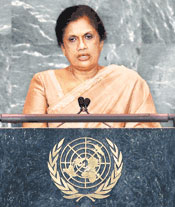 Mr.
President, Mr.
President,
Excellencies,
Distinguished delegates
Ladies and gentlemen
May I at the outset extend our sympathy and solidarity
to the people and the Government of the United States of
America as they begin reconstruction and rehabilitation,
following the recent Hurricane disaster on the Gulf Coast .
We do so while recalling the generous and spontaneous
response of the people, Governments of other nations and the
Government of the United States, and so many member States
of the United Nations, the UN and other international
agencies when the Tsunami waves hit Sri Lanka last December.
Mr. President, I had the honour to deliver my first
address to this august Assembly in my capacity as the
President of Sri Lanka at the historic Session in 1995 when
the United Nations celebrated its 50th Anniversary. It is a
distinct pleasure therefore, to revisit this forum ten years
later. More so because we commemorate this year, both the
50th Anniversary of Sri Lanka's UN Membership, and the 60th
Anniversary of the United Nations. It is time to take stock,
and remain focussed with a view to moving forward. We have a
substantial unfinished agenda and new challenges to deal
with.
Mr. President
The United Nations is the most
representative universal body, that can legitimately seek
common solutions to common problems, that are acceptable to
our diverse membership. As recognized by the High Level
Panel and the Secretary-General in his report "In larger
freedom: towards development, security and human rights for
all", the United Nations, despite its many achievements, and
because of its great potential, has to do more to keep pace
with the changes that have occurred in the world since its
inception sixty years ago. Reform of the UN must be in the
multilateral interest and embrace all facets of the UN's
activities.
The vision that we will adopt at this
summit should indeed be decisive. It should serve as a
roadmap which would catalyse further change and reform.
Reform must affect our entire agenda, the mechanisms we
adopt to implement it and the resources we make available.
It cannot be piecemeal and must benefit all member States
equitably. The integrated approach to security, development
and human rights is the key to this.
Mr. President,
Allow me to re-visit an issue of current significance -
global terrorism - taken up both in 1995 and in the year
2000, where action remains pending internationally, even as
we in Sri Lanka are trying out an integrated approach to
resolve our problem in the midst of great challenge.
More than 10 years ago, my Government launched a bold policy
of a negotiated settlement in place of conflict, and a
federal solution as against a separate State. With the
support of a broad multi-ethnic coalition of parties I
proceeded to talk with the rebel armed group the Liberation
Tigers of Tamil Eelam (LTTE) about ending the conflict, and
discuss with all the parties in parliament about a new more
inclusive, political Constitution that would share power
with all communities. This policy shift laid the ground work
for a new approach to fighting terrorism and the peace
process in my country, that simultaneously addressed
Security, Development and Human Rights.
We engaged
the rebels in a ceasefire that we hoped would save lives and
allow people, particularly those living in the
conflict-affected areas to live and work more closely and
freely. This we believed would have a positive influence on
the overall climate for peace, thus improving security. We
increased development work in conflict-affected areas
because we believed that all of our citizens, irrespective
of where they live, what ethnicity they belong to, or even
who they are forced to live under, must have access to
health, education and jobs. And we believed this would give
the rebel group, the LTTE an opportunity to engage in useful
and constructive work that may benefit the people directly,
rather than preparing for conflict.
And we took a
number of steps to improve the human rights of all the
people of the country, with a special focus on the concerns
of ethnic communities who have not been fully included in
the past.
As part of the peace process, successive
Governments have given the LTTE all facilities as a party to
negotiations, including access to foreign entities and
Governments, at times using the good offices of the
facilitators - the Norwegian Government, who have made
considerable efforts to move the process forward under
difficult circumstances. However, this process of engagement
and accommodation does not seem to have persuaded this Group
to move away from terrorism, as is evidenced by their recent
killing of my Foreign Minister, their continued recruitment
of child soldiers and their killings of political rivals.
Such actions of an armed group engaged in a peace process
tests the commitment of a vast majority of the people of the
country, to pursuing a negotiated settlement. Although we
had the option of a military response, we have rejected it.
And instead are choosing a different approach - to reiterate
our commitment to a ceasefire and to a political solution,
whilst reviewing the previous approach towards negotiating
with this Group. This review has begun with a call to the
international community to help exert real pressure on the
LTTE, in order that we can engage them in a process that
will lead to a lasting peace, bringing about democracy and
human rights.
Mr. President,
The challenge we
face in Sri Lanka is not unique. Vulnerable democracies
which have undertaken bold, political initiative to address
the root causes of terrorism and seek political solutions by
engaging ruthless armed groups find themselves in a genuine
dilemma as to how to develop a credible and acceptable
approach to such negotiations.
If a democratic
State, which consistently conforms to international norms
and laws and uses non-military means to address the problem
of terrorism, weakens as a result of the activities of
terrorists, chaos, and lawlessness will follow. Extremism,
fundamentalism and tribalism will reign supreme. As a
result, peace and security, within and among States, as well
as universally accepted human rights norms and fundamental
freedoms will suffer. It will also lead to weakening of the
'inter-Governmental system', which is the bedrock of this
Organization. This 'inter-Governmental system' chain can
only be as strong as its weakest link. It is therefore
essential to strengthen collective ability of the system to
combat and address terrorism.
In this regard, we
must be absolutely clear that the engagement of armed
non-state actors for peace making should not be done at the
expense of the capability for democratic governance of a
sovereign State that is conducting itself according to
internationally accepted laws and norms. The UN and the
international community can help in developing mechanisms
that support States engaging in such peace process and
sanction terrorist groups that undermine them.
Mr.
President,
It is, therefore, timely for this
Assembly to address the question of practical means to deny
external access and support to such entities to sustain
their military and fund raising activities that are
detrimental to the ongoing peace processes. We hope that the
mechanisms already put in place by the Security Council
against such offending non-state actors will eventually
represent an effective deterrent against such activities. In
the absence of such measures, those groups may continue to
engage in illicit financing and arms procurement whilst
enjoying the political privileges gained through engagement
in peace processes. This in turn will erode the credibility
of all our peacemaking efforts including those of the United
Nations, and years of work in codifying international legal
and other measures against terrorism.
Even with
rebel groups engaged in peace processes we must adopt
procedures that reward genuine peace making on one hand, and
impose sanctions on acts of terrorism on the other. Without
this, vulnerable democracies will find it extremely
difficult to launch and sustain effective negotiations with
armed groups.
The Secretary General in his report to
the current Summit has correctly observed that a small
network of non-state actors and terrorists, have brought
about new challenges before the international community. The
forces of globalisation have aggravated this situation.
Trans-national networks of terrorist groups have acquired
global reach and made common cause in posing threats to
democracy, peace and security within and amongst states.
Mr. President,
If we are to fight global terrorism, poverty and
disease, we must take an integrated approach to security,
human rights and development, both nationally and
internationally. We must act together as a UN system to
support and strengthen States that are addressing these
challenges comprehensively. This would form an essential
part of the mission of the UN for the next decade.
Thank you |