�...There are victims, there are executioners, and there are
bystanders... Unless we wrench free from being what we like to
call �objective�, we are closer psychologically, whether we like
to admit it or not, to the
executioner than to
the
victim...�
Howard
Zimm quoted by David Edwards in 'The Difficult Art of Telling
the Truth', 2001[see also
Struggle for
Tamil Eelam and
Sachi Sri Kantha's Twenty Books on Eelam Tamils]
* indicates
link to
Amazon.com
bookshop on line
** indicates link to
Amazon.co.uk
online bookshop
ஜா. அடைக்க்க்கல ராசா -வன்னிக்
காட்டு வசம்,
2003
Alagappan, M.V.M.
Tears in Teardrop Island, Sterling Publishers Private
Limited, New Delhi, 1985
Alison, Miranda -
Cogs in
the Wheel? Women in the Liberation Tigers of Tamil Eelam in
Civil Wars, Vol.6, No.4 (Winter 2003), pp.37--54
"This article examines
women�s involvement as combatants in the Sri Lankan Tamil
guerrilla organisation the Liberation Tigers of Tamil Eelam
(LTTE). It addresses women�s motivations for choosing to join
the organisation, then examines the debate over the LTTE�s brand
of nationalist feminism before looking at how women�s
experiences in the movement have affected their views on gender
in society. The article hopes to shed some light on the feminist
debate about these women, and through this on the broader global
feminist debate about women�s roles in nationalism and war. The
article argues for an analysis of women�s involvement in the
movement that accords the women agency and is open to certain
positive results stemming from their participation, yet
recognises the problematic nature of nationalist feminism."
Anderson, Jon Lee and Scott Anderson:*
War Zones, (Dodd, Mead & Co, New York, 1988), pp.173-233.
Book Note by Sachi Sri Kantha
- Journalist brothers had covered the Sri Lankan civil war (in
the form of oral histories) and between the covers provide a
comparison with four other civil wars which raged simultaneously
in mid 1980s in Northern Ireland, El Salvador, Uganda and
Israel. The unusual format of oral interviews to tell the story
provide a fresh perspective to the extant literature on Eelam
Tamils. Andersons had stated why they adopted this format, as
follows: �There is always war. It is not a strange thing; in
much of the world, war is commonplace and people learn to live
with it�Our experiences gave us a desire to show how people cope
when living in the midst of conflict, and we felt that the best
way to do this was to let people tell their own stories in the
form of an oral history.� Only one chapter of the book covers
Sri Lanka. But within the 60 pages allocated to this chapter,
voices of quite a number of prominent Tamils � circa mid 1980s �
have been recorded for posterity. These include, TULF leader
Amirthalingam, academic Radhika Coomarasamy, journalist
S.Sivanayagam, LTTE theoretician Anton Balasingham, EROS-LTTE
commander Balraj, government official Marianpillai Anthonimuthu,
Batticaloa Citizen Committee leader Sam Tambimuttu, Catholic
priest Father Chandra, LTTE commander Kumarappa and EPRLF
spokesman Loganathan Ketheeswaran. It is rather ironic that
quite a number among these met with untimely deaths
subsequently.
Annaraj, M.S. & Fr Paul Caspersz Ed -
Literature as Social Text: Dreamboats: Short Stories from the Sri
Lankan Plantations, Satyodaya Centre, Kandy, Sri Lanka,
2004.
Arulanantham, Karunyan: Victims of War in Sri Lanka - A
Quest for Health Consensus, Tamil Information Centre, London, 1995
Arumugam, Sanmugam -
Dictionary of Biography of
the Tamils of Ceylon
...This compilation portrays the profiles of
over 775 Ceylon Tamils, who have contributed some good to the
community. They range from the eminent to the not so eminent and
span centuries, from the era of the Tamil Kings of Jaffna to the
present time...
more
Balasingham, Anton:
Politics of Duplicity,
Published by Fairmax Publishing Ltd, 2000
The author of this study, Anton Balasingham, is the
political advisor and theoretician of the
Liberation
Tigers of Tamil Eelam
(LTTE), the politico-military organisation of the Tamil people
inhabiting the North-eastern region of Sri Lanka...
more
Balasingham, Anton: War
and Peace: Armed Struggle and Peace Efforts of Liberation Tigers,
2004
Balasingham, Adele:
Will to Freedom, The:
An Inside View of Tamil Resistance
(Fairmax Publishing Ltd., Mitcham, 2001), 380 pp.
Balasingham, Adele.
Women Fighters of
Liberation Tigers, LTTE International Secretariat, London, 1993
*Blodgett,
Brian :
Sri Lanka�s military: The Search For A Mission, July 2004
"This book explores the change of Sri Lanka's
military's mission from protecting the country from external
threats to countering insurgencies. From 1947 to 2004, Sri
Lanka's military has searched for a mission. When its initial
worry of an invasion by India did not materialize, the military
turned its focus on internal insurrection. With an expected end
to the 20-year conflict between the Jaffna Tamils and the
Sinhalese government, the military's mission will return to
external defense. However, without significant external or
internal threats, the government will neglect the military and
it will again become incapable of defending against any threat.
This book exams all aspects of the three services (army, navy,
and air force). Each chapter covers a decade of history and
includes each service's mission, operations, doctrine and
tactics, command and organization, weapon procurement and
existing weapons, personnel, retention, recruitment, training,
and summaries of each decade."
Bose, Sumantra: States,
Nations, Sovereignty- Sri Lanka, India and the Tamil Eelam Movement,
Sage Publications, London, 1994
"Demands for 'national self determination' are, in one
sense, therefore also a struggle for a higher form of democracy.
It must then be recognised that 'post-colonial liberation
movements' far from being inherently 'undemocratic',
'subversive', 'terrorist' ad infinitum, are often the most
effective medium for democratic assertion by social groups who
have been deprived of equal citizenship rights, who have been
subjected to state oppression. This is something that is true
from Palestine to Kashmir, from Kurdistan to Tamil Ceylon...
The political and philosophical vision that is
required today has been eloquently articulated, ironically
enough, by
radical Tamil nationalists
('chauvinists' and 'separatist terrorists', according to the
official wisdom), in 1985: "We know that in the end, national
freedom can only be secured by a voluntary pooling of
sovereignties, in a regional and ultimately in a world context.
And we recognise that our future lies with the peoples of the
Indian region, and that the path of a greater and larger union
is the (eventual) direction of that future. It is a union that
will reflect the compelling and inevitable need for a common
market and a common defence and foreign policy, and which will
be rooted in the common heritage that we share with our brothers
and sisters not only of Tamil Nadu but also of India as a whole.
It is a shared heritage that we freely acknowledge and it is
shared heritage from which we derive strength - and we know,
that we too, as a people, can contribute to that strength."
more
Bright, Jagat Singh. Ceylon Kicks India, Streamlines
Publishers Pvt.Ltd, Cochin, India, 1983
British Tamil Forum,
The
Unspeakable Truth, 2008
*Bullion,
Alan J.
India, Sri Lanka and the Tamil crisis, 1976-94
London; New York : Pinter, 1995.
*Burrow S.M. -
Buried Cities of Ceylon, 1999
Casie Chetty, Simon :
The Tamil Plutarch, A Summary
Account of the Lives of the Poets and Poetesses of Southern India and Ceylon,
First Published in 1859, Second Revised Edition published by Asian Educational
Services,1982
*Chattopadhyaya
H.P. -Ethnic
Unrest in Modern Sri Lanka : An Account of Tamil-Sinhalese Race
Relations 1994
Committee for Rational Development. Sri Lanka - the Ethnic
Conflict- Myths, Realities & Perspectives, Navrang, New Delhi, 1984
* Daniel,
Valentine E.,
 *Depinder Singh -
The IPKF in Sri Lanka Hardcover, Published 1992 *Depinder Singh -
The IPKF in Sri Lanka Hardcover, Published 1992
Neil Devotta -
From ethnic outbidding to ethnic conflict: the institutional bases
for Sri Lanka's separatist war - Journal of
the
Association for the Study of Ethnicity and
Nationalism Vol. 11(1), 2005, 141-159
Neil Devotta -
Blowback: Linguistic Nationalism, Institutional Decay, and Ethnic
Conflict in Sri Lanka, 2004
Neil Devotta -
Sinhala Buddhist Nationalist Ideology: Implications for Politics and
Conflict Resolution in Sri Lanka, 2007
| *
De Silva, Kingsley M & Howard R. Wriggins:
J.R. Jayewardene of Sri Lanka: A Political Biography/from
1956 to His Retirement (1989)
* De
Silva, Kingsley M & Howard R. Wriggins:
J.R. Jayewardene of Sri Lanka a Political Biography:
1906-1956
* De
Silva, Kingsley M:
A
History of Sri Lanka
(C. Hurst & Co, London, 1981), 603 pp.
Book Note by Sachi Sri Kantha -
A comprehensive general survey of Ceylon�s history in one
volume. The main text consists of 38 chapters and an epilogue, ending
with a mention of Mrs.Sirimavo Bandaranaike�s expulsion from the
parliament on 16 October 1980 by the maneuvers of her nemesis
J.R.Jayewardene. While there is hardly any doubt that the text is
superbly written by one of the eminent historians of Sri Lanka, the
interpretations and pro-Sinhala bias of th author (cryptically weaved
into the text) have to be taken into note by the readers with a critical
eye. The asymetrical balance in the text is also a demerit. The ancient
history of the island (about which there is much haze and controversy),
from 500 BC to AD 1250 is covered only in first 78 pages. Subsequent 34
pages covers the period from 1250 to 1600. Thus, the bulk of the text �
450 pages � is devoted to the history of recent 380 years, from 1600 to
1980.
De Silva, K.M. and Samarasinghe, S.W.R. de A.Peace accords
and ethnic conflict. London ; New York : Pinter ; New York : Distributed in
USA and Canada by St. Martin's Press, 1993, Series title: ICES ethnic
studies series.
De Silva, K.M. Sri Lanka, problems of governance. Delhi
(India) : Konark Publishers, c1993., Series title: Governing South Asia ; 5.
De Silva and May, R.J.. Internationalization of ethnic
conflict. London : Pinter Publishers, 1991. Series title: ICES ethnic
studies series.
De Silva, K.M. Letters on Ceylon, 1846-50, the
administration of Viscount Torrington and the 'rebellion' of 1848; the
private correspondence of the Third Earl Grey and Viscount Torrington.
Kandy, K. V. G. de Silva, 1965.
De Silva, K.M. Ethnic conflict in Buddhist societies : Sri
Lanka, Thailand, and Burma. London : Pinter ; Boulder, Colo. : Westview
Press, 1988.
De Silva, K.M. The "traditional homelands" of the Tamils :
separatist ideology in Sri Lanka : a historical appraisal. Rev. 2nd
ed.Kandy, Sri Lanka : International Centre for Ethnic Studies, 1995.; Series
title: Occasional papers (International Centre for Ethnic Studies) ; 4.
De Silva, K.M. Regional powers and small state security :
India and Sri Lanka, 1977-1990. Washington, D.C. : Woodrow Wilson Center
Press ; Baltimore : Johns Hopkins University Press, c1995.
De Silva, K.M. Managing ethnic tensions : reflections on a
theme. [Kandy, Sri Lanka] : International Centre for Ethnic Studies,
[1983?].
De Silva, K.M. Managing ethnic tensions in multi-ethnic
societies : Sri Lanka, 1880-1985. Lanham, MD : University Press of America,
c1986.
De Silva, K.M and Pieris G.H. The university system of Sri
Lanka : vision and reality. New Delhi : Macmillan India Ltd., 1995, Series
title: ICES Sri Lanka studies series
De Silva, K.M. Religion, Nationalism, and the State in
Modern Sri Lanka. Tampa, Fla. : Dept. of Religious Studies, University of
South Florida, 1986.; Series title: USF monographs in religion and public
policy ; no. 1.
De Silva, K.M. Separatist ideology in Sri Lanka : a
historical appraisal of the claim for the "traditional homelands" of the
Tamils of Sri Lanka . International Centre for Ethnic Studies, 1987.; Series
title: Occasional papers (International Centre for Ethnic Studies) |
*Dixit,
J N
:
Assignment Colombo, Konarak Publishers, 1998, Rs 400. 393pp Copies of the
book may be obtained from Mr K P R Nair, Konarak Publishers, A-149, Main Vikas
Marg, New Delhi 110 001. [see also
J.N. Dixit on India's Role in the Struggle for Tamil Eelam]
Book Note by Sachi Sri Kantha
- Jyotindra Nath Dixit served as India�s High Commissioner to
Sri Lanka, from April 1985 to April 1989, a critically tumultous
period of recent times. This book is Dixit�s version of history,
in the events he played a prominent role, which include the
ill-fated Rajiv Gandhi-Jayewardene Accord (1987) and induction
of Indian army in Eelam. Undoubtedly the book presents a slanted
view promoting the �India knows best on what�s good for Eelam
Tamils�; but, the bias is mildly counter-balanced by Dixit�s
frank appraisals on the duplicity of Sinhalese politicians and
perceptions on Pirabhakaran�s tenacity and valor to defend the
rights of Tamils.
*Dubey, Ravi
Kant -
Indo-Sri Lankan Relations : With Special Reference to the Tamil
Problem Deep & Deep Publications, New Delhi, 1989
Emmanuel, S.J:. Church, Politics & War in Shri Lanka, Centre for
Society & Religion, Colombo, 1994
Emmanuel, S.J.: Let My People Go - Published by the Tamil Catholic
Chaplaincy, Germany, 1997
Enriquez C.M -
Ceylon: Past and Present ISBN-10: 8120613856 ISBN-13:
978-8120613850
Latif Farook - Nobody�s People � The
Forgotten Plight of Sri Lanka�s Muslims, 2009
Farmer, Bertram H:
Ceylon � A Divided Nation (Oxford University Press, 1963), 74
pp.
Book Note by Sachi Sri Kantha
- Rather than a book, this is a booklet, as indicated by the
author in his Introduction. Lucidly written, this is the first
work by a �foreigner� [a Fellow of Cambridge University] to
prophesy the disintegration of a �contraption� called �unified
Ceylon�, which was created by the British colonial policies in
1833. The title says it all. The booklet�s another plus point is
it�s foreword, written by Viscount Soulbury, where the architect
of the island�s second major constitutional reform in the 20th
century provides a belated mea culpa for his short-sightedness.
To quote Soulbury, �Unhappily and for reasons indicated by
Mr.Farmer, the death of Mr.D.S.Senanayake led to the eventual
adoption of a different policy which he would never have
countenanced. Needless to say the consequences have been a
bitter disappointment to myself and my fellow Commissioners.�
Fonseka, Carlo: Towards a peaceful Sri Lanka :
six introductory seminars for university students, Helsinki : World Institute
for Development Economics Research of the United Nations University, c1990,
Series title: Research for action
*Fries, Yvonne -
The Undesirables : The Expatriation of the Tamil People of Recent Indian Origin
from the Plantations in Sri Lanka to India / Hardcover / Published1985
* Gnanaprakasar,
Nalloor Swamy
Critical History of Jaffna: The Tamil Era 2003 Reprint
Edition,172pp
Goodhart, Lord William et al.
Judicial
Independence in Sri Lanka - Report of a Mission to Sri Lanka (14-23
September 1977) by the Centre for the Independence of Judges and lawyers, Geneva
Switzerland, 1998
Gunaratna, Malinga H. The Plantation Raj, H.W.Cave &
Co.Ltd,Colombo, Sri Lanka, 1980
Gunaratna, Rohan. Indian intervention in Sri Lanka :
the role of India's intelligence agencies 1961-Colombo : South Asian Network on
Conflict Research, 1993.
Gunaratna, Rohan. Sri Lanka, a lost revolution? : the
inside story of the JVP 1961- Kandy, Sri Lanka : Institute of Fundamental
Studies, 1990.
Gunaratna, Rohan. War & Peace in Sri Lanka, with a
post-accord report from Jaffna, introduction by Ralph Buultjens.1961-Colombo :
Institute of Fundamental Studies, Sri Lanka, 1987.
Gunasingham, Murugar :
Sri Lankan Tamil Nationalism - A Study of its Origins, MV
Publications, P.O.Box 271, Kingswood, Sydney, NSW 2747,
Australia
Gunasingham, Murugar
-
Primary Sources for
History of the Sri Lankan Tamils - World Wide Search
Gunasingham, Murugar -
கலாநிதி முருகர் குணசிங்கம் -
Tamils in Sri Lanka - A
Comprehensive History (C.300 B.C. - 2000 A.D.) -
இலங்கையில்
தமிழர் � ஒரு முழுமையான வரலாறு (கி.மு. 300 கி.பி. 2000 )
Major General Harkirat Singh (Retd.) -
Intervention in Sri Lanka: The IPKF Experience Retold Hellmann-Rajanayagam, Dagmar.
The Tamil Tigers :
Armed Struggle for Identity Stuttgart : F.
Steiner, 1994, Series title: Beitrage zur Sudasienforschung ;
Bd. 157. Hellmann-Rajanayagam, Dagmar.
The Tamil Tigers :
Armed Struggle for Identity Stuttgart : F.
Steiner, 1994, Series title: Beitrage zur Sudasienforschung ;
Bd. 157.
Hellmann-Rajanayagam, Dagmar
Female Warriors, Martyrs and Suicide Attackers:
Women in The LTTE, International
Review of Modern Sociology, Vol. 34, No. 1 (Spring) 2008
Hellmann-Rajanayagam, Dagmar (2005).
And Heroes Die: Poetry of The Tamil Liberation Movement In
Northern Sri Lanka. South Asia, New Series, Vol. XXVIII, No.
1 (April): 112-153.
"The LTTE does not merely represent the
old symbols and emotions of Tamil heroism; it presents
itself as the guardian and protector of this tradition. And
this concept is accepted by the people because it is
familiar to them from innumerable lessons and tales. �Tamil�
virtues like strict discipline and honourable conduct
resurface in the LTTE: we protect you, your people, and your
women. The demand for an independent Eelam rests as much on
the struggle against racial and national discrimination as
on past glory. The complex sources of this poetry,
therefore, lead to intratextual contradictions that are,
however, not usually recognised as such. Again, this is a
sign for the programmatic and ideological skill of the
militants who resume precisely those traditions that
resonate within the population. The synthesis provides
something completely new, something pertinent only to the
LTTE."
Holmes, Robert W.: Jaffna (Sri Lanka) 1980 (The Christian
Institute for the Study of Religion and Society, Jaffna College,
Jaffna, 1980), 542 pp.
Book Note by Sachi Sri Kantha -
A sound and clean ethnological portrayal of
Jaffna society � the city and the peninsula � in the 20th
century, before the emergence of Velupillai Pirabhakaran and
LTTE, by an American historian. Sadly, the Jaffna described by
Robert Holmes in 1980 is no more now. Still, the book is worth
for reading, for author�s insight as a non-Tamil who had lived
in Jaffna for more than a decade, from 1948 to 1960 and taught
at Jaffna College, Vaddukoddai.
Hoole, Rajan et al. The Broken
Palmyra
- The Tamil Crisis in Sri Lanka,The Sri Lanka Studies Institute, Claremont, CA
1988, Revised 1990, 464pp
Book Note by Sachi Sri Kantha -
This book provides a good chronological synopsis
of events which happened in the Jaffna peninsula from 1983 to
1989. The demerits of the book are, the sociological and
psychological interpretations relating to the birth and growth
of LTTE, which are biased and filled with half-baked criticism.
In search for their �truth in all its nakedness�, the four
authors pointed accusing fingers on Tamil society as a whole.
Thus, the book took an easy route to popularity among the
anti-LTTE pundits in Colombo and Chennai. [see also
review]
* Hoole, Rajan
-
Sri Lanka: The Arrogance of Power: Myths, Decadence & Murder
*
Hyndman, Patricia.
Sri Lanka -
Serendipity under Siege, Spokesman, Bertrand Russel
House, Gamble Street, Nottingham, England
Hyndman, Patricia -
Democracy in Peril: Sri Lanka a Country in Crisis, 1985
Hyndman, Patricia - LAWASIA
Human Rights Standing Committee -
Sri
Lanka: Escalating Violence and Erosions Of Democracy, March
1985
Indrapala, K: Evolution
of an Ethnic Identity - The Tamils in Sri Lanka C. 300 BCE to C.
1200 CE
Ivan, Victor: Road to Conflict - Sri Lanka in Crisis
Institute of Race Relations: Sivanandan, Ambalavaner. Ed. Sri Lanka
Racism and the Authoritarian State, London, 1984
Institute of Race Relations:
Sri Lanka: testimony to state terror, Race & Class, Vol.
26, No. 4, 71-84 (1985)
There are two nations in Sri Lanka, both ruled
by the Sri Lankan government - one, the Sinhala/Buddhist South,
under civilian rule, and the other, the Tamil North (and
increasingly the East), under a military dictatorship.
Ironically enough, the cause of this separate dispensation is
alleged by the Sri Lankan government to be the figirt for a
separate state by the Northern (and Eastern) Tamils. That story
however, has been told at length in the special issue of Race &
Class ('Sri Lanka: racism and the authoritarian state') which
appeared in Ju ly 1984 on the anniversary of the '83 pogroms.
Here we wish to record a few of the 200 affidavits (sworn before
justices of the peace) from witnesses testifying to the
atrocities of the security forces in Jaffna in the period March
November 1984. (A fuller dossier, from which these documents
have been excerpted, is published by the South Asia Bureau. *)
J.R. Jayawardene -
Men and Memories: Autobiographical Recollections and Reflections
Karthigasoo Jeganathan -
Memories are Forever,
2005
*Kadian, Rajesh.
India's Sri Lanka Fiasco, Vision Books, NewDelhi, 1990
*Kapferer, Bruce -
Legends of People, Myths of State : Violence, Intolerance and Political Culture
in Sri Lanka and Australia (Smithsonian Series in Ethnographic inquiry
/ Paperback / Published 1998
Kaarthikeyan, D.R. and Radhavinod Raju:
Triumph of Truth � The Rajiv Gandhi Assassination � The
Investigation, New Dawn Press Inc, New Delhi, 2004, 261 plus xxv
pp
Subramanier Katiresu -
A Hand Book
to the Jaffna Penninsula and a Souvenir of the Opening of the
Railway to the North, First Published 1905, Re Published by
Asian Educational Services, 2004. ISBN 8120618726, 9788120618725.
111 pages
Kularatne, Major M.A.A.J.
How Do Separatist Insurgents Use Negotiations for Their Growth and
Survival?
Several scholarly discussions have been held and
numerous studies conducted on the subject of counterinsurgency
warfare but only a little emphasis has been made on studying the
relationship between negotiations and the growth of insurgents.
For that reason, an effort was made to research this unexamined
area, initially by conducting an in-depth review on the
literature published on the subjects of insurgency and
negotiations to acquire a sound knowledge on the theoretical
foundations pertaining to the key areas of the research question
and subsequently by analyzing a case study on the Sri Lankan
scenario, where a prolonged counterinsurgency campaign has been
waged for the last two decades.
This research focuses on four different episodes
where the Government of the Democratic Socialist Republic of Sri
Lanka (GOSL) and the Liberation Tigers of Tamil Eelam (LTTE) had
conducted negotiations from 1985 to 2003 in order to analyze how
an insurgent organization makes use of negotiations for its
growth and survival through a case studies methodology.
The study concludes by logically assessing how the LTTE, as a
separatist insurgent organization, has been able to make use of
the aforesaid negotiations for its growth and survival. The
conclusion also meets the broad purpose of the research by
making recommendations for legitimate counterinsurgents to
gainfully engage in negotiations while denying the insurgents
from gaining advantages during negotiations.
Chellamuthu Kuppusamy
- Prabhakaran:The Story of His Struggle for Eelam,
2009
Leary, Virginia.
Ethnic Conflict and Violence in Sri Lanka,
International Commission of Jurists, Geneva, 1983
*Little, David -
Sri Lanka : The Invention of Enmity (Series on Religion, Nationalism, and
Intolerance) Us Institute for Peace, Paperback / Published 1994
Livingstone, Samuel. The Sinhalese of Ceylon and the Aryan Theory,
Published by M.S.Seevaratnam, Kodavil, 1987
M. Mayilvaganan -
The Re-emergence of the Tamil Nadu Factor in India�s Sri Lanka
Policy, November 2007
Makenthiran, Suppiramaniam -
Tamils in Independent Ceylon, 2003
Captain Malaravan - War
Journey, Translated from Tamil by N Malathy, 2007
*Manogaran,Chelvadurai
and Pfaffenberger, Bryan. -
The Sri Lankan Tamils : Ethnicity and Identity,
Westview softcover ed. Boulder : Westview Press, 1994.
*Manogaran,
Chelvadurai -
Ethnic Conflict and Reconciliation in Sri Lanka, University of
Hawaii Press, Honolulu, 1987, 232 pp.
Book Note by Sachi Sri Kantha
- The author states in his preface, why he wrote this book;
�There has been no comprehensive study by geographers of the
ethnic conflict in Sri Lanka which has been partially caused by
the inability of a community to preserve and develop a
well-defined geographical region considered to be its
traditional homeland. My aim has been to analyze among other
factors the geographical determinants of the conflict,
especially those dealing with the allocation of water on a
spatial basis for agricultural development and land settlement.�
Of the five chapters which makes the book, the third chapter
entitled, �Tamil Districts: Conflict over Traditional Homelands,
Colonization and Agricultural Development� is a valuable one.
Manogaran, Chelvadurai -
The untold story of
ancient Tamils in Sri Lanka:Kumaran Publishers, Chennai, Tamil
Nadu, 2000
*Manor, James. Ed.
Sri Lanka in Change and Crisis
, Croom Helm,London & Sydney, 1984
*Matakal
Mayilvakanap Pulavar -
Yalpana Vaipava Malai or the
History of Kingdom of Jaffna
Deirdre McConnell -
The Tamil people's right to
self-determination
in Cambridge Review of International Affairs, Volume 21 Issue 1
2008
*McGowan,William.
Only Man is Vile - the Tragedy of Sri Lanka, Farrar, Straus and Giroux, New
York, 1992
* Mendis G.C.
-
Early History of Ceylon
*Misra, S.S.
Ethnic conflict and security crisis in Sri Lanka, Delhi :
Kalinga Publications, 1995.
Timothy J. Moore -
Ethnic and Communal
Violence : The Independence of the Judiciary: Protection of
'Fundamental Rights' and the Rule Of Law in Sri Lanka - Fragile
Freedoms? - Report of a mission to Sri Lanka in June 1983 on behalf
of the International Commission of Jurists
*
Muttuttampippillai, A:
Jaffna History 2nd Edition pp 170
Nadesan, Somasunderam.: The JVP Insurgency of 1971, The Nadesan Centre
for Human Rights through Law, Colombo, 1988
*Narayan
Swamy, M.R.
-
Tigers of Lanka From Boys to Guerrillas /
Hardcover / Published: January 1994, 2nd Edition
with Epilogue, 1996, 358pp
"....Velupillai Pirabaharan was born in Jaffna hospital on November
26, 1954 when Tamil-Sinhalese relations were inching towards a flash point.
He was the youngest of four children of Vallipuram Parvathi and
Thiruvenkatam Velupillai. Theirs was a typical middle class family where the
youngest was the darling of all...The
Tiger was the insignia of the ancient Tamil Chola kingdom, and Pirabaharan
was visibly enthusiastic when the logo was first shown to him... His motto
was talk little and hear more..." [see also
excerpts]
Book Note by Sachi Sri Kantha - An
Indian journalist�s version of the origin and growth of LTTE,
from late 1970s to 1991. An epilogue, inserted in the 2nd
edition, provides author�s impressions on the �Fall of Jaffna in
December 1995�. Though sympathetic to the Indian interests, the
book provides a readable account on the strengths of LTTE and
its leader. The last three sentences in the epilogue are
prophetic; �If the LTTE�s posturings were not enough,
Kumaratunga has vowed not to talk to the Tigers until they lay
down their weapons, obviously aware that it is one demand which
Prabhakaran would never, never agree to. Even if the two sides
agree one day to talk through a mediator, one cannot be very
optimistic. And whether you like the LTTE or not, whether the
other Tamil groups whole-heartedly back a devolution package or
not, no peace process can succeed in the
face of a veto by the Tigers.�
Narayan Swamy, M.R.
-
Inside an Elusive Mind - Prabhakaran
Published by Literate World, Inc, USA, 2003
Navaratnam, V - The Fall
and Rise of the Tamil Nation published by the Tamilian Library,
Montreal and Toronto - 1995 (purchase inquiries to P.O.Box 70, La Prairie,
Quebec, J5R3Y1, Canada)
Netherlands Sri Lanka Coordinating Centre
- Memorandum on
Human Rights Violations and Ethnic Violence in Sri Lanka,
December 1983.
Nissan, Elizabeth et al.- Accord:
An International
Review of Peace Initiatives - Special Edition on Sri Lanka,
August 1998
Nyrop, Richard et al: Area Handbook for Ceylon
(Foreign Area Studies [FAS], U.S. Government Printing Office,
Washington DC, 1971, 523 pp.
Book Note by Sachi Sri Kantha -
This multi-authored comprehensive handbook was
prepared by the American University, Washington DC, in four
sections and 25 chapters �to be useful to military and other
personnel who need a convenient compilation of basic facts��.
Though the information presented in three sections (political,
economic and national security) consisting of 13 chapters are
dated now and only of interest for historical purposes, the
information provided in the first 12 chapters, pages 1 to 224 �
ethnological and anthropological facets � are still of value for
students of Sri Lankan history.
*O'Ballance, Edgar.
The Cyanide War : Tamil Insurrection in Sri Lanka, 1973-88 , Brassey's (UK),
Maxwell Pergamon Publishing Corporation, London,1989
Oette, Lutz. The International
Crime of Genocide - The Case of the Tamil People in Sri Lanka, Published by
the Tamil Information Centre, London, 1997
Ostrovsky, Victor and Hoy, Claire.
By Way of Deception; The Making and Unmaking of a Mossad Officer,
St.Martin�sPress, New York, 1990
*Palanithurai.G,
Mohanasundaram,
Dynamics of Tamil Nadu politics in Sri Lankan ethnicity New
Delhi : Northern Book Centre, 1993
Parameswaran, N - Early Tamils of Lanka - Ilankai (purchase
inquiries to K.Rajendra, 75 Walpole Road, London E17 6PS
*K
Paramothayan
- Edge of the Lagoon: Some
Perspectives of Jaffna * Parker H
-
Ancient Ceylon * Parker H
-
Ancient Ceylon
* Pieris
P.E. -
Ceylon and the Hollanders (1658 - 1790)
* Pieris
P.E. -
Ceylon and the Portuguese (1505 - 1658)
* Pieris
P.E. -
The kingdom of Jafanapatam, 1645,: Being an account of its
administrative organisation as derived from the Portuguese archives
* Pieris
P.E -
Tri Sinhala - the Last Phase (1796-1815)
Percival R - Account of the island of Ceylon
*
Pettigrew, Joyce ed.
Martyrdom and Political Resistance : Essays from Asia and Europe (Comparative
Asian Studies, 18) published by VU University Press for Centre
Asian Studies, Amsterdam and is essential reading for those seeking to
further their understanding of the
continuing struggles for freedom in many parts of the world.
From the Preface: "New nations are formed within
post-colonial states and old nations gain their freedom from recent empires. At
a time like that, it seems pertinent to consider the role of traditions of
martyrdom in shaping and sustaining political resistance. This collection of
essays, dealing among others with Sikhs in the Punjab. Tamil Tigers in Sri Lanka
and the IRA in Northern Ireland. explores the social variables that allow the
martyr�s sacrifice to be effectively utilized by a political movement. The
essays consider how various forms of social association as well as religious and
historical tradition influence the place of the martyr in a resistance struggle
and describe the differing social and political processes that affect martyr
authentication."
Piyadasa, L. Sri Lanka - The Unfinished Quest for Peace, Marram Books,
London, 1988
*Piyadasa, L.
Sri Lanka: The Holocaust and After, Marram Books,London, 1984
*Piyasena,
S & R. Y. Senadheera -
India, "We Tamils", and Sri Lanka,
Hardcover / Date Published: January 1987
Ponnamblam, Satchi.
Sri Lanka: The National Question and the Tamil Liberation Struggle, Tamil
Information Centre, London and Zed Books Ltd, London - 1983
Ponniah, S - Satyagraha and the Freedom Movements of the Tamils 1956 to 1961
Prabhakaran - A Leader
for All Seasons
- Glimpses of the Man behind the Leader - Published by the
International Federation of Tamils, 2004
"இத்தலைவனின்
சொற்களில் ஆவேசமும் உண்டு அன்பும் உண்டு. நிதானமும் உண்டு
தீர்க்கதரிசனமும் உண்டு. 'உள்ளத்தில் உண்மையொளி உண்டாயின்
வாக்கினிலே ஒளியுண்டாம்" என்று அன்று பாரதி பாடிய கவிதைக்கு
இத்தலைவன் இலக்கணமாக விளங்குகிறான்..."
more
*Pratap, Anita :
Island of Blood: Frontline Reports from Sri Lanka, Afghanistan and Other South
Asian Flashpoints
Rasanayagam, Mudaliar C. :Yalppanac
carittiram - History of Jaffna - August 1999
* Richardson, John:
Paradise Poisoned: Learning About Conflict, Terrorism and Development from Sri
Lanka's Civil Wars, 2005
Roberts, Michael. Ed. Collective Identities, Nationalisms and Protest in Modern
Sri Lanka, Marga Institute, Colombo, 1979
Rupesinghe, Kumar & Verstappen, Berth.Ed. Ethnic Conflict and Human
Rights in Sri Lanka: An Annotated Bibiliography, Hans Zell Publishers,London,
1989
Russel, Jane.: Communal Politics under the Donoughmore
Constitution 1931-1947 (1982), 358 pp.
This is a 1976 doctoral degree thesis of
British political scientist (born 1950) on the late British
period of the island history. It provides a good focus on the
origin of Sinhala-Tamil crisis in the 1930s, with
S.W.R.D.Bandaranaike and G.G.Ponnambalam at opposite ends.
Between 1973-1976, Russell had interviewed and corresponded with
leading political players and the then �budding talents� of the
1930s decade, such as S.Handy Perinbanayagam, C.Suntheralingam,
Sir John Kotelawala, P.de S.Kularatne, G.G.Ponnambalam,
A.Ratnayake, Colvin R.de Silva, M.Vythilingam, J.R.Jayewardene
and Dr.S.A.Wickremasinghe.
Sabaratnam, T -
The Murder of a Moderate: Political Biography of Appapillai
Amirthalingam
Sahadevan, P. : India and overseas Indians : the Case
of Sri Lanka, Delhi : Kalinga Publications, 1995.; Series title: International
studies (Delhi, India)
Samarasinghe, S.W.R. de A. and Samarasinghe Vidyamali.:
Historical Dictionary of Sri Lanka (Scarecrow Press, Lanham, MD,
1998), 214 pp.
Book Note by Sachi Sri Kantha
- A handy reference book, providing a chronology of important
events which had occurred in Ceylon since 10,000 BC to the end
of 1995. The main text consists of brief sketches of notable
personalities, parties and events in 269 entries from A to Z.
Majority of the entries related to only the 20th century. Among
the 23 personalities who receive individual recognition, Tamils
are represented by only three individuals; alphabetically,
Amirthalingam, Chelvanayakam and Pirabhakaran. Authors being
Sinhalese, subtle anti-Tamil bias is revealed in the
interpretation of the events described.
N.Sanmugathasan - Political
Memoirs of an Unrepentant Communist,1989
Charles Ponnuthurai Sarvan -
Sri Lanka: Reign of Anomy - An essay on the ethnic conflict
Satyendra, Nadesan -
Thirteenth Amendment to Sri Lanka Constitution, London
Tamil Forum, 1988
Satyendra, Nadesan -
The Charge is Genocide - the Struggle is for Freedom, 2007
Sardeshpande, S.C. -
Assignment Jaffna - IPKF in Sri
Lanka, Published 1992
"....Used as we are to wars of a fortnight or
three weeks, the CI Ops against the LTTE in Sri Lanka, which
went on for nearly two and a half years, proved indeed tough -
and to many, too much. Careerists suffered a great deal.
Calculations of many went awry and many were `found out' if not
found wanting. Large numbers felt uncomfortable, dissipated,
disheartened. Some were dispirited, on the verge of tears. The
contagion spread to the families of not only officers but jawans
also. One common question most earnestly asked was: 'When will
our husbands return?' People, village elders, old veterans,
friends back home asked: `What are you doing in Sri Lanka'? We
quietly asked ourselves: `What are we achieving?'
Peter Schalk and Alvappillai Velupillai -
Reflections of the Leader - Quotes by Veluppillai Pirapakaran:
Tamil Source in English Translation
| Schalk,
Peter - Historisation of the Martial
ideology of the Liberation Tigers of Tamil Eelam, Journal of South Asian
Studies, New Series Vol XX, No.2, 35-72, December 1977
- Women Fighters of the Liberation Tigers in Tamil Eelam, South Asia
Research, Volume 14, No.2, 163-183 Autumn 1994
-
The Revival of Martyr Cults among Ilavar, Temenos 33 (1997), 151-190
- The Controversy about the Arrival of Buddhism in Tamilakam,
Temenos 30 (1994), 197-232
- List of Writings on Tamil
Related Subjects |
*Seevaratnam, N. Ed.,
The Tamil National Question and the Indo-Sri Lanka Accord, Konark
Publishers Pvt.Ltd., Delhi, India, 1989
*Senaratne,
Jagath P :
Political violence in Sri Lanka, 1977-1990 : riots,
insurrections, counterinsurgencies, foreign intervention, Published:
Amsterdam : VU University Press, 1997.
[suggested by
Ravi Rajaratnam]
�jAzhan�
Shanmugalingam - ciRpi cetukkAta cintany� � Unsculptured Thought
Sieghart, Paul.
Sri Lanka - A Mounting Tragedy of
Errors, International Commission of Jurists and Justice, London, 1984
Marshall R. Singer: Tamil - Sinhalese Ethnic Conflict in Sri
Lanka: A Case Study in Efforts to Negotiate a Settlement, 1983-1988
Paperback, Published 1994
Marshall R. Singer:
Sri Lanka's ethnic conflict: have bombs shattered hopes for peace?,
1996
Marshall R. Singer: *
The Emerging Elite : A Study of Political Leadership in Ceylon,1964
Sachi Sri Kantha -
Pirabhakaran Phenomenon, 2005
Sivanandan, Ambalavaner: *
When Memory Dies, 1998
| Sivanayagam,
S
Sri Lanka: 10 Years
of Jayawardene Rule, July 1987
Sivanayagam, S -
The Thimpu Talks:1985 - The Sinhala-Tamil Conflict and the India
Factor, published by the Tamil Information Centre
"...The cardinal principles put forward by the Tamil
delegation at the
peace negotiations at Thimpu in 1985 under Indian auspices, remain
the most important concepts which express the aspirations of the Tamil
people of Sri Lanka. India played a major role in events leading up to
the negotiations. These events are a lesson for any future
involvement of India. This background paper is an essential
reference material for those who are interested and involved in the
conflict in Sri Lanka..." - Publisher's Note
Sivanayagam, S -
The Pen and the Gun, 2001 - Selected Writings 1977 to 2001 292pp
Sivanayagam, S - Sri
Lanka: Witness to History - A Journalist's Memoirs, 1930-2004 published
by Sivayogam, London, 2005
|
* Sivathamby, Karthigesu (Civattampi,
K�arttik�ecu) -
Sri Lankan Tamil society and politics
Chris Slee, Brian Senewiratne & Vickramabahu Karunarathne -
The Tamil Freedom Struggle in Sri Lanka
Spencer, Jonathan. Ed. Sri Lanka, History and Roots of
Conflict, Routledge, London and New York
**Somasundaram,
Daya:
Scarred Minds : The Psychological Impact of War on Sri Lankan Tamils
Sri Lanka Court of Appeal Judgment:
Senthilnayagam and Others v Seneviratne and Another, 1981
Sri Lanka Supreme Court Judgment:
Gunawardena v Perera and Others, 1983
Sri Lanka Co-ordination Centre, 1983, Sri Lanka - �Paradise� in ruins,
Kassel: Sri Lanka Co-ordination Centre.
Suryanarayan, V. Sri Lankan Crisis and India's
Response. New Delhi : Patriot Publishers, 1991.
*Tambiah,
Stanley Jeyaraja.:
Sri Lanka � Ethnic
Fratricide and the Dismantling of Democracy (Oxford University
Press, Delhi, 1986), 198 pp.
Tambiah, Stanley Jeyaraja -
Buddhism Betrayed? - Religion, Politics & Violence in Sri Lanka,
University of Chicago Press, 1992, 203pp
A controversial book by one of the leading
anthropologists of our generation. It stirred the proverbial
hornet�s nest in Sri Lanka. The book tells the story of how
Sinhala Buddhist priests (known as bhikkus in local lingo)
belonging to the three sects � namely Siam Nikaya, Amarapura
Nikaya and Ramana Nikaya � influenced the Sinhalese politics in
the island from 1880s to 1980s. Anti-Tamil riots of 1958 and
1983 are chronicled, but the 1977 anti-Tamil riots have been
overlooked. The raw material for the book was based on the
published literature of Sinhalese academics such as
K.N..Dharmadasa, K.M.de Silva, Gananath Obeyesekere and Kumari
Jayewardene. [see also
Back Cover of Book & short excerpt]
Thambiah, H. W. (1950).*
The Laws and Customs of the Tamils of Jaffna Ceylon; an Account of the Island Physical, Historical, and
Topographical with Notices of Its Natural History, Antiquities and
Productions, Volume 1 (of 2)
(English)
Ceylon; an Account of the Island Physical, Historical, and
Topographical with Notices of Its Natural History, Antiquities and
Productions, Volume 1 (of 2)
(English)
Tennent, James Emerson, Sir, 1804-1869 -
Sketches of the Natural History of Ceylon (English)
Thornton, E.M. & Niththyananthan, R.
Sri Lanka, Island of Terror
- An Indictment, Eelam Research Organisation, (ISBN 0 9510073 0
0), 1984
Thirunavukarasu, M - Broken Promises - An Historical Record of How Sinhala
Leaders Make and Break Pledges, Published by the International Federation
of Tamils, 1995
Tragedy of January Tenth
1974 - Report of the Commission of Inquiry
- O.L.De Kretser, former Judge of the Supreme
Court of Ceylon. President, Classical Association of Ceylon,
Chairman; Rt.Rev.Dr.Sabapathy Kulandran, former Bishop,
V.Manicavasagar, former Judge of the Supreme Court of Ceylon -
Members; A. V. Vatepillai, Secretary to the Commission
Margaret Trawick -
*
Enemy Lines: Warfare, Childhood, and Play in Batticaloa (Philip E.
Lilienthal Books)
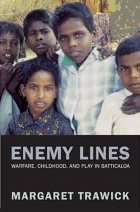 "Enemy
Lines captures the extraordinary story of boys and girls coming
of age during a civil war. Margaret Trawick lived and worked in
Batticaloa in eastern Sri Lanka, where thousands of youths have
been recruited into the Sri Lankan armed resistance movement
known as the Tamil Tigers. This compelling account of her
experiences is a powerful exploration of how children respond to
the presence of war and how adults have responded to the
presence of children in this conflict. Her beautifully written
account, which includes voices of the teenagers and young adults
who have joined the Tamil Tigers, brings alive a region where
childhood, warfare, and play have become commingled in a world
of continuous uncertainty." [see also Book Review
by David F. Lancy, Professor of Anthropology, Utah State
University] "Enemy
Lines captures the extraordinary story of boys and girls coming
of age during a civil war. Margaret Trawick lived and worked in
Batticaloa in eastern Sri Lanka, where thousands of youths have
been recruited into the Sri Lankan armed resistance movement
known as the Tamil Tigers. This compelling account of her
experiences is a powerful exploration of how children respond to
the presence of war and how adults have responded to the
presence of children in this conflict. Her beautifully written
account, which includes voices of the teenagers and young adults
who have joined the Tamil Tigers, brings alive a region where
childhood, warfare, and play have become commingled in a world
of continuous uncertainty." [see also Book Review
by David F. Lancy, Professor of Anthropology, Utah State
University]
![]() Trawick,
Margaret (1999). Reasons for Violence: A Preliminary Ethnographic Account of the
LTTE. In Gamage, Siri and Watson, I.B. (eds.),
Conflict and Community in Contemporary Sri Lanka: 'Pearl of the East' or the
'Island of Tears'? New Delhi. Trawick,
Margaret (1999). Reasons for Violence: A Preliminary Ethnographic Account of the
LTTE. In Gamage, Siri and Watson, I.B. (eds.),
Conflict and Community in Contemporary Sri Lanka: 'Pearl of the East' or the
'Island of Tears'? New Delhi.
**Vanniasingham,
Somasundaram.
Sri Lanka: The Conflict Within, Sangam Books Ltd., London, 1989
Ravindiran Vaitheespara -
Theorizing the
National Crisis: Sanmugathasan, the Left and the Ethnic Conflict
in Sri Lanka
Ravindiran Vaitheespara -
Beyond 'Benign' and 'Fascist' Nationalisms: Interrogating the
Historiography of Sri Lankan Tamil Nationalism
*Venkatachalam,
M.S.
Genocide in Sri Lanka, forewords by M.
Sivasithamparam, A. Amirthalingam Delhi, India : Gian Pub. House,
c1987.
விழுதாகி வேருமாகி .....போரியல் பதிவுகள்
-
நுஃலாசிரியர்கள் : அ.காந்தா, செ.புரட்சிகா, மலைமகள
Vittachi,
Tarzie.
Emergency '58 - The Story of
the Ceylon Race Riots, Andre Deutsch, 1958
from the Preface - "The people of
Ceylon have seen how the mutual respect and good will which
existed between two races for several hundred years was
destroyed within the relatively brief period of thirty months.
This book, most of which was written during those long, tense
curfew nights of May and June 1958, is a record of the events,
passions and under-currents which led to the recent communal
crisis, and of the more remarkable instances of man's inhumanity
to man in those hate-filled days. It is also an account of the
rapid disintegration of the old-established order of social and
economic relationships in so far as it contributed towards the
disaster which overtook the country... Many Ceylonese-Sinhalese
and Tamils-lost their lives in the riots of May and June. Many
of them lost their children, their property, their means of
livelihood and some even their reason. In Colombo, Jaffna,
Anuradhapura, Polonnaruwa, Batticaloa, Eravur, Kurunegala and
many other places where the two communities clashed the ugly
scars will remain tender long after time has buried the physical
signs of chaos. There is no sense in putting the blame on one
community or the other. A race cannot be held responsible for
the bestiality of some of its members...
Emergency '58 ends with a question: 'Have we come to the
parting of the ways?' Many thoughtful people believe that we
have. Others, more hopeful, feel that the bloodbath we have
emerged from has purified the national spirit and given people a
costly lesson in humility... The story of the race riots of
1958 is a story of violence, unreason, anger, jealousy, fear,
cynicism, vengeance and many other states of heart and mind
which the people of Ceylon experienced. I have presented it like
that and, therefore, I will freely admit that Emergency '58 is
opinionated. But I make one claim for the book: it has been
written with the old journalistic saw in mind :facts are sacred,
comment is free..."
*Watson, Ian Bruce
(Editor), Sri Gamage (Editor)
Conflict and Community in Contemporary Sri Lanka : 'Pearl of the Indian Ocean'
or 'the Island of Tears (Studies on Contemporary South Asia, 3) /
Paperback / Published 1999
Bradman Weerakoon
- Rendering Unto Caesar:
Memoirs of a Sinhalese Bureaucrat, Vijitha Publications,
Colombo, 2004, 396 pp.
Lucian G. Weeramantry -
Assassination of a Prime Minister:
The Bandaranaike Murder Case
Whall, Helena J. The Right to Self-Determination - The Sri Lankan Tamil
National Question, Tamil Information Centre, London, 1995
Wickremasinghe, Surya. Ed. An Untimely Death - A Commemmoration of
K.Kanthasamy, Published by Maheswary Velautham for the Kanthasamy Commemoration
Committee, Colombo, 1989
* Wijemanne, Adrian
-
War and Peace in Post Colonial
Ceylon1948-1991, Orient Longman, 1996
*Wijesinha,
Rajiva.
Current Crisis in Sri Lanka , New Delhi : Navrang, 1986.
*
Wijesinha, Rajiva,
Civil strife in Sri Lanka : the United National Party government, 1989-94
Colombo : McCallum Books, c1995
*
Wijesinha, Rajiva -
Sri Lanka in crisis, 1977-88: J.R. Jayawardene and the erosion of
democracy
|
Wilson, Jeyaratnam, A : [see also
One Hundred Tamils of 20th Century - Jeyaratnam A
Wilson] *Politics
in Sri Lanka, 1947-1979 2d ed. London : Macmillan,
1979.
Book Note by Sachi Sri Kantha -
In seven chapters, Wilson provides a solid
overview of post-independent political trends in Ceylon, through
the first seven general elections until 1970. The period covered
overlaps with Prof.Wilson�s professional career as a teacher in
political science at the University of Sri Lanka, from 1952 to
1972. Having married Susili Chelvanayakam, the daughter of
Federal Party leader S.J.V.Chelvanayakam, the author was a
privileged observer of Sinhala-Tamil politics during this
period, from a vantage perch.
The Break-Up of Sri Lanka : The
Sinhalese-Tamil Conflict C.Hurst & Company, London, Orient
Longman Ltd., 1988.
Book Note by Sachi Sri Kantha -
In the preface, author has noted, �My considered
view is that Ceylon has already split into two entities. At
present this is a state of mind; for it to become a territorial
reality is a question of time. Patchwork compromises, even if
underwritten by New Delhi, are passing phenomena. The fact of
the matter is that under various guises the Sinhalese elites
have refused to share power with the principal ethnic minority,
theTamils�� Then, in the last sentence of the penultimate
chapter, Professor Wilson had stated his objective of authoring
this book; �My purpose has been to offer an explanation of how
the situation in the country developed to its present tragic
impasse.� In 230 pages, he had succeeded in his mission.
In reviewing this book to the Mainichi Daily News, Tokyo (April
30, 1989), I summed up as follows: �The merit and demerit of
this book lies in its descriptive style of providing meticulous
details of names and events. Non-Sri Lankans, other than those
specializing in Sri Lankan studies, may find reading such
details a tough assignment. However, journalists who cover
contemporary Sri Lankan events will benefit much from reading
this book.� However, during the past 15years � after reading
numerous insipid and error-ridden commentaries of foreign
journalists covering the Sri Lankan beat � I�m convinced that an
academic book like this should taste like castor oil to mediocre
journalists. This book is also an anathema to partisan Sinhalese
analysts and to the sin-eaters among Tamil politicians. [see
also Preface to the Book]
** Sri
Lankan Tamil Nationalism, Hurst & Co
* S.J.V.
Chelvanayakam and the Crisis of Sri Lankan Tamil Nationalism 1947-1977 : A
Political Biography Hurst & Co., 1994.149pp
The only available English biography of Eelam
Tamils� acknowledged leader for 20 years (1956-1977). Penned by
his son-in-law and political scientist, the author stated in his
Preface, �I have sought in these pages to explain and analyse
Chelvanayakam�s career and character from within. For I knew him
intimately and was privy to his innermost political thoughts
between 1953 and 1977�There are times when the needs of a
potentially extraordinary person and of history coincide and
this occurred in the case of S.J.V.Chelvanayakam. He was the
right person at the right time.� In a brief review of the book
[Tamil Times, Jan.1995, p.29], I had noted previously, �Chelva
has much to offer for future biographers. Prof.Wilson has just
opened the route. Others can follow him for a richer harvest.�
|
Woolf, Leonard:
*
Growing � An Autobiography of the years 1904-1911 (Harcourt,
Brace & World Inc, New York, 1961), 256 pp; especially chapter II.
Jaffna [pp.21-131][see also
Biographical Note]
Book Note by Sachi Sri Kantha
- If one wants to learn how the Jaffna society looked like 100
years ago, this is the book to read. The author Leonard Woolf
(1880-1969), the husband of equally famous Virginia Woolf nee
Stephen landed in Jaffna, at a tender age of 24, as a rookie
civil servant of the then British Empire. Woolf had reminisced
about his stay in Jaffna (1905-1907) tenderly as an �innocent
imperialist�. On the pitfalls of describing from memory the
events which occurred more than five decades earlier, Woolf had
disarmed the reader with a charming caveat;
�I have tried in the following pages to tell
the truth, the whole truth, and nothing but the truth, but of
course I have not succeeded. I do not think that I have anywhere
deliberately manipulated or distorted the truth into untruth,
but I am sure that one sometimes does this unconsciously. In
autobiography � or at any rate in my autobiography � distortion
of truth comes frequently from the difficulty of remembering
accurately the sequence of events, the temporal perspective.�
After serving in Jaffna, Woolf was posted to
Kandy and then promoted as Assistant Government Agent to
Hambantota. While serving in Kandy, Woolf was privileged to view
the so-called �sacred tooth relic� of Lord Buddha. His verdict
is blasphemous to Sinhalese Buddhists. To quote, �I have seen
it, as I said, at close quarters three times and I should say
that, whatever else it may be, it has never been a human tooth.
If my memory is correct, it is a canine tooth, about three
inches long and curved.� (p.144).
*
Wright, Amold -
Ceylon - Twentieth Century Impressions
*
Wriggins, Howard W:
Ceylon � Dilemmas of a New Nation (Princeton University Press,
Princeton, 1960), 506 pp.
Book Note by Sachi Sri Kantha
- A worthy analysis covering the political development of Ceylon
from 1931 to the end of 1958, just before the assassination of
the then prime minister S.W.R.D.Bandaranaike. Wriggins
subsequently served as the American ambassador to Sri Lanka,
during President Jimmy Carter�s period. What Wriggins inferred
in his concluding chapter on the political institutions is
remarkably true, even now. To quote, �Political parties are
loose, personal associations rather than organized parties. They
lack orderly and accepted ways of changing or confirming
leaders, for sounding out memership opinion, or for resolving
internal differences.�
Naddup Pattan T.H.Yogaratnam -
Readings from Tamil History
Yogasundram, N. -
A Comprehensive History of Sri Lanka: From
Prehistory to Tsunami, 2006, Colombo: Vijitha Yapa
Publications. Lawrence J. Zwier
-*
Sri
Lanka: War-Torn Island, Library Binding /
Published: November 1997 |