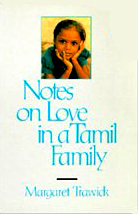
 *
Notes on Love in a Tamil Family *
Notes on Love in a Tamil Family
by
Margaret Trawick,
University of California Press, Berkeley, 1992
*
indicates link to
Amazon.com
bookshop on line
Winner of Ananda Kentish Coomaraswamy Book Prize, 1992
"Margaret Trawick�s study of anpu or love offers extraordinary
insight into how familial relationships in South India are expressed and
experienced. Her highly original study of an extended family establishes the
ideology of love as central to interpreting the tensions and shifting balances
between generations and genders. Demonstrating remarkable ease with a range of
topics in South Indian scholarship, she shows how anpu illuminates patterns in
Tamil poetics, theology, ritual life, cross-cousin marriage, and the raising of
children. The book�s engaging style intertwines vivid description,
self-disclosure and questioning, and critical analysis of earlier theory.
Trawick presents an understanding of culture as performed or constructed in the
interaction between informant and anthropologist, a refreshing addition to the
current critiques on ethnography. She skillfully weaves many strands into a
poetic text. Scholars familiar with South Asia will perhaps respond differently
to the multiple levels of this book, but all will admire its courage and
intelligence. Margaret Trawick treats the most powerful of all emotions, love,
with humanity."
[see also:
1.
Book Review by Avis Sri Jayantha at Sangam.org
2.
Review: An Ethnography of Love in a
Tamil Family by Sujata Sriram & Nandita Chaudhary
and
3.
Selected Writings
- Margaret Trawick
"...The central topic of this book-in Tamil, anpu, in English,
"love" is a feeling, and my approach to the study of this feeling has been
through feeling. I have tried throughout the course of my research and writing
to remain honest, clear-headed, and open-minded, and to follow the dictates of
reason and empirical observation in my descriptions and analyses of the events I
have sought to comprehend. But I have not attempted to be "objective" in the
common sense of this term. I have never pretended to be disinterested or
uninvolved in the lives of my informants, and I have never set my own feelings
aside. Only by heeding them have I been able to learn the lessons that I try, in
this volume, to pass on...
Now the first thing that this book is about is the way that
India both exceeds and shatters Western expectations, the way it both exceeded
and shattered mine. Of course there are the stereotypes: India is "more
spiritual" than the West, its people "impoverished," "non materialistic,"
"fatalistic," and "other-worldly," its society structured according to a "rigid
caste hierarchy," its women "repressed" and "submissive," its villagers
"tradition-bound" and "past-oriented," their behavior ordered by "rituals"
and constrained by "rules" of "purity" and "pollution." "
These words are not just products of popular Western fantasy.
Scholars and specialists in South Asian culture use them often. But one thing I
learned in India was that these words are just words, our words, to refer to
certain scattered events occurring in South Asia. The propositions they imply
are partial truths, half truths, and anyone going to India who expects all of
Indian life to confirm to them will find herself merely deluded and confused. It
would almost be better, I think, if we could abandon such words, all those words
that imply explanation and understanding of such a large place as India, at
least (those words whose referents are only scholarly abstractions, certainly
those words over which academic people alight). Alas, if you wish to address the
academic specialists, you must use them."
from the first chapter:
"More than a quarter of my life has passed since I began writing this book.
Its heart has stayed constant during this time, but its features have changed
and changed again as I have moved and taken it with me from one world to another
to another. It is beginning to look to me now as I look to myself, like a
beaten-up suitcase with a lot of stickers on it.
The story I tell in this starting chapter describes the events that led up to
my living with a South Indian Tamil family some years ago and to my writing
about them now. One or two pages are about my pre-India days and about what I
think led me to go to India in the first place. The rest of this chapter is
about some of the things I learned in India from Indians in particular, from one
person-about how what I learned from experience meshed or failed to mesh with
what I learned from books, and about how a Tamil poem, partially and for a brief
time, became my life.
A few stanzas of this poem are presented later in this chapter. These stanzas
are complex and much of what they refer to is foreign to people of this country,
so I offer an explication of them which is partly my own and partly that of the
man who taught them to me. You, reader, may find these poem-fragments dense and
strange, but don't for that reason ignore them, for in fact they are alive, and
they are stronger than they seem, clad as they are in my homespun translations.
Behind the translations and explications are the Tamil songs that are the reason
for this book. This book is built to hold them, and through it they may be heard
to echo by those who listen closely. They are the voices of people who lived
hundreds of years ago, but they are also the voices of people who live now. The
things I want you to know but haven't the power to say, these other voices will
tell you.
The remaining chapters of this book are about exactly what the title says,
love in a Tamil family, the family of the man who taught me the poem. 'These
chapters describe different aspects of Tamil family life that touch upon
love-kinship organization, childrearing, sexual relations, habits of speaking,
rules of behavior.
The central topic of this book-in Tamil, anpu, in English, "love" is a
feeling, and my approach to the study of this feeling has been through
feeling. I have tried throughout the course of my research and writing to
remain honest, clear-headed, and open-minded, and to follow the dictates of
reason and empirical observation in my descriptions and analyses of the
events I have sought to compprehend. But I have not attempted to be
"objective" in the common sense of this term. I have never pretended to be
disinterested or uninvolved in the lives of my informants, and I have never
set my own feelings aside. Only by heeding them have I been able to learn
the lessons that I try, in this volume, to pass on.
I was born in 1948. My father, a psychiatrist, spent the war as a naval
doctor in China and Okinawa, and he brought home paintings and tapestries of
landscapes, birds, horses, courtly lovers, heavens, earths, and hells. I lived
many hours of my childhood in those pictures. My mother's best friend from her
childhood in Los Angeles was Hisako Nishihara. After the bombing of Pearl
Harbor, Hisako's relatives were put in detention camps, though they were
American citizens. Both mother and Hisako loved the beauty of life forms. They
were honors students in bacteriology at UCLA. When I was about twelve I came
across mother's college notebooks, which she had saved, filled with pencil
drawings of microbes, each drawing precise and exquisite. Hisako became a
laboratory assistant. Mother became a medical secretary. Both of them married
their doctor-bosses at the end of the war and spent the remainder of their lives
as housewives.
I was raised in Kentucky, my father's native house. Mother never felt
completely happy there. One of her adulthood friends was Alene Dorsey, a black
woman from the tobacco- and pig-growing area outside of Louisville; Alene's
natal home had been a shack lined with newspaper. She wanted something better
for her family now, but the segregation laws in effect in Kentucky at that time
blocked her every effort. She was eighteen when she went to work for my mother,
put our household in order, and started helping to raise me. I think I was three
or four. I remember once listening to the song "My Old Kentucky Home" (�'tis
summer, the darkies are gay..") and asking Alene, "Are you a darkie?" and Alene
bursting into tears.
Mother spoke often of the stupidity of racism and xenophobia. She praised the
beauty of Japanese culture. When I went to college, I considered majoring in
Japanese, but didn't. Perhaps it was too cool and northern for me. I loved
biology, philosophy, religion, poetry, math, language. I didn't much like
people. I ended up majoring in anthropology, as a strange kind of compromise
between these various loves and as a concession to the species to which I
grudgingly owed allegiance. I thought that if I could learn to see human beings
as a part of nature, I might learn to love them better. I read the classics in
anthropology as they were assigned. Emile Durkheim's organic metaphor (society
is an organism) and Claude Levi-Strauss's structuralism (mythic thought is wild
thought, wild thought is as patterned and well-ordered as a wild plant)
delighted me. When it came time to choose an area for field research, I chose
India.
Like the Asian brides 1 had heard of, I devoted my life to India before I had
even met it. I went to graduate school in anthropology, determined to become a
specialist in India.
"You know," said an older woman anthropologist to me and my human husband,
Keith, "this will mean long periods of time away from home."
"We know," we answered eagerly, excitedly.
Unlike an Asian bride, I calculated that if my marriage with India got too
rough, I could always divorce myself from it. But I was wrong.
The college I went to was Harvard, but Keith was not a Harvard man. I never
liked Harvard men. I liked tough, working-class ones like Keith. My mother's
father was Irish, a worker in the steel mills of Pittsburgh from the age of
twelve. Mother idolized him. I was a populist to the core and a lover of the
underdog. Like a female coyote, if two males had ever battled for me (none ever
did) I would have gone with the loser.
I chose to do my field work in South India probably because, through, my
mother, I am Irish. In many ways, South India is to North India as Ireland is to
England. South India has been dominated politically and culturally by North
India for many centuries. Tamils in particular, the most populous of South
Indian ethnic groups (defined by the language they speak) take pride in their
identity and more than once in this century have attempted to establish a
separate Tamil nation. Also like the Irish, Tamils believe in strong sentiment:
rage, grief, compassion, affection, desire, laughter, and ecstasy are openly and
frequently displayed in the streets and courtyards of Tamil Nadu. And like the
Irish, Tamils value the gift of gab: fabulous conversationalists, storytellers,
singers, and poets abound among them.
Now the first thing that this book is about is the way that India both
exceeds and shatters Western expectations, the way it both exceeded and
shattered mine. Of course there are the stereotypes: India is "more spiritual"
than the West, its people "impoverished," "non materialistic," "fatalistic," and
"other-worldly," its society structured according to a "rigid caste hierarchy,"
its women "repressed" and "submissive," its villagers "tradition-bound" and
"past-oriented," their behavior ordered by "rituals" and constrained by "rules"
of "purity" and "pollution."
These words are not just products of popular Western fantasy. Scholars and
specialists in South Asian culture use them often. But one thing I learned in
India was that these words are just words, our words, to refer to certain
scattered events occurring in South Asia. The propositions they imply are
partial truths, half truths, and anyone going to India who expects all of Indian
life to confirm to them will find herself merely deluded and confused. It would
almost be better, I think, if we could abandon such words, all those words that
imply explanation and understanding of such a large place as India, at least
(those words whose referents are only scholarly abstractions, certainly those
words over which academic people alight). Alas, if you wish to address the
academic specialists, you must use them.
I have tried, anyway, in my own narrative not to lean on such words too much.
This has not been difficult, because they explain very little of what I
experienced in India. The women I knew there, for instance, were more aggressive
than me, more openly sexual than me, more free in their criticisms of their men
than me. Here in America I often get in trouble for arguing, losing my temper,
speaking my mind. But in Tamil Nadu, one of my woman friends, Anni, asked me
pointedly, "is it your habit to bow and defer to everyone?" My personality in
Tamil Nadu was no more sweet and obliging than it is in America; if anything, I
was more short-tempered there.
As for Anni, she was milder than many Tamil women I knew indeed, she was
known for her patient and loving nature. But when she accused me, through her
question, of excessive deference, she was not being sarcastic. Compared to her,
I was a little mouse. The notion of the repressed and submissive Indian woman
simply did not apply to the people among whom I lived-and yet in some ways it
did. Anni would not have been Anni without her fidelity to her men and her
ability to endure hardship for their sake, to do without while they did with.
She was proud of these qualities of hers and wore them fiercely. They entitled
her to speak freely and to walk with her head held high...."
|