|
TAMIL
NATION LIBRARY: Unfolding
Consciousness
* indicates
link to
Amazon.com
online bookshop
[see also
From Matter to Life to Mind: An Unfolding Consciousness ]
 "...In
modern times there is no lack of understanding of the fact man
is a social being and that 'No man is an Iland, intire of it
selfe' (John Dunne, 1571-1631). Hence there is no lack of
exhortation that he should love his neighbour - or at least not
to be nasty to him - and should treat him with tolerance,
compassion and understanding. At the same time, however, the
cultivation of self knowledge has fallen into virtually total
neglect, except, that is, where it is the object of active
suppression. That
you cannot love your neighbour, unless you love yourself; that
you cannot understand your neighbour unless you understand
yourself; that there can be no knowledge of the 'invisible
person' who is your neighbour except on the basis of self
knowledge - these fundamental truths have been forgotten even by
many of the professionals in the established religions.
Exhortations, consequently, cannot possibly have any effect;
genuine understanding of one's neighbour is replaced by
sentimentality,
which ofcourse crumbles into nothingness as soon as self
interest is aroused... Anyone who goes openly on a journey
into the interior, who withdraws from the ceaseless agitation of
everyday life and pursues the kind of training - satipatthana,
yoga, Jesus Prayer, or something similar - without which genuine
self knowledge cannot be obtained, is accused of selfishness and
of turning his back on social duties. Meanwhile, world
crisis multiply and everybody deplores the shortage, or even
total lack, of 'wise' men or women, unselfish leaders,
trustworthy counselors etc. It is hardly rational to expect
such high qualities from people who have never done any inner
work and would not even understand what was meant by the words..." "...In
modern times there is no lack of understanding of the fact man
is a social being and that 'No man is an Iland, intire of it
selfe' (John Dunne, 1571-1631). Hence there is no lack of
exhortation that he should love his neighbour - or at least not
to be nasty to him - and should treat him with tolerance,
compassion and understanding. At the same time, however, the
cultivation of self knowledge has fallen into virtually total
neglect, except, that is, where it is the object of active
suppression. That
you cannot love your neighbour, unless you love yourself; that
you cannot understand your neighbour unless you understand
yourself; that there can be no knowledge of the 'invisible
person' who is your neighbour except on the basis of self
knowledge - these fundamental truths have been forgotten even by
many of the professionals in the established religions.
Exhortations, consequently, cannot possibly have any effect;
genuine understanding of one's neighbour is replaced by
sentimentality,
which ofcourse crumbles into nothingness as soon as self
interest is aroused... Anyone who goes openly on a journey
into the interior, who withdraws from the ceaseless agitation of
everyday life and pursues the kind of training - satipatthana,
yoga, Jesus Prayer, or something similar - without which genuine
self knowledge cannot be obtained, is accused of selfishness and
of turning his back on social duties. Meanwhile, world
crisis multiply and everybody deplores the shortage, or even
total lack, of 'wise' men or women, unselfish leaders,
trustworthy counselors etc. It is hardly rational to expect
such high qualities from people who have never done any inner
work and would not even understand what was meant by the words..."
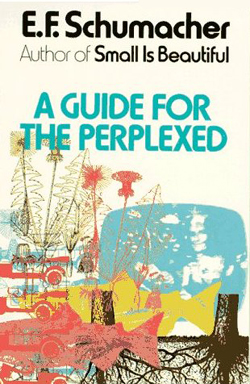
Excerpted from A Guide for the Perplexed by E. F. Schumacher.
Copyright � 1978. All rights reserved
Chapter One
On a visit to Leningrad some years ago. I consulted a map to find
out where I was, but I could not make it out. From where I stood, I
could see several enormous churches, yet there was no trace of them
on my map. When finally an interpreter came to help me, he said: "We
don't show churches on our maps." Contradicting him, I pointed to
one that was very clearly marked. "That is a museum," he said, "not
what we call a 'living church.' It is only the 'living churches' we
don't show.
It then occurred to me that this was not the first time I had been
given a map which failed to show many things I could see right in
front of my eyes. All through school and university I had been given
maps of life and knowledge on which there was hardly a trace of many
of the things that I most cared about and that seemed to me to be of
the greatest possible importance to the conduct of my life. I
remembered that for many years my perplexity had been complete; and
no interpreter had come along to help me. It remained complete until
I ceased to suspect the sanity of my perceptions and began, instead,
to suspect the, soundness of the maps.
The maps I was given advised me that virtually all my ancestors,
until quite recently, had been rather pathetic illusionists who
conducted their lives on the basis of irrational beliefs and absurd
superstitions. Even illustrious scientists, like Johannes Kepler or
Isaac, Newton, apparently spent most of their time and energy on
nonsensical studies of non existing things. Enormous amounts of
hard-earned wealth had been squandered throughout history to the
honor and glory of imaginary deities, not only by my European
forebears, but by all peoples, in all parts of the world, at all
times. Everywhere thousands of seemingly healthy men and women had
subjected themselves to utterly meaningless restrictions, like
voluntary fasting; tormented themselves by celibacy; wasted their
time on pilgrimages, fantastic rituals, reiterated prayers, and so
forth; turning their backs on reality-and some do it even in this
enlightened age-all for nothing, out of ignorance and stupidity;
none ofit to be taken seriously today, except of course as museum
pieces. From what a history of error we had emerged! What a history
of taking for real what every modern child knew to be totally unreal
and imaginary! Our entire past, until quite recently, was today fit
only for museums, where people could satisfy their curiosity about
the oddity and incompetence of earlier generations. What our
ancestors had written, also, was in the main fit only for storage in
libraries, where historians and other specialists could " study
these relics and write books about them, the knowledge of the past
being considered interesting and occasionally thrilling but of no
particular value for learning to cope with the problems of the
present.
All, this and many other similar things I was taught at school and
university, although not in so many words, not plainly and frankly.
It would not do to call a spade a spade. Ancestors had to be treated
with respect: they could not help their backwardness; they tried
hard and sometimes even got quite near the truth in a haphazard sort
of way. Their preoccupation with religion was just one of their many
signs of underdevelopment, not surprising, in people who had not yet
come of age. Even today, of course, there remained some interest in
religion, which legitimized that of earlier times. It was still
permissible, on suitable occasions, to refer to God the Creator,
although every educated person knew that there was not really a God,
certainly not one capable of creating anything, and that the things
around us had come into existence by a process of mindless
evolution, that is, by chance and natural selection. Our ancestors,
unfortunately, did not know about evolution, and so they invented
all these fanciful myths.
The maps of real knowledge, designed for real life, showed nothing
except things which allegedly could be proved to exist. The first
principle of the philosophical mapmakers seemed to be "If in doubt,
leave it out," or put it into a museum. It occurred to me, however,
that the question of what constitutes proof was a very subtle and
difficult one. Would it not be wiser to turn the principle into its
opposite and say: "If in doubt, show it prominently"? After all,
matters that are beyond doubt are, in a sense, dead; they constitute
no challenge to the living.
To accept anything as true means to incur the risk of error. If I
limit myself to knowledge that I consider true beyond doubt, I
minimize the risk of error, but at the same time I maximize the risk
of missing out on what may be the subtlest, most important, and most
rewarding things in life. Saint Thomas Aquinas, following Aristotle,
taught that "The slenderest knowledge that may be obtained of the
highest things is more desirable than the most certain knowledge
obtained of lesser things. "Slender" knowledge is here put in
opposition to "certain" knowledge, and indicates uncertainty. Maybe
it is necessarily so that the higher things cannot be known with the
same degree of certainty as can the lesser things, in which case it
would be a very great loss indeed if knowledge were limited to
things beyond the possibility of doubt.
The philosophical maps with which I was supplied at school and
university did not merely, like the map of Leningrad, fail to show
"living churches"; they also failed to show large unorthodox"
sections of both. theory and practice in medicine, agriculture,
psychology, and the social and political sciences, not to mention
art and so-called occult or paranormal phenomena, the mere mention
of which was considered to be a sign of mental deficiency."
|