|
TAMIL
NATION LIBRARY: Politics
-
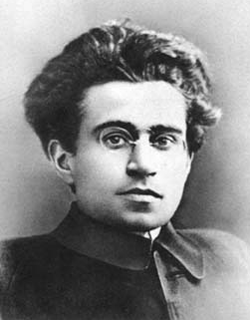
Gramsci,
James Joll, 1977, Fontana Modern Masters
 [see
also
1.
An Introduction to Gramsci's Life and Thought - Frank
Rosengarten
Antonio Gramsci was born on January 22, 1891 in Ales in the
province of Cagliari in Sardinia... In the spring of 1919,
Gramsci, founded L'Ordine Nuovo: Rassegna Settimanale di
Cultura Socialista (The New Order: A Weekly Review of Socialist
Culture), which became an influential periodical... On the
evening of November 8, 1926, Gramsci was arrested in Rome and,
in accordance with a series of "Exceptional Laws" enacted by the
fascist-dominated Italian legislature, committed to solitary
confinement at the Regina Coeli prison ...This began a ten-year
odyssey, marked by almost constant physical and psychic pain as
a result of a prison experience that culminated, on April 27,
1937, in his death from a cerebral hemorrhage. No doubt the
stroke that killed him was but the final outcome of years and
years of illnesses that were never properly treated in prison...
Gramsci's intellectual work in prison did not emerge in the
light of day until several years after World War II... By the
1950s, and then with increasing frequency and intensity, his
prison writings attracted interest and critical commentary in a
host of countries, not only in the West but in the so-called
third world as well. Some of his terminology became household
words on the left, the most important of which, and the most
complex, is the term "hegemony" as he used it in his writings...
Also extremely pertinent, both theoretically and practically,
were such terms and phrases as "organic
intellectual"... and [see
also
1.
An Introduction to Gramsci's Life and Thought - Frank
Rosengarten
Antonio Gramsci was born on January 22, 1891 in Ales in the
province of Cagliari in Sardinia... In the spring of 1919,
Gramsci, founded L'Ordine Nuovo: Rassegna Settimanale di
Cultura Socialista (The New Order: A Weekly Review of Socialist
Culture), which became an influential periodical... On the
evening of November 8, 1926, Gramsci was arrested in Rome and,
in accordance with a series of "Exceptional Laws" enacted by the
fascist-dominated Italian legislature, committed to solitary
confinement at the Regina Coeli prison ...This began a ten-year
odyssey, marked by almost constant physical and psychic pain as
a result of a prison experience that culminated, on April 27,
1937, in his death from a cerebral hemorrhage. No doubt the
stroke that killed him was but the final outcome of years and
years of illnesses that were never properly treated in prison...
Gramsci's intellectual work in prison did not emerge in the
light of day until several years after World War II... By the
1950s, and then with increasing frequency and intensity, his
prison writings attracted interest and critical commentary in a
host of countries, not only in the West but in the so-called
third world as well. Some of his terminology became household
words on the left, the most important of which, and the most
complex, is the term "hegemony" as he used it in his writings...
Also extremely pertinent, both theoretically and practically,
were such terms and phrases as "organic
intellectual"... and
2.
Antonio Gramsci - Monica Stillo ]
 From
the back flap: 'Who has really attempted to
follow up the ' explorations of Marx and Engels? I can only think of
Gramsci.' Of a man who died at the age of forty-six leaving only a number of
newspaper articles and a collection of often fragmentary and disjointed
notebooks, and who had spent the last ten years of his life as Mussolini's
prisoner, this claim by Louis Althusser, the French Marxist, is indeed
remarkable. But in this study James Joll demonstrates why ; Antonio Gramsci
(1891-1937) has become not only ' a significant contemporary guide to
revolutionary action, but also a representative intellectual hero of our
time. Quoting extensively from Gramsci's own writings - the Prison
Notebooks, the Letters from Prison, the political journalism -James Joll
integrates the twin aspects of his achievement: Gramsci the active '
politician, of the Turin Factory Council Movement, the formation of the
Italian Communist Party, the opposition to the Fascists; and Gramsci the
Marxist ideologue, of historical materialism and `hegemony,' 'active' and
'passive' revolution, 'traditional' and 'organic' intellectuals, `democratic
centralism' and the 'Philosophy of praxis.' From
the back flap: 'Who has really attempted to
follow up the ' explorations of Marx and Engels? I can only think of
Gramsci.' Of a man who died at the age of forty-six leaving only a number of
newspaper articles and a collection of often fragmentary and disjointed
notebooks, and who had spent the last ten years of his life as Mussolini's
prisoner, this claim by Louis Althusser, the French Marxist, is indeed
remarkable. But in this study James Joll demonstrates why ; Antonio Gramsci
(1891-1937) has become not only ' a significant contemporary guide to
revolutionary action, but also a representative intellectual hero of our
time. Quoting extensively from Gramsci's own writings - the Prison
Notebooks, the Letters from Prison, the political journalism -James Joll
integrates the twin aspects of his achievement: Gramsci the active '
politician, of the Turin Factory Council Movement, the formation of the
Italian Communist Party, the opposition to the Fascists; and Gramsci the
Marxist ideologue, of historical materialism and `hegemony,' 'active' and
'passive' revolution, 'traditional' and 'organic' intellectuals, `democratic
centralism' and the 'Philosophy of praxis.'
Gramsci on the Organic
Intellectual:
- "Man can affect his own development and
that of his surroundings only so far as he has a clear view of what
the possibilities of action open to him are. To do this he has to
understand the historical situation in which he finds himself: and
once he does this, then he can play an active part in modifying that
situation. The man of action is the true philosopher: and the
philosopher must of necessity be a man of action.
- 'Man does not enter into relations with
the natural world just by being himself part of it but actively by
means of work and technique. Further, these relations are not
mechanical. They are active and conscious... Each of us changes
himself, modifies himself to the extent that he changes and modifies
the complex relations of which he is the heart. In this sense,
the real
philosopher is, and cannot be other than the politician,
the active man who modifies his environment, understanding by
environment the ensemble of relations which each one of us enters to
take part in it. If one's individuality is the
ensemble of these relations, to create one's personality means to
acquire consciousness of them, and to modify one's own personality
means to modify the ensemble of these relations.'
- "Each man ... carries on some form of intellectual activity,
that is, he is a 'philosopher', ...he participates in a particular
conception of the world, has a conscious line of moral conduct and
therefore contributes to sustain a conception of the world or to
modify it, that is, to bring into being new modes of thought... All
men are intellectuals . . . but not all men have in society the
function of intellectuals. Thus, because it can happen that everyone
at some time fries a couple of eggs or sews up a tear in his jacket,
we do not necessarily say that everyone is a cook or a tailor."
- "...as time goes on, intellectual groups. which
once performed an organic function, lose their links with a
particular class and 'put themselves forward as autonomous and
independent of the dominant social group... The whole of idealist
philosophy can easily be defined as the expression of that social
Utopia by which the intellectuals think of themselves as
"independent", autonomous, endowed with a character of their own.'
But this feeling of independence is, of course, an illusion. Croce
and other liberal idealist philosophers are inevitably linked to the
class-structure of the society in which they live, and are as much
bound to the industrialists � the ruling class of the liberal
society of their day of whose liberalism they are the spokesmen � as
the Catholic priesthood was to the feudal aristocracy..."
- "...The error of the intellectual consists
in believing that it is possible to know without understanding and
especially without feeling and passion... that the intellectual can
be an intellectual if he is distinct and detached from the
people-nation, without feeling the elemental passions of the people,
understanding them and thus explaining them in a particular
historical situation, connecting them dialectically to the laws of
history, to a superior conception of the world...
History and politics cannot be made without passion,
without this emotional bond between intellectuals and the
people-nation. In the absence of such a bond the relations between
intellectuals and the people-nation are reduced to contacts of a
purely bureaucratic, formal kind; the intellectuals become a caste
or a priesthood..."
- "The mode of being of the new intellectuals can no longer
consist in eloquence, which is an exterior and momentary mover of
feelings and passions, but in active participation in practical
life, as constructor, organizer, 'permanent persuader' and not just
a simple orator.."
- "One has, to struggle against . . . the false heroisms and
pseudo aristocracies and stimulate the formation of homogeneous,
compact social blocs, which will give birth to their own
intellectuals, their own commandos, their own vanguard - who in turn
will react upon those blocs in order to develop them. "
-
"The position of the philosophy of praxis is the antithesis of that
of catholicism. It does not tend to leave the `simple' in their
primitive philosophy of common sense, but rather to lead them to a
higher conception of life. If it affirms the need for contact
between intellectuals and 'simple' it is not in order to restrict
scientific activity and preserve unity at the low level of the
masses, but precisely in order to construct an intellectual-moral
bloc which can make politically possible the intellectual progress
of the mass and not only of small intellectual groups..."
|