|
|
"To us
all towns are one, all men our kin. |


| Home | Whats New | Trans State Nation | One World | Unfolding Consciousness | Comments | Search |
|
|
"To us
all towns are one, all men our kin. |
| Home | Whats New | Trans State Nation | One World | Unfolding Consciousness | Comments | Search |
Home >
Tamilnation Library >
International Relations > Noam
Chomsky Failed States TAMIL NATION
LIBRARY: International Relations "..Among the most elementary of moral truisms is the
principle of universality: we must apply to ourselves the same standards we
do to others, if not more stringent ones. It is a remarkable comment on
Western intellectual culture that this principle is so often ignored and, if
occasionally mentioned, condemned as outrageous... Reigning doctrines are
often called a "double standard." The term is misleading. It is more
accurate to describe them as a single standard, clear and unmistakable, the
standard that Adam Smith called the "vile maxim of the masters of mankind: .
. . All for ourselves, and nothing for other people." Much has changed since
his day, but the vile maxim flourishes..." From the Inside Book Cover
Forceful, lucid and meticulously documented,
Failed States offers a comprehensive analysis of a global superpower that
has long claimed the right to reshape other nations. It topples governments
it deems illegitimate, invades states judged to threaten its interests, and
imposes sanctions on regimes it opposes - while its own democratic
institutions are in severe crisis, and its policies and practices recklessly
place the world on the brink of nuclear and environmental disaster.
Systematically dismantling the United States' position as the world's
arbiter of democracy, Failed States is Chomsky's most focused - and urgent -
critique to date. From Chapter 1 - Stark, Dreadful, Inescapable... "Half a century ago, in July 1955, Bertrand Russell and Albert Einstein
issued an extraordinary appeal to the people of the world, asking them "to
set aside" the strong feelings they have about many issues and to consider
themselves "only as members of a biological species which has had a
remarkable history, and whose disappearance none of us can desire." The
choice facing the world is "stark and dreadful and inescapable: shall we put
an end to the human race; or shall mankind renounce war?" The world has
not renounced war. Quite the contrary. By now, the world's hegemonic power
accords itself the right to wage war at will, under a doctrine of
"anticipatory self-defense" with unstated bounds. International law,
treaties, and rules of world order are sternly imposed on others with much
self-righteous posturing, but dismissed as irrelevant for the United
States�a long-standing practice, driven to new depths by the Reagan and Bush
II administrations. Among the most elementary of moral truisms is the principle of
universality: we must apply to ourselves the same standards we do to
others, if not more stringent ones. It is a remarkable comment on
Western intellectual culture that this principle is so often ignored
and, if occasionally mentioned, condemned as outrageous. This is
particularly shameful on the part of those who flaunt their Christian
piety, and therefore have presumably at least heard of the definition of
the hypocrite in the Gospels. Relying solely on elevated rhetoric, commentators urge us to appreciate
the sincerity of the professions of "moral clarity" and "idealism" by the
political leadership. To take just one of innumerable examples, the
well-known scholar Philip Zelikow deduces "the new centrality of moral
principles" in the Bush administration from "the administration's rhetoric"
and a single fact: the proposal to increase development aid�to a fraction of
that provided by other rich countries relative to the size of their
economies. The rhetoric is indeed impressive. "I carry this commitment in
my soul," the president declared in March 2002 as he created the Millennium
Challenge Corporation to boost funding to combat poverty in the developing
world. In 2005, the corporation erased the statement from its website after
the Bush administration reduced its projected budget by billions of dollars.
Its head resigned "after failing to get the program moving," economist
Jeffrey Sachs writes, having "disbursed almost nothing" of the $10 billion
originally promised.
Meanwhile, Bush rejected a call from Prime Minister Tony Blair to double
aid to Africa, and expressed willingness to join other industrial countries
in cutting unpayable African debt only if aid was correspondingly reduced,
moves that amount to "a death sentence for more than 6 million Africans a
year who die of preventable and treatable causes," Sachs notes.
When Bush's new ambassador, John Bolton, arrived at the United Nations
shortly before its 2005 summit, he at once demanded the elimination of "all
occurrences of the phrase 'millennium development goals'" from the document
that had been carefully prepared after long negotiations to deal with
"poverty, sexual discrimination, hunger, primary education, child mortality,
maternal health, the environment and disease."
Rhetoric is always uplifting, and we are enjoined to admire the sincerity
of those who produce it, even when they act in ways that recall Alexis de
Tocqueville's observation that the United States was able "to exterminate
the Indian race . . . without violating a single great principle of morality
in the eyes of the world." Reigning doctrines are often called a "double standard." The term
is misleading. It is more accurate to describe them as a single
standard, clear and unmistakable, the standard that Adam Smith called
the "vile maxim of the masters of mankind: . . . All for ourselves, and
nothing for other people." Much has changed since his day, but the vile
maxim flourishes. The single standard is so deeply entrenched
that it is beyond awareness. Take "terror," the leading topic of the
day. There is a straightforward single standard: their terror against us
and our clients is the ultimate evil, while our terror against them does
not exist�or, if it does, is entirely appropriate.
One clear illustration is Washington's terrorist war against Nicaragua in
the 1980s, an uncontroversial case, at least for those who believe that the
International Court of Justice and the UN Security Council�both of which
condemned the United States�have some standing on such matters. The State
Department confirmed that the US-run forces attacking Nicaragua from US
bases in Honduras had been authorized to attack "soft targets," that is,
undefended civilian targets.
A protest by Americas Watch elicited a sharp response by a respected
spokesman of "the left," New Republic editor Michael Kinsley, who patiently
explained that terrorist attacks on civilian targets should be evaluated on
pragmatic grounds: a "sensible policy [should] meet the test of cost-benefit
analysis" of "the amount of blood and misery that will be poured in, and the
likelihood that democracy will emerge at the other end"�"democracy" as
defined by US elites, of course. The assumptions remain beyond challenge,
even perception. In 2005, the press reported that the Bush administration
was facing a serious "dilemma": Venezuela was seeking extradition of one of
the most notorious Latin American terrorists, Luis Posada Carriles, to face
charges for the bombing of a Cubana airliner, killing seventy-three people.
The charges were credible, but there was a real difficulty.
After Posada escaped from a Venezuelan prison, he "was hired by
US covert operatives to direct the resupply operation for the
Nicaraguan contras from El Salvador"�that is, to play a prominent
role in Washington's terrorist war against Nicaragua. Hence the
dilemma: "Extraditing him for trial could send a worrisome signal to
covert foreign agents that they cannot count on unconditional
protection from the US government, and it could expose the CIA to
embarrassing public disclosures from a former operative." A
virtual entry requirement for the society of respectable
intellectuals is the failure to perceive that there might be some
slight problem here. At the same time that Venezuela was
pressing its appeal, overwhelming majorities in the Senate and House passed
a bill barring US aid to countries that refuse requests for extradition�US
requests, that is. Washington's regular refusal to honor requests from other
countries seeking extradition of leading terrorists passed without comment,
though some concern was voiced over the possibility that the bill
theoretically might bar aid to Israel because of its refusal to extradite a
man charged with "a brutal 1997 murder in Maryland who had fled to Israel
and claimed citizenship through his father." At least temporarily, the
Posada dilemma was, thankfully, resolved by the courts, which rejected
Venezuela's appeal, in violation of a US-Venezuelan extradition treaty. A
day later, the head of the FBI, Robert Mueller, urged Europe to speed US
demands for extradition: "We are always looking to see how we can make the
extradition process go faster," he said. "We think we owe it to the victims
of terrorism to see to it that justice is done efficiently and effectively."
At the Ibero-American Summit shortly after, the leaders of Spain and the
Latin American countries "backed Venezuela's efforts to have [Posada]
extradited from the to face trial" for the Cubana airliner bombing, but then
after the US embassy protested the action. Washington or merely ignores,
extradition requests for terrorists. the tool of presidential pardons for
acceptable crimes. Bush pardoned Orlando Bosch, a notorious international
terrorist and associate of Posada, despite objections by the Justice
Department, which urged that he be deported as a threat to national
security. Bosch resides safely in the United States, perhaps to be joined by
Posada, in communities that continue to serve as the base for international
terrorism. No one would be so vulgar as to suggest that the United States
should be subject to bombing and invasion in accord with the Bush II
doctrine that "those who harbor terrorists are as guilty as the terrorists
themselves," announced when the government in Afghanistan asked for evidence
before handing over people the United States accused of terrorism (without
credible grounds, as Robert Mueller later acknowledged) The Bush doctrine
has "already become a defacto rule of international relations," writes
Harvard international relations specialist Graham Allison: it revokes "the
sovereignty of states that provide sanctuary to terrorists." Some states,
that is, thanks to the exemption provided by the single standard. The
single standard also extends to weapons and other means of destruction. US
military expenditures approximate those of the rest of the world combined,
while arms sales by thirty-eight North American companies (one of which is
based in Canada) account for more than 60 percent of the world total.
Furthermore, for the world dominant power, the means of destruction have few
limits. Articulating what those who wish to see already knew, the prominent
Israeli military analyst Reuven Pedatzur writes that "in the era of a
single, ruthless superpower, whose leadership intends to shape the world
according to its own forceful world view, nuclear weapons have become an
attractive instrument for waging wars, even against enemies that do not
possess nuclear arms."
When asked why "should the United States spend massively on arms and
China refrain?" Max Boot, a senior fellow at the Council on Foreign
Relations, provided a simple answer: "we guarantee the security of the
world, protect our allies, keep critical sea-lanes open and lead the war on
terror," while China threatens others and "could ignite an arms
race"�actions inconceivable for the United States.
Surely no one but a crazed "conspiracy theorist" might mention that the
United States controls sea-lanes in pursuit of US foreign policy objectives,
hardly for the benefit of all, or that much of the world regards Washington
(particularly since the beginning of the Bush II presidency) as the leading
threat to world security. Recent global polls reveal that France is "most
widely seen as having a positive influence in the world," alongside Europe
generally and China, while "the countries most widely viewed as having a
negative influence are the US and Russia." But again there is a simple
explanation.
The polls just show that the world is wrong. It's easy to understand why.
As Boot has explained elsewhere, Europe has "often been driven by avarice"
and the "cynical Europeans" cannot comprehend the "strain of idealism" that
animates US foreign policy. "After 200 years, Europe still hasn't figured
out what makes America tick." "
* indicates link to
Amazon.com
online bookshop
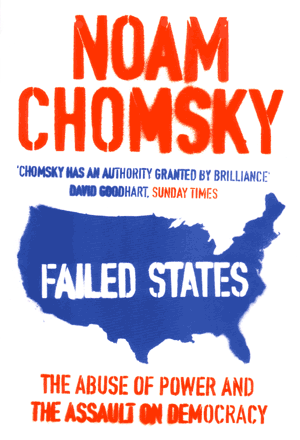
The United States has repeatedly asserted its right to use military
force against 'failed states' around the globe. In this much-anticipated
follow-up to his international bestseller Hegemony or Survival, Noam Chomsky
turns the tables, showing how the United States itself shares features with
other failed states - and therefore is increasingly a danger to its own
people and to the world.
