|
TAMIL
NATION LIBRARY: History & Geography
* indicates link to
Amazon.com
online bookshop
|
|
1 |
|
Dravidian movement, Tamil Nadu,
Tamil language
|
|
|
19 |
|
Sanskritic, Brahmanical,
Indo-Aryan
|
|
|
35 |
|
Muruga, Telugu, Chera Nadu
|
|
|
44 |
|
Tamilakam, Tamil language,
Kannagi
|
|
|
57 |
|
Dravidian movement, Brahmin,
M.G. Ramachandran
|
|
|
72 |
|
|
94 |
|
mother goddess, amman goddesses,
panchayat
|
|
|
134 |
|
Dravidian languages, Backward
Classes, Nadars
|
|
Labbay, amman, Vanniar
|
|
|
144 |
|
Jati, culture of India, Tamil
culture
|
|
|
 Jacob
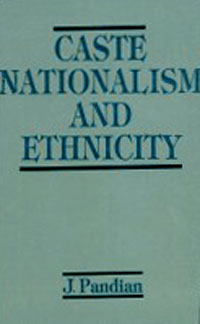
Pandian's book is an important contribution to further our
understanding of the Tamil collective identity. That which
follows is taken from the conclusion: Jacob
Pandian's book is an important contribution to further our
understanding of the Tamil collective identity. That which
follows is taken from the conclusion:
".... in defining ethnicity it is necessary to make a distinction between the
symbols of cultural boundaries that are transmitted from one generation to the
next, and the use of these symbols - the explanations and interpretations of
these symbols in the construction of group or ethnic identity.....
People use the symbols of cultural boundaries selectively in the development of
group or ethnic identity... The individual "rewrites" his biography depending on
the context in which he deploys the symbols, and depending on how and why he
defines a particular manner he adds to or alters the meaning of the symbols to
his advantage. The individual may also become an "exemplary symbol" or "role
model" for others to emulate...
Any trait, biological or cultural, can become an emblem of collective identity.
Biological, linguistic, religious and political traits often are identified by
the believers as denoting their distinctiveness. The existence and persistence
of these denotations are, however, sustained by the connotations - the meanings
embodied in the symbols of cultural boundary...
Among the Tamils, Tamil
language is the emblem of Tamil ethnic identity. ...although "language
constitutes the single most characteristic feature of a separate ethnic
identity...ethnicity is frequently related more to the symbol
of a separate language than to its actual use by all members of a group."
Tamil language functions as the emblem of Tamil identity because of the
existence of the various symbols of boundaries in Tamil culture.
..... it is the use of the symbols of
Chenthamil,
karppu, and
Tamilakam
which enables the denotation of Tamil language as the emblem of Tamil collective
identity. Chenthamil and karppu are
religious symbols,
and are evocative of female imageries. These can be used, and used
interchangeably, and both represent purity/chastity as a sacred principle of the
Tamils. Tamil women are believed, in relation to the symbol of karppu, to be
endowed with sacred power, and are divinized through the imageries of
"goddesses" such as
Kannagi who had the power to render justice in the political arena. Kannagi
not only transformed the religious symbol, but also resolved in her life and
action the opposition between the religious/feminine and political/masculine
symbols, and she became a role model.
Both men and women could do what Kannagi had done. Men could attain purity, and
women could attain
political justice. But purity requires constant protection, and men are
believed to provide such a protection. Unless men safeguard the purity of women
and the purity of Tamil language, both the language and Tamil women would cease
to be chaste and lose their sacred power, resulting in men losing the political
power to protect their families.
Self-immolation
by men in the 1960's when the Hindi language was "imposed" in Tamil Nadu was a
cultural response, based on the above symbolic logic.
The efforts on the part of the leaders of the Dravidian movement to
attain political autonomy for Tamil Nadu also was a cultural response, based
on the same symbolic logic.The leaders and followers of the Dravidian
movement transformed and synthesized the political and religious symbols of
cultural boundaries: the symbols were simultaneously religious and
political, and
Kannagi
gained importance as a religious as well as a political metaphor.
.....language is not the sole emblem of collective identity among the
Tamils. The Tamils are divided into several jati groups, each group having
distinctive ritual status and political power. The emblems which denote or
identify ritual status and political power are jati name and jati title,
respectively.
Three symbols of cultural boundaries (nadu veadu, amman and panchayat) are
involved in the formulation of jati identity, and in the representation of such
an identity as ritual or political emblems. Jati identity has both ritual and
political dimensions: jati names are ritual emblems which represent a group's
sacredness with reference to occupational purity, performance of certain
purificatory rituals, etc.; jati titles are political emblems which represent a
group's corporate power and/or politico-economic dominance.
Jati titles (political emblems of jati identity) are rooted in the beliefs and
practices associated with nadu veadu rituals. It is the symbol of nadu veadu
which enables a child to internalize the meaning of ritual boundaries. Notions
of temporary and permanent pollution as well as connotations of hierarchy in
relation to purity and pollution are represented in the symbol of nadu veadu.
Nadu veadu is also a symbol of the ritual privileges and prerogatives of a
household, and by extension, of a jati group.
The symbol of amman is the pre-eminent boundary of health: the symbol is used to
conceptualize personal and group health, good or bad. Amman, as the goddess,
provides the self and the group prolection, and also punishes; when worshipped
with a particular name and a particular ritual, she is a personal or group deity
and represents a combination of ritual and political boundedness of a jati group
or village territory ... Amman is also linked with nadu veadu rituals: it is the
woman of the household who is the sacred keeper of nadu veadu, sharing in the
attributes of the amman (and vice versa).
Amman is transformed from a religious to a political symbol in its use, and it
is not uncommon to fuse the domains and meanings of experience embodied in all
the three symbols. Amman can be viewed as the "master symbol" of the Tamil
village, and can be interpreted as the core of other symbols of
boundary-maintenance in Tamil culture.
Amman links the literary and village traditions and plays a central role in the
formulation of identity at both personal and group levels.
In sum, the Tamils use the symbols of
Tamilakam, Panchayat,
Chenthamil, Amman,
Nadu
Veadu and
Karppu in the conceptualization of collective identity. Some of these
symbols are directly related to jati group identity and others to Tamil
ethnic identity. But jati and Tamil ethnic identities are not opposed;
in fact, both jati and Tamil ethnic identities have common epistemological
roots, although Tamil language serves as the emblem of Tamil identity and
distinctive ritual/political emblems represent jati identity...
The symbol of Tamilakam in the literary tradition, and the symbol of
Panchayat in the village tradition connote territorial protection, corporate
authority, external-rational action. The symbols of Chenthamil and Karppu in the
literary tradition, and the symbols of Amman and Nadu Veadu in the village
tradition connote spiritual power, ritual purity/pollution, self, life, and
internal-emotional content The emblems which denote Tamil and jati identities
derive their legitimacy from these symbols.
..... it is necessary to make a distinction between ethnicity and ethnic
identity systems. Fundamental to this distinction is the fact that ethnicity is
a conglomeration of religious and political symbols that represent cultural
boundaries; the symbols are used selectively in the formulation of ethnic
identity systems, vary in their use in time and context, and differ in their
significance to the believers.
Ethnic systems arise from the self-conscious, organized use of ethnicity
to conceptualise self and/or collective identity. This selfconscious, organized
use of ethnicity may be characterized as identity summation. Individuals seek
consistency and coherence in their formulation of identity, but ethnicity qua
ethnicity does not have systemic consistency or coherence.
Within the same cultural tradition, a number of political and religious symbols
of greater or lesser importance exist, and some of these have more continuity
and have greater relevance as representing cultural boundaries. It is not
necessary for these symbols to be interrelated as a systemic whole. It is true
that these symbols often fuse each other's meanings and are transformed to
convey a collective or synthetic meaning; but the fusion, transformation and
synthesis occur in their use to conceptualise identity. We can say that the
symbols of cultural boundaries are like books in a library: an individual may
organize his knowledge through a selective reading of books.
To the question, "What is your group identity?" a Tamil may answer
by identifying his jati title or jati name, his language, occupation,
religious or political affiliation. Depending on the context and who the
questioner is, the answers would vary.
An individual has a coherent system of self and group identity but what this
system does is to enable the individual to employ and deploy multiple identities
in his lifetime and in different experiential contexts. In other words, there is
no set pattern of identities that remain static. The individual knows what
"appropriate" identity to dramatize, and knows how to respond to the
dramatisation of the "appropriate" identity by others.
This knowing comes from the internalization of the symbols of cultural
boundary, and their significance comes from their use; their use also verifies
the validity of the symbols. This is what I have called identity summation.
There is the selective use and the cumulative verification-validation of the
symbols and it is conceivable that an individual may accumulate some significant
symbols, and others will know how to interact with him, giving priority to or
emphasizing the use of those particular symbols.
In Tamil culture,
it is probably not very common to have all six symbols of cultural boundary
combined equally by every Tamil in a way that enables us to state, "This is
Tamil ethnic identity."
Some may give more importance to Western or Islamic values than to jati
values, and some may decry "Tamil
nationalism" as harmful; but even these individuals "know" how and when
to use the symbols of cultural boundary. Furthermore, the use of a single
symbol may fuse the meanings of the other symbols, and although an
individual may not acknowledge the use of the other symbols, the users can
comprehend their collective identities.
In the conception of self or collective identity, the systemic aspect, namely,
coherence and consistency, is frequently breached or eroded. Internal
experiences of individuals and groups as well as their encounters with
external factors make it necessary to generate new symbols or modify the old
symbols of cultural boundary. Again, by using the analogy of the library, we
can see how new books are constantly written to make the past relevant to
the present...."
|