[see also
One Hundred Tamils of 20th Century - S.Sivanayagam]
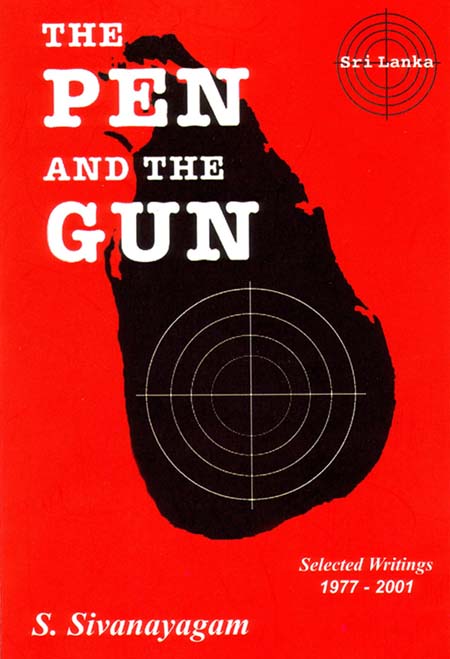
Book Note
by
Sachi Sri Kantha
- This book mainly consists of 80 editorials the author had penned
between 1977 and 2000, for four journals; Saturday Review, Tamil Information
Magazine, Tamil Nation and Hot Spring. It also includes a few tracts
and elegies. Of the tracts, Sivanayagam�s �Open
Letter to the American Ambassador in Sri Lanka�, dated March 11, 2001,
is a memorable one. Though it was addressed to Mr.Ashley Wills, the
then American ambassador in Colombo, its text seems timeless in its
appeal. Among the elegies, those describing the activities and services of
educator Handy Perinbanayagam,
Senator S.Nadesan, attorney
K.Kanthasamy,
journalist
Rita Sebastian,
Professor
Alfred Jeyaratnam
Wilson and
Professor Christie Jeyaratnam Eliezer are meritorious.
Foreword by
Brian Senewiratne, 2001
It is an honour for me, a Sinhalese, to be invited to write a Foreword to
a book on the problems facing the Tamil people in Sri Lanka. I hope that my
doing so is not a kiss of death to the book! Siva appreciated this risk but
wrote to me with characteristic defiance, "Damn those who refuse to go
through the book because Brian's name appears on it. Posterity is on our
side, Brian." I hope for posterity's sake that the Sinhalese will go through
this book and not do what President Jayawardene did to the Saturday Review,
i.e. to close it because he could not face the truth.
The Tamils have been systematically discriminated against by a succession
of Sinhalese-dominated governments for more than fifty years. In the past
two decades these oppressed people have been trying to establish (or rather,
re-establish) a separate independent Tamil nation in the pursuit of the
right of self-determination. There are those who think that the only way to
reach this goal is through the barrel of a gun and have armed themselves
with AK47s. There are others whose "gun" is their pen, which, if properly
used, is probably more effective than the conventional gun. The old adage
"the pen is mightier than the sword (gun) is, and has always been, true.
Siva is an expert with the pen and has used this God-given gift with
courage, determination and at tremendous cost to himself and his family for
nearly two decades. His reward has been persecution, illegal arrest and
detention, and even being chained to a hospital bed in India where he sought
refuge from the barbaric regime in Colombo. His life has been reduced to
that of a gypsy. Amazingly, he goes on struggling and writing.
I first "met" Siva in 1982 when I read a remarkable journal coming out of
Jaffna, the Saturday Review, which was edited by him. That was compulsory
reading. With Jaffna brutalised by the armed forces behaving like an army of
occupation, there were two publications coming out of Jaffna, the Saturday
Review, an English weekly, and Suthanthiran , a Tamil bi-weekly, both of
which published information about atrocities in the Tamil area. The Saturday
Review, in English, was the only one through which the problems facing the
Tamil people were transmitted to the Sinhalese people and the outside world.
It had the largest circulation of any Sri Lankan paper outside the country.
Those who have missed the literary gems � the editorials written by Siva -
will find these reproduced in this book. President Jayawardene had no answer
to Siva. His answer was to ban the Saturday Review and attempt to arrest
Siva. Miraculously he escaped � a story in itself.
I followed Siva to the Tamil Nation, Tamil Voice International, which
incidentally published several of my articles, and to Hot Spring. His
outstanding editorials and articles from these journals are found in this
book. He took on the Sinhalese leaders without fear or favour and continues
to do so. He also took on the so-called Sri Lankan diplomats who have been,
and still are "Sinhalese" diplomats. Siva's "assault" on the one-time Sri
Lankan ambassador to the U.S.A is well worth reading. However, from my
perspective. the most fascinating part of the book is the Introduction in
which he deals with the origins of the Sinhala people. Perhaps I should
thank the writers of the Mahavamsa for this arrant nonsense which has done
so much damage to the country. Siva's hilarious, but perfectly correct,
comments on this claptrap is well worth repeated reading.
Those of us who are addicted to writing will appreciate not only the
contents of this book but also the style of presentation. It is ofcourse the
difference between a journalist and a doctor of medicine! When I wrote a
short piece for the flyer for this book, Siva responded by telling me that I
could afford to he critical of any part of the contents. I low can I when I
agree completely with what he has written? No one could have done a better
job.
As I have said I "met" Siva when I got addicted to reading the Saturday
Review in the early eighties. Amazingly, I had not actually met him
physically until June 2001 when I was invited to London to address a
luncheon meeting of the International Foundation of Tamils on "The Abuse of
Democracy in Sri Lanka". One reason for not being able to meet him in all
those years that I have been running round the world campaigning for the
cause of the Tamil people could be either that he was in hiding or in some
terrible jail in India without charge or trial or chained to a hospital bed
in Madras where he sought refuge from oppression in his own homeland. In
July 200 I while waiting to deliver an address on "Democratization. Time for
radical change" at the "Sivan Kovil" hall in London, I thought I might spend
the afternoon with Siva. I visited him in his one-room-shared-kitchen-toilet
accommodation in London. It was perhaps my finest hour. I marvelled at the
sacrifice that he had so ungrudgingly made to the cause of the Tamil people.
I am delighted that he has dedicated this book to one of the finest
people I have met, a dear friend who is no more, Kandiah Kanthasamy. My only
regret is that this book is in English. It should be translated into Sinhala
and made compulsory reading in Sri Lanka. I hope that someone with a sense
of true patriotism will do this.
From the Introduction -
 Sri
Lanka's post-independence history could be said to be divided, symbolically,
into two phases � the supremacy of the sword and the ascendancy of the gun!
The dividing line between the two falls roughly around the mid-eighties. The
sword is the one you see in Sri Lanka's national flag and in the official
emblem: a figurative but yet ferocious-looking lion holding a threatening
sword in its right paw, with its tail raised in the air � altogether a
picture of aggression.
Sri
Lanka's post-independence history could be said to be divided, symbolically,
into two phases � the supremacy of the sword and the ascendancy of the gun!
The dividing line between the two falls roughly around the mid-eighties. The
sword is the one you see in Sri Lanka's national flag and in the official
emblem: a figurative but yet ferocious-looking lion holding a threatening
sword in its right paw, with its tail raised in the air � altogether a
picture of aggression.In life, we take many things for granted, and not
many people, certainly not the non-Sri Lankans, are likely to pause and
wonder how the lion came to be in Sri Lanka's national flag, nor why some
patriotic Sinhalese like to call themselves members of the Lion Race.
To understand this mindset, one has to go back to a pseudo-historical
work called the Mahavamsa ("The Great Chronicle') written by Buddhist
bhikkhus, which as a leading Sinhalese historian K.M.de Silva says, was
"permeated by a strong religious bias, and encrusted with miracle and
invention".' Compiled at the beginning of the sixth century after Christ,
but containing as it does the island's recorded history from 500 B.C. it is
also embellished with tales of mythical beings and miracles.
While it is possible to separate the grain from the chaff and use it as
an invaluable source of the rich historical tradition of the island, the
myths and legends that adorn the Mahavamsa unfortunately took a permanent
grip on the popular Sinhalese imagination; with disastrous results to the
country and its peoples.
The inventive narration of the founding of Sri Lanka with the arrival of
the Sinhalese is a case in point. The story surrounding Vijaya, the supposed
founder of the Sinhalese race, as is given in the Mahavamsa is not only
fanciful but sordid as well. The Sinhalese people, it is said, are
descendants of an "amorous" princess in the country of the Vangas (Bengal in
India) who mated with a lion! The soothsayers had "prophesied her union with
the king of beasts", says the chronicle, "and for shame the king and queen
could not suffer her:" So she left her home, seeking an independent life and
joined a caravan. What follows is an intriguing account that has all the
drama that would make a good Hollywood blockbuster!
The caravan was travelling to the "Magadha country" and on the way a lion
attacked it in the forest. While "the other folk fled this way and that" the
princess fled along the way by which the lion had come. "When the lion had
taken his prey and was leaving the spot he beheld her from afar, love (for
her) laid hold on him, and he came towards her with waving tail and ears
laid back. Seeing him she bethought her of that prophecy of the soothsayer
which she had heard, and without fear she caressed him stroking his limbs.
The lion, roused to fiercest passion by her touch, took her upon his back
and bore her with all speed to his cave, and there he united with her, and
from this union with him the princess in time bore twin-children, a son and
a daughter " The son's hands and feet were formed like a lion's and the
mother named him Si(n)habahu. The daughter was named Si(n)hasivali. Thus
they lived in the lion's cave for sixteen years.
Now, it was the lion's habit to close the cave entrance with a rock
before setting forth in search of prey. When Sihabahu was sixteen, he asked
his mother: "Wherefore are you and our father so different, dear mother?" So
she told him. The next thing that happened was of course what could he
called in contemporary terms, a case of malicious desertion! When the lion
had gone out in search of prey, young Sihabahu dislodged the rock that
covered the cave, carried his mother and sister on his two shoulders,
clothed themselves with branches of trees and escaped to the border village.
When the lion returned and found the wife and children gone, "he was
sorrowful, and grieving after this on, he neither ate nor drank", says the
Mahavamsa. l le set in search of them in neighbouring villages, and wherever
he went, the people fled in fear. They then went to the king and told him: "
The lion ravages the country. ward (this danger) O' King."
The king offered a reward of a thousand gold pieces to anyone who would
bring the lion's head. Since there were no takers, he increased the reward
in turn to two thousand and then three thousand gold pieces. Sihabahu
accepted the promise of reward and despite his mother restraining him went
to his lather's cave. As soon as the lion saw his son, he came forward with
love towards him. Sihabahu's arrow struck the lion's forehead, but because
of his tenderness towards his son, the arrow rebounded and fell on the earth
at the youth's feet. And so it fell three times, but "then did the king of
beasts grow wrathful and the arrow sent at him struck him and pierced his
body."
Sihabahu took the head of the lion with the mane and returned to the city
to receive a hero's welcome. In course of time, he founded the new "kingdom
of Lala", made Sihasivali (his sister) the queen, and by her had "twin sons
sixteen times", thirty two sons in all. The eldest of them was named Vijaya
whom the king consecrated as prince-regent. Vijaya, according to the
Mahavamsa, turned out to be ''of evil conduct". He, and his followers, seven
hundred of them, perpetrated "many intolerable deeds of violence" that
angered the people. The father Sihabahu lost his patience, half-shaved the
heads of the lot of them and put them on a ship banishing them from his
kingdom. It was this Vijaya who eventually landed in Lanka and founded the
Sinhala race, according to the chronicle!
Not a pleasant way to trace the origin of the Sinhalese people � a story
of animal descent, an over-sexed princess, a parricide father, an incestuous
marriage and a wicked son banished by his people! One would have expected
the Sinhalese people to have dismissed this story of a shameful genealogy
from their minds, and laughed it off � given their habitual sense of humour
� (unlike the Tamils, they have a greater capacity to laugh at themselves)
as arrant nonsense. But alas, their politicians were of a different mould.
When the leaders of predominantly Hindu India opted for the Asoka Chakra,
with its Buddhist connotation of Peace as the national emblem at the time of
independence, the Buddhist leaders of Sri Lanka who claim that the island is
the first and final repository of Buddhism, Ahimsa and Maithreyedecided to
make a ferocious-looking lion holding a sword on its paw as their flag and
emblem!
This represented an unfortunate state of mind, which was bound to have a
deleterious effect on the future history and governance of the country.
Should it surprise anyone that the country has been experiencing one form of
violence or another and shedding of blood for 45 years of its 53-year
post-colonial history?.
The history of violence in the country wears several faces: Sinhala mob
violence against Tamils (1956 1958); Sinhala dissentient violence against
the State (1971); Sinhala State violence against Sinhala dissent (1971);
Sinhala State violence against Tamil civilians (1977, 1981, 1983. Tamil
militant violence against the State (1983 ...); Tamil militant violence
against Tamil dissent...Tamil militant violence against Sinhalese
civilians.... and suddenly in mid - 1987 Sinhala violence turned inwards
with floating corpses in rivers and streams in the south, while in the North
and East, an "Indian Peace-Keeping Force" went to war with the Tamil Tigers.
By now the violence had peaked into a frontal war between two
nationalisms that has shown no signs of abating after seventeen years of
bloodshed and loss of seventy thousand human lives. Bad enough for the
Sinhala State to carry a historical baggage going back to 2500 years,
complete with lion and sword, but worse for the Sinhalese people to burden
themselves with myths and legends that reflect badly on their own past.
Historically speaking, one could say the tiger- an equally ferocious
predator in the jungle as the lion -was at least a late starter in the
jungle politics of Sri Lanka! The calculation must have been that against
the Sinhala Lion and the Sword of State, the effective counterpoise would be
a Tamil Tiger and an AK 47 gun!
America, when it started out, was a blank page of history waiting to be
written upon", wrote Tocqueville, the French political scientist. The
problem about Sri Lanka is that it is a country heaving with a heavy cargo
of the past that even to identify a national hero, the Sinhalese go back two
thousand years, before Christ, to remember a Dutugemunu! (The Tamils at
least can claim a living one!) What they choose to remember and what they
recall with pride are matters for Sinhalese politicians and the Sinhalese
people, but by foisting what they believed was a symbol of Sinhala pride
(and four Bo-leaves in the flag to denote Buddhist hegemony) in a country
that was multi-ethnic, multi-cultural, multi-lingual and multi-religious,
they had legitimised Sinhala-Buddhist majoritarianism at the very beginning
of life as an independent nation. Two stripes of red and green placed
alongside the Lion flag - like the two stripes on a squirrel, - as
Tamil Senator S.R.Kanaganayagam quipped at that time, were added later as a
patronizing gesture towards the presence of two "minorities" in the country
, the Tamils and the Muslims. As for the fair-skinned Burghers, they were
not even given a thought. They were expected to leave the country, which
they did, in large numbers � for Australia. The Tamil exodus out of the
country was to start 35 years later, with the State-inspired pogrom of 1983.
That year remains as a major watershed.
The title of this book needs a word of explanation. The contents here
correspond almost nearly (beginning 1982) with the period when the gun
had come into play in the political life of the country (Sri Lanka).
Previously, I had spent thirty years in Colombo, involved with the written
word - in newspaper journalism, advertising, tourist promotion, magazine
publishing but the kind of writing devoid of political content. The events
in Jaffna in May-June 1981 were to rouse the political animal in me. If
any State could virtually declare war against its own citizens, and in a
part of its own territory (Jaffna) and do it unashamedly....
that happened in
1981 . Nancy Murray, a member of the Campaign against Racism and
Fascism, and of the Council of the Institute of Race Relations said in a
subsequent report:
"By 1981, the Liberation Tigers had killed perhaps twenty
policemen, many of them notorious torturers. In April and May of
1981, following the
Neervely bank robbery, twenty seven men were arrested, and at
least twenty two of them, according to an Amnestv International report,
tortured in a number of ways and then chained to walls at the Elephant
Pass army camp and elsewhere for six months at a time. Against the
background of' relentless State repression, Jayawardene's effort to
defuse the situation by calling elections for District Development
Councils was probably doomed, from the start, even if he had not aroused
Tamil suspicions by sending up a contingent of 300 specially trained
Sinhalese policemen to oversee the election proceedings in Jaffna.
"The run-up to the elections was predictably violent. Tamil Youth groups
denounced the TULF, for going along with the elections - they viewed the
DDCs as toothless and TULF cooperation as a sell-out. On 24 May, a UNP
candidate was assassinated and the army went on a rampage of looting and
torture. And then, on 31 May, an unidentified gunman fired some shots at
an election meeting, and the tense atmosphere exploded into
State-sponsored mayhem. With several high-ranking Sinhalese security
officers and two Cabinet Ministers, Cyril Mathew and Gamini Dissanayake
(both self confessed Sinhala supremacists), both present in the town,
uniformed security men and plainclothes thugs carried out .some well-
organised acts of destruction. They burned to the ground certain chosen
targets -
including the
Jaffna Public Library, with its 95,000 volumes and priceless
manuscripts, a Hindu temple, the office and machinery of the independent
Tamil newspaper Eelanadu, the house of the MP for Jaffna, the
Headquarters of the TULF, and more than 100 shops and markets. Four
people were killed outright. No mention of this appeared in the national
newspapers, not even the burning of the Library, the symbol of the
Tamils' cultural identity....'
As a Tamil, as a book-lover, what happened was saddening and shocking
enough. But as a newspaperman by training, the way the Colombo newspapers
blacked out - what should have been banner headlines on Page 1 - outraged my
sensibility as a journalist. As a believer in the notion that an unseen hand
shapes our lives, confirmation of it came when I received an urgent message
from
K.Kanthasamy (to whom this book is dedicated) asking whether I could
meet with few Tamil activists at a meeting he would be arranging. It
was out of this meeting came the action plan for an English-language
newspaper for the Tamils, to be brought out from Tamil soil, and with me to
accept both the responsibility (and the risk) of editing such a paper. Used
to quick decisions, foolish or otherwise, I did not hesitate. In
September, I gave the required three months' notice of resignation at the
Colombo Plan Bureau, shifted myself and my family to Jaffna and in January
1982, launched the Saturday Review. And with that my own future was sealed.
Having lived a life with neither glory nor ignominy for the first fifty
years of my life, the next twenty was to become a roller-coaster ride!
Hounded by the Sri Lankan government, escape to India by a midnight
country boat, separation from the family, jailed by the Indian
government without charge for one year, incarceration in two jails,
Vellore and Madras, chained to the bed in the Madras General Hospital, a
further detention under police guard for six months, litigation after
litigation paid for by friends of the Tamil Forum Ltd., in the UK, a nomadic
life for one and a half years through six to seven countries and finally
hard earned safety in the West. There are no regrets however. Journalism is
no journalism if it lacks passion. But it goes with a price. Having paid
that price, I believe this book is its own reward."
Two tales of a city named Jaffna & Sivanayagam's Pen and the Gun
by Ajith Samaranayake, Sri Lanka Sunday Observer, 17 March 2002
The Norwegians are coming, the Prime Minister goes to Jaffna and hopes rise
again about the end to our communal blood-letting. The peace forces are on
the march, the doves take to the skies and the hawks uncertainly scan the
horizon.
In the corridors of the mass media the men and women come and go not talking
like T.S. Eliot's women about Michael Angelo, but about Anton Balasingham
who in an earlier incarnation as A.B. Stanislaus had been such a quiet young
man when he was at the 'Virakesari' and the British High Commission.
Veteran observers, seasoned cynics and men about town, however, can be
pardoned for feeling a sense of deja vu. Haven't we seen all this before
stretching from Thimpu to Jaffna via Madras and New Delhi? What is the
assurance that this time round the truce will hold and things will not come
apart as it has happened so many times in the past?
To understand this dilemma and predicament S. Sivanayagam's 'The Pen and the
Gun' offers us an invaluable key. Sivanayagam, who edited the 'Saturday
Review' in Jaffna from January 1982 to July 1983 when it was banned, has
since been the editor of various publications in India and Britain and has
led a nomadic life in exile in India, Singapore, Honk Kong and several
African countries before obtaining political asylum in France and later
Britain not to mention one and a half years he spent in a jail and under
Police guard in a hospital in Madras at Prime Minister Rajiv Gandhi's
pleasure when the latter was desperately trying to keep the Indo-Lanka
agreement in place.
Sub-titled 'Selected Writings 1977-2001' this anthology offers what is
surely a unique insight into the evolution of the one intractable issue
which has plagued Sri Lanka from Independence but which for several decades
after was swept under the carpet as a dirty little secret which nobody dared
to utter in polite company.
This book is more than an anthology of collected writings. Although not an
autobiography it offers insights into the writer who on his own admission
had led a fairly tranquil life in journalism, advertising, the Ceylon
Tourist Board and finally the Colombo Plan until he was propelled by a sense
of mission following the mounting attacks on the Tamil community and its
sense of collective helplessness to assume an interventionist role.
The Saturday Review which Sivanayagam edited from Jaffna was unusual in the
sense that it was a newspaper sprung from the soil of the Tamil heartland
but edited with aplomb in a language which has remained the language of the
ruling class in Sri Lanka and the lingua franca of the elite irrespective of
the homage which is ritually paid to the official language which appears
increasingly to be only for the hoi polloi.
In another sense 'The Pen and the Gun' is the biography of a whole people.
There is a sense of elegy in Sivanayagam's description of the Jaffna of days
gone by when in the famous words of the late Maoist leader N. Sanmugathasan
the North was regulated by a 'postal order economy'.
The boys were studious, the people law-abiding and their ultimate trophy was
a good Government job. Sivanayagam says that the used to joke in Jaffna that
even if you looked after hens it should be for a Government department for
there was a respectable salary and pension attached to it! Another joke had
it that if you tripped and fell in Jaffna the chances were that you would
fall on a school teacher or a pundit!
How then did such a tranquil people take to arms, how did the haven of peace
erupt in flames. How did Jaffna spawn one of the most violent movements of
terror and how was it able to bring about the near prostration of a country?
It is the familiar tale but Sivanayagam tells it in a way which is all his
own. He has a superb command of the English language and when necessary he
can slip into the vernacular as well. In that sense he is the English
parallel to B.A. Siriwardena, the unbeatable editor of the 'Aththa' whose
loss is widely felt.
Sivanayagam recalls
S. Nadesan who appeared for the 'Saturday Review' in the Supreme Court
telling him that some of the politically-appointed judges of the time were
squirming when he quoted from the editorials 'Because your language can
sometimes be very biting'.
So much for the singer but what of the song? As we have already observed it
is the familiar one but one which we will be ignoring at our peril if we are
to remain as one nation and one people. The Tamils implicitly trusted the
Sinhala leadership at Independence to the extent that two of them, C.
Suntharalingam and G.G. Ponnambalam, became Ministers of the first Cabinet.
But soon the marginalisation of the Tamil community started under all
Governments, both UNP and SLFP, and when the Federal Party took to the
Gandhian path they were rebuffed with violence. 1958 could have been
dismissed as an aberration if it was not followed regularly until the Tamil
people felt estranged to the point of demanding separation.
The book consists basically of the editorials Sivanayagam had written but a
solid ideological underpinning is provided by a series of articles tracing
Sinhala-Tamil relations, both historically and otherwise, under the title of
the 'Inevitability of Tamil Eelam'. Sivanayagam has often been demonised as
the supreme Eelam propagandist but that is to make him a cheap demagogue. He
is a greater man and a man of wide humanistic sympathies.
Yet I have one lingering doubt. Sivanayagam comes close to idolising
Velupillai Prabhakaran and after the tortures the Tamil community has been
subject to who can quarrel with him? But given the fact that Prabhakaran is
the supremo of the LTTE will he be amenable to a solution which while being
honourable by the Tamil people can still be offered to the large Sinhala
constituency as an acceptable proposition? After all it was Sivanayagam
himself who has described Tamil Eelam as a 'state of mind' something like
Pirandello's 'Six Characters in Search of an Author'.
Whether Eelam will be transformed from a state of mind to a nation state or
whether Sri Lanka as we know it will hold surely depends on the historic
sense and sagacity of all our leadership transcending both communal and
political boundaries.