|
Most Western scholars and journalists have interpreted Sri Lanka as a
tropical island paradise, ruled by 2,500-year-old Buddhist ideals of peace and
compassion. Maintaining the entrepreneurial and profit-motivated capitalist
system, yet stridently pursuing non-alignment, Sri Lanka is seen as a
respectable working model of a Third World democracy, changing governments in
classic style, with modernization uniquely facilitated by superimposition of the
modern on the indigenous. Only occasionally do "race" riots and bloodshed, in
the words of Ian Jack, "stain the face of paradise". (Sunday Times, London, 18
October 1981.)
One scholar wrote: "The political system provides a better model of a
participatory democracy than many states of Europe or America ... The ethnic
minorities were preoccupied with protecting their interests against undue
domination by the Sinhalese-Buddhist majority." The Economist (London, 13 June
1981), in a special 20-page Sri Lanka: A Survey, in its desire to cater to the
world's multinationals and assure them that peace prevailed, sacrificed facts,
compromised with objectivity and even presented the rioting in Sri Lanka as one
by its Tamil community (the reverse of the truth). The opening paragraph stated:
Until 1977 it [Sri Lanka] was best known as a leading member of the
non-aligned movement; a democracy that had voted every one of its
governments out of office; a poor country that somehow avoided the harshness
of its neighbours' poverty; an island of gentle beauty marred only by
occasional riots by its Tamil minority. [Emphasis added.]
However interpreted, behind the romantic veneer and political facade lies the
reality of deprivation of basic rights to citizenship, franchise, and the
language of the Tamil ethnic nation of nearly four million people; three decades
of national oppression; military occupation; police and army repression; and,
today, a mandated Tamil genocide.
Bourgeois scholarship possessed no analytic tools to expose and come to grips
with these social conflicts. The stark unreality of this inadequate bourgeois
analysis, totally disregarding social formation, class conflict and
socioeconomic crises, was first revealed when the JVP revolution broke out in
1971.
When the seemingly secure and enduring state structure portrayed by these
scholars crumbled and virtually collapsed, when thousands of Sinhalese teenagers
resorted to armed insurrection and a revolutionary attempt to seize power to
resolve the socio-economic crises generated by the reactionary policies of the
ruling class, bourgeois scholarship was baffled. Similarly, these scholars have
ignored the more than three decades of national oppression of the Tamil people.
This is so even today, when national oppression has reached the most acute stage
of genocidal repression: incarceration of Tamil intellectuals, Catholic priests,
human-rights activists; and when armed revolutionary struggle for Tamil national
liberation is engaging the total energies of the degenerate bourgeois state.
From 1971 state power has been maintained only by frequent national
emergencies, by rifles and bayonets, deliberately provoked Sinhalese chauvinism,
and a servile, sycophantic state-controlled press. Chauvinism has become an
article of faith and to give it teeth President Jayewardene said in 1977: "If
the Tamils want war they'll have war, if they want peace they'll have peace."
The national question and even the legitimate struggle of the Tamils for justice
is thus denied as non est. Patriotic liberation fighters are branded as
"terrorists" and confronted by state terrorism.
In the absence of any properly grounded scholarly study and freely available
information, the facts of the Tamil national question in Sri Lanka have been
concealed from the Sinhalese, the Tamil people and the world community. Hence
this attempt to bring together the several dimensions of this struggle, which
David Selbourne has properly described as "a true national question, if ever
there was one". My analysis is grounded on materialist, historical bases in
order to expose the issue's complex historical causes and to correct grave
misconceptions surrounding it.
In a memorandum to the Constituent Assembly in 1972, the late Handy
Perinbanayagam, veteran nationalist, distinguished educationist, uncompromising
social revolutionary and unrepentant Gandhian who, in the 1920s, was the first
to admit "low"-caste people into his home, reflected the thinking of the
concerned Tamils:
The "Sinhala only" Act and the change in political climate that ushered
it in came about at a time when it seemed that Ceylon politics had outgrown
the racialist approach and that ideological alignments were taking shape
.... When "Sinhala only" was made the law of the land, not the slightest
effort was made to temper the wind to the shorn Tamil lamb. The self-esteem
of the Tamil-speaking community was trampled underfoot. The law was stark,
blunt and without any recognition of the fact that there was in Ceylon
another sizeable linguistic group to whom their language was just as vital
and precious as Sinhala was to the Sinhalese .... With the passing of the "Sinhala
only" Act, the entire Tamil community became frustrated, unreconciled and
psychologically uprooted. They despaired of human help and sought divine
aid. Pilgrimages, fasts, Yagas were resorted to .... The self-respect of the
Tamil people was more precious than national unity ... anyway there could be
no national unity as long as the Tamils and their language were condemned to
perpetual inferiority .... The Tamil-speaking people of Ceylon will never be
reconciled to an inferior status in their homeland.
Handy Perinbanayagam's organization, the Jaffna Youth Congress, in 1928, was
the first in the country to demand independence for the people of Sri Lanka. For
nearly 50 years he represented Sinhalese-Tamil unity. His commitment was so
strong and his politics so principled that he declined the FP's nomination as
its candidate in three elections to parliament in the 1950s and 1960s; standing
as an independent he lost each time.
He was the only Tamil to hold a clear position on the national question. I
had many private discussions with him and his forthright formulation of the
Tamil national question was that linguistic and cultural rights and equality are
of fundamental importance, and that from those spring equality between two
nations of co-ordinate status in a unitary state. He considered that ethnic and
cultural loyalties override class interests, political party or any other group
loyalty in society when a people is threatened and oppressed by another, and
that unless equality is conceded, national self-determination of the oppressed
nation would be the result. But until his death in 1977, he hoped for, and
strived to achieve, the reversal of the "Sinhala-only" law and gain recognition
of Tamil too as an official language.
The Tamil bourgeois FP and TC politicians never understood the national
question in these terms and their political discourse was so conservative and
reactionary that they alienated concerned socialist-oriented Tamils, and also
the progressive Sinhalese, by their sterile romantic demagogy and collaboration
with the conservative UNP. They possessed no political coherence and advanced no
strategies or tactics that took account of the class forces at work in the
country.
If they had shed their conservatism and sacrificed their bourgeois in
reality, petit-bourgeois - class interests, and from the beginning engaged in
revolutionary socialist struggle, the Tamil people could never have been driven
into the captive situation to which the politics of personal power brought them.
The politics of revolutionary socialist struggle were advanced by the first
Tamil Marxists, C. Tharmakulasingham and V. Sittampalam, in the mid-1930s and
early 1940s, and in the Lanka Sama Samaja Party (LSSP) at that time they were
the pioneers who correctly formulated the national question, class struggle and
the course of the proletarian revolution. They challenged G.G. Ponnambalam's
bourgeois communal politics, and Sittampalam wrote the famous tract Communalism
or Nationalism ... A Reply to the Speech Delivered in the State Council on the
Reform Despatch (1939).
The LSSP and these Tamil party leaders correctly saw the plantation Tamil
proletariat as the vanguard revolutionary force. In the mid-1940s Sittampalam
organized them for the revolutionary socialist struggle. But unfortunately, both
for the Tamils and for the revolutionary cause, Tharmakulasingham and
Sittampalam died in 1945 and 1946 respectively, and the vacuum they left was
never filled.
After 35 years, the Eelam Liberation Tigers have today come to advance the
revolutionary struggle for Tamil national liberation.
The Sinhalese politicians were never willing to concede that the state structure
agreed at independence was an alliance of the Sinhalese and Tamils to live under
one central government with equal rights. On becoming fully aware of Tamil
subjugation, and the blind alley into which the policies of Sinhalese
chauvinists and Tamil conservatives were taking the Tamil nation, in 1969 I
formed the Tamil Socialist Front, to join with any genuine socialist forces
among the Sinhalese.
Again in 1979, along with some progressive Sinhalese socialists, including
LG. Herat Ran Banda and the famous political scholar bhikkhu (Buddhist monk)
Panjaasara Thero, I launched the Podu Jana Party (Ordinary People's Party),
which stood for equal rights for the Tamils and socialist advance. But each time
it proved a Herculean task to fight the forces of reaction and the parties
floundered.
On the last occasion, as soon as the party was launched, the Prevention of
Terrorism Act was passed and President Jayewardene sent the army with a mandate,
as he put it, to "wipe out" the Tamil "terrorists" demanding a separate state.
More than 10 young Tamils were killed by the army. I was driven to the
conclusion that national oppression had reached such a level that life in a
unitary state was impossible and national unity could no longer be advocated as
a sensible political goal.
Sri Lanka, from the mid-1970s, degenerated into racist violence. Despite the
paucity of writings on the subject, the publicity by Amnesty International (AI)
of "racist" murder, detention and torture of young Tamils contributed to
international awareness of the Tamil national question and freedom struggle, The
AI report by Louis Blom-Cooper QC in 1975 stated:
. . . 42 young members of the Tamil community ... arrested for their
agitation (generally peaceful, so AI understands) for greater autonomy for
the Tamils, who feel that the provisions in the 1972 constitution regarding
language and religion discriminate against them. They had been detained
without trial under the Emergency Regulations for periods ranging from one
year to two and a half years . . .
The subsequent annual reports of A1 from 1976 on contained details of young
Tamils, often held incommunicado and tortured for their political beliefs. The
International Commission of Jurists (ICJ), stated in 1977:
It would be a pity if Sri Lanka's leadership waited for bombs to explode
and for prisons to fill up again, before conceding that the Tamils need
reassurance that they have a place in the future of the island.
The Tamil struggle for independence by secession in a separate state of Eelam
was internationalized when, in May 1979, the House of Representatives of the
State of Massachusetts passed the Eelam Resolution calling for the creation of
the Tamil state of Eelam. In 1981, several British MPs sent letters and
telegrams to President Jayewardene calling for an end to imprisonment of Tamils
without trial and for their release. Addressing the Commonwealth Parliamentary
Seminar, held in Colombo in June 1981, Jayewardene angrily reacted, in these
words:
... These telegrams and letters accuse this government of imprisoning
people without trial, even murdering them.... There is one district in our
country in which we are having some trouble with terrorists . . . I cannot
release people without trial, who have been put into jail under the normal
laws of the land. If I may say so, they are talking through their hat. When
you meet your colleagues, please tell them that I said so. [New
Internationalist, November 1981.]
Yet three months later, in August 1981, when the Sinhalese rioting against
the Tamils broke out, Jayewardene stated:
A few days ago in several estates in the Ratnapura District, estate
labourers had been subjected to violence and merciless harassment ... by, I
am ashamed to say ... people of my own race . . . I am ashamed that this
sort of thing should have happened in this country during my government.
[Ceylon Daily News, 21 September 1981.]
Because of the rioting against the Tamil people, in August 1981 the Tamil
Nadu State Assembly, in India, passed a resolution unanimously condemning the
violence and expressing sympathy with the Sri Lanka Tamils. The Hindu (Madras,
22 August 1981) reported:
The Finance Minister and Leader of the House, V.R. Nedunchezhian, who
moved the resolution, and the Leader of the Opposition,
M. Karunanidhi, and other party leaders who extended unqualified support to
it, said they did recognize the dictum that no country had the right to
interfere with the internal affairs of another nation. Where human and
minority rights were at stake, everyone had a right to demand justice, they
contended.
And the Indian Express (New Delhi, 13 July 1981) correctly summed up the
Tamil national struggle in these words:
... the cause for Eelam has picked up pace now and what it lacked in
world propaganda in the 1950s and 1960s has been effectively achieved in the
1970s and the present decade.
In all my writings, past and present, I have steadfastly held to the dictum
enunciated by C.P. Scott, editor of the Manchester Guardian for 50 years: "Facts
are sacred, comment is free." In fact, comment has been kept to a minimum, to
let the facts and events speak for themselves.
As with my previous book, in this work too I am greatly obliged to Robert
Molteno of Zed Press, my publishers, for his constant encouragement, from the
time he became aware that I was engaged in writing this book, and for his
critical assessment of the manuscript. Lastly, once again I record my
appreciation for the keen interest taken by my wife Vasantha in my writing of
this book, and for her constant pressures to get back to writing, when I had, on
the way, so often stopped writing because of my onerous duties on the Bench.
Satchi Ponnambalam London
15 July 1983

Sri Lanka is the name of the island earlier known as Ceylon. The new name was
bestowed by the Republican constitution on 22 May 1972. "Ceylon" is the name by
which the island came to be known to the outside world after Portuguese
mercantile penetration in the early l 6th Century.
To the Tamils and the Sinhalese, the indigenous people, the country had
various appellations. Its earliest name, among the aboriginal Tamils, was
Tamaraparani, the name of a river in Tamil Nadu, south India. The island is
referred to by this Tamil name in Emperor Asoka's 3rd Century BC Rock Edict in
Girnar, western India. Tamaraparani became Taprobane to the Greek travellers at
the time of Alexander the Great. The early Indian Sanskrit works refer to the
island as Lanka, its name in the Sanskrit language. The name Tamaraparani fell
into disuse by the 1st Century AD and a new Tamil name, Ilankai, came into use.
The island is referred to by that name in the Tamil classical Sangam literature
(lst-4th Century AD). And so it continued until the 1970s, when Tamil
consciousness led to the naming of the north and east of Sri Lanka, the
traditional Tamil homelands from time immemorial, as Eelam.
There has been no name for the island in the Sinhala language, then or now.
The present name Sri Lanka is its Sanskrit name, meaning "the resplendent
island". The closest Sinhala name is Sihala, used just once in the Dipavamsa and
twice in the Mahavamsa. Generally, Lanka has been the Sinhala name used. Sri
Lanka has been variously described by the early travellers. "Ceylon is
undoubtedly the finest island of its size in the world," said Marco Polo. Others
have enchantingly described it as "the pearl of the Orient", 'the pendant on the
chain of India", "this other Eden, this demiparadise", "the land without
sorrow".
Sri Lanka is situated at the southern extremity of the Indian subcontinent,
separated from it at its narrowest point by only 22 miles of sea called the Palk
Strait. It lies between six and 10 degrees north of the Equator, and on the
longitude of 79 to 81 degrees east. Sri Lanka is a medium sized island
charmingly and strategically situated in the Indian Ocean. It became a trading
post in the age of early European maritime adventure and a strategic naval base
in the age of imperialism.
The island has an area of 25,332 square miles (16.2 million acres)� almost
the size of Ireland or Tasmania. It has mountainous terrain in the central part,
with an average elevation of 3,700 feet, surrounded by an upland area ranging
between 1,000 to 3,000 feet. The rest of the country comprises a coastal plain,
broad in the north and narrowing in the east, west and south. There is an
abundance of rivers, all starting in the central hills and flowing outwards to
the Indian Ocean. More than three quarters of the land area is arable, and the
climate is admirably suited for most tropical crops .
Sri Lanka is a country of heterogeneous culture, with two separate and
distinct ethno linguistic nations (Sinhalese and Tamils), five communities (the
Tamils of Indian origin, Sri Lankan Muslims, Indian Muslims, Burghers, and
Malays) and four great religions (Hinduism, Buddhism, Christianity and Islam).
According to the last population census, at the end of 1971, Sri Lanka had a
population of 12.7 million, and it is now estimated to be about 15.5 million.
For reasons of history, the Sinhalese live in the west, south and centre, and
the Tamils in the north and east. Until the administrative unification of the
country by the British in 1833, this pattern of distribution was one of mutual
exclusiveness. This was a result of differences in language, religion and
culture and of political organisation in the past under separate Sinhalese and
Tamil kingdoms. The areas the Sinhalese and the Tamils occupied were their
traditional and exclusive homelands, to which they owed their first loyalty.
The Tamils were the aboriginal people of Sri Lanka, and, in this writer's
contention, the Sinhalese came with the introduction of Buddhism in the 3rd
Century BC. The Muslims arrived to trade from Arabia or India, or even from
Arabia via India, around the 10th Century; the Tamils of Indian origin after the
opening of plantations by the British in the 1840s; the Malays from Malaya as
mercenaries of the Dutch in the 18th Century; and the Burghers are the relic of
the Portuguese and Dutch conquest, in the 16th and 18th Century respectively.
According to the 1971 census, there were 9,146,679 Sinhalese, constituting
71.9% of the population. The Sinhalese are divided into the low country
Sinhalese and the up country, or Kandyan, Sinhalese. The former comprise 42.8%
and the latter 29.1% of the population. The Tamils numbered 2,611,935, or 20.5%
of the population. The Tamils are divided into the Sri Lankan Tamils and the
Tamils of Indian origin. The former comprise 11.1 % and the latter 9.4% of the
population. The Muslims are divided into the Sri Lankan Muslims (6.5%) and the
Indian Muslims (0.2%). The Muslims are Tamil speaking. Hence 27.2% of Sri
Lanka's people are Tamil speaking. The Malays constitute 0.3% and the Burghers a
similar figure.
Buddhism is the ancestral religion of the Sinhalese and is professed by 67%
of the people, all Sinhalese. Hinduism is the ancestral religion of the Tamils
and is professed by 17.6%, all Tamils. Christianity is professed by Sinhalese,
Tamils and Burghers and is the religion of 7.7%; and Islam, professed by
Muslims, is the religion of 7.1% of the population.
As stated earlier, the Sinhalese and Tamils are separate and distinct
nations. Because of their particular historical past, and because of national
ethnic differences and the occupation of separate homelands, each possesses
separate and distinct national consciousness and owes its loyalty first to its
own homeland. and then to Sri Lanka.
The British were the colonial rulers of the country from 1796. Having brought
the Sinhalese and the Tamil nations together in 1833 for purposes of
administrative convenience, after a century of colonial rule and colonial
plantation economy the British withdrew at independence in 1948, leaving the two
nations yoked together under a Westminster model constitution in a unitary state
structure.
Earlier, in 1946, the Sinhalese and Tamil political elite had arrived at a
constitutional settlement for independence, the Sinhalese upper middle class
political leadership promising just and fair government and power sharing on the
basis of partnership to reap the benefits of freedom and self government. Both
the Sinhalese and Tamil leadership, in perfect amity and unity, adopted the
independence constitution as representing "the solemn balance of rights" between
the Sinhalese and Tamil peoples.
The independence constitution contained an entrenched and inviolable non
discriminatory safeguard, in Section 29(2), based on a provision in the Northern
Ireland constitution. As in Northern Ireland, it proved ineffective in
safeguarding the rights it intended to preserve inviolate. That constitution
bestowed by the British at independence, contained no law on citizenship
franchise or on individual and communal rights in a multi national state.
After independence, the Sinhalese bourgeois political leadership, via the
arithmetic of the ballot box and gerrymandering, denied citizenship and
franchise to one half of the Tamil people the million Tamil plantation workers
of Indian origin, long settled in the island. It then set half a million of them
on a course of compulsory repatriation to India, a country most of them had
never seen. The plantation Tamils of Indian origin were the largest component in
the organized working class in the country and had already engaged in working
class struggle, displayed unexpected class solidarity and voted for the Marxist
parties, who relied on them to advance their revolutionary struggle. This was
the first line of attack by the upper middle class to keep power in its hands.
The Sinhalese governments, by a policy of aggressive state financed Sinhalese
colonization and resettlement of the traditional Tamil areas, sought to end the
Tamils' exclusive occupation of their homelands in the north and east . Under
this programme, which was accelerated after 1948, over 200,000 Sinhalese
families were resettled in colonized enclaves, organized in clustered villages
in over 3,000 square miles of the Tamil homelands. As a result, one third of the
Batticaloa district in the eastern province�in the Tamil heartland�was taken
into the new Sinhalese Amparai district. The Trincomalee district and the
Batticaloa district (reduced in size because of the carving out of the Amparai
district), formerly exclusively Tamil, were according to the 1971 census 28.8%
and 17.7% Sinhalese, respectively
Then, in violation of the policy of governments from as early as 1930 to make
Sinhala and Tamil the official languages of the country, Sinhala was made the
only official language by the government of S.W.R.D. Bandaranaike. The Tamils
were administered in another's language and given the oppressive stamp of a
subject people. The doors of government employment, on which the Tamils had
principally relied for employment and economic advance, were closed to them.
This forced Tamil government employees to study and work in Sinhala or leave
employment. Tamil officers were given three years to learn Sinhala or face
dismissal. This discrimination was extended to the security services, public
corporations and other services, and to the private sector, where proficiency in
the official language was an obvious premium.
Tamil parents and educationists resisted the teaching of Sinhala to their
children, although often in the past they had done so voluntarily. Now they
resisted, afraid they would lose their separate national ethnic identity as
Tamils and would face assimilation. Still worse was the government's decision
that children should be taught in their mother tongue: Sinhalese children in
Sinhalese and Tamil children in Tamil. This led to an anomalous situation: Tamil
children were supposedly "educated" without knowing the official language of
their country. They became alienated and could find no role outside their own
regions. Hence their patriotism was directed towards their own homelands.
The younger generation of Sinhalese and Tamils became strangers to each
other, and, to the Tamils, the unitary state became a monstrous irrelevance,
which served only to perpetuate their disadvantaged condition. In short, the
state not only failed to safeguard their interests, their language and culture,
but actively discriminated against them because of their Tamil birth. In fact,
they had no state; hence the urge to create a state, called Eelam, in their own
homelands .
From 1956, the Tamils did not participate in the government of Sri Lanka.
They were ruled by the Sinhalese. And the Sinhalese acted in their own interest,
not in the interest of the Tamils. Hence the discrimination against them in
employment and education. For the benefit of the Sinhalese, the government
introduced lower qualifying marks in the competitive examination for entrance to
the university. This eliminated competition. The merit system no longer existed.
Yet various stratagems of "standardisation", "district quotas", etc. were used
to favour Sinhalese students, thereby removing a large number of Tamil students
who had qualified for university admission.
It is these students, who were so flagrantly and unjustly excluded from
university and prevented by the state from achieving their aspirations, who are
today in the vanguard, providing the groundwork and leadership of the armed
liberation struggle for the secession of the state of Eelam.
Of the four prevailing religions, Buddhism at first became the de facto state
religion of Sri Lanka. Then the 1972 Republican constitution directed the state
to give the "foremost place" to Buddhism and to "protect and foster" it. The
1978 constitution of the Democratic Socialist Republic went further and directed
the state "to protect and foster the Bud&a Sasana", i.e. to include not only
the religious doctrine but also the Buddhist sects, monasteries and bhikkhus.
Hindus, Christians and Muslims have only private rights of worship. The argument
was advanced that, in the old Sinhalese monarchical society, the king was
advised by the Sangha. In this manner, Sri Lanka was made a theocratic state.
From independence, the Sinhalese governments totally isolated the Tamil
homelands from all economic development programmes and projects undertaken with
massive foreign aid from Western donor countries. As a result, over the last
three decades, while the Sinhalese people and their homelands have prospered and
flourished, the Tamil people and their homelands have suffered and become the
backyard colony of the Sinhalese.
There occurred four major anti Tamil "race" riots, in 1956,1958,1977 and
1981; each time the Tamil people living in Colombo and the Sinhalese areas of
the south had to assemble as refugees and withdraw to their homelands in the
north and east. The last two riots were well organized and specifically directed
against the plantation Tamils, many of whom abandoned the plantations and fled
to the north and east. Previously mute, exploited, miserable coolies in the
plantation enclaves, on resettlement they are becoming a new political force
uniting with their brethren of the north and east. This is a development of
great importance, not only for the Tamil national liberation struggle, but also
for the proletarian revolution and socialist reconstruction.
In all these riots, hundreds of Tamil people were killed, many Tamil women
raped and countless numbers of Tamil homes looted and burnt. After the 1958
riots, Professor Howard Wriggins wrote:
"The memory of these events will retard
the creation of a unified modern nation state commanding the allegiance of all
communities." It is important to remember that all these things happened despite
the fact that the Majority of the Sinhalese are Buddhists and despite the
fundamental Buddhist concepts of karma ("compassion") and metta ("universal
love").
All these methods were used by the Sinhalese rulers to avoid and divert the
class struggle, common to both the Sinhalese and Tamil oppressed and exploited
classes, fuelled by the reactionary economic policies adopted to benefit their
class and to consolidate power in their hands. So they resorted to Sinhalese
Buddhist propaganda. Their objective was to let national ethnic forces divide,
contain and smother class forces.
We shall see how the working class was betrayed, in crucial revolutionary
Situations, by its leaders, who were of the same social class as the rulers and
by their "Marxist" parties, because they could not advance a revolutionary
Proletarian programme. Since the leaders betrayed them, the proletariat failed
subsequently in its historic task of fighting the oppression of the Tamil nation
and supporting their right to self determination. I shall come to these matters
shortly, when I deal with the national question.
Hence the goal of the Sinhalese ruling class, pursued and consummated within
a relatively short period of ten years, was to achieve the conquest of the Tamil
nation and its lands by the force of majority legislative power, executive
edicts, military repression to quell peaceful political protest, anti Tamil
rioting and state financed colonization. To these have now been added frequent
states of emergency, the Prevention of Terrorism Law and "Tiger" hunting to
maintain that conquest.
As a result of the reactionary economic policies of the ruling class, the
dependent capitalist agro export economy has been in continual decline and
perennial crisis. Whenever it is about to sink, it is kept afloat by foreign
aid, IMF loans and World Bank organized "Paris Club" Aid Consortium commodity
import credits. The conditions for these included the devaluation of the rupee,
cuts in welfare expenditure, removal of food subsidies and a general willingness
to transfer the accumulating burdens on the poor. At the same time, to benefit
the rich, both local and foreign, the government encourages an "open economy",
liberalised imports, removal of exchange controls, incentives for foreign
capital, tax holidays, constitutional guarantees for foreign investors, etc.
Yet, after 30 years of this type of policy, the economy today is in its
deepest crisis ever. Sri Lanka, two years ago held out as the "IMF's success
story", is today yet another "IMF disaster". While heaping the burdens on the
poor, President Jayewardene stated in 1983:
The recent spate of price increases and revision of the Rupee
against the dollar in Sri Lanka were the result of the requests of the IMF . .
. the increased price of essential commodities, including rice and bread as
well as transport fares, were necessary to obtain an Extended Fund Facility
from the IMF to tide over the precarious balance of payments situation'.
The revolutionary pressures are contained by frequent states of emergency.
Power frequently alternates between the political and the military. When it gets
power, the military is not accountable to the politicians. The only connection
is the family ties linking the two�at the top. But at the bottom, for soldiers
and people, there is the same stark reality of brutality and suffering. This
structure is maintained by guns and by a servile and sycophantic press. But the
class question is about to come to the surface, as the national question already
has done, in the form of revolutionary armed struggle for national liberation.
We have seen that national oppression of the Tamils started in the very first
year of independence, with the enactment of the Citizenship Act of 1948, which
denied a million Tamils their basic right to citizenship, rendering them
stateless. This was followed by their disfranchisement the following year.
We have also seen how national oppression then extended to the Sri Lankan
Tamils. The denial of their language rights seriously affected their political,
economic, social, educational and cultural life. We have also seen how their
lands were colonized and taken over by the Sinhalese. We have also seen how
there were riots against them, and how both the Sri Lankan and the Indian Tamils
were driven to their homelands. We have seen how life in a unitary state was
made impossible and irrelevant to them. We have seen that, in reality, the
Tamils had no state to protect and advance their interests. In that context,
what was obviously and urgently needed was their own state, comprising their
homelands in north and east Sri Lanka. The United States Declaration of
Independence in 1776, in a similar situation, stated:
We hold these truths to be self evident, that all men are created
equal, that they are endowed by their Creator with certain inalienable Rights
that among these are Life, Liberty and the pursuit of Happiness.
That to secure these rights, Governments are instituted among Men, deriving
their just powers from the consent of the governed. That whenever any Form of
Government becomes destructive of these ends, it is the Right of the People to
alter or abolish it, and to institute a new Government, laying its foundation
on such principles, and organizing its powers in such form, as to them shall
seem most likely to effect their Safety and Happiness. . . When a long train
of abuses and usurpations, pursuing invariably the same Object, evinces a
design to reduce them under absolute Despotism, it is their right, it is their
duty, to throw off such government, and to provide new guards for their future
security . . . and such is now the necessity which constrains them to alter
their former Systems of Government.
For about a quarter century, the Tamil people and their bourgeois nationalist
leaders attempted peaceful political dialogue, non violent agitation and behind
the scenes negotiations, and they entered into open or secret pacts with their
Sinhalese counterparts to win recognition for Tamil as an official language or,
as an alternative, regional autonomy. They even collaborated to win tangible
concessions to soften the rough edges of their deprived status.
But each time pacts were broken, laws and regulations were not implemented,
and they could not win a single concession. The Tamil people were second class
citizens even in their own homelands. They were given their children's birth
certificates, their land titles, their tax certificates, their passports, in Sinhala. Mrs Bandaranaike, as prime minister from 1960 to 1964 and from 1970 to
1977, set her face resolutely against any political accommodation or modus
vivendi. In 1964, she said that the Tamils "must accept" the place that she had
allotted them. In the 1970s, with a six year emergency in force, her army
resorted to institutionalised repression of the Sri Lankan and Indian Tamils and
the Tamil speaking Muslims. Her Republican constitution removed the meagre
safeguards against discriminatory legislation contained in Section 29(2), and
the Tamils were reduced to their lowest position since 1948.
Because of the level of oppression, secession became the inevitable political
goal of the Tamils, and at their insistence the Tamil bourgeois nationalist
leaders formed the Tamil United Front (TUF). In 1975 its leader Chelvanayakam
declared secession to be the goal of the Tamil people. In 1977, the TUF was
Reformed as the Tamil United Liberation Front (TULF), and in the subsequent
general election asked the Tamil people for a mandate to secede as the separate
State of Tamil Eelam. The TULF stated in its election manifesto:
The Tamil nation must take the decision to establish its
sovereignty in its homeland on the basis of its right to self determination.
The only way to announce this decision to the Sinhalese government and to the
world is to vote for the Tamil United Liberation Front.
What the TULF was asking, in terms of the national question, was a plebiscite
on secession. The people understood it as such and overwhelmingly expressed
their collective national will to secede. They expressed, through the democratic
political process, their thirst for self determination. This was their answer to
a quarter century of national oppression. It was thus the task of the leadership
to translate that will into reality.
This was a turning point. The Tamils no longer wanted to live in union with
the Sinhalese but decided to organize themselves as a political state, separate
from them. The historic significance of this decision was that the union,
devised for the Sinhalese and the Tamils by their British overlords in 1833, had
failed to be satisfactory or workable, after 115 years of British rule and 30
years of independence.
There was an important political dimension to this decision to seek
secession. This was the role of young Tamils in the 1977 election. They had
become the worst sufferers because of the "Sinhala only" law, their educational
disadvantages, the employment impasse, the economic stagnation of the Tamil
areas and other forms of national oppression.
From 1972, they were subjected to
arbitrary arrests, and often to beatings by the police, whenever they protested
against the various discriminatory measures employed by the United Front
government to shut them out of the university, and whenever they organized black
flag demonstrations against visiting ministers. These led them to form
themselves as the "Tigers" to oppose and resist national oppression.
They were
the leading force behind the TULF's decision to secede. In fact, the TULF had
simply to endorse their position, because theoretically, as we shall see, they
had become familiar with Marxism-Leninism and with all of Lenin's tracts on the
"Right of [Oppressed] Nations to Self Determination".
Just as in the 1970 election the young Sinhalese JVP had campaigned and
secured victory for the United Front coalition, principally because of the UF's
socialist programme in the Joint Election Manifesto, in the 1977 election the
young Tamil "Tigers" campaigned and secured victory for the TULF, principally
because of the TULF's programme for secession.
In the 1970 election, for young JVP supporters, unemployment, the high cost of living and income disparities
were predominant issues which needed resolution, in the 1977 election, for the
"Tigers", national oppression, questions of education, employment, language
rights, cultural discrimination, Tamil self respect and other aspects of the
national question were the key issues.
Because of the role of young Tamils, the TULF won all 10 seats in the Jaffna
peninsula, where it received 71.8% of the votes. Jaffna is the heartland and
the intellectual capital of the Tamils, and such an absolute victory on the
question of secession was decisive. Jaffna had given the lead in all political
and social questions among the Tamils since political unification in 1833. The
TULF won the four other seats in the northern province mainland, and in the
eastern province it won Trincomalee, Batticaloa (lst member), Paddirippu and
Pottuvil (2nd member). The young Tamils were active mainly in the peninsula and
in the important town constituencies of the eastern province. The results
indicated that they had won a "yes" vote in a democratic referendum. They were
aware that Lenin had described the referendum as follows:
The right of nations to self determination implies exclusively the
right to independence in the political sense, the right to free political
separation from the oppressor nation. Specifically this demand for political
democracy implies complete freedom to agitate for secession and for referendum
on secession by the seceding nation [emphasis added] .
That the young Tamil "Tigers" based their ideology and strategy for national
liberation on Marxism Leninism and Lenin's theses could be seen in Towards
Socialist Eelam, a popular theoretical work published in Tamil by the
Liberation Tigers of Tamil Eelam, in 1980. This book is a Marxist-Leninist
analysis of national struggle and class struggle and of the proletarian
revolutionary strategies to be advanced concerning the Eelam national question.
The second part of the book explains the failure of the young JVP revolution of
1971.
After 1977, legalized national oppression of the Tamils became the goal of
the Sinhalese governments. The Proscribing of the Liberation Tigers of Tamil
Eelam Law was passed in 1978, and the following year, it was repealed and
replaced by the Prevention of Terrorism Act, the most draconian law ever to
enter the statute book of Sri Lanka. This law did not define "terrorism" and
treats every Tamil who commits "any unlawful act", at home or abroad, as a
"terrorist" liable to be detained by the police for 18 months without trial. It
authorized hitherto unknown powers of entry, search, seizure and interrogation,
including keeping the arrested incommunicado by the police.
The provisions of this act clearly violate the UN Universal Declaration of
Human Rights and the International Covenant on Civil and Political Rights. It
has been condemned by the International Commission of Jurists and its repeal has
been called for by Amnesty International.
Immediately after the passing of this act, a state of emergency was declared
in the Tamil areas on 11 July 1979, and President Jayewardene dispatched one of
the four battalions of the Sri Lanka army to Jaffna, with a mandate, in his own
words, to "wipe out" the "terrorists" demanding secession. More than 10 Tamils
were arbitrarily arrested in their homes on the very first day, and the bodies
of two of them�Inpam and Selvaratnam�were put on public display.
As a member
of a delegation of MIRJE, a human rights organization, I subsequently
interviewed the families of both and received first hand reports of how the army
and police had come in, in civilian dress, and requested them to come to the
gate of their houses and had taken them away for no known reason.
The army then resorted to arbitrary arrests of innocent young Tamils,
detained them and engaged in systematic torture. David Selbourne, of Oxford
University, poignantly described the torture the young Tamils were subjected to
by the Sinhalese army in an army camp in the Tamil area:
The torture of Tamil detainees at Elephant Pass�"if they groan and
cry there (Aiyu, amma, amma!) [unbearable, mother, mother!], no one can hear
them�and at the Panagoda army camp is now a routine matter. And with a high
turnover of short term detentions�in which young Tamils are taken in, often
repeatedly, for interrogation and a beating, and then released�an estimate of
numbers is difficult. There have been a few Argentinian style "disappearances"
also . . .2
In November 1982, repression was for the first time extended to Tamil
intellectuals and Catholic priests. The only law that has been applied to the
Tamil people by the Sinhalese government from the time of the 1979 declaration
of the state of emergency, is the Prevention of Terrorism Act. And, according to
the scope of this act, every Tamil is a possible "terrorist". The armed
patriotic resistance offered by the "Tiger" movement will be dealt with in
Chapter 6.
The Tamils differ from the Sinhalese in language, religion, culture, customs
and traditions. The Sri Lankan Tamils are a separate nation with their Tamil
language, Hindu religion, Tamil Hindu culture and heritage, and a history of
independent political organisation, in separate sovereign kingdoms m the north
and east, for centuries. Equally, the Sinhalese are a separate nation with their
Sinhala language, Buddhist religion, Sinhalese Buddhist culture and heritage and
history of monarchical rule, in a number of Sinhalese kingdoms in the west and
central areas, for centuries.
The fact that they are two ethnic nations is beyond dispute. As late as 1799,
Sir Hugh Cleghorn, the first Colonial Secretary of Ceylon, wrote in the famous
"Cleghorn Minute":
Two different nations, from very ancient period, have divided
between them the possession of the island: the Sinhalese inhabiting the
interior in its Southern and Western parts from the river Wallouve to that of
Chillow, and the Malabars [another name for Tamils] who possess the Northern
and Eastern Districts. These two nations differ entirely in their religions,
language and manners.
Both the Sinhalese and the Tamils were subjugated in battle by the Portuguese
at different periods. The Portuguese, then the Dutch and until 1833 the British
ruled the Sinhalese and Tamil areas as separate domains. In 1833 they were
brought together by British fiat. During the colonial period, they lived in
"union but not unity" (to borrow Dicey's phrase describing the relations between
the French speaking and English speaking Canadians). The two peoples lived in
concord and discord, amity and enmity, but were held together by a common
master, a common language and an impartial rule .
The important fact is that, in the colonial period, they co operated and
combined and yet retained their freedom to live their own life, without let or
hindrance. That Tamils and Sinhalese had an equal share in the national
patrimony was accepted as axiomatic. But a strong common national bond with a
common culture, traditions, heroes and saints, and a common national ideology to
hold the two nations together, failed to develop.
This was the case even at a time when, except at the level of the elite, the
social organization of both Sinhalese and Tamils was basically non competitive
and non acquisitive. Social emphasis was not on the individual but on the group,
the village community. Progress or success was not the aim, and both groups, as
we know today, suffered. Both were basically peasant agriculturists and the
activities of the government did not touch them. The caste society of both
provided considerable social cohesion, as each caste group was functionally
related and dependent on the other.
All these no longer exist and competitiveness for scarce resources, and
acquisition of wealth and influence, have become the objectives of a bourgeois
society. These could have been held in check, or even satisfied, by a properly
organised socialist society, but that was not what the ruling class wanted. The
upper class, and its middle class allies, have, by their policies and
propaganda, brought about the break up of the nation. These developments must be
fully appreciated before we proceed to formulate the national question. In their
act of self determination, through the democratic referendum of 1977, the Tamils
expressed their collective desire to secede. It was a historic democratic
decision but the Sinhalese political leaders were unwilling to concede the right
of self determination, in the sense of its secession and political independence.
The UNP, in its election manifesto of 1977, had
The United National Party accepts the position that there are
numerous problems confronting the Tamil speaking people. The lack of a
solution to their problems has made the Tamil speaking people support even a
movement for the creation of a separate state. In the interest of national
integration and unity, so necessary for the economic development of the whole
country, the Party feels such problems should be solved without loss of time.
The Party, when it comes to power, will take all possible steps to remedy the
grievances in such fields as (1) Education, (2) Colonisation, (3) Use of Tamil
language, (4) Employment in the Public and Semi Public Corporations. We will
summon an all Party Conference as stated earlier and implement its decisions.
Yet when it came to power, with a five sixths majority, it betrayed its
pledge to the people, both Tamils and Sinhalese, and took no action to solve the
problems of the Tamil people. Hence, it is reasonable to assume that the 35 year
old subjugation of the Tamils will continue.
President Jayewardene demonstrated this when, in October 1982, he told David
Selboume:
"They can't separate, and what we give them can't be different from
any other part of the country."
This clearly showed that he had no comprehension
of the national question. It also showed that the "Tigers" were right in their
belief that there would be no peaceful, political resolution of the national
question.
Hence, to achieve secession, the Tamil nation was left with no alternative
but armed struggle. Basing themselves on Marxist Leninist theory, the patriotic
Eelam Liberation Tigers viewed the Tamil national question, and their armed
struggle, in terms of Lenin's theoretical analysis. In a letter to Prime
Minister Premadasa, released to the local press, foreign high commissions and
and embassies, the Liberation Tigers declared on 20 July 1979:
The most important factor that we wish to state clearly and
emphatically is that . . . we are revolutionaries committed to revolutionary
political practice. We represent the most powerful extra parliamentary
liberation movement in the Tamil nation. We represent the militant expression
of the collective will of our people who are determined to fight for freedom,
dignity and justice. We are the armed vanguard of the struggling masses, the
freedom fighters of the oppressed. We are not in any way isolated and
alienated from the popular masses but immersed and integrated with the popular
will, with the collective soul of our nation.
Our revolutionary organisation
is built through revolutionary struggles based on a revolutionary theory. We
hold the firm conviction that armed resistance to the Sinhala military
occupation and repression is the only viable and effective means to achieve
the national liberation of the Tamil Eelam. Against the reactionary violence
and terrorism perpetrated against our people by your Government we have the
right of armed defence and decisive masses of people are behind our
revolutionary struggles. [The full text of this letter appears as an
Appendix.]
We have seen that the principal factor that generated the demand for
secession is national oppression by the big Sinhalese nation of the small Tamil
nation. Theoretically, Tamil nation, as an oppressed nation has the right to
self determination, and on the basis of a democratic referendum resolved upon
secession. Some self styled Marxists in Sri Lanka, lacking in theoretical
clarity, while conceding that the Tamil nation as an oppressed nation has the
right to self determination contend that self determination does not include
secession. The correct theoretical position has been precisely and clearly
stated and restated by Lenin that self determination of nations is nothing but
secession and the formation of an independent state. To clear up the theoretical
muddle it is necessary to quote some passages from Lenin:
Self determination of nations in the Marxist programme cannot,
from a historico-economic point of view, have any other meaning than political
self determination, state independence, and formation of a nation state'
(Lenin: The Right of Nations to Self Determination)
Again, Lenin formulated:
Consequently, if we want to grasp the meaning of self
determination of nations, not by juggling with legal definitions, or
"inventing" abstract definitions, but by examining the historico economic
conditions of the national movements, we must inevitably reach the conclusion
that the self determination of nations means the political separation of those
nations from alien national bodies and the formation of an independent
national state'.
Lenin advanced the freedom of an oppressed nation to secede as a universal
socialist principle of workers' democracy. He viewed the struggle of an
oppressed nation to secede as a revolutionary mass action and a necessary part
of the proletarian attack on the bourgeoisie. In the case of the Tamils too,
since their historic decision in the 1977 elections, the struggle for secession
needs historical fulfilment, and the revolutionary struggle advanced by the
Eelam Liberation Tiger Movement has been on the basis of socialist democracy and
proletarian revolution. Hence it is a classic and authentic attempt to resolve
the national question, and one that is sui generis and needs to be supported by
all freedom lovers, liberationists, Tamil patriots and genuine Marxist
Leninists.
One last point needs to be adverted to. Many readers may be left with the
question as to how in the face of such genocidal repression by the state terror
machine secession could be achieved and the Eelam state established. I could do
no better in answer than refer to Lenin, again:
Under no circumstances does Marxism confine itself to the forms of
struggle possible and in existence at the given moment only, recognizing as it
does that new forms of struggle, unknown to the participants of the given
period, inevitably arise as the given social situation changes." (Collected
Works, Volume 11, p. 213)
References
1. In the appendix to the Tamil book Towards Socialist Eelam, all Lenin's
writings on the self determination of oppressed nations are cited, without a
single exception
2. David Melbourne, in The Sinhalese Lions and Tamil Tigers of
Sri Lanka in
The Illustrated Weekly of India, Bombay 17 and 24 October 1982.
Sri Lanka presents a rich diversity of peoples and cultures, some ancient and
indigenous, others modern and transplanted. From the early centuries of its long
history, Sri Lanka has been a diverse society, the components of diversity being
ethnicity, language and religion. l The island's geographical proximity to India,
its strategic location on the east west sea route and the mercantile and
territorial encroachments of the European powers contributed to the ethno
linguistic and religious make up of the country.
Every great change that swept India had its repercussions in the island and,
until the beginning of the 16th Century, Sri Lanka was a pawn in the power
struggles of the south Indian Tamil kingdoms of Pandya, Chola and Chera. During
the four and a half centuries of European rule, beginning with the Portuguese
conquest of maritime areas in 1505, the elements of diversity have kept
increasing. And by the time of the British conquest, in 1796, the island had
acquired its multi ethnic structure, the two well developed ethnolinguistic
cultures of Sinhalese and Tamil, and the four great religions of Hinduism,
Buddhism, Christianity and Islam. While the island as a natural geographical
unit imposed a certain unity on the people, their diverse cultures, which are a
residue of history, dictated separate collective identities and solidarities.
The outstanding fact of Sri Lanka's nationality structure is that, from
ancient times and continuously over the last two millennia, two major ethnic
people�the Sinhalese and the Tamils�have lived in and shared the country as co
settlers This shared descent is traceable to the 2nd Century BC. The history of
the people before that time has not been unravelled on a valid historical basis
and is wrapped up in myths and legends invented by the Pali chronicles of the
Sinhalese�the Dipavamsa and Mahavamsa�written in about the 4th and 6th Centuries
AD, respectively.
Both these chronicles are verse compositions in Pali, the
Buddhist scriptural language, written by Buddhist monks, not in the historical
tradition but as being the words of Mahanama, the author of Mahavamsa, "for the
serene joy and emotion of the piously They were written unabashedly from the
Sinhalese Buddhist Standpoint, lauding the victories of the Sinhalese kings over
the Tamil kings, treating the former as protectors of Buddhism and saviours of
the Sinhalese, While deriding the latter as invaders, vandals, marauders and
heathens.
In an effort to establish that the Sinhalese are the original occupiers of
the island, the chronicles misrepresent the aboriginal Nega and Yaksha (or
Raksa) Tamil people as non humans, and validate their version by creating myths
about the past. yet these chronicles and their stories have been relied upon by
historians for the reconstruction of the early history of the island, and this
mythological history has been retold in later Sinhalese historical and literary
works, and repeated in the Buddhist rituals, so that they constitute the current
beliefs of the Sinhalese. They exert a direct influence on present day ethnic
relations in Sri Lanka. As Walter Schwarz, a perceptive writer on the national
question in Sri Lanka, has observed: "The most important effect of the early
history on the minority problem of today is not in the facts but in the myths
that surround them, particularly on the Sinhalese side."2
It is not established on valid historical grounds when and how the Sinhalese
emerged as an ethnic people in the country. There exists no historical evidence
for a Sinhalese presence before the 2nd Century BC. The place of evidence has
been taken by the Vijaya legend, invented by the authors of the chronicles. The
Dipavamsa, literally "The Story of the Island" (probably written in the 4th
Century AD), purports to narrate the story of the island from the earliest human
times.
It introduces Vijaya, as the first occupant and founder of the Sinhalese, in
these words: "This was the island of Lanka called Sihala after the lion. Listen
to this chronicle of the origin of the island which I narrate." According to the
chronicle, Vijaya, the grandson of a union between a petty Indian king and a
lioness, on being banished for misconduct by his father Sinhabahu (the lion
armed), came with 700 men by vessels and landed on the west coast of Lanka, at a
place called Tambapanni, in 543 BC, on the day Buddha died, i.e. passed into
nibbana. Vijaya's men were lured into a cave and captured by a demoness (Yaksha)
queen named Kuveni. Vijaya rescued his men, married Kuveni and had a son and
daughter.
Vijaya later told Kuveni that before being crowned king of Lanka he should
marry a human princess. He therefore banished Kuveni and the children into the
jungles, sent his ministers to the Tamil king Pandyan, who ruled the Madurai
kingdom in south India, and took the king's daughter as his wife. His men also
obtained their wives from the Madurai region. Kuveni was later killed by the
demons. In the jungles, the children married incestuously and had many children,
from whom, the chronicle states, the Veddas3 of Sri Lanka arose.
Vijaya is said to have held his coronation and made himself the king of Lanka
and ruled for 38 years from Tambapanni, his capital. He and the Tamil princess
had no children and hence, on his death, his brother's son Pandu Vasudeva came
from Bengal and became the king of Lanka. This story has been re told with
greater embellishment in the Mahavamsa, literally "The Story of the Great Dynasty" (written in the 6th Century AD), the source
of the present day early history of Sri Lanka.
There is no historical evidence whatsoever for the arrival of Vijaya and the
related story. There is no trace of a place named Sinhapura or of the petty king
Sinhabahu in Bengali history. But because of their inability to account
historically for the emergence of the Sinhalese, historians follow the lead of
the Vijaya legend.4 Thus K.M. de Silva, Professor of History at the University
of Sri Lanka, states:
Both legend and linguistic evidence indicate that the Sinhalese
were a people of Aryan origin who came to the island from Northern India about
500 BC. The exact location of their original home in India cannot be
determined with any degree of certainty. The founding of the Sinhalese is
treated in elaborate detail in the Mahavamsa with great emphasis on the
arrival of Vijaya (the legendary founding father of the Sinhalese) and his
band in the island.5
On the basis of this legend, the present day Sinhalese claim that they are
the first settlers and are of Aryan origin. The foremost propagandist of the
Sinhala Buddhist "revival", Anagarika Dharmapala, wrote in 1902 on the origin of
the Sinhalese:
Two thousand four hundred and forty six years ago a colony of
Aryans from the city of Sinhapura in Bengal . . . sailed in a vessel in search
of fresh pastures . . . The descendants of the Aryan colonists were called
Sinhala after their city Sinhapura, which was founded by Sinhabahu the lion
armed king. The lion armed descendants are the present Sinhalese .6
The chronicles introduce the mythical Vijaya and his men as the first
settlers and proceed to misrepresent the settled Tamil Naga and Yaksha people as
non humans. The former are described as "snakes" and the latter as "demons".
This has also been uncritically repeated by modern historians according to whom
the Nagas and Yaksha are non humans of prehistoric times .
But it is an undeniable fact that, in the proto historic period of the island
to (c.1000-100 BC), there were two Naga kingdoms, one in the north called Naga Tivu
in Tamil, and called Naga Dipa in the Indian Sanskrit works, and the other in
the south west, in Kelaniya. Even the Pali chronicles mention them in a
different context, in connection with the purported visits of Buddha to the
island. The Mahabharata and Ramayana, the two great Indian epics written in
Sanskrit before the 6th Century BC mention the Naga kingdoms and their conquest
by Ravanan, the Tamii Yaksha king of Lanka. So does the Greek astronomer and
geographer Ptolemy, writing in the 2nd Century AD, who locates Naga Dipa in the
north, covering the territory from Chilaw in the west to below Trincomalee in
the east.
According to tradition, the Tamils of India and Sri Lanka are the lineal
descendants of the Naga and Yaksha people. The aboriginal Nagas, called Nakar in
Tamil had the cobra (Nakam, in Tamil) as their totem. The Hindu Tamils, to this
day, continue to worship the cobra as a subordinate deity in the Hindu pantheon
and there are many temples for the cobra deity all over north Sri Lanka.7
Equally, the Yakshas were not demons but worshippers of demons, as shown by the
still prevalent practice among the Hindu Tamils of propitiating the demons,
which arose out of primitive fear and belief in the destructive power of demons.
Ptolemy describes the Tamil Yaksha people:
"The ears of both men and women
are very large, in which they wear earrings ornamented with precious stones."
The wearing of ear rings by both men and women is a custom still extant among
the Tamils in the villages of north Sri Lanka and in south India, and the poor,
unable to purchase gold ear rings, wear rolled palmyrah leaves instead. That the
ancestors of the present day Tamils were the original inhabitants of Lanka is
well brought out by the historian Harry Williams:
"Naga Dipa in the north of Sri
Lanka was an actual kingdom known to historians" and "the people who occupied it
were all part of an immigrant tribe from South India�Tamil people called
Nagars".8
Another writer states: " . . . long before the coming of the Sinhalese
there would have been long periods when the island was inhabited by the
ancestors of the present Tamil community".9
Recent archaeological excavations of burial mounds in the old Naga Dipa area,
which covered a region from Chilaw up to Trincomalee through Anuradhapura, have
shown skeletal remains of a people of megalithic culture who practised
inhumation as a mode of burial in the proto historic period. The artefacts found
within, such as rouletted pottery with graffiti symbols, iron nails, bronze seal
rings, arrow heads, spears and daggers, show that those people had a settled and
civilized life. The Sangam literature (lst- 4th Century AD), reflecting the
indigenous cultural tradition of the Tamils of south India, mentions inhumation
as a custom then prevalent. These finds have, on paleographical reckoning, been
dated to not later than the 4th Century BC 10 and the skeletal remains classified
as those of south Indian type.11The north western urn burial site (Pomparippu)
is said to offer many parallels with those found on the Coromandel coast of
Tamil Nadu, south India. 12 Ptolemy refers to Naga kingdoms on the Coromandel coast, and towns with
toponyms like Nagar Koil and Naga Patinam, appearing from the earliest times,
confirm that Naga people of the same origin occupied the Tamil areas of south
India and Sri Lanka. The latter may have migrated from south India in early
times, when Sri Lanka was certainly joined to mainland India through the shallow
ridge of sandbanks called Adam's (or Rama's) Bridge in the Gulf of Mannar.
Furthermore, the important find of a statuette of Lakshmi, the Hindu goddess of
good fortune, in the Anaikoddai excavation (1982) confirms other evidence that
the Naga people were Hindus and that Hinduism was the religion of the people of
Sri Lanka before the introduction of Buddhism.13
The conclusions that could validly be drawn from the new historical data
clearly establish that the ancestors of the present day Tamils were the original
occupiers of the island, long before 543 BC, which the Pali chronicles date as
the earliest human habitation of Sri Lanka.
How, then, does one explain the emergence of the Sinhalese as an ethnic
entity in the island? In the 3rd Century BC (the date usually assigned is 247
BC), Buddhism was introduced into the island by missionaries led by Bikkhu
(Buddhist monk) Mahinda, possibly the son of Asoka, the great Emperor of India
(c 273 - 232 BC), who became converted to Buddhism and was determined to spread
the religion far and wide.
Devanampriya Theesan the Tamil Hindu king of Lanka at
that time, accepted the missionaries from Asoka and became converted to
Buddhism. Since, in those days, the religion of the ruler became the religion of
the people, and because Hinduism has always been infinitely flexible and little
given to rigorous dogma, Buddhism, being an offshoot of Hinduism, spread fast in
the island.
Mahinda brought not only the religions message but also the Pali canon, i.e.
the scriptures as preached by Buddha in Pali, a language of Aryan people who
overran India in ancient times, driving the Dravidians�the pre Aryan people of
north and central India�southwards. The Buddha dhamma (the doctrine comprising
the moral order), or at least the basic "five precepts" were taught to the
people in Pali, and they are still recited by the Buddhists in Pali. The Sangha
(the order of Buddhist monks), whose prerogative it was to know and preach the
doctrine, learnt Pali in order to understand the dhamma as well as the Vinaya
(rules of discipline for the Sangha). In this way, with Buddhism came Pali, a
new language, and it was learnt by the bhikkhus to preach the dhamma as well as
for the writing of books, just as Latin was used by the Christian clergy in
medieval Europe.
In the course of time, the Sinhalese language as well as the alphabet and the
script grew from the Pali language. With the spread of Buddhism and the growth
of the Prakritic Sinhalese language, there occurred a religio linguistic
division of the people into those who remained Hindu Tamils and the emergent
Buddhists speaking the Sinhalese language. This development can be inferred from
a number of Sinhalese Buddhist features in Sri Lanka. Firstly, there is no
evidence whatsoever of the Sinhalese as a people, or of Sinhala as a language,
before the introduction of Buddhism in 247 BC. The earliest cave inscriptions are
in the same Brahmic script as the famous Rock Edicts of Asoka in western India.
The Encyclopaedia Britannica states:
The earliest surviving specimens of the (Sinhalese) language are
brief inscriptions on rock, in Brahmi letters, of which the earliest date from
c 200 BC. The language of these inscriptions does not appear to be greatly
different from the other Indian Prakrits (i.e. chronologically Middle Indo
Aryan languages) of the time.l4
Secondly, the Sinhalese Buddhists, in the practice of Buddhism, have not
quite succeeded in freeing themselves from their Hindu past. They continue to
worship the Hindu deities, although Buddha revolted against the worship of gods
and Buddhism opposes idol worship.15
Thirdly, the caste system, the central feature of Hindu society, prevails
among the Sinhalese Buddhists, although Buddhism is opposed to caste. This again
is a vestige of the Hindu past.
These, taken together with the historical and archaeological data outlined
earlier, lead one to the irresistible conclusion that Sinhalese emerged as a
result of the ascriptive cleavage consequent upon the spread of Buddhism in the
Pali language. The Sinhalese, then, in terms of their origin, are not an Aryan
people as popularly claimed, but Tamil people who adopted a language which
developed from Pali, an Aryan dialect.
Even the pioneer Sri Lanka historian Dr G.C. Mendis, although he uncritically
accepted the Vijaya legend of the chronicles, was left in doubt about its
validity and observed:
" . . . it is not possible to state whether they [the Sinhalese] were Aryan
by blood or whether they were a non Aryan people who had adopted an Aryan
dialect as their language".16 Equally, Dr S. Paranavitana, the
former Archaeological Commissioner, stated:
"Thus the vast majority of the
people who today speak Sinhalese or Tamil must ultimately be descended from
those autochthonous people of whom we know next to nothing.''l7
There is, however, no single origin of the present day Sinhalese, as over the
centuries diverse people have merged to form the Sinhalese ethnicity. The
Tamils, living among the Sinhalese in the south, "gradually adopted the
Sinhalese language, as some of them still do in some of the coastal districts,
and were merged in the Sinhalese population''.l8
Between the 14th and 18th
Centuries, large numbers of Dravidians, mostly from Malabar, south India, came
over and settled and were assimilated as Sinhalese. So did the Colombo Chetties,
whose ancestors came from the Chettiar community, in Tirunelveli district of
Tamil Nadu, owing to a great famine there in the 17th Century.
Furthermore, in 1739, since Sri Narendrasinghe, the Sinhalese king of the
Kandyan kingdom, had no suitable progeny to succeed him, the brother of his
Tamil queen, from the Nayakkar royal dynasty in Madurai, ascended the throne and
took on the Sinhalese name Sri Vijaya Rajasinghe. This line of Tamil kings
continued until the Kandyan kingdom was ceded to the British in 1815. The kings
of the Nayakkar dynasty took on Sinhalese names and professed Buddhism to please
their subjects. So did their families, courtiers and retinue, who came over in
substantial numbers.l9
Hence, in reality, as Dr N.K. Sarkar has put it: " . . . no matter what the
racial origin, little remains of the original stock, except a belief in it".20
Broadly speaking, in terms of present day identification and self image, a
Sinhalese is one who bears a Sinhalese name and speaks the Sinhala language,
whatever his origins may be.
The Sinhalese people and the Sinhala language are found only in Sri Lanka.
The Sinhala language is the mother tongue of the Sinhalese, who are 71.9% (69.3%
in 1953) of the Sri Lankan population, today a little over 15 million. In 1953,
Sinhala was the only language spoken by 58.9%, Sinhala and Tamil by 9.9% and
Sinhala and English by 4.29 of persons three years and over. The Tamils (both
Ceylon Tamils and "Indian" Tamils) constitute 20.5% ( 22.9% in 1953) of the Sri
Lankan population. The Tamil language is the mother tongue of the Tamils and
also of almost all Ceylon Muslims (or Moors) who form 6.5% of the population,
and the Indian (or "Coast") Muslims who form 0.2%. Tamil was the only language
spoken by 21.6% and Tamil and English by 2.9% of persons three years and
over.21
The Sinhala language grew out of Pali and is not connected to the present day
Indo Aryan languages of northern India, which are all related, with varying
degrees of kinship, to Sanskrit language. The vocabulary consists basically of
Pali words with many Sanskrit and Tamil loan words. The long vowels of the Pali
words are shortened and the double consonants reduced to single ones. Dr W.S.
Karunatillake admits:
"There have been several linguistic traditions that have
exerted varying degrees of influence on the development of the Sinhalese
language. Of these Tamil is one of the most important. There is reason to
believe that in the past, the study of Tamil language and literature was
cherished by the Sinhalese scholars."22
Sinhalese is written in a variation of the Pali script, but in rounded
letters like those of the Dravidian language scripts, closely resembling Telegu
letters. In the first century AD, the Sinhalese alphabet showed a sudden
deviation from the letters inscribed in the rocks and resembled those in the
inscriptions of the Andhra kingdom, and was probably introduced from there. At
that time, Andhra was a great centre of Buddhism, with the famed Amaravati and
Nagarjunikonda, on the river Krishna. And, according to Benjamin Rowland, in his
Art and Architecture of India, the Nagarjunikonda "monasteries included one
building specifically reserved for resident monks from Ceylon".
Until the 6th Century, the Sinhalese language remained in its Prakritic
stage, and it was only by the 10th Century that the language and script
developed almost to its present form. Pali died out in India by about the 12th
Century but is used as the standard language of Theravada Buddhism, which
prevails in Burma, Sri Lanka, Thailand and Kampuchea.
The earliest Sinhalese
literary works were produced towards the end of the 10th Century. Much
literature was produced in the 13th and 14th Centuries, all by bhikkhus, and
this is considered to be the classical period of Sinhalese literature. They were
all of Buddhist religious inspiration, comprising commentaries on sacred texts
and elaborations of the Jatakas (the tales of previous births of Buddha). As the
premier work of Sinhalese poetry, Kavsilumina, states: "The choicest flower of
the tree of scholarship is the portrayal of the grandeur of Buddha." Secular
literature began only in the 20th Century.
Buddhism and Hinduism were the only religions of the Sinhalese and Tamils,
respectively, until, following upon the Portuguese conquest of the littoral
areas in 1505, Catholicism was introduced by the Portuguese and a minority of
the Sinhalese Buddhists and Hindu Tamils became converted to it Later, under
the British conquest and occupation (1796 - 1947), there were further
conversions to Protestant Christianity by both Sinhalese and Tamils,
particularly the English educated elite. Today, 67.4% are Buddhists (all
Sinhalese), 17.69 are Hindus (all Tamils), 7.1% are Muslims, 6.4% are Catholics and 1.4% are
Protestant Christians. 93.5% of the Sinhalese are Buddhists and 6.5% are
Catholics or Protestant Christians. Of the Tamils, 81% are Hindus and the rest
are Catholic or Protestant Christians.
Religious division has taken place in such a way that being a Buddhist
implies being a Sinhalese, and being a Hindu implies being a Tamil. Despite this
contrasting ethno religious configuration, there has been no conflict between
the two on religious grounds. Between the Buddhists and Muslims there have been
conflicts, such as the 1915 riots, and also sporadic fighting in recent times
over religious differences. There were also clashes between the Sinhalese
Buddhists and Sinhalese Catholics in the early 1960s over Catholic dominance of
the public and defence services, over education and over what the Buddhist
chauvinists then objected to as the Catholic clergy "representing a foreign
power" and engaging in "Catholic action", i.e. insidious priestly intervention
in the recruitment and promotion of Catholics in government jobs.
The Mahavamsa links the story of the landing of Vijaya, the "origin myth", to
a series of religious myths regarding the place of Buddhism in Lanka, as
ordained by Buddha. According to the chronicle, Vijaya landed on the day Buddha
passed into nibbana (death and enlightenment). Both these events are recorded as
having occurred in 543 BC. The chronicle states:
"The prince named Vijaya, the
valiant, landed in Lanka, in the region called Tambapanni on the day the
Tathagatha (another name for Buddha) lay down between two twin like sala trees
to pass into nibbana."
In this way, the chronicle vests the "origin myth" with a religious
significance. Even more important is the assertion in the chronicle that Buddha,
just before his death, summoned Sakka, the king of gods and the divine protector
of the sasana (the dhamma doctrine as taught by Buddha), and instructed him:
"Vijaya, son of Sinhabahu, is come to Lanka . . . together with 700 followers.
In Lanka, O Lord of Gods, will my religion be established, therefore carefully
protect him with his followers and Lanka."
By such injunctions of the Master,
the chronicle represents Vijaya and his supposed descendants the Sinhalese
Buddhists�as a chosen people with the special mission of preserving the Buddhist
religion in Sri Lanka.
These are reinforced by further myths of visits of Buddha to the island, to
make the "pious" believe that the island has been consecrated by Buddha. His
first visit is set out thus:
" . . . at the ninth moon of his buddhahood, at the
full moon of Phussa, himself set forth to the isle of Lanka, to win Lanka for
the faith, for Lanka was known to the Conqueror as a place where his doctrine
should shine in glory".
According to the chronicle, this visit was to Mahiyangana, in the south east,
where Buddha is said to have quelled the heathen Yakshas. His second is said
to be to Naga Dipa, in the north, where he quelled the Nagas. On his third
visit, Buddha is said to have gone to Kelaniya and several other places,
including Anuradhapura, and "left traces of his footprints plain to see on
Sumanakuta". i.e. Adam's Peak.
In the 1960s, when the renowned archaeologist Paranavitana (himself a Buddhist), in an attempt to demythologize these tales,
declared that the chronicle's account of Buddha's visits was pure legend, the
bhikkhus raised a hue and cry. These myths haunt the minds of the people and
prevent honest scientific inquiry into Sri Lanka's antiquity.
In their myth making endeavour, the chroniclers falsified not only the early
history of the island but even the great historical event of Buddha's nibbana.
They wrongly took 543 BC as the year of Buddha's nibbana and made the supposed
arrival of Vijaya coincide with it.
Wilhelm Geiger and Mabel Bode the eminent
scholars of Pali Buddhism, date Buddha's nibbana in 483 BC. According to the
views of such scholars as General Cunningham, T.W. Rhys-Davids, Max Muller,
Vincent Smith, Percival Spear and H. Parker, Buddha's nibbana could not have
occurred before 486 BC. D.C. Sircar, the epigraphist of the government of India,
convincingly calculates nibbana to have occurred in 486 BC.23 This is 57 years
subsequent to the date stated by the Mahavamsa.
When such a great historical and religious event of international importance
could be distorted to suit the whims of the author of the chronicle, could any
reliance be placed on the other stories of the chronicle? That they were written
as panegyrics "for the serene joy and emotion of the pious" has been forgotten.
On the distortion of historical events by Mahavamsa, H . Parker in Ancient
Ceylon observes:
Tissa ascended the throne in 245 BC and is said to have reigned
for 40 years; but this cannot be trusted, as the reign of kings who lived
about the time have been extended to make the supposed arrival of the first
Magadhese settlers under Vijaya synchronise with the very doubtful date
adopted by the Sinhalese historians as the time when Buddha attained Nirvana
or died, viz. 543 BC.24
Regarding Buddha's visits, there is no evidence whatsoever, not even legends
in India or any of the Buddhist countries, to support them. This genre of
Mahavamsa stories is nothing but a tangled web of cleverly contrived fictions
purely for "the serene joy and emotion of the pious".
But because of their
unquestioned repetition in later historical and literary works (Culavamsa,
Pujavaliya, Thupavamsa, Rajavaliya, etc.), all of religious inspiration, and on
being orally transmitted from generation to generation in the Buddhist rituals
they occupy a revered place in present day Sinhalese Buddhist popular
beliefs. Sinhalese scholars have represented these myths and fictions as the
early history of Lanka. In 1956, Dr Walpola Rahula, the scholar monk wrote that
"for more than two millennia the Sinhalese have been inspired that they were a
nation brought into being for the definite purpose of carrying the torch lit by
Buddha".25
Contemporary Buddhism in Sri Lanka has little of the doctrinal and philosophical goals of the ancestral religion. The doctrine's prime non worldly goal
of striving for salvation, by withdrawal and ascetic renunciation of worldly
craving, has been drastically transformed in recent times by selfstyled
"revivalists" under the slogan of a "return to righteousness".
As such, the
Buddhism of the urban elite vigorously pursues the goods and wealth of this
world. It is also markedly anti Buddhist in being aggressively intolerant of
other religions and ethnic entities, and is encrusted with grand visions of
Sinhalese Buddhist domination of the island. Village Buddhism, on the other
hand, is steeped in magic and exorcism, folklore and myths, pilgrimages and
pageantry. While the belief in the truth of the doctrine certainly prevails and
iconic images of Buddha are ubiquitous in Sri Lanka, the knowledge of the
doctrine and the practice of the Buddhist ethical way of life are conspicuously
absent at all levels. Surveying the scene, Dr E.W. Adikaram, a lay Buddhist
scholar, recently protested:
The Buddhists who get worked up over real or imaginary wrongdoings
of others are injuring themselves first. They are also creating an oppressive
atmosphere which is not conducive to any spiritual growth. A person with even
a little sensitiveness can feel this oppressive atmosphere in Sri Lanka today
. . . if Buddhism is merely an empty shell devoid of love and compassion, the
earlier it disappears the better it is for the world.26
Though Buddhism infinitely values human life as being the one and only
condition from which nibbana is attainable, Sri Lanka is reputed to have the
highest murder rate per capita in the world. The Mahavamsa made a virtue of
killing in defence of Buddhism, in its panegyric of the victories of the
Sinhalese prince Dutugemunu over the Tamil king Ellalan, in the 2nd Century BC
war in which thousands of Tamils were killed.
The chronicle capriciously states that Dutugemunu's war cry was: "Not for
kingdom, but for Buddhism." According to the chronicle, Dutugemunu, in
repentance over the lives lost in war, addressed the eight arhats (saints):
"How
shall there be any comfort for me, O venerable sirs, since by me was caused the
slaughter of a great host numbering millions?"
The arhats replied:
"From this
deed arises no hindrance in thy way to heaven . . . Unbelievers and men of evil
life were they, not more to be esteemed than beasts. But as for thee, thou wilt
bring glory to the doctrine of the Buddha in manifold ways; therefore cast away
care from thy heart, O ruler of men."
This 2nd Century BC war was recalled by
Sinhalese Buddhist chauvinists and, in 1956, Dr Walpola Rahula characterised it
as the "beginning of nationalism among the Sinhalese".27 on the perpetuation of
this myth, Professor Gananath Obeyesekere states:
. . . the mythic significance of Dutugemunu as the saviour of the
Sinhalese race and of Buddhism grew through the years and developed into one
of the most important myths of the Sinhalese, ready to be used as a powerful
instrument of Sinhalese nationalism in modern times. Although the
justification for killing is unusual, the general message that emerges is
everywhere the same: the Sinhalese kings are defenders of the secular realm
and the sasana; their opponents are the Tamils.28
The Sinhalese Buddhist collective consciousness is symbolized in pilgrimages
and pereheras (religious processions), bana (sermon preaching), sil (
meditation), pirit (reciting of sacred texts to exorcise evil spirits), vesak
(celebration of the birth, enlightenment and passing away of Buddha), dana
(giving of alms), tovile (devil dancing) and other ceremonies.
The Sinhalese are broadly divided into the low country and up country (or
Kandyan) Sinhalese. This division is not ethnic, but came about as a result of
the European occupation of the littoral and the rise of the Kandyan kingdom,
which prevailed from the 16th Century till its cession to the British in 1815.
The low country Sinhalese are now 40%, and the Kandyans 29%, of the total Sri
Lankan population. The former occupy the western and southern coastal, mainly
urban, areas and were subject to European influence continuously from the time
of the Portuguese conquest. The latter live in the central highlands and the
north central plains, mainly rural areas, and had a traditional social structure
and way of life centred around the monarchy, feudal aristocracy and Buddhist
monasteries.
Both the low country and the Kandyan Sinhalese are predominantly Buddhists.
Of the Sinhalese Christians, the low country Sinhalese are about 62% and the
rest are Kandyans. Although the cultural differences between the two were
slight, the Kandyan traditional elite opposed the early British attempts to
administratively integrate the Kandyan with the low country regions. And in the
20th Century constitutional reform representations, the English educated Kandyan
elite stridently asserted that they were a "nation" separate and distinct, for
fear of domination by their more articulate low country brethren.29
The personal laws of the Kandyans are their own customary laws, whereas the
low country Sinhalese come under Roman Dutch law, introduced during the Dutch
occupation of the littoral from 1656 to 1795. The low country Sinhalese were the
first to take advantage of the political and economic changes which colonialism
brought about. They serviced the coffee plantations established by the British
as building and cart transport contractors, artificers, arrack and toddy renters
and retail traders, and with the profits earned they bought coffee, coconut and
later rubber estates.
It was also from the low country Sinhalese that the British recruited the
local intermediaries for the consolidation of colonialism. Those who played this
role soon abandoned the Buddhist religion and embraced Christianity, put on
Western dress, repudiated traditional customs, values and food, and adopted
European customs, consumption patterns and life styles.
Their leaders were soon
co opted as nominated members into the Governor's Legislative Council, and they
advanced politically through the Ceylon National Congress, founded in 1920.
Since independence, the low country Sinhalese have provided the leadership of
all Sinhalese political parties, with the exception of Mrs Sirima Bandaranaike
(nee Ratwatte), who, being born into a Kandyan feudal aristocratic (Radala)
family, married S.W.R.D. Bandaranaike, a scion of a low country Sinhalese
family, which received great rewards and patronage from the British.
There exist significant internal differences within the Sinhalese on the
basis of caste. A caste society has endogamous kinship groups, with
hierarchical ordering of occupations and services on a hereditary basis. Caste
divisions were integral to, and a surviving remnant of, ancient Hindu society.
There is no certainty as to how it arose but has been perpetuated by the old
Hindu conception of the group as the basic unit of organization, and by the
belief in karma, i.e. the state of life a person is born into is due to his
actions in his previous birth.
But, although Buddhism and Christianity are theoretically opposed to caste
divisions, such divisions prevail among the Sinhalese, low country and Kandyan,
Buddhists and Christians, alike. But the Sinhalese caste divisions are not as
deep, nor their influence so pervasive, nor their observance so rigid, as among
the Hindu Tamils. In particular, there are no Brahmin priestly caste and no
"untouchables" among the Sinhalese.
The conventional "highest" caste are the Goyigama caste Sinhalese, in origin
agriculturalists, and they predominate among both the low country and the Kandyans. They form about 51% of the low
country Sinhalese and nearly 85% of the Kandyan Sinhalese.30 Within the low
country Sinhalese, the Karava come next
(about 17%), followed by the Salagama (about 8%) and the Durava (about 6%).
Those who constitute the last three castes are mainly Tamils and Malayalis who
came from south India between the 14th and 18th Centuries as fishermen,
cinnamon peelers, etc. and were not socially accepted by the Goyigama, although
they became Sinhalised by acculturation. The "low" or "depressed" castes among
the low country Sinhalese are the Batgam, Wahumpara, Berava, Hina, Rajaka, etc.
Traditional Kandyan society was one of status based feudal relations between
the landowning aristocracy, or the Radala (Kandyan Goyigama), and the landless
who rendered various obligatory services to the former. The landless comprised a
number of Goyigama sub castes placed lower down in the ritual hierarchy. There
were also a few non Goyigama low caste groups. Professor Bryce Ryan, in his study
of Sinhalese caste patterns, observed:
"Where the Radala exists, caste
differentiation generally is at its maximum, for around him adhere the various
service castes and with him, too, traditional modes of conduct persist.''31
The caste division among the Sinhalese is most evident in endogamy, cross
caste marriages being rare compared to inter ethnic marriages and marriages
outside one's religion. In the rural, particularly Buddhist areas, caste and
class boundaries often coincide: the rich and the dominant are the Goylgama; the
poor and the oppressed are of low caste.
During the British colonial period there were considerable factional
rivalries for political and economic ascendance between the elite of the low
country Goyigama and the Karava; and between the low country Goyigama and the
Kandyan Goyigama. The Tamil Vellala (the equivalent highest" caste to the
Goyigama) elite always combined with the low country Goyigama and against the
Karava, on the basis of upper caste exclusiveness and loyalties.
It must be remembered that inter dining and intermarriage between castes was
taboo. With the bourgeoisie, loyalties were based first on class, then on caste,
and ethnicity at that time did not seem a likely framework for domination.
Because of this, the Goyigama always treated the Karava with contempt, while it
freely coalesced with the Tamil Vellala.
This was to have its repercussions later on, when, mainly in order to crack
this low country Goyigama Tamil Vellala alliance, the Karava elite created the
"Sinhala only" law and became its most unrelenting agitators. Nearly all the
front line "Sinhalese only" zealots, and the bhikkhu campaigners of the Ramanya
sect, were Karavas.
From that time to the present, it has been the Karava pressure group that has
determined the course of the Sinhalese Tamil ethnic conflict in the country.
Briefly stated, it has a powerful vested interest, for it is also basically a
lower middle class group and earlier found itself in competition (in education,
employment, etc.) with the Tamils, predominantly a functional lower middle
class community. The Karava took a head start in servicing the plantations and
serving the colonial administration, and were initially in the ascendance, but
were ousted from about 1920 by the low country Goyigama elite .
Sinhalese collective identity, in terms of self ascription, is not an ethnic
identity but an ethno religious identity�Sinhalese Buddhist. The dominant
distinguishing mark is Buddhist religious culture, which is central in the
self perception of the Sinhalese Buddhists. The emergence of the Sinhalese
Catholics and Protestants brought about a cleavage in Sinhalese identity. To the
Sinhalese Buddhists�in particular, to the Kandyans the Sinhalese non Buddhists
are as much non Sinhalese as Tamils or Muslims, for their point of reference is
religion and not linguistic identity.
Professor Gananath Obeyesekere pointed out that this self image resulted from
the conversion of some Sinhalese to Christianity.
This identity simply equates Sinhalese = Buddhist�the two cultural
labels are the constituent elements of a single identity . . . The Sinhalese
Buddhists today perceive the Sinhalese Christians as not only nonBuddhists,
but also in a sense as non Sinhalese, for their Christian cultural markers are
viewed as alien.32
This religious centrality in the self perception of the Sinhalese Buddhists
is not something new; it was so in the pre colonial times. Professor Obeyesekere
states:
Up to the 16th century being a Sinhalese implied being a Buddhist
. . . With the advent of the European powers, a split in the Sinhalese
identity occurred as a result of the existence of Catholic and Protestant
Sinhalese who were clearly not Buddhist. Sinhalese ceased to be an ethnic
identity.
The Catholic and Protestant Sinhalese, too, define themselves more in terms
of their respective religion than their linguistic culture. It is their
religious sub culture that is critical in their self ascription. In fact, when
English held sway, i.e. before the "Sinhala only" law in 1956, the Sinhalese
Christians found more in common with the Tamil Christians than with the
Sinhalese Buddhists. And up to the "Sinhala only" law, there was considerable
religious tolerance between the Sinhalese Buddhists and the Tamil Hindus.
But today the Tamils, be they Hindus or Christians, view the Sinhalese as a
monolithic entity united in a single endeavour to subjugate and destroy their
identity as a distinct ethnic entity in the country.
The Sri Lanka Tamils of today are the lineal descendants of the original
inhabitants of the island. To this ancient ancestry, the latter day invasions by
the armies of the south Indian Tamil Pandyan, Chola and Chera kings, and those
raised by the usurping Sinhalese kings, made successive additions. In the proto
historic period of the island, the early totemistic Tamil tribes migrated from
their homelands in south India and settled in the north, in the south west
around Kelaniya and in the south east around the river Walawe Ganga. In the
north, they founded a sovereign kingdom called Naga Dipa. In the 2nd Century AD,
Ptolemy located the earlier Naga Dipa kingdom as covering the territory from
Chilaw in the west to below Trincomalee in the east. The ancient Tamil name of
the island was Tamaraparani. From those ancient times of the Naga Dipa kingdom,
the Tamils have occupied the northeastern littoral, which is their exclusive
homeland.
At the time of the introduction of Buddhism (3rd Century BC), Tamil kingly
rule was centred in Anuradhapura, the ancient capital which the Tamil kings
founded. Devanampriya Theesan, the Tamil king at that time, was followed by
Senan and Kuddikan (177 155 BC) and by Ellalan (145 101 BC). With the defeat of
Ellalan by the Sinhalese prince Dutugemunu, in 101 BC, which is a historical
fact, Anuradhapura became the seat of the Sinhalese dynasty.
The popularized
Sinhalese version of Sri Lanka history, however, represents Devanampriya Theesan
as a Sinhalese king (which is wrong, for, as was earlier contended, Sinhalese
emerged subsequent to the introduction of Buddhism), and Ellalan (called Elara
in Sinhalese) as "a Chola prince, who invaded Ceylon . . . captured the
[Sinhalese] government at Anuradhapura and ruled for about forty five years".33
The fact that Tamil kings ruled from Anuradhapura before the rise of the
Sinhalese kings is borne out by Mahavamsa itself, which in Chapter 24, with
its usual mystification of kings and events, states that when Dutugemunu
informed his father Kavantissa, ruler of the southern principality of
Ruhuna,that he was going to declare war against the Tamils, his father replied:
"Let Tamils rule that side of the Maha Ganga [now Mahaweli Ganga] and the
districts this side of the Maha Ganga are more than enough for us to rule."
The chronicle goes on to say that Dutugemunu's first battle was with a Tamil
petty king Chathan, who was ruling Mahiyangana in the south east, and thereafter
he is said to have fought 31 Tamil petty kings from Mahiyangana to Anuradhapura,
before he met Elara in battle.
These episodes from Mahavamsa clearly indicate the location and area the
Tamils occupied, and contradict the notion that Ellalan was a Chola invader from
India. Even after the passing of Anuradhapura into the hands of the Sinhalese
kings, a number of Tamil kings at various times ruled over the Rajarata kingdom.
The history of the Tamil people in Sri Lanka after Ellalan's death is lost in
obscurity as, for the next 1,000 years, the Pali chronicles describe only the
struggles of the Sinhalese king with the invading south Indian Tamil forces.
Hence there is no continuous history of the fortunes of the Tamil people in Sri
Lanka until 1214, when an independent Tamil kingdom, with its capital in Jaffna,
came into existence.
From that time, Sri Lanka was divided into two ethno linguistic nationstates;
the Tamils in the north and east, and the Sinhalese in the south and west the
two effectively separated by impenetrable jungle. These two ethno linguistic
nations remained separate and isolated by reason of separate political loyalties
and differences in language, religion, culture and customs.
According to Ibn Battuta, a North African Muslim traveller who visited Ceylon
in 1344, the Tamil king Ariya Chakravarti, who had his royal palace in Jaffna,
was a powerful ruler who owned sea going vessels and a cultured man who could
converse in Persian.34
Then, in 1505, the Portuguese conquered the maritime Sinhalese kingdom of
Kotte, near Colombo, and for over a century attempted to conquer the Tamil
kingdom, but met the Tamil military forces in losing battles. The Tamil king
Sankili gave great assistance to the Sinhalese king of Kandy by obtaining
reinforcements from south India in the latter's war against the Portuguese. This
made the latter determined to conquer the Tamil kingdom.
In 1621, the Portuguese
finally won the war of conquest, thanks to their superiority in steel and
gunpowder, captured the Tamil king Sankili and took him as captive to their
headquarters in Goa, India, where he was hanged. For a few years thereafter,
the Tamils continued their resistance to foreign rule, under the leadership of a
coastal petty king, Varnakulathian, but were subjugated.
The Portuguese administered the Tamil "Jaffna Patnam", as they called it, as
a separate domain from their Sinhalese maritime possession. So did the Dutch,
who captured it from the Portuguese. In 1802, by the Treaty of Ancient Holland
ceded her possessions in Sri Lanka to the British, who also Continued to retain
the separate identity of the Tamil areas until 1833, when, for the first time,
for administrative convenience, the British unified the low country Sinhalese,
the Kandyan and Tamil areas, and brought them under a Single unitary political
authority�the government of Ceylon.
In this way, the Tamils and the Sinhalese were defeated, severally and at
different times, in battle with the Portuguese conquistadores. Their separate
collective identities and political loyalties were extinguished by conquest and
were brought within a unitary Ceylonese nation state.
Sir Robert Brownrigg, an
early British governor of what were then the separate (Tamil) Jaffna Patnam and
the low country Sinhalese region, wrote in his despatch dated 10 July 1813 to
the Secretary of State for Colonies:
"The Tamil language, . . . which with a
mixture of Portuguese is used through all provinces, is the proper tongue of the
inhabitants from Puttalam to Batticaloa northward inclusive of both these
districts. Your Lordship will therefore have no objection to my putting the
Tamil language on an equal footing of encouragement with the Sinhalese."
Throughout the British colonial period, the Sinhalese and the Tamil people
remained equal in their subordination to the British raj. Both Sinhalese and
Tamil languages were also equal in their subordination to English, and so were
Buddhism and Hinduism to Christianity.
According to the 1971 census, Ceylon Tamils numbered 1,415,567, or 11.7% of
the population, and the Indian Tamils, who were recruited as labour for the
British plantations in the l9th Century and settled in Sri Lanka, were 9.4%.
Tamil is also the mother tongue of almost all the Muslims, who are 6.7% of the
population. As such, Tamil is the mother tongue of 27.8% of the people of Sri
Lanka.
In India, Tamils number 50 million and live in Tamil Nadu state, extending
from Pulicat Lake to Cape Camorin, and from the Western Ghats to Coromandel
coast�the homeland of Tamils in India. There are substantial settled Tamil
communities in Malaysia and Singapore, and in smaller numbers in Burma, Fiji,
Mauritius, South Africa, Jamaica, Trinidad and Guyana; their forefathers were
recruited in south India under the indentured labour system, by the British in
the 19th Century, to work in the plantations that were then being opened up.
Although the Tamils have one generic culture, because of this diaspora there are
variations in dialect and distinct sub cultural characteristics.
From 1956, large numbers of educated Sri Lanka Tamils have emigrated as a
direct result of Sinhalese being made the only official language, of escalating
violence owing to ethnic conflict and of government discrimination of Tamils
in employment and other fields. Today, these Tamil emigrants constitute sizeable
numbers in Britain, the United States, Canada and Australia They have chosen to
live in these countries, amidst alien cultures, racial discrimination and low
social status, rather than submit to indignities and humiliation in their own
country. From the mid 1970s, a number of political activists and freedom
fighters demanding a separate Tamil state of Eelam, comprising the north and the
east, have fled from police and army repression instigated by the Sri Lanka
government and found asylum in India, Britain, France and West Germany.
The Tamils are Dravidians, an ethnic division (earlier believed to be only a
linguistic division from the Aryans) which includes the Canarese, Malayalis and
Andhra people who occupy the whole of south India. Tamil is the oldest and the
principal Dravidian language; in fact, "Dravida" and "Tamil" are two forms of
the same word. The Tamils claim that the word "Tamil" means sweetness. Karl Graul, the eminent German philologist, says:
"The Tamil language if well spoken,
is extremely pleasing to the ear; like honey it is."
In fact, the greatness of
the Tamil language, and its antiquity, has been proclaimed not only by Tamils
but by foreign philologists such as Pope, Caldwell, Ellis (British) Zeigenbalg
and Fabricus (German), Roberto di Nobili and Constantine Beshi (Italian) and
Kamil Zvelebil (Czech).
The Tamils have an ancient literary and cultural heritage. The first Tamil
grammar, Tholkapiyam, was compiled as early as the first millennium BC. The
classical Sangam literature dates from the 1st to the 4th Centuries AD and
consists of a collection of poems including the Eight Anthologies (Ettutogai)
and Ten Idylls (Pattupaatu) and a number of literary works dealing with war,
love, religion and society. To these were added, in the 6th Century, the lyrical
epic works Silapadikaram and Manimekhalai and the two didactic works
Thirukkural and Naladiyar. The Ceylon Tamils have maintained their own separate
and distinct linguistic and cultural continuum in the island for so many
centuries that in reality the Tamil literary and cultural heritage of south
India operates only as a source of historical inspiration, particularly in the
present context.
As noted earlier, Hinduism was the only religion of the Tamils until the
advent of European powers led to the introduction of Christianity and the
conversion of a minority of Tamils to Catholic or Protestant Christianity
Hinduism is the traditional religion of India and contemporary Hinduism is a
synthesis between Aryan Brahamanistic Vaisnavism and Dravidian Saivism (a cult
exalting Siva as the Supreme Being) and Hindu practices. The latter alone
prevails among the Sri Lanka Hindus.
Hindu religious practices consist, in the
main, of the worship of deities and a host of rituals. Hinduism is a religion
without missionaries, and is not an "organized" religion. Conversion to it is
technically difficult because a Hindu is born into a particular caste, which the
Hindus believe is predetermined according to one's Karma, actions in a previous
life which influence the present and future. These notions greatly influence
both the religious and social life of Hindu Tamils.
The Tamil ethnic identity remains a linguistic and cultural identity, unlike
the all inclusive ethno religious identity of the Sinhalese Buddhists To the
Tamils, it is the language culture index that is dominant and commands loyalty,
not any particular religious adherence. The Sri Lanka Hindus faced no such
religious problems as the Hindu Muslim confrontation in India. The original link
between Tamil ethnicity and the Hindu religion has come to be severed, and the
Sri Lanka Hindus effectively regard religion as a matter of private conscience.
The Hindus have never called for any official position for their religion in the
affairs of state and do not exert any religious political
The introduction of Christianity did not cause any split in Tamil ethnicity
or self perception, nor lead to the emergence of any perceptible antithesis
between Tamil Hindus and Tamil Catholics or Tamil Christians. This is so despite
the fact that 81% of Tamils are Hindus. And the Hindu revivalist movement
initiated by Arumuga Navalar (1829 1870) to denounce Christianity and regenerate
Hinduism did not evoke much public enthusiasm.
The strongest attack on Christianity was by the Buddhist and not by the Hindu
revivalists. This ethno linguistic primacy in Tamil collective identity is
evident in the acceptance of S.J.V. Chelvanayakam, a Christian, as the leader of
the (Tamil) Federal Party (FP), and later of the Tamil United Liberation Front
(TULF), and also in the comfortable majorities he won from a predominantly Hindu
electorate from 1947.
At the same time, G.G. Ponnambalam, the veteran leader of
the rival Tamil Congress (TC), although a Hindu, suffered defeat at the hands of
Alfred Durayappah, a Christian, in 1965, and C.X. Martyn a Catholic, in 1970, in
Jaffna, another predominantly Hindu electorate. On the contrary, a non Buddhist
Sinhalese rarely contests a Buddhist seat and no Christian has been the leader
of any of the Sinhalese political parties, for Sinhala Buddhist identity is a
sine qua non for leadership of political parties, including even the "socialist"
Lanka Sama Samaja Party (LSSP), the radical Janatha Vimukthi Peramuna (JVP) and
the Communist Party (CP).
An important facet of Tamil collective identity is that, owing to centuries
of an insular linguistic and cultural way of life and a shared historical
experience, the Sri Lankan Tamils possess and assert an identity distinct and
separate from both the Tamils of south India and the Indian Tamils.
They almost
consciously cut themselves off from the former because of their desire for a
unified polity in which they felt their future laid. They also prided themselves
on speaking "pure" Tamil, in contrast to Madras (south Indian) Tamil; which is
heavily laden with Telugu and Mayalalam words. With the plantation Tamils, the
Sri Lankan Tamils had no connection whatsoever until recent times, and then it
was a tenuous political link at leadership level. This link led most of the
Tamil bourgeois MPs to join in the campaign of the Sinhalese political class,
soon after independence, to deprive working class plantation Tamils of their Sri
Lankan citizenship and franchise.
This orientation of the Sri Lankan Tamils has driven them into such a critical situation that, even in the face of the gravest threat to their continued
survival as a nation, they are unwilling to compromise with their separateness
from the Tamils of mainland India, or to break with their integration (scarcely
more than a century old) with the rest of the island.
Tamil political
consciousness has always been innately conservative, and Tamil leadership has
lacked the perspicacity to comprehend, and the dynamism to come to grips with,
the nature and sweep of Sinhalese policies.
Hence the Tamil political leadership
has evinced no genuine desire to recreate an independent Tamil state. And the
alternative of seceding, with a view to confederating with the Tamil Nadu state
or federating with the Indian federal union, has not even entered the realms of
political debate.
Tamil society, from the earliest times, was caste based, but not on the lines
of the familiar fourfold division of the Aryan caste system. Caste
stratification among the Tamils has a variation of its own. The "highest" caste
are not the priestly Brahmins but the Vellala, who form about 75% of the
Tamils. Caste and class boundaries among the Tamils coincide, and the Tamil
"bourgeoisie" and political elite are the Vellalas. The Karayars, equivalent to
the Sinhalese Karava, are the next in size and importance. There are then
several lower castes, descending in order of importance of the services required
by the Vellala in the traditional society, and affected with increasing degrees
of pollution in the eyes of the Vellala. The lowliest are the "untouchable"
Pariah, the scavengers.
Much of the early sharpness of caste differences has now been blunted by
mobilisation and agitation at the political level and changed socioeconomic
conditions Rules of endogamy continue to be rigidly observed, but concepts of
purity and pollution, and the hierarchical ordering of occupations, are a thing
of the past. "Untouchability" and its attendant degradations have virtually
ceased to exist, and discrimination in public against lower castes is banned by
the Prevention of Social Disabilities Act, 1957.
Traditionally, the Tamils lived by agriculture in the "dry" or "arid" zones
less favourably endowed by nature than the "wet" zones occupied by the
Sinhalese. As a result, the Tamils took advantage of the colonial government's
decision to open the administrative service to locals proficient in the English
language. They studied English in the Christian missionary colleges established
in Jaffna, and, in open competition with the rest of the population, entered the
civil, clerical, technical and professional services in significant numbers.
This avenue of employment gave increased incentive for English education,
which the Tamils came to venerate, and government service became their
biggest�indeed their only major�industry. Fortified with English education, some
Tamils emigrated to Malaya and found employment in the then Federated Malay
States government service. At independence in 1948 Tamils occupied about 30S0 of
the positions in the government service and an equal percentage of places in the
University of Ceylon. The attractions of white collar employment weaned later
generations away from agriculture, dependent as it was on the vagaries of the
weather.
These made the Tamils virtually a lower middle class community in the island.
And, in the competitive context in which they found themselves they developed
the middle class virtues of hard work, thrift, loyalty and single minded
devotion to duty, and the conservative traits of security, narrow individualism
and slow advancement. These developments tied them firmly to the government and
the nerve centre in south Sri Lanka, where the Tamil political leaders, mainly
lawyers, made their money and reputations and had a personal interest in
remaining.
Hence their policy of seeking to protect future interests of the Tamils
within the existing political structure. This has today come under fire from the
new generation of young Tamils in Jaffna, who, feeling the brunt of
discrimination, deprivation of language rights and the indignity of living as
aliens in their own country, have taken up arms in the struggle for liberation
and for a Separate Tamil state of Eelam in the north and east of Sri Lanka.
The so called Indian Tamils are in the main the descendants of the workers
imported from the Tamil areas of south India by the British planters, with the
assistance of the colonial government, from the 1840s, as cheap labour for the
large scale coffee and later tea plantations in the hill country areas. They
arrived in gangs of 25 to 100, each under a kangany (leader) as the recruiting
agent. Beginning with about 3,000 in 1839, the arrivals increased to 77,000 in
1844. With the establishment of tea plantations in the 1880s, more workers, men
and women, arrived. Although in the coffee era they came mainly as migrant
workers for seasonal coffee plucking, with the establishment of tea plantations
which required intensive labour they came as immigrant workers and settled in
the island.
In the 1911 census, when they were separately enumerated as Indian Tamils,
they totalled 530,983 and outnumbered the Ceylon Tamils (528,024). On arrival,
they were hired by the estates but continued under the kangany, who then became
their labour contractor and supervisor They were paid a pittance of a wage and
housed in barrack like ghettos, back to back 10 by12 feet "line" rooms within
the estates. Nearly all of them were poor and illiterate and often belonged to
lower caste groups, accustomed to social inferiority, discrimination and
oppression. In Sri Lanka, they had no contact with the world outside the estate
and lived wholly alienated from the surrounding Sinhalese villagers, separated
from them by ethnicity, language, culture and religion. Their collectivized
working life and their presence in alien surroundings made them hold on to their
Indian roots.
To the Sinhalese, they were a slaving Tamil community, and the Sri Lanka
Tamils regarded them with condescension. Their enslaved and miserable plight
lowered the esteem of Tamils in particular, and India and Indians in general, in
the eyes of the Sinhalese people. Although their enterprise and toil opened up
the forests, hills and valleys of central Sri Lanka for coffee, tea, rubber and
cocoa, and their cheap labour laid the foundations of the island's prosperity
based on those exports, in human terms they remained a classic agricultural
proletariat and, as a class, little better off than bonded slaves.
The Indian Tamils do not express their collective identity in terms of
language, culture or religion. It is their class identity that is always in the
forefront. From the 1930s, they came to be organized into trade unions and, by
the 1950s, every Indian Tamil was a member of a union, often allied to the left
wing political parties. Their distinctive position as the largest proletarian
force and their unionisation, resulting in class solidarity and militancy,
brought about substantial improvements in their previously exploited working
life.
But soon they came under trade unions organized by second generation leaders
of their own community, and their strength came to be dissipated in inter union
rivalries and attempts to bolster the self image of their leaders. The Ceylon
Indian Congress (CIC), which in the 1940s was the representative union and
political wing of the Indian Tamil workers, splintered in the 1950s into the
Ceylon Workers' Congress (CWC) and the Democratic Workers' Congress (DWC), with
the leadership of both allied to capitalist interests.
In 1927, the Donoughmore Constitutional Reform Commission estimated that 40%
to 50% of the Indian Tamils could be regarded as permanent residents of Sri
Lanka. In 1938, the Jackson Report on Immigration estimated that 70% to 80% of
them were permanently settled. It is therefore reasonable to assume that at
independence in 1948 nearly all of them, numbering about 900,000 were
permanently settled in Sri Lanka. The Indian Tamils voted in the 1931 and 1935
elections for the colonial State Council and in the 1947 election for the first
parliament, to which power was transferred at independence. In the 1947
election, eight Indian Tamil members of parliament, of whom six were from the CIC, were elected, and their strength bolstered the Tamil representation to 24
of the 95 elected members.
But soon after independence, the government of D.S. Senanayake enacted the
Ceylon Citizenship Act, 1948, which made the Indian Tamils non citizens. In the
following year, by the Ceylon (Parliamentary Elections) Amendment Act, they were
disfranchised. In this way, they became not only voteless but also stateless,
for Articles 5 and 8 of the Constitution of India defined citizenship in terms
which excluded persons of Indian origin settled outside India
The origins of the Muslims (also called "Moors") of Sri Lanka remain obscure.
Though the presence of some Muslims who came as traders to the island can be
traced to about the 10th Century, the Muslims became a settled community only
from about the 12th Century. They came to the island for trade but it is not
certain whether they are of Arab or Indian descent
Just before the creation of Muslim representation in the Legislative Council
in 1889, there arose a controversy as to their origin and ethnicity, as the
Tamil member had hitherto been considered their representative, an arrangement
in which the Muslims had acquiesced. P. Ramanathan, the then Tamil member
contended that the Muslims originated in south India and were Tamils who had
embraced Islam.35 Professor Vijaya Samaraweera states:
Ramanathan's thesis caused great consternation among the Muslims.
Evidence shows that there was among them equally a tradition that their
ancestors were Tamils of South India who had been converted to Islam, at the
same time as a tradition that they originated from Arabic migrants to Sri
Lanka, but the assertion of the latter tradition took a new immediacy and
importance within the context of the political developments of the 1880s ....
Given Ramanathan's stature, within and without the administration, it became
imperative that his views should be challenged . . . The critics did not deny
that culturally there were points of similarity between the Muslims and the
Tamils this was, to them, the result of the inevitable process of
acculturation of a minority people. The use of Tamil as the every day language
of the Muslims was easily explained; Tamil was the lingua franca of commerce
in the region at the time the Arab migrants reached the ports of south India
and Sri Lanka and they adopted it for obvious reasons of convenience.36
The Muslim spokesmen sought to make out that their ancestors came as traders
or were the Hashemites who left Arabia in the 7th Century on account of
persecution by a new ruling dynasty.
Tamil is the mother tongue of nearly all the Muslims, but they do not seek
their collective identity in language or culture but in their religion Islam.
They possess religious unity but lack a common ethno cultural unity and
therefore do not make a distinct ethnic entity. From early times they have been
dispersed all over the island and do not have a defined territory in the island
as their homeland.
An early 20th Century impression of them is as follows:
"They are an
enterprising and speculative race [sic] . Their chief occupation is petty trade
and as traders it is difficult to surpass them. They are ubiquitous and active
in the metropolis [Colombo] and in the remotest village."37
Although they are a predominantly trading community, in the eastern province
they are a large peasant community, constituting about a third of the population
of the area, and in Colombo a large number of them are workers. Since the 1911
census, Muslims born in the country have been classified as Sri Lankan Muslims
and those who acknowledged that they came for trade, and would return to India,
as Indian Muslims. In the 1971 census, Sri Lankan Muslims numbered 824,291, or
6.5% of the population, and Indian Muslims 29,416, or 0.2%.
The Muslims were persecuted by the Portuguese both for their trading
activities and for religious differences. The Dutch too kept them out of their
traditional occupation. As a result, many Muslims moved to the areas of the
Sinhalese Kandyan kingdom. There occurred a Muslim revival in the last quarter
of the 19th Century. It took the form of laymen, learned in the Koran and in
Arabic, challenging the authority of the religious mullahs over doctrinal
matters. These lay activists were of the view that "the community became mullah
ridden and men and women were led into a state of blissful ignorance in the name
of religion".
They criticized the manner in which the mullahs and ulama managed
the mosques. By their constant attacks they confined the religious leaders to a
narrow spiritual role. They regarded themselves essentially as a business and
religious community, became inward looking and did not participate in the rising
"nationalist" movement in the country. Their withdrawal was perhaps also due to
the Sinhalese Muslim riots of 1915, when Muslims were subjected to brutal
attacks by rioting Sinhalese in the Kandyan areas. This led them to look to the
colonial government for protection and to collaborate with it. In fact,
throughout the whole constitutional process leading to independence, the Muslim
voice was hardly heard. Even in the post independence period, the Muslims have displayed a
Conservative political profile, never confrontational, but always looking for
advantages in the shifting political landscape. Their principal concern has been
to maintain their entrenched role in the wholesale and retail trade. There have
been long standing Muslim "notables" in the conservative United National Party
(UNP) and the centrist Sri Lanka Freedom Party (SLFP) and they have been getting
the best out of both. There have been Muslim ministers in the cabinets of all
governments since 1948, and between 1965 and 1970 there were 12 Muslim MPs
although as a community they were a majority in only six electorates in terms of
today's politics of personality and charisma, the Muslims are reckoned as
important in winning elections for they are everywhere in Sri Lanka.
The Burghers and Malays are two small ethnic communities. The Burghers
constituted 0.6% of the population in 1953 but are now 0.3%. They are a relic of
the Portuguese and Dutch occupation of the island. With the British conquest,
they adopted English as their language and are divided between Catholics and
those belonging to the Dutch Reformed Church. The Portuguese Burghers are
entirely Catholic and some of them still speak Portuguese Most of them speak
Sinhalese, and the Portuguese Burghers in Jaffna speak Tamil.
Although small in number, the Burghers are not homogeneous. There are
divisions between those of pure European descent, registered by the Dutch
Burgher Union, and the rest. During the British period, they occupied a favoured
position and were an influential community, important in the professions,
politics and government, and the mercantile services. But with the dethronement
of English by the Sinhala only Act in 1956, about half the Burgher population
emigrated, mainly to Australia. The 44,000 who remain today, 31,000 of them in
Colombo district, are learning Sinhalese and will eventually become assimilated.
The Malays number 43,000, or 0.3% of the Sri Lanka population. Nearly all of
them live in two areas, one in Slave Island, a municipal ward in Colombo, and
the other in Hambantota. The Malays are regarded as Muslims since their
religion is Islam, but they are distinct from the other Muslims in that they
speak the Malay language. They have a separate collective consciousness and
during the process of constitutional reform in the 20th Century Some Malays
asserted a separate identity from the Ceylon Muslims. The Malays possess a high
degree of adaptability, for most of them in Colombo Speak English, Sinhalese and
Tamil as well as Malay.
References
1. The descriptive phrase "plural society" has been uncritically applied by
many social scientists to describe the ethnic and community structure Al in Sri
Lanka. That phrase, as used by J.S. Furnival to describe and interpret the
Burmese and Javanese social patterns of colonial times, is inappropriate to the
Sri Lankan situation for it implies cultural minorities ] in a foreign country
held together by the political power of the native dominant group. Furnival
wrote: "In Burma, as in Java, probably the first thing that strikes the visitor
is the medley of peoples�European, Chinese, Indian and native. It is in the
strictest sense a medley, for they mix but do not combine. Each group holds by
its own religion, its own culture and language, its own ideas and ways. As
individuals they meet, but only in the market place, in buying and selling.
There is a plural society, with different sections of the community living side
by side, but separately, within the same political unit; Even in the economic
sphere there is a division of labour along racial lines;" Colonial Policy and
Practice, Cambridge, 1948, p. 304. Walter Schwarz, The Tamils of Sri Lanka,
Minority Rights Group, London, 1975.
3. The Veddas of Sri Lanka did not originate in the way Dipavamsa makes out.
They are the descendants of the Tamil Yakshas and are racially akin to the
Toddars, Kurumbars and Pulindars�the Dravidian jungle tribes of south India who
still live in Nilgris, Quilon and Coromandel regions. Of the Veddas, the
Harmsworth Encyclopaedia states: "The Veddas are the descendants of king Ravana
and they are shill living in the jungles of north eastern provinces of Ceylon
with their ancient customs. Both the Toddars of Nilagiri and the Vedda are
Dravidians." According to Tamil tradition, Ravanan, the Tamil king of Lanka,
conquered the Malaya archipelago and the Tamil people colonized the whole of
south Indo China, all of which comprised the Tamil Yaksha empire. Confirmation
for this comes from the Hindu customs and beliefs that are dominant in these
countries. That may also be due to the expansion of the Tamil Chola empire in
the I 1th Century, which covered the whole of south Indo China. Dr G.C. Mendis
states: "The Veddas belong to the same racial stock as the pre Dravidian jungle
tribes of South India such as Irulas and the Kurumbars, and are said to be
racially connected with the Toalas of the Celebes, Batin of Sumatra and the
Australian aborigines"; Early History of CeyZon, p. 4 A.C. Burnell, in EZements
of South Indian Palaeography, states: "South India was the source of the early
civilisation of Java." He states that Dravidian words occur in Kawi and Javanese
and they are apparently all Tamil, and that the architecture in Java is south
Indian; " . . . we might then assume that the legend referred to is simply an
allegorical allusion to emigration of some Raksas from South India and Ceylon to
the northern coast of Sumatra. This version would appear to receive
corroboration from the tradition of Ravana's conquest in the Malaya archipelago;
and should it prove acceptable, we must conclude that Sumatra was originally a
country of Raksa empire. At all events the legends deserve consideration, as
indicating the sources from where Sumatra received her settlers, or at any rate
colonizers".
4. K.M. de Silva (ed.), Sri Lanka, A Survey, C. Hurst, London, 1977. How far
this version constitutes the official as well as the established history of the
island can be seen from the following. In Ceylon, a picturesque book published
by the government of Ceylon (1952, p. 3), it is stated: "About 500 years before
the birth of Christ, immigrants from North India settled in the island and
established Sinhalese dynasties of Anurad hapura and later of Polonnaruwa. The
ancient Chronicles of Ceylon tell us that the first immigrants were a band of
Aryan speaking adventurers from North India, under the leadership of Vijaya who
is generally regarded as the founder of the Sinhalese race." Professor S.U.
Kodikara in his Indo Ceylon Relations since Independence, writes: "According
to tradition, the Sinhalese . . . are the descendants of settlers who came from
North India in the 6th Century BC." Dr I.D.S. Weerawardena, former lecturer in
politics in the University, wrote in Ceylon and Her Citizens: "The Sinhalese . .
. came more than 2,000 years ago, probably from the region close to Bengal. You
must have read the story of Vijaya and his 700 men. That story illustrates the
fact that our Sinhalese ancestors came from North India . . . it is difficult to
say exactly when the Tamils came to this country. Some people think that a few
Tamils might have been in Ceylon as traders even when the Sinhalese first came,
but it is certain that they came in large numbers in the Tamil invasions which
began very early in our history. In the 13th Century they were powerful enough
to establish an independent kingdom in the North."
5. K.M . de Silva (ed .), supra 6. Anagarika Dharmapala, History of an Ancient Civilisation, 1902.
7. Having names of gods as prefixes or suffixes to their names has been a
long tradition among the Tamils. Since the cobra is venerated, many Tamils have
names with the prefix "Naga", such as Nagarajah, Nagaratnam, Naganathan,
Nagamany, etc.
8. Harry Williams, Ceylon, The Pearl of the East, Hale, London, 1950.
9. Zelanicus (pseud.), Ceylon, Between the Orient and Occident, Elek London,
1970.
10. V. Begley, "Proto historical material from Sri Lanka and Indian
Contacts", in K.A.R. Kennedy and G.C. Possehl (eds.), Ecological Backgrounds of
South Asian Pre History, New Orleans, pp. 191 196.
11. P.K. Chanmugam and F.L.W. Jayewardene, "Skeletal Remains from
Thirukketiswaram", in Ceylon Journal of Science, 1954.
12. S.K. Sitrampalam, in "Anaikoddai Excavations", in the Tribune, Colombo,3
April 1982.
13. Four ancient temples for Hindu gods were built centuries before the
Christian era�Tirukketiswaram, Muneeswaram, Tirukkoneswaram and Kathirkamam�in
the northern, western, eastern and southern directions of the island,
respectively, and Tamil tradition has it that Hindu gods are guarding Lanka on
all four sides. There are references to these temples in the Mahavamsa (Chapter
34).
14. In Vol. 20, p. 567
15 The Hindu deity Ganesha has been enshrined at the entrance to the sacred
pipal tree at Anuradhapura from time immemonal, and Buddhists worship it before
going to the inner courtyard of the pipal tree. The pipal tree is venerated as a
branch of the tree under which Buddha received enlightenment in Bodh Gaya.
16. G.C. Mendis, The Early History of Ceylon, Calcutta, 1943, p. 9.
17. S. Paranavitana, quoted in 12 supra.
18 Mendis, so pra, p. 10.
19 See L.S. Deveraja, The Kandyan Kingdom, 1707 1760, Colombo,1972.
20. N.K. Sarkar, The Demography of Ceylon, Colombo, 1957, p. 191. And Sir Ivor Jennings wrote: "The Sinhalese 'race' is as mixed as the English, if not more so. Any difficulties that this mixture might
cause is overcome by the polite fiction that if the father is Sinhalese
the offspring are Sinhalese, whatever the mother may be"; The British
Commonwealth of Nations, Hutchinson, 1961, 4th ed., p. 107.
21. These statistics are from The Census of Ceylon, Vol. III, Part I; Department of Census and Statistics, Colombo, 1960, p. 604.
22. W.S. Karunatillake, "Tamil Influence on the Structure of Sinhalese Language", a paper presented at the Fourth International Conference
on Tamil Studies, 1974.
23. D.C. Sircar, The Inscriptions of Asoka, p. 9
24. H. Parker, Ancient Ceylon, London, 1909, p. 423.
25. Walpola Rahula, History of Buddhism in Ceylon: The Anuradhapura Period, Colombo, 1956.
26. Quoted in Race Relations in Sri Lanka, Centre for Society and Religion,
Colombo, p. 61.
27. Walpola Rahula, supra, p. 79.
28. G. Obeyesekere, "The Vicissitudes of the Sinhala Buddhist Identity through Time and Change", in George de Vos and Lola Romanucci Ross (ads.), Ethnic Identity: Cultural Communities and Change,
reprinted in Michael Roberts (ad.), Collective Identities: Nationalisms
and Protest in Modern Sri Lanka, Colombo, 1979, p. 286.
29. John A. Halangoda, Present Politics and the Rights of the Kandyans, Kandy, 1920, also The Rights and Claims of the Kandyan People, Kandy, n.d. (?1929).
30. The census does not classify people according to castes and therefore no statistics of caste are available. R.F. Nyrop, Area Hand book for Ceylon, Washington, 1971, contains a list of castes among the
Sinhalese, Sri Lanka Tamils and "Indian" Tamils.
31. Bryce Ryan, Caste in Modern Ceylon, New Brunswick, 1953, p. 99.
32. Obeyesekere, supra, p. 282.
33. Walpola Rahula, supra, p. 79.
34. Ibn Battuta, H.A.R. Gibb, London, 1929.
35. See Hansard, Legislative Council, 1885, Vol. II, p. 234; also Ramanathan, "The Ethnology of the 'Moors' of Ceylon", in Journal of Royal Asiatic
Society (Ceylon Branch), Vol. X.
36. Vijaya Samaraweera, in "The Muslim Revivalist Movement, 1880 1915" in Michael Roberts (ed.), supra, pp. 243 276.
37. P. Arunachalam, in "Population", in Arnold Wright (comp.), Twentieth Century Impressions of Ceylon, London,1907.
The Portuguese conquest and occupation of the Sinhalese littoral and Tamil
areas was followed by the Dutch in 1656 and the British in 1796. After initial
control by the British East India Company from Madras, these areas became a
British Crown Colony in 1802. The Kandyan Sinhalese kingdom, which withstood the
Portuguese and early British attempts at conquest, was ceded to the British by
the Kandyan Convention of 1815. The four and a half centuries of European rule
effected great changes in the political, economic, religious and social
structure, in the ethnic collective identities and in the outlook and life of
both the Sinhalese and the Tamil people.
The Portuguese conquest occurred in the early stages of what Marx called the
period of primitive accumulation. Earlier, the Arab caravans had taken overland
to the eastern Mediterranean the spices, silks, muslins, carpets, etc. of the
Orient which Europe's wealthy classes considered necessities, at a time when
trade was draining Europe of its gold and silver. Since the Mediterranean had
become almost a Muslim lake, the Portuguese set out to discover an alternative
Christian trade route to seek the wealth of the Orient. Following upon Vasco da
Gama's discovery of the Cape of Good Hope in 1498, the Portuguese maritime
adventurers made their way to Sri Lanka.l
The Portuguese conquistadores arrived when capitalism was not yet the
dominant form of production; the world market and the international division of
labour were still to emerge. To them conquest was to acquire a trading post and
secure the sea route to the East. Expansion of the realm, or colonization for
settlement, was not their objective. They administered the Sinhalese and Tamil
areas as separate territories. Conquest was followed by conversion, to extend
the frontiers of medieval Christendom. Except for Catholic proselytization
almost at the point of the sword, there was no change in the politico socio
economic structure.
Much the same is true of the Dutch. They continued the separate
administration of the Sinhalese and Tamil areas. In the Sinhalese portion, they
introduced Roman Dutch law and effected certain reforms within the interstices.
Dutch patronage, in the form of "land grants" to the low country Sinhalese
mudaliyar (area headmen) "aristocracy", signalled the beginning of a
contradictory historical dynamic. In the Tamil portion, they codified the thesawalamai (Customary laws of the Tamils) and compiled the tombos (land titles).
The Dutch ruled primarily for commercial gain and expanded the spice trade.
Unlike their predecessors, they were not great zealots of religious
proselytization .
During this time, for the Kandyan Sinhalese, the monarchy became the focal
point of loyalty and the sacred symbol holding society together. The Kandyan
social structure became authoritarian and hierarchical, dominated by feudal
aristocratic families and temple chiefs. These controlled the royal court but
were divided into rival factions. In 1760, they unsuccessfully rebelled against
the Nayakkar king Kirti Sri; and in 1815 they succumbed to the machinations of
the British governor, deposed Nayakkar king Sri Wikrema and ceded the Kandyan
territory to the imperium of His Britannic Majesty.
After the conquest, the British continued to administer the Sinhalese and
Tamil areas, and after 1815 the Kandyan areas, as separate entities. But in
pursuance of the Colebrooke Cameron Commission recommendations, the separate
administrations were abolished and the Sinhalese and Tamil people were brought
together in a single politico geographic entity under a centralized government.
A nominated legislative council was established in 1833, including three non
British members. Thereafter, progress to representative government was through
reform of the council and membership of it became the grand prize which the Sri
Lankan elite fought for.
By subsequent introduction of representation on ethnic and communal lines,
the colonial government kept ethnic differences alive and prevented the growth
of cross ethnic all island political identification. For purposes of
administration, the island was divided into the western, northern, eastern,
southern and central provinces, each under a government agent. Since the
northern province, administered from Jaffna, was found to be too large, the
north central province was created in 1873. Two additional Kandyan provinces,
Uva and Sabaragamuwa, were set up in 1886 and 1889 respectively.
From early times, the colonial government encouraged the study of English as
empire builders from Roman times have recognized the great influence
language wields over colonized people. Macaulay wrote in his historic minute of
1835 (in a comparable situation in India):
"We must do our best to form a class
who may be interpreters between us and the millions we govern; a class of
persons Indian in blood and colour, but English in taste, in opinions, morals
and intellect. '
English education was provided mainly by Christian missionary schools, set up
to aid Christian proselytization. The government's policy was one of limiting
state schools and granting state aid to private schools. The colonial government
recruited local personnel, proficient in English, for junior and middle level
bureaucratic positions. Hence English education came to be valued and it spread
outwards, particularly to Jaffna, where a number of mission schools was
established. English education became the primary means of economic advancement,
social mobility and elite status.
In this way, English education, Christianity, Western culture and values
became the dominant forces in the country. But they remained the preserve of the
upper and growing middle classes. Towards the close of the l9th Century the
prestigious civil service, the apex of the colonial administrative structures
was opened up to Sri Lankans, and from 1920 rapid "Ceylonisation" of the
bureaucracy took place. Alongside government service, the English educated went
into the medical, legal and teaching professions, engineering technical and
allied occupations, and banking, brokerage and mercantile jobs. This
bureaucratic bourgeoisie, having power and privilege Over the local populace and
benefiting from colonial rule through various patronage networks, quickly
climbed up the hierarchy.
From the 1830s, the estate system of coffee plantations, established by
British capital and entrepreneurship, produced fundamental socio economic
changes. The new export economy, dominated by the demands of commodity
production, was linked to the imperial network and controlled by the metropolis.
It was vitally dependent on foreign trade, capitalist production, a permanent
labour force and low wages�a structure which was the antithesis of the
prevailing self sufficient rice growing village economy. Large areas of the mid
and up country highlands, which were used by the Kandyan and low country
Sinhalese villagers for slash and burn cultivation, firewood collection and
grazing land, were declared crown land and sold to the coffee planters. Being
landless and deprived of their traditional means of production, the villagers
became tenant cultivators or agricultural labourers.
The importation of a large number of Tamil workers as cheap labour to work
the plantations created a human problem of considerable dimensions. They came to
be regarded with contempt and resentment by the Sinhalese people in whose areas
the plantations were set up. The establishment of plantations, and their linkage
by road and rail to the port of Colombo for export, opened many new avenues of
profitable enterprise. The low country Sinhalese who went to service the
plantations, as forest clearers, building and cart-transport contractors, arrack
and toddy renters, retail traders and suppliers of food, accumulated large
amounts of money with which they bought coffee and, later, coconut and rubber
estates. By 1880, the low country Sinhalese owned 13,500 acres of coffee land.
The low country Sinhalese mudaliyars and maha mudaliyars (chief headrnen),
receiving the patronage of the British administration for their services to
colonialism acquired "waste lands", which were then declared crown land and
became the landed elite. Between 1860 and 1889, of the 247,500 acres of Crown
land alienated, the mudaliyars acquired 83,700, or one third.2
With the extraction and export of graphite becoming important from the 870s,
some of the newly rich acquired graphite mine lands and became mine owners. The
improvement of communications led to the expansion of the market and to the rise
of merchant capitalism. The local bourgeoisie created by plantation capitalism
and commercialisation of the economy set up the Low Country Producers'
Association (LCPA) in 1908, as a counter to the European controlled Chamber of
Commerce, and declared their interests as follows:
Most of us are planters. Our interests are in many respects
identical with those of the [European] planters. It is true that many of them
have shown us the way and they deserve the credit for having brought capital
into the country and shown us the path along which we may all win prosperity.
We have followed in their footsteps and our interests are now the same.3
The political and economic processes at work during the British colonial
period restructured society and determined the movement of national affairs. The
bureaucratic opportunities, the capitalist mode of production and accumulation,
and the avenues of upward mobility for the few, divided society on the basis of
economic and social classes. The ethnically divided political society became
economically differentiated and socially diversified, giving rise to a new
social pyramid.
The old ethnic differences came to be subsumed by class interests which
crystallized in the emerging bourgeoisie. The bourgeoisie comprised the two main
strata noted earlier: one arising from the colonial bureaucratic and
professional system, and the other from plantation capitalism and
commercialization of the economy.
The interests of the bourgeoisie, in line with its comprador formation, were
complementary to those of the metropolitan colonialists. But, as it developed,
it sought to consolidate and advance itself, and so came into conflict with the
metropolitan ruling class. The expression of this desire by the indigenous
bourgeoisie came to represent the Sri Lankan brand of nationalism. The local
bourgeoisie expressed no genuine desire to acquire sovereignty or independence
in the sense of political liberation. It was "national" only in the sense of
being inter ethnic in composition, but dominated by the low country Sinhalese.
It was united in its desire for politico socio economic ascendance as a "serving
class" along the path of dependent agro export capitalism which the colonial
structure ordained.
Despite political unification and class solidarity, the national society was
not defined by loyalty to the political state, but involved separate ethno
cultural and religious loyalties. What, in effect, took place under colonial
rule was political and administrative nation building at the centre. The
sectional loyalties often surfaced but were held in check by a common master, a
secular state, a shared language (English) and a relatively impartial rule.
While the low country Sinhalese and the Tamils, being long accustomed to
foreign rule, acquiesced in British overlordship and sought to make the best of
the changing conditions, the Kandyan Sinhalese, coming under foreign rule for
the first time, and having vivid memories of monarchical rule and kingly
charisma, looked back with nostalgia and steadfastly held on to the traditional
norms, ideologies and religious institutions of the old society.
When the Kandyan aristocracy and the Buddhist bhikkhus had ceded the kingdom
to the British by the Kandyan Convention of 1815, Governor Brownrigg and the
British agreed to maintain the privileges of the aristocracy and support the
Buddhist religion. But soon these elements grew dissatisfied as the British
showed little inclination to implement the agreement, and in 1817-18 they
resorted to a violent rebellion to get rid of the British popularized in Sri
Lankan history as the "Great Rebellion". Though the insurrection was put down
with ruthlessness, the British alienated the influential Kandyan aristocracy and
the Buddhist sangha.
Again, in 1848, the Kandyan Sinhalese, as well as the low country Sinhalese
and the Tamils, rebelled against the imposition of a series of new taxes by the
colonial government. The Kandyans attempted to drive the British out of Kandy,
but failed. Although British rule was consolidated, the Kandyans continued to
resent their amalgamation with the low country areas the establishment of
plantations, the influx of low country Sinhalese settlers and Indian immigrant
labourers, and the general failure of the British to support the Buddhist
religion
Kandyan national consciousness was the central problem facing the colonial
administration in the first half of the 19th Century. In 1850 Governor
Torrington wrote:
. . . the theory of attempting to break up the so called
nationality of the Kandyans by annexing different portions of the Kandyan
country to the adjacent districts of the Maritime Provinces has in reality
proved a failure and as such it is better to meet and provide for the remnant
of the Kandyan nationality, if such it can be called, than to be voluntarily
blind to the fact of its existence.4
British rule, in the second half of the l9th Century, was marked by an
attempt to alleviate Kandyan grievances. The traditional gansabhava was revived
as the unit of village level administration; proselytization in the Kandyan
areas almost ceased; and the Kandyan provinces of the northcentral region, Uva
and Sabaragamuwa, were created. Governor Gregory the architect of the Kandyan
pacification policy, showed sympathy for Buddhist sentiments but emphasized the
neutrality of the government in religious affairs. Governor Gordon (1883 1890),
who followed him, went even further and revived the old aristocracy with
increased power and influence, in order to deflate the growing assertiveness of
the Westernized elite.
From the 1890s, the Kandyans became supporters of the colonial government.
Professor K.M. de Silva states:
. . . Kandyans between the 1880s and the attainment of
independence, took satisfaction in a new role, that of associates of the
British, and a counterweight to the reform movement dominated by the
indigenous Western educated elite. The leaders of Kandyan opinion seldom
showed any sympathy for the political aspirations of the reform movement They
stood aloof, hostile and suspicious.5
Even after the establishment of the unified colonial state, both the
Sinhalese, low country and Kandyan, and the Tamils, continued to live in their
traditional areas, and migration outside their respective areas was limited to
employment, professional life and trade. In this respect, the Tamils
significantly outnumbered the Sinhalese, since the capital city, Colombo, in the
south, was the centre of gravity. The Tamils who moved to Colombo by and large
settled there, and the influence the Tamil elite wielded was so great that in
1912, Sir P. Ramanathan, a Tamil, was elected to the first "educated Ceylonese"
seat in the Legislative Council. And, in 1920, the Tamil political elite sought
nomination from the Ceylon National Congress (CNC) to stand for the Colombo Town
seat.
Those were, of course, the palmy days of English educated middle class unity,
when the indigenous bourgeoisie was consolidating itself in order to wrest
constitutional concessions from a reluctant imperial government. The extent of
Tamil migration to the south can be gauged from the fact that, according to the
1971 census, 365,000 (or one quarter) of the Sri Lanka Tamils lived in the
Sinhalese areas; and in Colombo city they numbered 103,000.
Under colonial rule, Sinhalese and Tamils participated in the political
process, in economic activity and in national life as equal partners. Most
Tamils who moved to the Sinhalese areas spoke Sinhalese, and vice versa, though
at the upper class level English was the common language and the only language
the brown sahibs could speak. There was considerable social intercourse and
personal friendship between Sinhalese and Tamils who came into contact with one
another. Amity was more pronounced at the level of the ordinary people than at
elite level, where jostling for advancement and prestige often brought them into
competition.
By the time the Kandyan national question had receded into the background,
the low country Sinhalese had become the focus of national political activity.
This was so both in terms of informal agitation over specific policies of the
colonial government and formal political activity involving the advancement of
the bourgeoisie through the legislative council and organisations formed to
elect members to the council.
As to specific government policies, the acquisition of land for plantations
and the excise policy of licensing taverns for sale of arrack and toddy on a
wide scale, became the early issues for anti government agitation. The
opposition to the former was spearheaded by the Chilaw Association, an elitist
grouping of Chilaw Christians, who later became one wing of the middleclass
'nationalist" movement. C.E. Corea, the leader of this association described the
land acquisition policy as "flagrant shameful robbery" of the sort "which placed
British rule in Ceylon on a level with the . . . most barbarous types of
government by plunder".6 Opposition was not widespread, however, and failed to
evoke as great a response from the people or the government as the temperance
and prohibition issue.
The manufacture, sale and consumption of arrack and toddy increased with the
growth of the plantations, the construction of roads and railways to link the
plantation areas, the building of the southern railway line to Nlatara, the
construction of irrigation works, etc. The liquor business was one of the
principal avenues by which many low country Sinhalese, particularly the Karava
Catholics, earned their fortunes in the early days of the plantations. It did
not call for much investment but the returns were enormous because of the
system of "farming" or "renting" which the government adopted for easy
collection of revenue.
Beginning as a criticism of government policy by moderate Christians who
wanted reform, the temperance movement soon became fairly widespread in the
western and southern provinces and caused concern to the government. The
movement passed into the hands of Sinhalese Buddhists, who campaigned by
portraying liquor consumption as a foreign Christian vice, contrary to Sinhalese
culture and the tenets of Buddhism.
Defined in this way, the issue evoked religio cultural and national sentiment
and became the springboard for more militant and vociferous Sinhalese Buddhist
propaganda against British rule, colonial bureaucracy, the Christian religion
and the Western way of life. At the same time the pre colonial Sinhalese past
was idealized as a virtuous society and a glorious civilization
This propaganda was initiated by Anagarika Dharmapala, a confused and
quixotic Buddhist with a crusading missionary zeal, and carried on by his
protege Piyadasa Sirisena, a Sinhalese writer, novelist and publicist, and later
by Munidasa Cumaratunga, a Sinhalese grammarian and literary figure. The
propaganda was based on distortions, half truths and lies, but, peddled as
historical evidence of the glories of the ancient Sinhalese, it called upon
Sinhalese Buddhists to reject all that was foreign and to resurrect the past.
Dharmapala wrote:
The sweet gentle Aryan [sic] children of an ancient historic race
are sacrificed at the altar of the whisky drinking, beef eating belly god of
heathenism How long, to how long, will unrighteousness last in Lanka ....
Practices that were an abomination to the ancient Sinhalese have today become
tolerated .... Arise, awake, unite and join the army of Holiness and Peace and
defeat the hosts of evil.7
In order to idealize the Sinhalese past, Dharmapala wrote:
"No nation in the
world has a more brilliant history than ourselves .... There exists no race on
earth today that has had more triumphant record of victory than the Sinhalese."8
In 1906, Piyadasa Sirisena wrote: "The Sinhalese nation has for 2,540 years
(reckoned on Mahavamsa's year of arrival of Vijaya in 543 BC) been unsurpassed
in virtue."9 And Cumaratunga wrote: "There is perhaps no other nation
older than we. How can we, therefore, accept the theory that everything of ours
is derived from outside?"10 Once a "nationalist" note had been struck by his blasts against everything
foreign, Dharmapala turned his invective at the Anglicized and Christianized
Sinhalese elite, ridiculing them for their Westernized life, foreign dress and
European names (such as Perera, Silva, Diaz, Cabral, Gomez). Finally, he turned
to the Tamils, Muslims and other non Buddhists in the island. He wrote: "We do
not find fresh fields to increase our wealth .... Tamils, Cochins [meaning
Indian Tamils], Hambarakarayas are employed in large numbers to the prejudice of
the people of the island sons of the soil . . . who belong to a superior
race.''11 This propaganda created a new Sinhalese Buddhist ideology, not based on
history or pristine Buddhism, but exerting a great influence on the Sinhalese
Buddhists�meeting the aspirations of the emerging Sinhalese bourgeoisie and
inspiring the dormant Buddhist village intelligentsia. It served to feed the
earlier myth and folklore retailed by Mahavamsa, and eventually brought all
Sinhalese Buddhists into the Dharmapala mould.
The formal political activity of the indigenous bourgeoisie was conducted in
copy book fashion, according to the rules laid down by the colonial rulers.
"Several nationalists accepted the idea that they must 'satisfy the authorities'
regarding their 'fitness' for responsible government and their capacity to
operate democratic institutions. They were imbued with a strong attachment to
British model of parliamentary government.''l2
Since the colony was run by the governor with his mainly European nominated
executive council and administered by a British dominated bureaucracy, political
activity was directed at achieving constitutional concessions and participation
in the government and administration, by seeking representation in the
legislative council and securing increased recruitment of Ceylonese to the
colonial bureaucracy. In the beginning, the demands were limited to these issues
and agitation was the result of disappointment at the slow rate of advance which
the British were willing to concede.
In 1911, the legislative council was enlarged to include "unofficial"
Ceylonese members and with it a new platform came to be provided for the
articulation of demands for further participation. With this political advance,
the Sinhalese and Tamil elite came together and intra Sinhalese caste rivalry at
that time was so great that national leadership roles fell to the Tamils. They
came
together as equal partners on a vague platform of proto nationalism
engendered by class interest, not on the basis of anti colonialism or a desire
for political liberation. Their separate ethnic loyalties and identities were
nevertheless held intact but were temporarily subsumed by the desire for
political consolidation. At the time, inter caste rivalry among the Sinhalese
was of political importance, as the Karava Sinhalese were economically and
politically dominant and the Goigama Sinhalese were bent on ending Karava
dominance, at least politically.
So in the 1912 election to the legislative council, the Goigama elite
supported Sir P. Ramanathan, against Sir Marcus Fernando, a Karava Sinhalese,
and the former got elected. This surface level political unity was somewhat cemented when the colonial government, mistaking the 1915 Sinhalese
Muslim riots
for an insurrection, declared martial law, resorted to repression and imprisoned
Sinhalese political leaders including Sir Don Baron Jayatilaka, Don Stephen
Senanayake and W.A. de Silva.l3
Sir P. Ramanathan, as a member of the legislative council, lambasted the
government for over reacting and successfully called for the release of his
compatriots and the lifting of martial law. This strengthened their unity and
led to the founding in 1919 of the Ceylon National Congress (CNC).
Sir P. Arunachalam, Ramanathan's brother, was elected as its first president. The CNC,
from the beginning a conservative political organisation, dominated Sri Lanka's
politics until independence.
A wedge was driven into the structure of Sinhalese Tamil political unity by
the colonial government's concession of constitutional reform in 1920. It
introduced territorially elected representation and enlarged the legislative
council to 23 members, with an unofficial majority. This made the Sinhalese
think in terms of their numerical strength and, ipso facto, greater
representation and the need to appeal to their own constituencies and electors.
Hence the Sinhalese leadership went back on an earlier pledge given to the
Tamils "to actively support a provision for the reservation of a seat to the
Tamils in the western province", and denied nomination to Sir P. Arunachalam for
the Colombo Town seat in the 1920 election. In consequence the Tamil leadership,
viewing their counterpart as unworthy and dishonourable political allies, left
the Congress and formed a segregated political pressure group called the Tamil
Mahajana Sabha on the basis of ascriptive solidarity a pattern that has often
been repeated to the present day.
The introduction of territorial representation, the elective principle and
Segregated formations gave rise to mobilization of the respective ethnic
Communities for political purposes. With the constitutional reform process
gathering momentum after 1920, the Tamils took on a new self image as a national
minority, vocal and articulate, on the lines of the Scots and the Welsh (but
not the Irish) in British politics. They did, in fact, compare themselves to the
Scots in their political struggles and bargains with the Sinhalese. The Tamil
political leadership then resorted to demanding communally weighted
representation and constitutional and legal safeguards, and sought to bargain
with the Sinhalese leadership.
By now the CNC had passed into the domination of the low country Sinhalese,
and reforming Congress politicians such as E.W. Perera, Paul E. Peiris, C.E.
Corea, D.S. Senanayake and George E. de Silva advocated united nation state and
a secular nationalism embracing the various ethnic, linguistic and religious
communities. Many attempts were made to patch up differences and bring back the
Tamils into the Congress. In 1924, C.E. Corea, a moderate Congress politician,
was elected president in order to show "proof of Congress's desire to secure
unity and co operation with the Tamils and Kandyans".
At the time, there was no monolithic Sinhalese entity, but deep divisions
within the Sinhalese on the basis of low country/Kandyan, Goyigama/Karava,
Buddhist/Christian rivalry and mistrust. In this context the Tamils were quite a
major force. The centrifugal forces among the Sinhalese were so great that, in
order to appease the Kandyan Sinhalese, S.W.R.D. Bandaranaike, in 1926, wrote in
favour of a federal state structure for Sri Lanka.l4
In 1920, the Kandyan Sinhalese, suspicious of the low country Sinhalese and
the Congress, formed the Kandyan Association and asserted the distinctiveness of
"the Kandyan nationality". This association described the reform proposed by the
Congress in 1920 as one that "threatens to destroy the present position of the
Kandyans". it accused the Congress politicians of seeking to keep "the whole of
the administrative power in their hands to dominate the weaker minorities''.15
By 1925, most of the Kandyan notables had left the Congress and founded their
own political organization, the Kandyan National Assembly.
While the Kandyan Sinhalese, with much weaker claims to nationhood, asserted
a separate nationality and were soon to demand a federal form of government, the
Tamil leadership failed to perceive the Tamil ethnic community as a nation,
although it possessed all the attributes of nationhood in full measure and was
historically a separate nation state. This was because of their denationalised
and deracine outlook and their bourgeois interests, which made them allies of
the dominant low country Sinhalese.
Their conceptual view of the state was
derived from British history, thought and institutions, their model was multi
ethnic Britain; and their perception of themselves was that of the Scots. Hence
they were content to demand "minority rights" rather than define themselves as a
nation, with rights of autonomy and self determination. The division between low
country and Kandyan Sinhalese also made them believe they could strike
favourable bargains within a united political structure.
It was only in 1951 that, for the first time, Tamil politicians defined the
Tamils as a distinct nation. The first annual convention of the Tamil Federal
Party declared:
"the Tamil speaking people in Ceylon constitute a nation
distinct from that of the Sinhalese by every fundamental test of nationhood".l6
The Ceylon Communist Party had, as early as 1944, defined the Sinhalese and
Tamil people as distinct nationalities, and recognized their right of self
determination, including Lithe right, if ever they so desired, to torm their own
independent state".I7 in order to "unify the different nationalities in the
period of the general national movement for freedom" the Communist Party
advocated a federal structure of government for independent Sri Lanka
The predominant goal of virtually all the low country Sinhalese, as well as
the Tamil political elite, was to forge a unitary state structure and to weld
the people into a single political community. But these groups, in particular
the Sinhalese leaders, were not inspired by any selfless desire to create a
common nationalism out of cultural diversities. They peddled as much
Sinhalese Buddhist jingoism as the Dharmapala Sirisena propaganda, based on an
exaggerated vision of the Sinhalese past. Dr Michael Roberts states:
The trumpets of Sinhala Buddhist cultural revivalism, moreover,
were sounded by a host of Sinhalese political activists among the local elite.
There is room to conjecture that in its essentials their thinking centred
around the concept of a Sinhalese nation.18
One such activist, E.T. de Silva, wrote:
Ceylon is the home and country of the Sinhalese while the north
perhaps is the home and country of the Ceylon Tamils .... With a few
exceptions to be found in every country the blood of the Sinhalese race is
as pure and unadulterated as it was in the times of their own kings ....
19
Earlier, in 1915, E.T. de Silva proclaimed: "This is a Sinhalese country. I
say so boldly."20 Even the few Sinhalese politicians who believed in an all island Ceylonese nationalism failed to challenge this kind of propaganda.
They were all self serving, middle class power seekers engaged in furthering
their own interests, with little or no concern for the future of the country or
the people.
The 1920-24 constitutional reforms, cumulatively called the Manning
Constitution, which created a Sri Lankan majority in the legislative council,
brought about a great confrontation between the legislature and the executive
The Ceylonese used their majority to convert the legislative council into a
court of inquisition to question British civil servants and in general to attack
government policies. The pressures exerted in this way were so great, and the
deadlock that ensued so paralyzed the administration, that Governor Sir Hugh
Clifford openly stated in 1926 that it was "quite impossible for the Government
to carry on its administrative duties".21 He therefore requested the Colonial
Office to send a special commission to recommend changes to the Constitutional
structure.
In November 1927 the special commission, under the chairmanship of the Earl
of Donoughmore, arrived in Sri Lanka with the following terms of reference:
To visit Ceylon and report on the working of the existing
constitution and on any difficulties of administration which may have arisen
in connection with it; to consider any proposals for the revision of the
constitution that may be put forward, and to report what, if any, amendments
of the Order in Council now in force should be made.
Many Organisations and public figures sent memoranda and went before the
commission. The Ceylon National Congress urged the extension of territorial
representation and asked for full responsible government, but opposed the
introduction of adult franchise which the commission proposed. The Tamil
leadership, on the other hand, pressed for the continuation of communal
representation, introduced in 1923, which had brought Sinhalese Tamil
representation in the legislative council to a ratio of 2:1. The Kandyan
National Assembly requested a federal system of government. Its memorandum
stated:
Ours is . . . a claim of a nation to live its own life and realize
its own destiny .... we suggest the creation of a Federal State as in the
United States of America .... A Federal system ... will enable the respective
nationals of the several states to prevent further inroads into their
territories and to build up their own nationality.22
Many public figures, both Sinhalese and Tamils, went before the commission
and declared that their respective castes, creeds and communities would perish
if their rights were not safeguarded by special representation in the
legislature. In general, everybody wanted the continuation of colonial rule. The
Kandyans and the Tamils, in particular, wanted the continuation of British rule
as a necessary safeguard against any possible low country Sinhalese domination.
The Donoughmore Commission Report (1928) made many recommendations of far
reaching significance. In recommending the abolition of representation, on
ethnic and communal lines and an extension of territorial representation, the
report said: "Territorial electorates, drawn with no eye to the distribution of
communities, mean rule by the majority community with no safeguards for the
minorities, while safeguards for the minorities inevitably deepen the division
of the nation on communal lines." It added:
In surveying the situation in Ceylon, we have come unhesitatingly
to the conclusion that communal representation is, as it were, a canker in the
body politic, eating deeper and deeper into the vital energies of the people,
breeding self interest, suspicion and animosity, poisoning the new growth of
political consciousness and effectively preventing the development of a
national or corporate spirit .... There can be no hope of binding together the
diverse elements of the population in a realisation of their common kinship
and an acknowledgement of common obligations to the country of which they are
all citizens so long as the system of communal representation, with all its
distintegrating influences, remains a distinctive feature of the
constitution.23
Representation on ethnic lines prevailed from the time of political
unification in 1833. From that year to 1889, a Sinhalese, a Tamil and a Burgher
were nominated to the legislative council to represent their respective
communities. In 1889, the council was restructured and a Kandyan Sinhalese and a
Muslim were also nominated to represent the interests of their communities.
Alongside it, in 1920, a measure of territorial representation was introduced
and expanded in 1924. From the beginning, the council was conceived as a body
that would mirror the diverse ethnic and community groups in the island. The
reality was that, though the ethnic entities were brought together by the
British, their separate loyalties as distinct nations prevailed and national
integration failed to take root.
By abolishing communal representation altogether, the commission removed a
delicate and pivotal balancing mechanism built into the political system to
mirror the nationality structure in the country. The commission's optimistic
assumption that, with the abolition of communal representation, the different
ethnic entities would cease to think on communal lines and national integration
would take effect was proved totally unfounded. Throughout the 1930s and up to
independence, the question of the proper Sinhalese Tamil ratio in the
legislature became the central bone of contention in the country. In fact, it
further deepened the divisions within the nation .
The ratio of 5: 1, brought about in the 1931 and 1936 elections on the basis
of the Donoughmore reforms, was conceded by the Sinhalese as being in their
favour and was resented by the Tamils as being grossly inadequate. In fact, in
1944, the Sinhalese leadership was willing to concede a ratio of 57% to 43%, but
the emerging Tamil leader G.G. Ponnambalam rejected it and continued his demand
for "balanced representation", i.e.50 seats for the Sinhalese and 50 seats for
the other communities.
Whatever the outcome, the abolition of communal representation would have
been a progressive step only if suitable institutions, with adequate powers,
were brought into being within the unitary structure, for the full development
and realization of the aspirations of the separate nations. Perhaps with this in
view, the commission recommended limited devolution of power to new district
councils. But these were never created and hence territorial representation
without devolution of power at once exposed the Tamil nation to the overwhelming
majority of the Sinhalese. Hence, subsequent Tamil attempts to redress this
imbalance.
The Donoughmore Commission recommended a state council, to be elected on
universal adult suffrage and a territorial electoral system. The adult franchise
increased the electors in each electorate to about 30,000, compared to about
5,000 in each for elections to the previous legislative council. The new system
of head count brought the Sinhalese Tamil representation in the state council,
as stated before, to a ratio of 5: 1, whereas in the legislative council it had
been 2:1. The state council was to divide itself into seven executive
committees, each of which would elect a chairman who would be appointed as
minister by the governor. Each committee would be responsible for a particular
area of government. Public service, law and finance were placed in the hands of
three British officers of state, who would be responsible to the governor but
would be non voting members of the board of ministers and the state council.
While rejecting the demand of the CNC for full responsible government, the
commission stated:
If the claims for full responsible government be subjected to
examination . . . it will be found that its advocates are always to be
numbered among those who form the larger communities and who, if freed from
external control, would be able to impose their will on all who dissented from
them. Those on the other hand who form the minority communities, though united
in no other respect, are solid in their opposition to the proposal. A
condition precedent to the grant of full responsible government must be the
growth of a public opinion which will make that grant acceptable, not only to
one section, but to all sections of the the people; such a development will
only be possible if under a new constitution the members of the larger
communities so conduct themselves in the reformed Council as to impose
universal confidence in their desire to act justly, even at a sacrifice to
themselves.
The greatest drawback of the Donoughmore scheme was that franchise and
territorial representation were to operate at a time when there were no
political parties. The commission failed to anticipate that, in the absence of
political parties, the dominant rallying point for candidates and constituents
would be ethnic or communal loyalty. Hence, as it turned out, territorial
representation, instead of rooting out the "canker" of communalism, actually
encouraged it. When there were elections with political parties, the politicians
perfected and perpetuated this trend. According to Sir Ivor Jennings, the
scheme:
far from encouraging the formation of parties, actually
discouraged them because it gave the independent member a substantial power as
a member of an executive committee and so split up the functions of government
that a party policy was impracticable.
The commission failed to come to grips with the all important national
question in Sri Lanka. Its starting point was that the people of Sri Lanka are one
nation, divided into a number of communities; whereas, in reality Sri Lanka is
one country, or politico geographic entity, with two nations (Sinhalese and
Tamils) and five communities (Indian Tamils, Sri Lanka Muslims, Indian Muslims,
Burghers and Malays). A nation and a community are fundamentally different.
According to Joseph Stalin's definition:
"A nation is a historically evolved,
stable community of language, territory, economic life, and psychological make
up manifested in a community of culture" 24
It is generally accepted that a
nation possesses a common ethnic identity, a continuous linguistic and cultural
tradition, a defined territory as homeland, a common way of life and a shared
historical experience. It is all these together that generate in a nation a
dominating sense of collective consciousness which gives it the capacity and the
will for political organization.
In most cases, where two or more nations live together in a single state, the
political structure is federal, each nation having an autonomous state or
regional government, with mutually agreed degrees of centralisation or
devolution. It is in this autonomy, and in the inviolability of its territory,
that a nation in a multi ethnic state finds its security for the preservation of
its separate identity, language and culture.
Although the Donoughmore Commission failed to correctly formulate the
nationality structure in Sri Lanka, its recommendation for devolution of power
to district councils indicates that it addressed its mind to the question. The
erroneous majority/minority equation, then advanced by the Tamil leadership, may
have prevented the commission from going further and providing for fully
autonomous states under a federal system of government.
The legislative council approved the Donoughmore Commission Report by a
narrow majority of two votes. Almost every low country Sinhalese member voted
for it, while all the Tamils and most Kandyan members voted against it. Based on
the report, the Donoughmore Constitution (1931) granted limited internal self
government. Under the new constitution, the legislative council that had
functioned since 1924 was dissolved, and elections to the state council were
fixed for May 1931. This was the first election under adult franchise and with
it Sri Lanka became the first Asian country to exercise the franchise .
The 1931 election shifted the political focus, for a time, to Jaffna. The
Youth Congress, an amorphous grouping of progressive minded young men in Jaffna,
being inspired by the Indian freedom movement and following Mahatma Gandhi's
ideals, had by 1929 resolved to seek complete independence for Sri Lanka. The
Youth Congress stood for a free united Sir Lanka and was resolutely opposed to
the communal politics of both the Sinhalese and Tamil leadership of the time. It
welcomed the Donoughmore reforms abolishing communal representation and
extending the franchise, but condemned the failure to grant responsible
government.
Hence, when the 1931 election was announced, the Congress, without due
deliberation, called for a national boycott of the election, emulating the call
of the Indian National Congress for a boycott of the Simon commission in 1928.
The Youth Congress expected organizations among the Sinhalese to follow their
lead. Although a number of Tamil leaders, who were members of the dissolved
legislative council, had earlier announced their candidature and had
reservations about a boycott, they did not want to defy the call and decided not
to contest the election. Hence there was no election for four Tamil seats in the
northern province.
The Jaffna election boycott was hailed in the Sinhalese areas as a great act
of protest. The Ceylon Daily News wrote:
"Public opinion in Jaffna is a potent thing. Those who defy it do so at
their peril. Ever the home of virile politics, Jaffna is determined to see
that the public spirit of her citizens is equal to any crisis." 25
The All Ceylon Liberal League expressed support for the boycott. A joint
telegram from Francis de Zoysa. E.W. Perera and T.B. Jayah to the Congress read:
"Congratulate Jaffna heartily on her brilliant achievement and deplore failure
to act likewise here for want of unity and a sufficiently strong public opinion.
Endeavouring to mobilize public opinion to attain the common object by best
means available."26
There was still sufficient scope for accommodation and consensus between
Sinhalese and Tamil politicians. The Sinhalese leadership was conservative and
moderate and aware that consensus was the touchstone for the Colonial Office in
Whitehall in deciding whether to grant further constitutional advance and an
eventual transfer of power. In the 1936 election, the Tamils contested the
northern constituencies and entered the second state council. The election
brought into the state council G.G. Ponnambalam, the emerging Tamil leader, and
Philip Gunawardena and Dr N.M. Perera, two Marxist socialists from the Lanka
Sama Samaja Party (LSSP), formed in 1935, which called for independence and
nationalisation of the means of production.
The question of adequate Tamil representation became the central issue and
Governor Sir Andrew Caldecott, in a confidential despatch of 28 October 1939 to
Malcolm MacDonald, the Secretary of State for the Colonies, wrote: ". . . all
our political fissures radiate from the vexed question of minority
representation 27
Governor Caldecott advised that a new delimitation committee be set up to
increase Tamil representation in the state council. Earlier, Caldecott had come
out in favour of abolishing the three officers of state, who retained control
over public service, law and finance, and transferring these functions to the
elected ministers, and, above all, for a cabinet government in place of the
board of ministers and the executive committee system.
The governor's views were welcomed by the ministers and, in 1936, a seven
member all Sinhalese board of ministers was constituted, avowedly to agree on
steps to advance to full self government. By then, the Sintulese political
leadership had come under D.S. Senanayake, a cautious conservative politician
committed to building a united free Sri Lanka, on the basis of majority minority
partnership of the Sinhalese and Tamil nations.
But when the package of constitutional reform proposals had been successfully
negotiated between the governor and the ministers, the war broke out and
derailed further progress and elections due in 1940 were put off until after the
war.
The granting of limited internal self government, and the establishment of a
board of ministers under the Donoughmore Constitution, paved the way for the
political ascendancy of the upper middle class. It enabled the "notables" in
this class to become ministers and membership of the state council was limited
to this class and its supporting allies, since the constitution barred the
election of anyone who "is unable to speak, read and write the English
language". up until 1931, the mass of the people regarded government as remote.
With adult franchise and wider electorates, their interests were aroused and
politicians became aware that they needed to identify with the people .
Sinhalese Buddhist propaganda had earlier been directed at the citadels of
colonial power: Christianity and Western culture. It now came to be directed at
local targets. Munidasa Cumaratunga was quick to make the masses aware of the
importance of the franchise. He wrote:
if we do not inquire what those whom we elect and send to the
legislature are saying and doing, and if on the other hand we are willing to
clap hands and to have processions . . . and to go and vote unashamedly when
[someone] who has been doing nothing but disservice for five years comes again
before us displaying non existent geniality, expecting to get into the
legislature once more, what do we deserve to get except a bolt of thunder?28
Again he wrote: "The power of the vote you have received, O Sinhalese! is a
sure weapon to destroy meanness. If, however, you give it away succumbing to
force, to sermons or to money, think intelligently, what succour will there be
for the country?"29 He revealed his antipathy to the Sinhalese political
leadership: "Sinhalese youth! The time has come for you to step forward . our
elders are intoxicated with their superiority in age .... They have no use for
the ordinary people."30
As early as 1922, Cumaratunga attacked the de nationalized character of the
leaders and pressed the need to use Sinhalese in the affairs of state. "If
people whom we send to the legislature cannot come into our midst and speak to
us in our language about what is needed for the development of our own country,
we will never be able to enjoy the benefits of self government.''31 His
fanatical love of the Sinhalese language made him not only discredit the
politicians who could not speak it, but write them off as politically
irrelevant. He wrote: "At the next general election let us adopt a new policy;
let us say beforehand that we shall not vote for a person who will not pledge
himself to speak exclusively in Sinhalese in the Council."32
In this way, Cumaratunga made Sinhalese language a sine qua non for political
survival and laid the basis for the later elevation of Sinhalese into the only
official language of the country. Cumaratunga's influence was great, for,
according to Dr K.N.O. Dharmadasa, he was usually referred to as Guru Devi (The
Teacher God) and reverently called Cumaratungu Muni (Cumaratunga the Sage).
Professor G.P. Malalasekera, Dean of the Faculty of Oriental Studies at the
University of Sri Lanka, wrote in 1948: "The services rendered by Cumaratunga to
the Sinhalese language are so great that his name will be cherished as long as
the Sinhalese language will last." On account of these attacks, some of the old guard politicians hastened to
discover their forgotten past. They learnt the Sinhalese language, abandoned
Christianity, re embraced Buddhism, discarded Western attire and donned
improvised local attire, calling it the "Aryan Sinhalese" dress.
Solomon West Ridgeway (named after British Governor Sir Joseph West
Ridgeway)33 Dias Bandaranaike, who, on his return from Oxford in 1925,
apologized to a delegation of his walauwa (manor) for not being able to speak to
them in Sinhalese and coming from a Westernized family which had converted to
Christianity, soon learnt Sinhalese, re embraced Buddhism and adopted local
dress.
These politicians, for the sake of political survival, took upon themselves
the task of elevating the Sinhalese language and Sinhalese Buddhist culture from
the declasse status to which they had been reduced by the English
language, Christianity and Western culture.
In 1932 G.K.W. Perera moved two resolutions in the state council calling for
the use of Sinhalese and Tamil in the judicial and civil administration.34 Two
years later, at the annual meeting of the CNC, he said: "One of the greatest
handicaps the people suffer from is the language of government. It is most
absurd for us to fight for rights on behalf of the large majority . . when we
deny ourselves the right of conducting our government in the people's languages
."35
In 1937 Philip Gunawardena of the LSSP moved a resolution in the state
council calling for the use of the Sinhalese and Tamil languages in recording
entries at police stations and in lower court proceedings.36 in 1939, the CNC
demanded that Sinhalese and Tamil be introduced as the official languages.37
This emphasis on the national languages was carried into the educational
field. In the 1930s many central schools were established in the Sinhalese rural
areas with Sinhalese as the medium of instruction. In October 1945 the state
council resolved to introduce "free education" and accepted, in principle, that
education should be in one's mother tongue.
In May 1944, a resolution moved by J.R. Jayewardene was passed in the state
council that Sinhalese and Tamil should be the official languages.38 This was
followed up by S.W.R.D. Bandaranaike, who on 20 September 1945 proposed that
steps should be taken to effect the transition from English to Sinhalese and
Tamil. A select committee of the state council made its report in 1946, entitled
"Sinhalese and Tamil as Official Languages" 39
These efforts at reform were used by politicians to mask the class conflict
in the country. By the 1930s, new classes had effectively crystallized and a new
social synthesis had emerged, with the upper middle class at the apex,
exploiting the working class at the base; and a lower middle class, although
exploited maintaining the upper class and helping it to reproduce itself.
Working class agitation and strikes by trade unions became widespread,
particularly in 1939-40.
The Ceylon Labour Party, essentially a trade union, formed by A.E. Goonesinha
in 1928, and the LSSP were in the vanguard of organized workingclass struggle.
The LSSP, which was opposed to the colonial government's involvement of Sri
Lanka in the war, used the opportunity of labour discontent and called a series
of strikes of agricultural workers in the plantations. The hitherto tranquil
plantations became a centre of defiance by working men and women, who often
resorted to violence.
The European planting community grew frightened. The European owned Times of
Ceylon described the situation as a threat to civil order. The local upper class
was alarmed as to what was in store after the transfer of power. The battle
lines had already been drawn on the basis of classes. Hence the ruling class
stumbled upon the language reforms to stifle and divert the class struggle. Its
hopes are evident in the following passage from the Report of of the Select
Committee of the State Council on official languages:
We trust that our efforts will remove the gulf that now divides
the people into two classes, and thus not only afford the vast majority of our
countrymen better opportunities of participation fully in the life of the
nation but also create a cultural and literary renaissance equalling the
golden ages of Lanka's historic past.40
With political advance and economic consolidation, the interests of the local
bourgeoisie came into conflict with its European counterpart. Their spokesmen
often alleged that they were denied equal facilities in commerce, banking and
business. In 1919 K. Balasingham, a Tamil politician, advocated protectionist
tariff policies In 1926 A. Mahadeva, another Tamil politician, stated in the
State Council: "something should be done to develop and to promote our interests
and also to adopt some system of protection for the Ceylonese". He attacked the
European economic domination as follows:
. . . How much of the enormous profits do we share? What
proportion of it goes out of the island .... The profits are mostly
distributed among absentee landlords and absentee shareholders. We are unable,
in the face of local monopoly that is actually in the hands of the European
merchants and the European mercantile community, to contest or wrest from them
any share in the commercial development of the island, or any share in the
profits. The profits of accumulating capital are entirely and jealously
guarded by the European ring 41
Michael Roberts correctly observes: "Whatever share the Ceylonese elite had
actually gathered for themselves, clearly, several politicians were not ready to
acknowledge this fact on the public platform."42 In connection with the
establishment of institutions to offer greater credit facilities, H.W.
Amarasuriya stated in 1937: ' Commerce and trade are the life blood of a nation
and unless a fair proportion of the island's trade is controlled by the
Ceylonese, the task of achieving economic independence would appear to be
futile."43
These politicians repeatedly called for protective tariffs on imported goods
and demanded that local markets be reserved for local producers. Often they
voiced the interests of the local coconut plantation capitalists, i.e. their own
interests. The Sinhalese Buddhist propagandist Anagarika Dharmapala was also in
the forefront, demanding that metropolitan capitalism be replaced by Sri Lankan
capitalism. The Buddhist Theosophical Society, to which Dharmapala belonged,
consistently pressed the point that it was "the business of the Ceylonese to
consider ways of accumulating capital" .44
Thus, in regard to economic nationalism, the bourgeoisie, both Sinhalese and
Tamil, and the Sinhalese Buddhist propagandists were united. The CNC even took
up with the anti imperialist stand of the LSSP and sought to use it, when the
1939 programme of the Congress stated: "It will be necessary to show [the people
of the country] that [they] are exploited, chiefly by the British imperialists,
the other Europeans and foreigners."45
In the political field, a significant development in 1937 was the formation
by S.W.R.D. Bandaranaike of the Sinhala Maha Sabha (the Great Council of the
Sinhalese), a segregated Sinhalese political Organisation. Bandaranaike was then
in the CNC and was the minister of local government in the state council.
The Sinhala Maha Sabha was formed not because of any pressing need for a
segregated political organization, or in response to the political symbolism
necessary to win votes. It was formed, as he himself stated, on account of his
own perception of the need for Sinhalese unity. Bandaranaike was dissatisfied
with the CNC stalwarts of the time. like Sir Baron Jayatilaka and D.S.
Senanayake, and was probably motivated by the desire to set up his own political
base. yet continuing within the CNC. It must also be said that he was not giving
notice of any preference for purely communal politics. But the Sabha came to
fill a vacuum in becoming the meeting point of the culturally subservient
Sinhalese elements, who were then the underdogs
Indeed, it would have needed great courage to assemble such an ethnically
segregated body, for, at the time, despite Sinhalese Tamil wrangles, any overt
pandering to ethnic loyalties was considered parochial, mean and divisive by
many of the establishment politicians. In fact, the older gentry in the CNC
assailed him for resorting to communally divisive politics, leading Bandaranaike
to state the rationale for its founding as follows:
We [the Sinhala Maha Sabha] saw differences amongst our own people
caste distinctions. up country and low country distinctions, religious
distinctions and various other distinctions�and we therefore felt that we
should achieve unity, which is the goal of us all. Surely, the best method was
to start from the lower rungs: firstly, unity among the Sinhalese; and
secondly, whilst uniting the Sinhalese, to work for higher unity, the unity of
all communities.46
On a lighter note, it needs to be added that Bandaranaike was the son of a
low country Maha mudaliyar and he married a Kandyan radala, political gossip
has it that he deliberately married a Kandyan in order to build a bridge between
the two groups. In the same way, D.S. Senanayake's marriage to a Kandyan is also
regarded as a means to link the two divisions of the Sinhalese people.
In the area of constitutional reform, Whitehall's delay in giving approval to
the consensus package presented by Governor Caldecott in 1939 led to
considerable disappointment. The unrest arising from the spate of strikes in
1940 led the European community to express fears to the Colonial Office about
their future in Sri Lanka.
The Europeans advocated a Royal Commission before any
further constitutional dispensation. In 1940, the Colonial Secretary implicitly
rejected the package when he suggested that the governor convene a conference of
the ministers and representatives of the Tamil minority to negotiate a
settlement of existing differences. By then, G.G. Ponnambalam had begun to
formulate the "fifty fifty" demand, as it was then popularly called, i.e. 50
seats for the Sinhalese and 50 seats for all other communities in a reformed
legislature, and a similar proportion in the cabinet .
The British government was bent on getting the wholehearted support and co
operation of the Sri Lanka government and politicians for the imperial war
effort With Japan's entry into the war, Lord Mountbatten's headquarters for
South East Asia Command was established in Sri Lanka. The country became a
"strategical base and a source of essential war materials, rubber in
particular". Hence, in order to placate the local politicians, the War Cabinet
in December 1942 declared that the constitutional objective was "the fullest
possible development of self governing institutions in Ceylon within the
Commonwealth". This, the ministers felt, was "too indefinite" and Governor
Caldecott agreeing with the ministers suggested that Whitehall withdraw it and
substitute another declaration, in May 1943, committing Britain to the offer of
"full responsibility for government under the Crown in all matters of civil
administration". When it was pointed out by the Colonial Office that a more
specific constitutional goal might result in the loss of minority support for
the war effort, Governor Caldecott replied:
It must be realised that the minority communities are just as keen
to be released from Whitehall apron strings as the majority, and that their
disagreement with the latter is solely in regard to the allocation of Council
seats and share of Government appointments, etc. i.e. in regard to the
machinery and not the essential characteristics of the administration which
all agree to keep national.47
The May 1943 declaration envisaged a stage of constitutional advance short of
dominion status. By 1935 the Marxist LSSP, and in 1940 the Communist Party,
founded as the United Socialist Party, had called for "the achievement of
complete national independence".
Inspired by this, some politicians in the CNC,
in particular Dudley Senanayake and J.R. Jayewardene, also set their sights on
independence and in the 1942 annual sessions voted for "complete independence".
Although the May 1943 declaration was a long way from independence, at the
urging of D.S. Senanayake it was accepted by the Board of Ministers, which
included Sinhalese and Tamils, of the CNC.
In July 1943 the Colonial Office clarified the declaration as requiring the
formulation of a draft constitution by the board of ministers, on condition
that, when approved by the Colonial Office, it must receive a three fourths vote
in the state council. In effect, what the Colonial Office was seeking was a
national consensus for the provisions of the new constitution. The Colonial
Office also included a reservation that a constitution so formulated would be
examined by "a suitable commission or conference" once victory had been won.
The draft constitution, prepared by the board of ministers, allocated 57
seats for the Sinhalese,15 for Ceylon Tamils, 14 for Indian Tamils and eight for
Muslims.48 The draft was sent to Whitehall in March 1944 and in July the
Secretary of State, Oliver Stanley, announced in the House of Commons that a
constitutional commission would be appointed to visit Sri Lanka to examine the
draft constitution and to consult with the various minority interests. The
ministers objected to this, on the grounds that the May 1943 declaration
requiring a three fourth majority of the state council for the adoption of the
constitution was sufficient protection of the interests of minorities.
The Constitutional Commission, with Lord Soulbury as its chairman, arrived in
the country on 20 September 1944 to examine the draft constitution and with a
specific term of reference iito consult with various interests, including the
minority communities, concerned with the subject of constitutional reform in
Ceylon". The board of ministers resolved on an official boycott but "allowed
their own scheme to speak for itself". The commissioners, however, held private
discussions with D.S. Senanayake, the leader of the state council, and Sir
Oliver Goonetilleke, the civil defence commissioner.
G.G. Ponnambalam, who in the same year founded the Ceylon Tamil Congress,
took his demand for "fifty fifty", or "balanced representation", before the
commission and presented his case in a 10 hour marathon session arguing that
Tamils would suffer discrimination at the hands of a numerically predominant
Sinhalese majority in the legislature. But the commission was unimpressed and
rejected the argument, not because the fifty fifty equation was unacceptable,
but because it was opposed in principle to any ethnic balance or ratio of
representation.
The commission held that there had been no proven acts of administrative
discrimination against the Tamils and was optimistic that there was not likely
to be any in the future. It noted that "the growth of left wing opinion already
constitutes a potential solvent of racial or religious solidarity" and that there
were "definite indications of the growth of a Left Wing movement more disposed to
concentrate on social and economic than on communal lines".49
To prevent discriminatory laws being enacted, the commission provided a
safeguard prohibiting the enactment of any law which would make persons of any
community or religion liable to disabilities or restrictions to which persons of
other communities or religions were not made liable, or confer advantages or
privileges on persons of any community or religion which were not conferred on
persons of other communities or religions. This provision, which became Section
29(2) of the Soulbury Constitution (1947), proved to be totally ineffectual in
preventing either individual discrimination or outright deprivation of existing
collective rights of franchise, citizenship language, etc. However, Lord Soulbury later said he felt he had "entrenched all the protective provisions for
minorities that the wit of man could devise".50
In regard to the commission's scheme of territorial representation, it was
led astray by the seemingly attractive territorial stipulation which the
ministers' draft constitution contained. The commission accepted the ministers'
proposed basis of distribution, namely one seat for 75,000 persons and one seat
for every 1,000 square miles of territory. The commission believed that the
territorial stipulation would work out to the advantage of the minority
communities while the other stipulation (one seat for 75,000 persons) benefited
only the rural Kandyan Sinhalese areas.
The scheme of representation which the
commission approved resulted in 67% Sinhalese representation in the 1947
election. Even this ratio was not written into the constitution but was left to
be worked out by a delimitation commission to be appointed after every census.
The abhorrence with which both the Donoughmore and Soulbury Commissions viewed
ethnic or community based ratios led them to adopt territorial schemes which
became one of the principal routes for later governments to gerrymander and
bolster Sinhalese representation to 80% by 1970.
The commission virtually rubber stamped the ministers draft constitution. Its
attitude was conditioned by several factors. Firstly, the state council had
earlier in 1944 passed a resolution that both Sinhalese and Tamil would be the
official languages, and in 1945 a select committee of the state council was
appointed to suggest the steps necessary to effect the transition. Hence, on the
matter of Tamil language rights, the commission was left in no doubt about the
equality of Tamil with the Sinhalese language.
Secondly, all Tamil state councillors, notably A. Mahadeva, who was a
minister and member for Jaffna, were actively collaborating with the Sinhalese
leadership. Sir W. Duraiswamy, a Tamil, was then the speaker of the state
council. In this context, G.G. Ponnambalam with his "fifty fifty" was seen as a
lone dissenter with unfounded fears of discrimination by the Sinhalese.
Professor S. Arasaratnam is very right when he states: "Far from presenting
themselves as a communal colossus waiting to crush under their feet the numerous
other minorities, the Sinhalese appeared to an impartial observer to be an
unorganised, disadvantaged people, relatively backward in education and with
large pockets of rural poverty.''51
Thirdly, the commission was faced with an official boycott by the ministers
and it was therefore not inclined to mutilate the ministers' draft constitution
submitted on the basis of consensus. Furthermore, D.S. Senanayake and Sir Oliver Gonnetilleke met the Commissioners unofficially and would certainly have
supported the draft constitution and pressed its acceptance.
Lastly, the internal government by the board of ministers from 1931 redressed
many of the Kandyan grievances and conferred great benefits, so that the Kandyan
Sinhalese leadership acquiesced in the provisions of the ministers' draft
constitution. All these circumstances led the Soulbury Commission to endorse all
the essentials of the ministers' draft constitution.
The Soulbury scheme envisaged an intervening constitutional stage before the
granting of dominion status or full self government. In fact, the commission
considerably restricted the external sovereignty of the country. But with the
victory in the war, the Labour Party, which swept to power in the 1945 election,
was committed to a quick process of post war dissolution of the empire.
In July 1945, D.S. Senanayake went to London, met the new Secretary of State,
G. Hall, and pressed for the immediate granting of dominion status. He came back
with an assurance that "His Majesty's Government will co operate with the people
of Ceylon so that such [i.e. dominion] status may be obtained in a comparatively
short time".
The Soulbury constitution was presented as a white paper in October 1945 for
acceptance by the state council, with a contingent promise of dominion status if
the new constitution worked successfully. The white paper was regarded as the
first signal of an early transfer of power and independence. On this assumption
the state council debated the new constitution on 8-9 November 1945. In the
debate D.S. Senanayake, the leader of the state council, president of the CNC
and architect of Sri Lanka's independence, urged the Tamils and other minority
communities to accept the constitution and assured them:
Do you want to be governed from London or do you want, as
Ceylonese, to help govern Ceylon? . . . on behalf of the Congress and on my
own behalf, I give the minority communities the sincere assurance that no harm
need you fear at our hands in a free Lanka.
The Tamils accepted this assurance, and all Sri Lanka Tamil members
unanimously voted for the acceptance of the Soulbury constitution. The motion
was passed in the state council by 51 votes to three. Two Indian Tamils and a
Sinhalese voted against. Thus a constitutional settlement was reached between
the Sinhalese and the Tamil leadership to press for independence in unity.
With the unanimous acceptance of the Constitution by the Tamil leadership,
D.S. Senanayake's hand was strengthened to take on the Colonial Office in his
demand for self government. In early 1946, Sir Henry Moore became the new
governor and in early 1947 Arthur Creech Jones replaced Hall as Secretary of
State. In February 1947, independence for India and Burma was announced by the
Colonial Office. With these developments independence for Sri Lanka became a
clear prospect. Once more, the Colonial Office raised the minority question, but
with the Tamils accepting the constitution and supporting the demand for self
government the road to independence was clear.
In the meantime, working class agitation and Marxist inspired labour unrest
culminated in the general strike of 1946, in which, for the first time,
government employees took a leading part. S. Kandasamy, a key trade unionist
was shot and killed by the police while heading a procession. A general election
was due any time and the Marxist parties the LSSP, the BLP and the CP�were
making a strong bid for power, attacking Senanayake's gradualism and
continuation of colonial rule.
In this situation, the granting of self government became a matter of
political survival for Senanayake and his men, while the Colonial Office and the
governor perceived it as necessary to save Sri Lanka for imperialism and
capitalism. Sir Charles Jeffries, then deputy under secretary at the Colonial
Office, who handled the negotiations leading to Sri Lanka's independence, later
wrote:
. . . it became clear daily to the Governor Sir Henry Moore and to
the Secretary of State . . . that if Ceylon was to be saved for the
Commonwealth and the free world, there would have to be something more
positive than the policy of gradual evolution contemplated by the 1945 White
Paper.52
Hence transfer of power was to be hastened and, in July 1947, the Secretary
of State announced in the House of Commons that, upon the signing of "agreements
on defence and external affairs" between the two governments, Sri Lanka would be
granted fully responsible status within the Commonwealth. Following this, a
general election for a new House of Representatives was announced.
The Ceylon National Congress was converted into the United National Party
(UNP), with D.S. Senanayake as its leader. The UNP included Sinhalese, Tamil and
Muslim "notables" of the CNC. The polling for the election was spread over the
period 23 August to 20 September 1947.
At party level, the election was a clear
left right contest between the three Marxist parties on the one hand and UNP on
the other. Ethnic cleavage, caste and religious considerations, patron client
linkages and deferential relationships, all played an important part. The UNP
won 42 of the 95 seats, the LSSP won 10, the BLP won five and the CP won three,
including the 1st Member in the threemember constituency of Colombo City.
The
Tamil Congress won all seven Tamil seats in the Northern and Eastern Provinces.
The Ceylon Indian Congress won all eight seats in the plantation areas, where
the Tamil workers predominated. There were 21 independent candidates who were
also returned. Since the UNP failed to win an absolute majority, Senanayake
wooed a number of independent members and with their support formed the
government.
On 4 February 1948, independence was granted to the people of Sri Lanka and
power was transferred to the Senanayake government. Sri Lanka thus became the
first of the British crown colonies to be granted independence.
The transfer of power was effected by removing the legal limitations on
extra-territoriality contained in the Soulbury constitution. This was done by an
order in council and an act of parliament conferring "statute of Westminster
powers" and by amendments to various UK statutes. No constitution setting out
the checks and balances necessary for the governance of a sovereign independent
multi ethnic state was framed by the British government. Nor was a constituent
assembly set up, as in India and Pakistan, to devise a constitution to suit the
particular nationality structure and to meet the needs and aspirations of all
the people of Sri Lanka.
In fact, prior to the transfer of power, no examination whatsoever of the
Soulbury constitution was undertaken by the Colonial Office to assess the
adequacy of the provisions of that constitution in the field of internal
government when the country became independent. Yet the important fact is that
the Soulbury constitution was designed for a stage in constitutional evolution
prior to dominion status and full self government. The questions of crucial
importance to an independent state�citizenship, franchise, individual and group
rights particularly in a multi ethnic state, were not the concern of the
Soulbury commission, as it was not fashioning an independence constitution. At
the time, there were no citizens of Sri Lanka, as all were subjects of the UK.
But the British government granted independence on the basis of this
constitution, which contained no law on citizenship, franchise and protection of
individual and group fundamental rights. These lacunae in the law of the
constitution bequeathed by the British to the people of Sri Lanka at
independence led a million plantation Tamil people to lose their citizenship and
franchise within two years of independence, and another million Sri Lanka Tamils
to lose the right to use their own language in the affairs of state. And they
opened the floodgates for blatant discrimination of Tamils in employment,
education and other areas of national life.
Because of this constitutional hiatus, left as a result of British naivety or
irresponsibility or a combination of both, independence was achieved, in effect,
only by the Sinhalese and not by the Tamil people. As a matter of fact, prior to
the transfer of power, the India Office in London had raised with the Colonial
Office the question of safeguards for the Tamils of Indian origin settled in the
island, but the matter was brushed aside.
Professor K.M. de Silva points out that, when D.S. Senanayake went to England
in July 1945, "he had obtained one vital concession problems relating to
citizenship, the Colonial Office agreed, were to be treated as falling within
the ambit of the Sri Lanka government's powers under the new constitution".53 if
this is true, and there is no reason to doubt it, then the British Government is
guilty of the gross betrayal of a million people who had toiled and produced the
wealth for the British to rule the colony.
The proper course for Britain would have been to bring the question of
citizenship of these people, whom British rule had brought to Sri Lanka, and to
resolve it before independence was granted to India and Sri Lanka. Because of
this failure, one million people became stateless and remain so today. The
denial of citizenship, followed by their disfranchisement the following year,
not only made them stateless and voteless but altered the whole Sinhalese Tamil
ethnic structural balance in the country and paved the way for the deprivation
of language and other rights of the Sri Lanka Tamils.
The consequences of the British legacy drove some Tamils,20 years after
British withdrawal, to petition the British monarch for redress. They went to
London in 1968 with a petition, signed by thousands of Tamils, setting out the
plight in which British rule had left the Sri Lanka Tamils, and presented it to
H.M. Queen Elizabeth, seeking her intervention as queen of Sri Lanka at that
time.
Lord Soulbury, after having served a term as governor general of independent
Sri Lanka, in a spirit of repentance for the failure of the British, took the
blame upon himself and later admitted: "I now think it is a pity that the
Commission did not also recommend the entrenchment in the constitution of
guarantees of fundamental rights."54
References
1. Rajavaliya, a 17th Century Sinhalese chronicle in the same tradition of
Mahavamsa, describes the arrival of the Portuguese: ". . . and now it came to
pass that a ship from Portugal arrived at Colombo, and information was brought
to the king that there were in the harbour a race of very white and beautiful
people who wear boots and hats of iron and never stop in any place. They eat a
sort of white stone and drink blood . . . they have guns with a noise like
thunder and a ball from one of them, after traversing a league, will break a
castle of marble"; Rajavaliya, translated by G. Gunasaekera, Government Press, Colombo, 1960.
2. Patrick Peebles, The Transformation of the Colonial Elite. The Mudaliyars of 19th Century Ceylon; University of Chicago, D.Phil. dissertion,
p245 3. Ceylon National Review, No.5, February 1908.
4. Report of the Committee of the Executive Council on the Fixed
Establishments of Ceylon, HMSO, 1852, p.175.
5. K.M. de Silva, "Resistance Movements in 19th Century Sri Lanka ', in Michael Roberts (ed.): Collective Identities, Nationalisms and Protest in Modern Sri Lanka, Colombo, p.144.
6. C.E. Corea, "The Sinhalese Peasants' Title", in the National Monthly oJ
Ceylon, February March, 1914.
7. From Anagarika Dharmapala's writings, in Ananda Guruge (ed ), Return to
Righteousness, Government Press, Colombo, pp.484 and 660.
8. Ibid . , p.735.
9. Piyadasa Sirisena, Jayatissa saha Rosalin, Colombo, 1971 edition, p.ii.
10. Quoted in K.N.O. Dharmadasa, "Language and Sinhalese Nationalism: The Career of Munidasa Cumaratunga", in Modern Ceylon Studies, Vol.3:2, July 1972.
11. Supra, Ananda Guruge (ed.), pp.515 16. Against the Muslims, Dharamapala wrote: "What the German is to the Britisher the Muhammedan is to the
Sinhalese. He is an alien to the Sinhalese by religion, race and language. He
traces his origin to Arabia, whilst the Sinhalese traces his origin to India and
to Aryan sources. To the Sinhalese without Buddhism death is preferable. The
British officials may shoot, hang . . . or do anything to the Sinhalese, but
there will always be bad blood between the Moors and the Sinhalese." This is an
extract from a letter Dharmapala wrote to the Secretary of State for the
Colonies, dated 15 June 1915, soon after the Sinhalese Muslim riots, p.541.
12. Michael Roberts (ed.), Collective Identities .
13. Dharmapala, at that time, was in Calcutta and he was interned there by
the Government, and Piyadasa Sirisena was held in custody during the riots .
14. In articles written by Bandaranaike serialized in the Ceylon Morning Leader, 19 May 30 June 1926.
15. Quoted in K.M. de Silva, A History of Ceylon, p 397.
16. The Case for a Federal Constitution for Ceylon. Resolutions passed at the
First National Convention of the Ilankai Tamil Arasu Kadchi, Colombo, 1951
17. Quoted in Michael Roberts (ed.), Collective Identities, p.42 3.
18. Ibid., p.344.
19. Ibid., p.350.
20. Ibid., p.56.
21. Ibid ., p.372.
22. See The Rights and Claims of the Kandyan People, Miller & Co., Kandy,
Sri Lanka, n.d. (?1927).
23. Ceylon Report of the Special Commission on the Constitution, July 1928,
London. p.39.
24. J.V. Stalin, Marxism and the National Question, New York, 1942, p.l6.
25. Ceylon Daily News, 4 May 1931.
26. Quoted in Silan Kadirgamar (ed.), Handy Perinbanayagam, A Memorial
Volume, Chunnakam, Sri Lanka, 1980, p.81.
27 Quoted in K.M. de Silva, "The Transfer of Power in Sri Lanka: A Review of
British Perspectives, 1938 1947", in Michael Roberts (ed.), Collective
Identities, p.422.
28. Quoted in K.N.O. Dharmadasa, Supra, p.l41.
29 Ibid., p.l41.
30. Ibid., p.l42.
31. Ibid ., p. l41.
32. Ibid., p.l42.
33. Governor Ridgeway wrote of the people of Sri Lanka: "They are quiet and
law abiding, but impulsive, excitable and often ignorant and therefore
credulous", Administration of the Affairs of Ceylon, Colombo, 1903.
34. Debates of the State Council of Ceylon, 1932, pp.794 and 1641.
35. Quoted in Michael Roberts (ed.), Collective Identities, p.406.
36. Debates of the State Council of Ceylon, 193Z, p.881 and 3090.
37. See Michael Roberts (ed.), Collective Identities, p.406.
38. See Debates of the State Council of Ceylon, 1944.
39. "Sinhalese and Tamil as Official Languages", Sessional Paper, XXII, of
1946.
40. Ibid. p.l2. Much the same was said by Mrs Sirima Bandaranaike when she
was Prime Minister in the 1960s: "We have tried to eliminate the wide gap which
existed between the government and the governed, between the elite and the
masses. By giving the due and rightful place to the Sinhala language as the
official language of the country, we have made it possible for these voiceless
millions who spoke only that language to play an effective part in the affairs
of the country."
41. Hansard, Legislative Council,1926, pp.845 46.
42. Michael Roberts (ed ), Collective Identities, p.393.
43. Quoted in Michael Roberts (ed.), Collective Identities, p.389.
44. Ibid., p.65.
45. Ibid., p.400
46. See S.W.R.D. Bandaranaike, Towards a New Era, Selected Speeches . . .
made in the Legislature of Ceylon, 1931 1959, Government Press, Colombo, pp.50
51.
47. Caldecott's despatch marked "Personal and Secret" to Oliver Stanley, 17
February 1943.
48. Reform of the Constitution, Sessional Paper XIV of 1944.
49. Ceylon Report of
the Commission on Constitutional Reform, London, 1955, paragraphs 262 and 267.
50. Quoted in Walter Swarz, supra.
51. S. Arasaratnam, in "Nationalism in Sri Lanka and the Tamils", in Michael
Roberts (ed.), Collective Identities, p.505.
52. Sir Charles Jeffries, Ceylon The Path to Independence, London, 1962, p.l
12.
53. K.M. de Silva, in "Transfer of Power in Sri Lanka: A Review of British
Perspectives, 1938 1947", in Michael Roberts (ed.): Collective Identities,
p.431.
54. Quoted in Walter Swarz, supra.
Freedom came on 4 February 1948, after four and a half centuries of
subjugation to foreign rule, without a shot being fired or a life being lost.
These centuries were, however, to take their toll with a vengeance in the next
three and a half decades, because of the nature of the freedom conferred. The
transfer of power from the departing British to the local ruling class, "a tiny
educated minority of English speaking islanders", was marked by "extreme
gentility". While the latter rejoiced in celebrations and festivities with the
visiting British royalty and scions of nobility, it was not a 'tryst with
destiny" for the mute millions of ordinary Sri Lankans. At the appointed hour,
the Rt. Hon. D.S. Senanayake mounted the podium in pin striped suit and tail
coat to symbolically receive the instruments of the transfer of power from the
Duke of Gloucester, representing HM King George Vl.
Soon, through the arithmetic of the ballot box and Sinhalese Buddhist
sectarianism, this freedom and independence became the prerogative of the
Sinhalese; the Tamils, left with assurances, gentleman's agreements and state
council resolutions, witnessed the collapse of them all and were aghast at their
betrayal. Starting as equals with the Sinhalese in subordination to the British,
the Tamils for a time became "junior partners" and, by the 1960s, had been
reduced a subject people under the rule of Sinhalese masters.
Of the social character of the class to whom power was transferred, the
sociologist Marshall Singer observes:
When the British made the decision to grant substantial degrees of
political authority to the "natives" in 1924, 1931 and finally complete
political independence in 1948, they granted that power to those who most
closely approximated themselves. In terms of social background, this meant
that the group to whom the British first began to transfer political power
were (1) broadly Ceylonese, (2) largely Christian, (3) mostly high caste, (4)
highly urbanised, (5) highly Western educated, (6) largely engaged in Western
type occupations, (7) of the highest economic and social class. More important
for the operation of the political process in Ceylon, in terms of self image
and world outlook, those individuals possessed a strong sense of
identification with the British values, attitudes and perspectives
When independence came, the ordinary Sinhalese people had not been socially
emancipated. they were still bound in servility and were subordinate to their
economic and social superiors. Their self identification stopped at the level of
their primordial loyalties and immediate social group. The Sri Lankan people, in
general, had not organized a political society nor developed political
consciousness and the capacity to unite at the wider national level.
In 1959 the delimitation commission observed: "The people, we are afraid,
have not yet learnt to think sufficiently in terms of principles and policies in
preference to race, caste or religion."2 Contrary to this reality in 1959, and
even today, the Soulbury Commission had optimistically asserted in 1946 that
"the growth of left wing opinion already constitutes a potential solvent of
racial or religious solidarity".3 we will see how, in the contest between
Sinhalese Buddhist chauvinism and left wing Marxism to shape the future of Sri
Lanka, the former triumphed and electoral politics drove Marxist politicians to
become "Sinhalese Marxists".
The first expression of Sinhalese Buddhist ethnocentrism was revealed in the
designing of the national flag of Sri Lanka, on the eve of independence. It was
a time when Sri Lanka was emerging as a modern nation with ethnic, linguistic
and religious differences. The flag of the new nation should have been a symbol
that would evoke the spontaneous loyalty of all the people of Sri Lanka. In
similar circumstances, at independence, India adopted the tricolour and Asokan
Chakra. In the historic past, the Sinhalese kings had depicted a lion on their
flag and the Tamil kings a bull. The lion represented the origin myth of the
Sinhalese, while the bull was the sacred animal of the Hindus.
The question of the national flag became a matter of great controversy. The
Sinhalese wanted the lion flag, while the Tamils resolutely opposed it. Some
Tamils suggested Adam's Peak, a mountain in central Sri Lanka and site of a rock
bearing a depression resembling an enormous footprint. It is a revered place of
Buddhist, Hindu and Muslim pilgrimage. In Buddhist legend, it is the site of Sri
Pada (or Sacred Footstep of Buddha), the imprint of Buddha's last contact with
this world. In Sinhalese, it is called Sarpanala. The Hindus call it Sivanoli
Patam and they believe it to be the footprint of Lord Siva. In Muslim legend, it
is the footprint of Adam. Christians also worship it as the footprint of St
Thomas.
The Senanayake government was unyielding in its determination to adopt the
lion flag but was willing to add a stripe each to represent the Tamils and
Muslims. Hence, the national flag, as adopted by parliament in 1948, comprised
the lion flag and two stripes. The lion flag has a highly stylized yellow
standing lion, with a sword held aloft in its front right raised paw, against a
red background with corners indented by four leaves of the pipal tree, under
which Buddha attained enlightenment at Bodh Gaya. And outside the lion flag are
a saffron stripe for the Tamils and a green stripe for the Muslims. The whole
flag is surrounded by a yellow border, the same colour as the lion.
The national flag is thus essentially the Sinhalese lion flag. Indeed the
1978 constitutions in article 6, states:
"The National Flag of the Republic of
Sri Lanka shall be the Lion Flag depicted in the Second Schedule" (emphasis
added).
The flag depicted in the second schedule to the constitution is the one
adopted in 1948. The very existence or relevance of the two stripes has come to
be forgotten by the parliament which enacted this later constitution.
The British bequeathed to Sri Lanka at independence a typical Westminster
model of parliamentary government. It must, however, be added that this was not
entirely a matter of British choice, for this was the scheme contained in the
ministers' draft constitution. It is also a matter of note that the Ministers'
draft constitution, although fathered by D.S. Senanayake, was fashioned by Sir Ivor Jennings, then the vice chancellor of the University of Sri Lanka and the
unofficial constitutional adviser to D.S. Senanayake.
There was to be a government and an opposition, elected and constituted on
party lines. The legislature was to consist of two houses. The House of
Representatives was to consist of 95 elected members and six members nominated
by the governor general to represent minority interests not adequately
represented by the elected members. The Senate was to consist of 30 members, of
whom 15 were to be elected by the lower house and 15 to be appointed by the
governor general.
The legislative power of the Sri Lanka parliament was "to make laws for the
peace, order and good government of the island", a hallowed phrase in English
colonial law which connotes "the widest law making powers appropriate to a
sovereign". And section 29(2)(b) and (c) provided that no such law shall impose
any disabilities, or confer any advantages, on members of any one community
only. The executive powers were to be exercised by a cabinet of ministers. The
queen was to be the head of state of the dominion of Ceylon, with a governor
general performing the constitutional functions of the British monarch.
All these institutions were to operate according to English constitutional
law and conventions and parliamentary practices and procedures. On the eve of
transfer of power, the British and Sri Lanka governments signed "defence and
external affairs" agreements of the widest import, according to which Britain
would give military assistance to the latter and the former would be permitted
to station and have bases for HM army, navy and air force in Colombo,
Trincomalee and Katunayake, as before. It was also agreed that Sri Lanka, as a
dominion, would be within the British Commonwealth, as it was known at that
time. All this meant that, even after independence, foreign influence was not to
end but would increase, with a host of transplanted institutions to be grafted
onto the future political structure of Sri Lanka.
After the 1947 election, with the help of the independent MPs, Senanayake
formed the government and became the first prime minister. He assembled a
cabinet of 14 with two independent Tamil MPs, C.Suntheralingaand C. Sittampalam,
and the rest UNP MPs.
His cabinet included his son Dudley Senanayake, Sir John
Kotelawala, a nephew, R.G. Senanayake, another nephew, and J.R. Jayewardene, a
kinsman. S.W.R.D. Bandaranaike was the only important member of the cabinet not
belonging to the Senanayake family tree. The Senanayake cabinet was a miniature
collection of representatives of the highest economic class who had benefited
from colonial rule and from plantation and commercial capitalism.
The opposition
was led by the Marxist LSSP, BLP and CP, and included, at the beginning, the
Ceylon Tamil Congress and the Ceylon Indian Congress, which as a working class
organization was allied to the Marxists. Dr N.M. Perera, the leader of the LSSP,
was elected leader of the opposition, which included personalities like Dr S.A.
Wickremasinghe, leader of the CP and the first Marxist to enter the legislature
(in the 1931 election), Philip Gunawardena, Dr Colvin R. de Silva, Pieter
Keuneman and 13 other fellow Marxists.
The cabinet and the shadow cabinet presented a picture of pro British
"constitutional" conservatives being directly confronted by anti British Marxist
"revolutionaries". These Marxist politicians were attracted by Marxist theory in
the cause of national liberation while students in England in the 1930s, and on
their return propagated Marxism and founded left wing political parties based on
trade unions.
Once independence was granted, they adopted a socialism aimed at
electoral acceptance and abandoned the goal of the revolutionary overthrow of
the dominant exploitative forces that controlled the post colonial state.
Broadly speaking, they were almost of the same social class as their political
adversaries. They possessed the means and the leisure to engage in full time
parliamentary politics. Most of them, like the UNP "notables", were not exposed
to electoral vicissitudes as they controlled safe "family" seats. Dr S.A.
Wickremasighe, for instance, was returned for the same seat continuously from
1931 to 1970.
In the political battlefield, they scathingly attacked the family politics of
D.S. Senanayake and Characterised the UNP as Uncle Nephew's Party. They severely
criticized the independence that Senanayake had achieved as a fake, pointing to
the continued presence of British military forces. Their reasoned critique of
the neo colonial strangehold on the country evoked much response. It was soon
taken up by Bandaranaike, in a vague manner, when he quit the UNP in 1951, and
was later adopted by the Sinhalese Buddhist propagandists, who diverted it into
sectarian channels, eventually degenerating into the fanaticism of the Sinhala
only activists in the late 1950s .
The Senanayake government directed its axe first against the Indian Tamils of
the plantations. By the Ceylon Citizenship Act No.18 of 1948, all Indian Tamils,
even those born or domiciled in Sri Lanka, were denied Sri Lankan citizenship.
The Citizenship Act laid down the law governing citizenship of Sri Lanka and
prescribed qualifications necessary for a person born before or after 15
November 1948 to become a citizen of Sri Lanka. The qualifications deliberately
aimed at excluding the Indian Tamils from Sri Lankan citizenship. The relevant
sections of the act are as follows:
4(1)Subject to other provisions of this Part, a person born in
Ceylon before the appointed date (i.e. 15 November 1948) shall have the status
or a citizen of Ceylon by descent, if (a) his father was born in Ceylon, or
(b) his paternal grandfather and paternal great grandfather were born in
Ceylon.
(2). . . a person born outside Ceylon before the appointed date shall have
the status of a citizen of Ceylon by descent, if (a) his father and paternal
grandfather were born in Ceylon, or (b) his paternal grandfather and paternal
great grandfather were born in Ceylon.
5(1) . . . a person born in Ceylon on or after the appointed date shall
have the status of a citizen of Ceylon by descent, if at the time of his birth
his father is a citizen of Ceylon . . .
These provisions mean that a person born in Sri Lanka before 15 November 1948
shall become a citizen only if his father was born in Ceylon, or if his paternal
grandfather and great grandfather were born in Sri Lanka. If he was born outside
Sri Lanka before 15 November 1948, then his father and paternal grandfather, or
his paternal grandfather and great grandfather, must have been born in Sri
Lanka. A person born in Sri Lanka after 15 November 1948 can only be a citizen
if at the time of his birth his father was a citizen of Sri Lanka.
The Sri Lanka Citizenship Act is unique in that it denies citizenship to a
person born in the country before or after 1948 unless, at least, his father was
born in or was a citizen of Sri Lanka. Citizenship is not related to one's birth
in the country but to the birth of one's ancestors. This crude legal formulation
was designed to deny citizenship to the plantation Tamils of Indian origin, not
only those living but those still to be born.
With this citizenship law, nearly
a million men, women and children of Indian origin, working and living in the
country and for whom Sri Lanka is their permanent home, became non citizens.
As stated in Chapter I, the 1938 Jackson Report on Immigration estimated that
70% to 80% of them were permanently settled in Sri Lanka. And because the
Constitution of India, 1950, treated persons of Indian origin permanently
settled in another country as citizens of their respective adopted countries,
they became stateless persons.
D.S. Senanayake had for a long time viewed the Tamils of Indian origin with
disfavour and argued that they were not permanent residents of Sri Lanka. He
took this view on the grounds that some of them used to go to India and come
back, and some sent money to their families in India. Senanayake played a
dominant role as chairman of the Land Commission in the late 1920s. Its Interim
Report of 1927 defined "Ceylonese" so as to exclude the Indian Tamils. The
report stated: "by Ceylonese, we mean the Sinhalese, Ceylon Tamils, Burghers,
Ceylon Moormen [i.e. referring to Muslims], Ceylon Malays and Europeans
domiciled in Ceylon, i.e. those who have adopted Ceylon as their permanent
home."4
Based on this report, the Land Development Ordinance of 1935, framed by D.S.
Senanayake as minister of agriculture and lands, excluded Indian Tamils from the
benefits of land alienation by the government. As early as 1940, Senanayake is
on record as saying:
It is unthinkable that we should give . . . full rights of
citizenship to people who have not made Ceylon their permanent home. The vast
majority of the Indians in Ceylon consider India to be their home and Ceylon
their place of occupation . . . They are here only to earn and to make money
and to take it away to India . . . Unless we stem the tide of the growing
domination of Indians in Ceylon in our economic and social life, our
extinction as a Ceylonese nation is inevitable.5
Senanayake must have known that this was untrue and that he was inventing
arguments to achieve a purpose, i.e. to deny citizenship to these Tamils for a
variety of reasons: inter alia, they were Tamils who had bolstered the Tamil
population to 23% in the island; they had expressed working class solidarity and
increasing militancy in 1930-40; they had supported the left wing political
parties. The fear of "inevitable extinction", then of the "Ceylonese nation",
later of the "Sinhalese nation", has been the only rationale of Sinhalese
politicians, for all the denials, deprivations and discriminations which became
the only coherent and systemised state policy from 1948.
In much the same way, in refusing to accept Tamil as an official language,
alongside Sinhalese, Bandaranaike said in parliament: "The fact that in the
towns and villages, in business houses and in boutiques most of the work is in
the hands of Tamil speaking people will inevitably result in a fear, and I do
not think an unjustified fear, of the inexorable shrinkage of the Sinhalese
language . . ."6
So, because of these fears of "inevitable extinction" in the 1940s and of
"inexorable shrinkage" in the 1950s, the Indian Tamils were denied citizenship
and the Sri Lanka Tamils were denied the use of Tamil as their official
language. As Sinhalese statements reveal, the real motive on each occasion was
economic, i.e. to prevent the Tamils from earning money and to eliminate them
from employment and business.
In truth, however, these Sinhalese positions were adopted, not out of any
great love for the Sinhalese people or the Sinhala language, but to divide the
working class, both Sinhalese and Tamil, which was united, militant and
threatening upper class control of the late colonial and post colonial state.
That power to challenge and change the status quo was amply demonstrated by the
1939 strikes and the defiance of the Tamil plantation workers, and the 1946-47
general strike of both the Sinhalese and Tamil working class, reaching its
climax in their electoral solidarity with the Marxist parties, and the CIC
allied to them, in the 1947 election.
Senanayake's statement shows that he entertained a xenophobic hatred of the
Indian Tamils. He had conceived the idea of excluding them from citizenship as
early as 1940; yet he made no public mention of his design until power was
transferred. And the Colonial Office either acquiesced in this design or was
inveigled by Senanayake's cajolery and gave the "concession", as Professor K.M.
de Silva sees fit to describe it, that citizenship should be treated as a matter
"falling within the ambit of the Sri Lanka government's powers" after
independence.
Though in his 1940 statement Senanayake implicitly conceded that there was,
at least, a small minority of Indian Tamils who considered Sri Lanka as their
permanent home, yet in 1948 he enacted legislation denying citizenship to every
one of them. He was clearly aware of the money these labourers were sending to
sustain their kith and kin, but he had no thought for their sweat and toil,
which alone made Sri Lanka economically strong enough to be granted independence
in 1948. Sir Charles Jeffries stated that Sri Lankan independence was regarded
by the Colonial Office as "a special case" justified, among other things, by its
"economic strengths" 7 Senanayake also had no thought for one of the worst forms of human
degradation�statelessness�that he was inflicting on one million people, whose
exploited conditions as later documented by Edith M. Bond in State of Tea
(1974)8 and revealed by Granada Television's documentary on the Plantation
Workers of Sri Lanka (1975) were to shake the conscience of the Western
capitalist world.
In 1949 Senanayake successfully wooed the Tamil Congress leader G.G.
Ponnambalam to join the government with his six Sri Lanka Tamil MPs.
Ponnambalam, being a conservative politician, was from the start ill at ease
with the Marxist firebrands seeking to upset the status quo. Ponnambalam was
appointed minister of industries in the Senanayake cabinet, and the roles of the
Sinhalese and Tamil conservative politicians were almost those of senior and
junior partners until 1953, when Ponnambalam resigned.
With Ponnambalam, the most articulate and vociferous Tamil agitator,
domesticated in his cabinet, D.S. Senanayake went in for the kill. By the Ceylon
(Parliamentary Elections) Amendment Act, No.48 of 1949, which was an amendment
to the 1946 order in council on franchise, Senanayake tied the franchise to
citizenship and deprived the Indian Tamils of their vote.
The 1949 act, in section 4(1), simply stated: "No person shall be qualified
to have his name entered or retained in any register of electors in any year if
such person is not a citizen of Ceylon."
The Indian Tamils had voted in 1931 and 1936, and in the 1947 elections they
elected eight Tamil MPs, all belonging to the left oriented Ceylon Indian
Congress (CIC). The Indian Tamils elsewhere voted for the Marxist parties and
helped the election of LSSP and CP MPs. The 1949 amendment deprived them of
their vote and they became a million stateless and voteless people. Both of
these steps were taken because they were Tamils who bolstered the Tamils'
strength in parliament and because their working class solidarity with their
Sinhalese counterparts was a constant danger to the upper class control of the
state.
The problems that later confronted them arose from their statelessness. From
then on, their role was to make the plantation agriculture, the backbone of Sri
Lanka's economy, earn the necessary foreign exchange, so that the island's
citizens could enjoy imports, the government could collect the revenue and the
British plantation holding companies could reap the profits.
The passage of the 1949 act broke the Sri Lanka Tamil Congress. Two MPs,
S.J.V. Chelvanayakam and C. Vanniasingham, resigned from the TC and founded the
Federal Party (FP), which from 1956 became the dominant political party of the
Sri Lankan Tamils. On resigning in 1949, Chelvanayakam declared with prophetic
foresight: "Today it is the Indian Tamils. tomorrow, it will be the Sri Lanka
Tamils who will be axed."
Earlier in 1949, the Indian and Pakistani Residence (Citizenship) Act, No.3
of 1949, sought to offer "citizenship by registration" to persons of Indian
origin on proof of (1) 10 years' continued residence in Sri Lanka prior to 1946,
without a break of more than 12 months in the case of unmarried persons, and (2)
seven years' continued residence for married persons. This act fixed a two year
time limit (i.e . 5 August 1951) by which applications must be made by those
wishing to be considered for "citizenship by registration".
The Ceylon Indian Congress at first chose to register its opposition by
calling upon those of Indian origin not to apply. It demanded that the
distinction between "citizenship by descent" in the 1948 act, and "citizenship
by registration" in the 1949 act, be removed and that citizenship should be on
the basis of "a simple and easily ascertainable factual test of residence and a
declaration of intention to settle permanently in Ceylon".9 There was opposition
to this act in India and the Indian government protested at its discriminatory
content, causing relations between the two governments to become strained.
Since the government was unyielding, a few weeks before the deadline the
Ceylon Indian Congress lifted the boycott and 237,034 applications were made at
the closing date. No administrative machinery competent to process these
applications was set up until 1962, and by 1964 only 134,188 persons of Indian
origin were admitted as "citizens by registration". As Professor A.J. Wilson has
written: "The sum effect of all three Acts was (I ) to disfranchise the
overwhelming majority of Indians who had up to date possessed the right to vote,
and (2) to make it extremely difficult for those Indian and Pakistani origin
people who wished to become citizens to qualify.10
The question of citizenship for persons of Indian origin became a subject of
continuing dispute between the governments of Sri Lanka and India. "The
government of India made it clear that it would not accept responsibility for
those Indians whose applications for citizenship were rejected by the Sri Lanka
Commissioner for the Registration of Indian and Pakistani Residents.'' 11
Discussions between the two governments continued, and in October 1964 agreement
was reached between Sirima Bandaranaike, Prime Minister of Sri Lanka, and Lal
Bhadur Shastri, Prime Minister of India, an agreement popularly known in Sri
Lanka as the "Sirima Shastri Pact".
It was agreed that of an estimated 975,000 persons of Indian origin in Sri
Lanka who were without citizenship, (1) 525,000 persons would be granted Indian
citizenship and progressively repatriated to India over a period of 15 years
(together with the natural increase in their number); (2) 300,000 persons
(together with the natural increase) would be granted Sri Lanka citizenship
during the same 15 year period; (3) both repatriation and granting of Sri Lanka
citizenship phased over 15 years would, as far as possible, keep pace with each
other in proportion to relative numbers; and (4) the status and the future of
the balance of 150,000 persons were to be the subject of separate agreement
between the two governments.
This agreement came into effect as the Indo Ceylon Agreement (1964). But the
Indian Tamils in the island were very dissatisfied with it.
With the deprivation of the franchise, the Ceylon Indian Congress ceased to
be an electorally relevant organization. Forced to confine itself to trade
unionism, and no longer needing to look for electoral alliances with the Marxist
parties, its interests in building its own membership among the plantation
workers brought it into conflict with the trade unions of the LSSP and the CP.
Because of the denial of citizenship and deprivation of the franchise, the
Indian Tamil workers became distrustful of those trade unions allied to
political parties with Sinhalese leadership, although the Marxist parties and
their MPs had opposed and voted against those laws.
In the late 1950s, the Ceylon Indian Congress splintered into the Ceylon
Workers' Congress and the Democratic Workers' Congress. The former, with more
than 150,000 members, was led by S. Thondaman, owner of the 1,000acre Medagoda
Estate and the 800 acre Wavendon Estate, employing more than 2,000 of the very
working class people he was leading. The Democratic Workersn Congress, with
about 45,000 members, was led by A. Aziz, a Colombo based business magnate. The
Indian Tamil plantation workers trusted their own community leaders, even though
they represented estate employer and capitalist class interests. In this way,
the largest and the most formidable proletarian force in the country fell into
the hands of reactionaries opposed to their class interest and came to be lost
to the working class movement and the left wing parties.
The Indian Tamil workers lived in continual fear of the police, the law,
government officials and the Sinhalese people around them. These drove them
increasingly into the hands of District union officials who were openly corrupt
and often deceitful. In fact, the unions became their "government", a sort of
"government within a government", and the district union officials their "MPs".
They became the unfortunate victims of their leaders, who used the strength of
their numbers to bargain with the capitalist parties, the UNP and SLFP, which
alternated in power, and had themselves elevated as nominated MPs and their yes
men as Senators. They could not obtain any solution to their peoples'
fundamental politico socio economic problems.
The Indian Tamils have been denied local government participation and are
barred from seeking employment outside the estates. They have, by law, been made
ineligible for land alienated by the government under village expansion and
colonization resettlement schemes. And, owing to a continuing fall in export
prices of primary produces, they were the victims of periodic retrenchment by
the plantation companies. As a result, they were frequently forced to encroach
upon jungle "crown" land and, whenever they did, would suffer police brutality
and were quickly evicted. Theirs is an acute problem that cries out for redress
after 35 years of independence and 50 years of adult franchise, which they once
exercised. All their problems are a direct consequence of the denial of
citizenship and franchise.
In 1981, HM Queen Elizabeth graced the Republic of Sri Lanka government's
celebration of 50 years of adult franchise by her visit to a country where one
million former British subjects have been deprived of citizenship and franchise
because of irresponsible British colonial policy.
By making the plantation Tamils stateless and voteless, by denying them
participation and representation even in local government, and by debarring them
from employment outside the estates, Sinhalese politicians rendered the largest
working class force impotent, docile and alien. By co opting their capitalist
leaders into the government, they forced these workers to look to them as their
"saviours", and they in turn silenced and imprisoned them in furtherance of
their own interests and those of the Sinhalese ruling class.
In this way, the Sinhalese upper class ensured its continued control of the
post colonial state, without any serious challenge from a united Sinhalese Tamil
working class. In so far as it made the ordinary Sinhalese people feel that they
belonged to the ruling ethnic community, they accepted the position of
domination conferred on them. That feeling was enhanced when the Sinhalese
politicians and their agents instigated riots by the Sinhalese people in the
villages and towns against the plantation Tamils, so as to keep them continually
in fear of their lives and to remind them of their alien condition in the
country.
Apart from the workers of Indian origin there were the Indian traders who had
for a long time controlled importing, wholesale and the bulk of the retail
trade. While the Indian Tamils, particularly the Chettiars and the Muslims,
controlled the food sector, a small community of Sindhi and Borah merchants from
Bombay controlled the import and wholesale trade in textiles. The Citizenship
Act of 1948 vested in the minister a discretionary power to grant citizenship to
not more than 25 persons a year who had rendered distinguished service in
various spheres of public life. Most of these traders, by lavishly contributing
to UNP funds, obtained their "distinguished citizenship" from the minister.
Although agreement was reached between the Sri Lankan and Indian governments
for repatriation and registration, its implementation�involving a million men,
women and children; their employment, home and worldly possessions; their
past, present and future�was not easy for governments and people. The inter
governmental agreement was reached on the assumption that 525,000 persons would
be willing to be repatriated to India, while what they wanted was to become
citizens of Sri Lanka.
The Sri Lanka government became aware that the departure of more than half
the plantation workforce would bring plantation agriculture to a grinding halt.
The trade unions found that repatriation of such a large number of members would
undermine their strength, and they would lose the "check off' membership
subscription of five rupees per worker per month. The union bosses preferred
them to remain in Sri Lanka, even as a stateless, voteless and degraded
humanity.
Hence, when Dudley Senanayakes's UNP came to power in 1965, which made S.
Thondaman, the CWC boss, an appointed MP, and formed a broadbased "national"
government, with the support of the FP, TC and CWC, the implementation of the
1964 agreement was deliberately slowed down. As a result, at the end of this
government's office in early 1970, only 12,798 persons had been repatriated and
7,316 had been registered as Sri Lanka citizens .
In July 1970, Mrs Sirima Bandaranaike came to power and made A.Aziz, the DWC
boss, an appointed MP. She speeded up the process of repatriation and
registration and, in July 1974, concluded another agreement with Mrs Indira
Gandhi with regard to the balance of 150,000, on the basis that 75,000 would be
repatriated and the other 75,000 would be registered as citizens of Sri Lanka.
This agreement is popularly referred to in Sri Lanka as the "Sirima Gandhi
Pact".
However, when Mrs Bandaranaike was voted out of office in July 1977, only
211,821 persons had been repatriated and 152,524 had been registered as citizens
of Sri Lanka. The others continued to be stateless and voteless, 30 years after
denial of their citizenship and franchise, and 13 years after agreement was
reached between the two governments.
The question as to whether the provisions of the Citizenship Act of 1948
were contrary to Section 29(2)(b) and (c) of the Soulbury constitution, which
prohibited the Sri Lanka parliament from enacting any law which would impose
disabilities or restrictions on members of any community or religion, came to be
decided by the Privy Council in the case of Kodakan Pillai v Mudanayake
in 1953.l2
The appellant, an Indian national resident in Sri Lanka for two years prior
to June 1950, was first refused registration as a voter under the 1949 franchise
law, on the ground that he was not a citizen, by the registering officer. He
appealed to the Revising Officer (a district judge), who held that the
Citizenship Act, 1948, and the Ceylon (Parliamentary Elections) Amendment Act,
1949, were ultra vires vis a vis the constitution. He also stated that the
Citizenship Act was in no true sense legislation to create the status of
citizen, but was, with the 1949 act, part of a legislative plan to reduce the
electoral power of the Indian community. The Crown appealed to the Supreme
Court, which allowed the appeal. Then the appellant appealed to the Privy
Council, which, while dismissing the appeal, stated inter alia as its reasons:
It is . . . a perfectly natural and legitimate function of the
legislature of a country to determine the composition of its nationals.
Standards of literacy, of property, of birth or of residence are, as it seems
to their Lordships, standards which a legislature may think it right to adopt
in legislation on citizenship, and it is clear that such standards, though
they may operate to exclude the illiterate, the poor and the immigrant to a
greater degree than they exclude the other people, do not create disabilities
in a community as such, since the community is not bound together as a
community by its illiteracy, its poverty or its migratory character, but by
its race or its religion. The migratory habits of the Indian Tamils are facts
which . . . are directly relevant to the question of their suitability as
citizens of Ceylon, and have nothing to do with them as a community.
On the legal question of the vires of the acts in question, the Privy Council
stated:
The principle that a legislature cannot do indirectly what it
cannot do directly has always been recognized by their Lordships' Board . . .
But . . . the court will not be astute to attribute to any legislature motives
or purposes or objects which are beyond its power. It must be shown
affirmatively by the party challenging a statute which is, on its face intra
vires, that it was enacted as part of a plan to effect indirectly something
which the legislature had no power to achieve directly.
The Privy Council made a serious error in its formulation of the legislative
function of the Sri Lankan legislature. After independence, the Sri Lanka
legislature's competence was limited to determining who its future nationals
should be, and could not extend to a power to choose nationals who already
composed the state. Any view to the contrary would make the state of Sri Lanka
and its legislature, vis a vis its pre existing nationals, not a successor state
and legislature but a revolutionary state seeking to repudiate the obligations
of the previous state.
But Sri Lanka on independence was not such a state, as it received its law
making power as a constitutional grant from a paramount authority. Since, up
until independence, all residents were British subjects, on transfer of power
their citizenship in the new state simply accrued, by the operation of the law
of state succession, as none was excluded nor a specific power vested to
prescribe qualifications for pre existing nationals.
These implications were not even referred to by the Privy Council, although
they constituted the starting point for the determination of the question of
legislative competence. Secondly, the Privy Council failed to ascertain the
meaning of the undefined word "community" used in Section 29(2). The word
"community" had been used in all official papers and documents in Sri Lanka
without ever defining elements of race, religion and culture, and not, as the
Privy Council stated, "by its race or religion". Since 1911, the Indian Tamils
had been separately enumerated and officially recognized in the census reports
as a community. The Ministers' draft constitution of 1944 had itself provided 14
seats for the Indian Tamils on the basis that they were a community.
It was not open to the Privy Council to substitute its own conception of the
word "community" when it had acquired a specific meaning in official usage, and
hence in the constitution. If the Privy Council had ascertained its real
meaning, it would have found no difficulty in recognizing that the provisions of
the citizenship and franchise laws imposed a disability on one community, and
were part of a plan to achieve indirectly what the legislature had no power to
achieve directly. What disability is more serious to a community than denial of
citizenship, and, based on it, deprivation of the franchise?
The Privy Council went on to declare that a community is not bound together
by its illiteracy, poverty or migratory character; yet, in reality, these were
the very characteristics that made the Indian Tamils a collective community The
Privy Council, in its exposition of the law, and in its inclusion of literacy
and property as possible "standards" for citizenship, give one the impression
that their Lordships were holding court in another world.
Their interpretation of the legislative power of the Sri Lanka parliament
rendered the safeguards in Section 29(2), in legal language, otiose, i.e.
serving no useful purpose. The government of Sri Lanka hailed this decision as a
great victory, and later governments were encouraged to use other legislative
measures depriving Tamils of other rights. This decision provoked widespread
disillusionment .
The disfranchisement of the Indian Tamils had two effects. Firstly, it made
them a community with no representation in the future legislatures of the
country. Secondly, all eight electorates in which they were represented� Nuwara
Eliya, Talawakale, Kotagala, Nawalapitiya, Maskeliya, Haputale, Badulla and
Bandarawela�came to return Sinhalese MPs to parliament, with very few voters in
each of them. This increased the Sinhalese representation in parliament from 67%
in the 1947 election to 73% in the 1952 election and, after the l959
delimitation, to 78%. This was considerably more than the proportion of the
Sinhalese population, which was 67.3% in the 1953 census and 71.2% in the 1963
census. And, in the 1970 election, Sinhalese comprised 80% of the legislature
when their population was only 71.2% in the 1963 census and 72.9% by 1971.
It was a case not simply of the head count and the arithmetic of the ballot
box, but of a predominant ethnic majority squeezing out an ethnic minority by
every means that the electoral system provided.
On the political front, in July 1951 Bandaranaike resigned as minister of
health and local government from the Senanayake cabinet, and from the UNP, and
took with him five other MPs. While in the UNP cabinet, he had kept his Sinhala
Maha Sabha (SMS), an ephemeral grouping, as a going concern throughout the
1940s. Bandaranaike occasionally came into conflict with Senanayake for
criticizing UNP policies of gradualism, and in 1949 he had to answer charges. In
his speech before he crossed the floor to join the ranks of the opposition, he
did not articulate any policy fundamentally different from the UNP's.
In September 1951 Bandaranaike disbanded the SMS and founded the Sri Lanka
Freedom Party (SLFP), on the lines of the earlier CNC and the UNP, with
Sinhalese, Tamils and Muslims. In fact, at its founding, Bandaranaike got two
Tamils elected as vice presidents of the SLFP. The SLFP's founding manifesto,
issued in September 1951, included the following under the heading of "National
Langauges".
It is most essential that Sinhalese and Tamil be adopted as
official languages immediately, so that the people of this country may cease
to be aliens in their own land, so that an end may be put to the inequity of
condemning those educated in Sinhalese and Tamil to occupy the lowliest walks
of life, and above all that society may have the full benefit of the skill and
talents of the people. The administration of the government must be carried on
in Sinhalese and Tamil.
Except for the call for an immediate change, there was nothing new in this,
for it was the accepted policy of the UNP government, and of politicians of the
time, that both languages should officially replace English. In fact, in early
1951, the UNP government had appointed the of ficial Languages Commission on the
basis that both languages should be the official languages, as the commission's
name itself indicates
In early 1952 D.S. Senanayake suddenly died and the UNP was thrown into a
state of confusion over who should succeed him. The ultra conservative elements
supported Sir John Kotelawala, but Senanayake's son, Dudley Senanayake, who was
minister of agriculture, was preferred by the party stalwarts and Dudley became
prime minister. Kotelawala, Dudley's uncle, then minister of transport, felt
cheated and, since he was in charge of the UNP propaganda machinery, he put out
the famous "Prime Minister Stakes", an anonymous leaflet revealing the goings on
within the UNP hierarchy. Eventually, however, he agreed to serve in Dudley's
cabinet.
In May 1952, Dudley Senanayake called a snap general election and won an
overall majority with 54 members. The SLFP faced the hustings for the first
time, and again Bandaranaike did not articulate any policy significantly
different to the UNP's. The SLFP won nine seats.
In the Tamil north and east,
the Federal Party also went to the polls for the first time and won two seats,
while the Tamil Congress won four seats. The Marxists had by then re grouped as
the LSSP under Dr N.M. Perera, the Viplavakari (Revolutionary) LSSP under Philip
Gunawardena and the CP under Dr S.A. Wickremasinghe, and won nine, two and two
seats, respectively. Even in the 1952 election, the independent MPs emerged as
numerically the second largest group. When the new parliament convened,
Bandaranaike was elected leader of the opposition, since the VLSSP and CP, owing
to differences with the LSSP, refused to support Dr N.M. Perera, a fellow
Marxist. This new role gave Bandaranaike the opportunity to confront the UNP
with its mistakes.
The UNP governments of the early post independence period failed to discern
the vulnerability of the dependent agro export economy that the country had
inherited, and were content to perpetuate its imbalances and stagnation. The
country's role on the periphery of the world capitalist system, as an exporter
of raw materials and an importer of consumer and luxury goods, was accepted as
the natural order of things. Nothing was done to break away from the inherited
dependent capitalist system, and to build a new structure capable of satisfying
the needs of the people and establishing social justice.
"The political leadership of the day was reluctant to make changes in an
economic system with which their own interests were identified. The result was
that in the economic structure, as in the political, there was an emphasis on
the maintenance of the status quo."l3 The maintenance of that system was for the
benefit of the ruling class and, when it led to inevitable periodic crises, the
people were made to suffer by the rulers.
J.R. Jayewardene, finance minister from 1948 to 1953, presented budgets that
were in continual deficit. The importation of luxury goods increased sharply,
while export earnings remained stagnant. No corrective measures were taken. The
economy was kept afloat by running down the accumulated war time foreign
reserves. The 1950 51 Korean war boom, for a time, relieved the situation but,
with its collapse, the first economic crisis of independent Sri Lanka began to
surface. The country's external assets, which stood at Rs l ,208 million in
January 1952, fell to Rs 685 million by the following July.
Jayewardene, presenting his 1953 budget, stated:
We are faced with the collapse of the boom, a heavy fall in our
export prices, and rising import prices. A combination of all these factors
could contribute to the downfall of the economy . . . I know the solution lay
largely in the elimination of the overall deficit but it was not possible to
take this step, without removing as well the subsidy on food .
In these words he was preparing the country for drastic cuts in social
welfare measures which benefited the lower classes. In early August 1953, Dudley
Senanayake abolished the subsidy on rice so that the price soared from 25 cents
to 70 cents a measure; sharply increased the price of sugar; abolished the free
midday meals for schoolchildren; cut down the public assistance rate; and
doubled rail fares and postal rates. The government sought to revamp the economy
by cutting down the redistributive expenditure going to the poorer strata of
society, while leaving the rich and privileged classes untouched.
The indignation which this provoked exploded in the hartal (general protest
strike) of 12 August 1953 the first mass agitation in independent Sri Lanka. The
working and lower classes spontaneously erupted and resorted to violent disorder
and disturbances all over the country. It was the most remarkable display of
militant class solidarity and open class conflict ever to take place in Sri
Lanka. The rulers were frightened, and Dudley Senanayake was widely believed to
have taken refuge in a ship berthed in Colombo harbour.
A state of emergency and curfew were declared, and repression and terror were
let loose to quell the people. The army was called to protect the rulers from
the wrath of the people. A number of people were killed by army firing. "Dudley
Senanayake had to face these troubles without a loyal cabinet since Sir John
Kotelawala had not forgotten or forgiven Senanayake for his being appointed
Prime Minister over his own claims.''l4
Being manifestly incapable of facing the situation, Senanayake resigned and
was immediately succeeded by Sir John Kotelawala. He restored the rice subsidy,
which afterwards became a sacred cow in Sri Lankan politics. G.G. Ponnambalam
refused to serve in Kotelawala's cabinet and withdrew the Tamil Congress from
the government. For the next 20 years, no elected Tamil MP became a minister in
a Sri Lankan government cabinet.
The Senanayake charisma had been an important factor in Sinhalese politics
and had welded the UNP into a closely knit conservative party. Although within
the Senanayake family, Kotelawala was not personally in the same mould. Whereas
the Senanayakes were cautious and moderate, Kotelawala was outspoken, brash,
flamboyant. He liked hunting and horse racing, parties and guests. He was also
out and out pro British and pro Western at a time when Asian leaders like
Jawaharlal Nehru of India, Sukarno of Indonesia and U Nu of Burma were evolving
the new ideology of neutralism and nonalignment for resurgent Asia. Sri Lanka,
under the influence of the Marxist parties, was at that time striving to rid
herself of neo colonial ties.
The Senanayakes were closely associated with Buddhist affairs and were
patrons of the reformed Ramanya sect, which comprised the largest number of
bhikkhus of the low country Sinhalese Karava, Salagama and Durava castes. Though
they maintained the image and ideal of a secular state, they were the first
prime ministers to pay deference to the Buddhist clergy in public and so opened
the door to religious pressure.
Kotelawala, however, was no more than a nominal Buddhist and gave no quarter
to the bhikkhus in secular affairs, failing to pay them the customary deference
in public and thereby alienating them. In 1954 he went to Nepal and went hunting
with the king of Nepal. This infuriated the Buddhist purists.
About the same time, Sir Lalita Rajapakse, minister of justice from 1948 and
president of the All Ceylon Buddhist Congress (ACBC), resigned from the cabinet.
The ACBC was formed in 1918 as a lay Buddhist organization of middle class
professionals to promote the interests of Buddhists. It had as its past
presidents such prominent politicians as F.R. Senanayake, D.B. Jayatilaka and
H.W. Amarasuriya. In 1955, it became a statutory body by the ACBC Act, which
empowered it "to represent the Buddhists and act on their behalf in public
matters affecting their interests".
In April 1954, the ACBC set up a high powered Buddhist commission of inquiry.
The ACBC and many Buddhist agitators had long viewed the Christian lead in
education as the key to their dominance in national affairs. From the 1930s,
they had demanded the take over of all schools by the government and an end to
the government's grant in aid system from which all Christian schools received
funds. In 1930, there were 1,353 Christian schools and only 240 Buddhist
schools. In the early l950s, the president of the ACBC, Professor George P.
Malalasekera, outlined Buddhist dissatisfaction with the Christian dominated
educational system. The Buddhist commission of inquiry was set up mainly to
produce a report and make recommendations so that the government could be
pressured to take over the schools.
Sinhalese Buddhist propagandists have, over the years, won many converts and
made significant strides in their cause. Their propaganda became
multifaceted�attacks on Christianity and Christians, Tamils and the Tamil past
and on Western culture and institutions: the revival of Buddhism, the
glorification of the Sinhalese "race", and the restructuring and purification of
the Sinhala language; attacks on political personalities and academics; and so
on.
Anagarika Dharmapala (1864-1931), whose earlier name was Don David Hewavitarne, took the name Anagarika (in Pali Buddhism meaning "the homeless
one") and Dharmapala (meaning "the guardian of the doctrine") and founded the
newspaper the Sinhala Baudhaya (Sinhalese Buddhist) in 1906.
Piyadasa Sirisena (1875 1946), whose earlier name was Pedrick de Silva, was
at first the correspondent of Sarasavi Sandaresa, which according to
contemporary impressions was "the mouthpiece of two millions of Buddhists in
Ceylon''.15 in 1903 Sirisena founded Sinhala JatEya (Sinhalese Race), a monthly
journal in Sinhalese. In 1910 he wrote that Sinhala JatEya had been started to
"improve the fortunes of the Sinhalese nation" by spreading "modern knowledge:
so long as they do not acquire modern knowledge they will not be rid of
unfounded fears and a sense of inferiority: so long as such a sense of
inferiority remains the Sinhalese nation will not be rich and powerful."16
We have, in Chapter 2, seen what "modern knowledge" Sirisena spread, and we
will see now who consumed this propaganda and what they did from 1956.
These propagandists evolved the slogan "Rata, Jatiya, Aagama" ("Country,
Race, Religion") and popularized it among the Sinhalese. In his History of an
Ancient Civilisation (1902), Anagarika Dharmapala wrote:
Ethnologically, the Sinhalese are a unique race, inasmuch as they
can boast that they have no slave blood in them, and were never conquered by
either the pagan Tamils or European vandals who for three centuries devastated
the land, destroyed ancient temples, burnt valuable libraries, and nearly
annihilated the historic race . . . This bright, beautiful island was made
into a paradise by the Aryan Sinhalese before its destruction was brought
about by the barbaric vandals . . . For the student of ethnology the Sinhalese
stand as the representatives of Aryan civilization . . . in the name of
Humanity and Progress, we ask the British people to save the Sinhalese race
from the jaws of the demon of alcohol and opium let loose by Christian England
for the sake of filthy lucre.l7
In 1911 Dharmapala proclaimed: "The Country of the Sinhalese should be
governed by the Sinhalese." In Dharmapala's view, the Tamils and others had no
place in Sri Lanka. Dr Michael Roberts states:
. . . in a pamphlet conveying "A Message to the Young Men of
Ceylon", in 1922, "Ceylon" and "the Sinhalese" are constantly juxtaposed and
viewed in synonymous terms: the essay begins by referring to the arrival of "a
crisis in the history of our nation" and with a reference to "we the heirs of
our beloved Lanka", and proceeds to exhort readers in terms of "We Sinhalese";
it refers to "the Sinhalese nation" and cautions that they "must look to the
future and protect the interests of the coming generation of Sinhalese". in
Dharmapala's vision, there was hardly any place for the Ceylon Tamils, Moors
or Burghers in Sri Lanka.l8
Roberts continues:
. . . Dharmapala even denied a place to the Sinhalese Christians:
thus in the very same letter, he referred to "the sons of the soil, the
Sinhalese Buddhists" a phrase that is of great significance because in his
thinking the concept of "sons of the soil" recurs over and over again and
carried a status of near deification . . . nor was Dharmapala an isolated
example in early 20th Century Lanka. Not dissimilar notions were echoed by
such propagandists as John de Silva, Charles Dias and Walisinha Harischandra.l
9
Professor Gananath Obeysekere states: "In his speeches and in the newspaper
he founded, he castigated the Westernized upper class and idealised the glories
of the past. The following passage is typical:
My message to the young men of Ceylon is . . . Believe not the
alien who is giving you arrack, whisky . . . Enter into the realms of our King
Dutugemunu in spirit and try to identify yourself with the thoughts of that
great king who rescued Buddhism and our nationalism from oblivion."
And Obeyesekere also states that in Dharmapala's perception there is no place
for the Tamils and others:
He held up the glories of the Sinhalese past as an ideal worth
resurrecting: "No nation in the world has had a more brilliant history than
ourselves". "There exists no race on earth today that has had a more
triumphant record of victory than the Sinhalese" . . . The country, as he
perceives it, is a Sinhalese Buddhist one, and there is hardly a place in it
for Tamils and Muslims, who are viewed as exploiters. The Christians are
condemned as meat eaters of "low Caste". "The country of the Sinhalese should
be governed by the Sinhalese." While on occasion he addresses himself to
Sinhalese qua Sinhalese, rather than Buddhists, the general bias in his
polemics is for a Sinhalese Buddhist nation.20
On the impact of Dharmapala, Obeyesekere states: "Though his initial impact
was on members of the alientaed Sinhalese intelligentsia living in the villages
. . . schoolteachers, monks, ayurvedic physicians, various types of government
officials, representatives of local bodies ('village committees') . . . he later
had an impact on all Sinhalese Buddhists."21
Hence, to say that Dharmapala has been ruling Sri Lanka from his grave since
1948 is in no way an overstatement. It seems that he had been doing so even
earlier, for Professor A.J. Wilson states:
Many of the measures adopted in the economic field by the
Sinhalese ministers of the 1930s could be traced back to the exhortations of
Anagarika Dharmapala in the first two decades of the 20th Century. Anagarika
had urged the Sinhala Buddhists to imitate the industrious Muslim traders. He
had attacked the Ceylon Tamils, Indian Tamils and Muslims on the score that
they were "employed in large numbers to the prejudice of the people of the
island", by which he meant the Sinhala Buddhists.22
Sarath Amunugama writes,
Dharmapala's propaganda both media and message helped actively to
fashion Sirisena's career. Dharmapala's public meetings, articles, newspapers,
popular organizations . . . all . . . impinged at various times on Sirisena's
life . . . Many young revivalists, including Sirisena, took Dharmapala as
their model. Like him they adopted "Aryan" names, changed their dress and
devoted their life to Buddhist agitational activity. Though Sirisena did not
adopt the lifestyle of an Anagarika, he faithfully emulated the philosophy and
propaganda techniques of his mentor. He too undertook speaking engagements,
joined various organizations for Buddhist advancement and was a frequent
essayist on issues which concerned Sinhala Buddhists. He was also well known
as a poet. Later he was to adopt journalism as a career. Though he is better
known today as a novelist, it is of significance that journalism remained his
principal source of occupation . . . [Besides, Jayatissa saha Rosalin]
Sirisena wrote many other popular novels, all dealing with the theme of
Buddhist Sinhalese virtues. He became a household name in the island . . .
In the introduction to Jayatissa, Sirisena wrote, "There are many books
written by me to put the Sinl1alese people on the proper path." The novel was
dedicated to "the Sinhalese nation wluch for 2,450 years has been unsurpassed in
virtue." Amunugama shows how Sirisena carried his cause into the novel:
A large part of the novel is taken up by a dialogue between
Jayatissa and his Catholic adversaries . . . on the Buddhist side, it took the
form of ridiculing Christianity with quotations from the Bible and of
expounding various aspects of the Buddhist doctrine. There was also an attempt
to contrast the glory of ancient Sinhalese civilization with the low level of
culture in Europe. The Christians are shown in a bad light, as being dupes of
arrogant, pleasure loving foreign priests who keep their flock in bondage with
threats of damnation. When confronted with the "truth" as shown by the young
crusader Jayatissa, they see their folly and embrace Buddhism 23
According to Michael Roberts, "on one occasion in 1937 Piyadasa Sirisena even
argued that it was futile to govern Ceylon with the co operation of Tamils and
Moors and that it was preferable to endure British rule if Sinhalese could not
win independence for themselves."24
An equally important propagandist was Munidasa Cumaratunga (18871944). Of him
Dr K.N.O. Dharmadasa writes,
Cumaratunga was one of the most outstanding personalities of the
Sinhalese literary scene in the period extending from the 1920s to the 1940s.
He is remembered today mainly as a grammarian and a literary figure. As a
grammarian his contribution was singular, unprecedented and, as yet,
unsurpassed. He was moreover, a gifted literary artist and a perceptive critic
. . . his career had a significance that extended beyond the literary and
linguistic spheres and its impact on Sinhalese society was much deeper than
hitherto recognized.
In place of the earlier slogan, "Country, Race, Religion", Cumaratunga
substituted a new slogan in a new trinity: "Basa, Rasa, Desa" ("Language,
Nation, Country"). He placed language first, carrying on a consistent campaign
for "purity" of the Sinhalese language, i.e. the removal of roots and words
borrowed from Pali, Sanskrit, Tamil and English. In his estimation, among all
these languages, pure Sinhalese "Helse" as he called it�ranked highest.
Answering a query in Helio, the English periodical he edited, he declared,
"Please understand that Helse language is older than the oldest of Indian
languages."
Dr Dharmadasa states, "His views, especially on the history of the Sinhalese
race and the Sinhalese language, were mostly passionate beliefs based on his own
conviction rather than on historical evidence. And the manner in which he
criticized those who disagreed with his views sometimes lacked concern for
propriety and etiquette."25
For a time, Cumaratunga was a member of Bandaranaike's Sinhala Maha Sabha,
but left and founded his Hela Havula ("The Pure Sinhalese Fraternity"), which
developed into a movement comprising many Sinhalese schoolteachers and Buddhist
monks. Cumaratunga subjected the Buddhist hierarchy, both clergy and laity, to
virulent criticism. He also attacked Sinhalese university dons for having
created "a language of their own which is at once debased, insipid and
inelegant". He attacked Sir D.B. Jayatilaka, the home minister and Leader of the
State Council and an accredited Sinhalese scholar, for producing an
unsatisfactory Sinhalese dictionary. He characterised Bandaranaike as "the
presumptuous leader of the Sinhalese".
All the political and propagandist currents and cross currents of the
Sinhalese came to converge, and received a respectable and, to many, acceptable
formulation, in D.C. Wijewardene's Revolt in the Temple, published in 1953 in
anticipation of the forthcoming Buddha Jayanti� the anniversary marking 2,500
years of Buddhism in 1956. Wijewardene, a close relation of the Senanayakes and
brother of Sri Lanka's press baron D.R. Wijewardene, was a Buddhist propagandist
who was seeking to be a political messiah. He wrote:
Since English education and Christian faith were the keys to
lucrative government jobs, a hybrid class of half educated, Europeanized
Sinhalese was soon formed. Buddhism and the Sinhalese language, Sinhalese
customs and manners, and even personal names, came to be looked down upon as
the contemptible residues of Oriental barbarism . . . Everything English and
Christian was at a premium . . . it was the lowest level the Sinhalese as a
nation had ever reached.
In this way, having so elegantly and quintessentially vindicated and accepted
the whole corpus of the Dharmapala school of thought and of the ACBC,
Wijewardene proceeded to open the political Pandora's box with messianic
fervour. He attacked the dominion status and independence which Sri Lanka had
received, and asserted that "it does not confer national freedom on Ceylon . . .
Our ultimate goal should not be Dominion Status, but independence . . . and a
constitution, not imported from Whitehall but drafted by a Constituent
Assembly."
He advocated the replacement of the monarchy by a republic, severing of the
Commonwealth connection, and abolition of the Senate. He prescribed a non
capitalist, non communist, but democratic socialist�and Buddhist� future for Sri
Lanka. Wijewardene argued that Buddhism, democracy and socialism were mutually
compatible and called for a democratic state founded on Buddhist religion and
governed by socialist concepts. He wrote: "The Buddha himself was a staunch
democrat. The Buddhist assemblies were fully democratic and had elaborate rules
of procedure, election and debate . . . The task remains to convert the State to
a programme of socialism through the conquest of the public opinion."
He expressly rejected class struggle and idealized political co operation as
"the Buddhist ethic and the last word in nationalism". To Wijewardene, there
were only Buddhists in Sri Lanka. The socialism that he was holding out did not
include a change of the ruling upper class or in the status quo. It was
"socialism" as a catchword designed to perpetuate the existing state power in
the hands of the upper class and to confuse and destabilize the working class.
He was advocating co operative socialism, in order to epitomize the Buddhist
middle path, when that middle path and all that was cardinal to the Buddhist
doctrine had long ago been jettisoned, lock, stock and barrel, by followers of
Dharmapala who were grooming themselves as the apostles of the rising Sinhalese
bourgeoisie.
Dharmapala, coming from a rich merchant family had written:
We must learn to stand on our own legs and not depend on the
alien. We must revive our industries . . . we consume but we do not produce
fresh wealth. Our ancestral wealth we squander in luxuries, and we do not find
fresh fields to increase our wealth by industries . . . Tamils, Cochins (and
others) are employed in large numbers to the prejudice of the people of the
island�sons of the soil who contribute to the largest share . . . All Asia and
Europe are moving towards progress, and we who belong to a superior race .
26
Wijewardene concluded with a clarion message: "The final solution of the
problem . . . will neither be communism or capitalism but something midway
between the two, represented by that new social and economic order known as
Socialism . . . If Lanka takes the right path, the rest of the world will
follow."27
Bandaranaike, who, since his departure from the UNP, had been at a loss for a
political ideology, fell for this nebulous middle path and became the heir to
Wijewardene's vague visionary hopes. This vitiated the class struggle and made
national ethnic forces override class factors. Upper class dominance and control
of the state was saved, at the cost of ethnic conflict and carnage. We shall
return to these issues shortly.
At the political level, with Kotelawala at the helm, everything began to go
wrong, not only for him but also for the UNP in the mid 1950s. In order to
placate the rising Buddhist lobby, the party hierarchy made much of Kotelawala's
hunting expedition with the king of Nepal near Buddhist shrines. In 1953,
Maithripala Senanayake, an important MP from the North Central Province,
resigned and joined Bandaranaike's SLFP. Kotelawala's brash manner in keeping
the bhikkhus at bay led the Ramanya bhikkhus to turn away from him and from the
UNP.
Amidst these shifting loyalties, Kotelawala went on a tour of Jaffna, the
homeland of the Sri Lanka Tamils, in early 1955. His last public meeting was in
Kokkuvil, presided over by the veteran nationalist and earlier Youth Congress
leader Handy Perinbanayagam, who suggested to him that Sinhala and Tamil should
be written into the constitution as the official languages.28 Kotelawala readily
agreed, since it was the accepted policy of the government that both should will
be made in the constitution to give parity of status to Sinhalese and Tamil as
the official languages of the country."
This apparently innocuous statement, reported in the newspapers, was taken up
first by L.H. Mettananda, a Buddhist propagandist and principal of Anansa
College, the leading Buddhist school. He misrepresented the phrase "parity of
status" as necessarily involving the study of Tamil by the Sinhalese, so that
the Sinhalese would thereby lose their identity as a Sinhalese "race". Much
publicity was given to his views by the Lake House group of newspapers, founded
by D.R. Wijewardene, a devout Buddhist. P. de S. Kularatne, another Buddhist
propagandist, soon echoed the same views. They all seized upon the phrase
"parity of status", suggesting that it implied the extinction of the Sinhalese .
Agitation was soon mounted, cleverly orchestrated by the Mettananda Kularatne
duo and supported by the Ramanya bhikkhus, for Sinhalese to be the only official
language. Mettananda denounced the UNP for betraying the Sinhalese. Bandaranaike
knew that the issue had the potential to propel him to power, and, in September
1955, announced that "the language subcommittee of the SLFP had resolved that
Sinhalese language be declared the official language of the country with
reasonable use of Tamil".
In this way, the long resolved two official languages policy became a
political issue. Because of Bandaranaike's statement, other political parties
soon took up positions. The LSSP and the CP declared for both Sinhalese and
Tamil as the official languages, and Dr N.M. Perera pledged the LSSP's
parliamentary support for amending the constitution to make Sinhalese and Tamil
the official languages. Philip Gunawardene, who in 1950 had broken away from the
LSSP (because of the re entry of the Bolshevik Leninist Party into the LSSP) and
had formed the Viplavakari (Revolutionary) LSSP, stated that his party stood for
"Sinhalese only", with Tamil as a regional language .
Meetings were organized to mobilize support for "Sinhala only". Processions
and demonstrations were held by "Sinhala only" enthusiasts and the language
issue became heated. Some UNP MPs became supporters of "Sinhala only" for the
sake of their political survival. Many rank and file members deserted the UNP.
The war against the UNP under Kotelawala came to be waged from within. Some
leading Ramanya monks, including Henpetigedera Gnanaseeha, the famous political
bhikkhu, approached Dudley Senanayake, who was then in self imposed political
exile, to lead a new party. But Dudley "felt that he could not work against the
UNP because if had been formed by his father".29
At the Kelaniya sessions of the UNP in February 1956, Kotelawala himself
proposed UNP's policy as "Sinhala only". It was a monumental volte face by the
very person who, as prime minister just a year before, had said that "provision
will be made in the constitution to give parity of status to Sinhalese and Tamil
as the official languages". it was regarded as a betrayal by the UNP, which at
its previous sessions, held as late as 21 January 1954, reiterated its accepted
policy of making Sinhalese and Tamil the official languages.
Kotelawala did not have the decency to resign with honour. Instead, confident
that he had taken the wind out of his opponents' sails by the Kelaniya
resolution for "Sinhala only", he decided to take the language issue to the
electorate. Hence, he called for the premature dissolution of parliament on 18
February 1956.
The acceptance of Sinhalese and Tamil as the official languages during the
state council period of the 1930s and 1940s was briefly outlined in Chapter 2.
As we saw, in May 1944 J.R. Jayewardene, who had just been elected to the state
council, proposed a motion to make Sinhalese "the official language of Ceylon
within a reasonable time". V. Nalliah moved an amendment to the motion, that
"Sinhalese and Tamil be made the official languages", which was accepted by the
proposer, Jayewardene.
In the debate that followed, D.S. Senanayake declared:
"The essential task is to build up a nation, and build up a nation not with one
language but with two." S.W.R.D. Bandaranaike said: "It is necessary to bring
about that amity, that confidence among the various communities, which we are
striving to achieve . . . Therefore, I have no objection to both languages being
considered official languages; nor do I see any harm or danger or real
difficulty arising from it." The amended motion was carried almost unanimously,
with 27 votes for with two against.
In pursuance of this resolution and at Bandaranaike's proposal, on 20
September 1945 a select committee of the state council was appointed, under the
chairmanship of J.R. Jayewardene, "to consider and report on the steps necessary
to effect the transition from English to Sinhalese and Tamil as the official
languages". The select committee in its report of 1946, entitled "Sinhalese and
Tamil as Official Languages", recommended that by 1957 all public servants
should be able to conduct business in both national languages, and that courses
in both Sinhalese and Tamil should be provided in secondary schools so that
administration on a bilingual basis should become feasible.
After independence, this accepted policy continued until the
Sinhalese Buddhist lobby became active in 1953-54. In 1954, a commission on
higher education was appointed under the chairmanship of Sir Arthur Wijewardene
(a retired Chief Justice). Sinhalese Buddhist propagandists such as L.H.
Mettananda went about collecting figures of Sinhalese and Tamil students
entering the university and presented evidence to the commission that the
proportion of Tamil students was considerably greater than their proportion in
the population.
The commission produced a majority report, written by Sinhalese, recommending
that "in the interests of equal opportunity" provision for higher education
should be available to at least six Sinhalese students for every one Tamil
student. The commission was also pressured by the Sinhalese Buddhist lobby to go
beyond its terms of reference and question the desirability of having two
official languages.
The commission accordingly questioned the need for two official languages.
This provoked the governor general, Sir Oliver Goonetilleke, to write to the
commission as follows: "You are no doubt aware that it is the accepted policy of
the Government that Sinhalese and Tamil should be the official languages of the
country, and any examination of this policy would be contrary to the terms of
reference."
The policy of "Sinhala only", as adopted by the SLFP and later by the UNP,
constituted the high water mark of the Sinhalese "politics of manipulation" that
had been adopted from the time of the Manning constitution in the 1920s. From
that time to the present, political issues and pressures in the country have
generally not arisen from consensus and the considered will of all the people.
Nor have there been any proper studies of the pros and cons of the policies to
be adopted. On the contrary, they have been generated by manipulative pressures
to serve the economic and political interests of the dominant class and to
enable it to stay in power.
Since in these fields the middle and lower classes are always the losers,
plenty of accommodation is afforded them in the cultural and religious fields,
which again are manipulated to benefit the dominant ethnic group. Thus the Sri
Lankan state represents and safeguards the interests of the dominant class (the
upper class) and the dominant ethnic group (the Sinhalese). This is principally
because the upper class politicians have had long experience in the exercise of
"power without responsibility"�witness their paralyzing the colonial
administration when Governor Clifford had to call for a special constitutional
commission because, as he put it, it had become "quite impossible for the
government to carry on its administrative duties"; or their role as ministers
from 1931 to 1947.
Law is not viewed as the instrument of good and just government aimed at
securing the willing compliance, loyalty and respect of the people, but simply
as an edict to be made and enforced, come what may. Hence, all manner of devious
arguments are advanced, and extraneous pressures exerted, in the making of law.
Bandaranaike told parliament in 1957:
. . . although the circumstances of the situation were such that
the Sinhalese language had to be declared the official language of this
country, there was no intention in fact to cause any undue hardship or
injustice to those whose language is other than Sinhalese in the
implementation of the Act.
Even in matters affecting the fundamental community rights of the Tamil
people, if the deprivation of such rights could be reduced to law by the show of
hands of the Sinhalese MPs, then that law acquired such sanctity that the whole
Tamil community could be imprisoned for challenging it.
Parliament, government and law are all transplanted institutions which roust
work on the basis of unwritten conventions, norms and limitations, and not by
the simple show of hands of an ethnic community. They are institutions foreign
to the Sinhalese tradition of authoritative monarchical rule whereby people are
subjects and are still regarded as such by the present day ruling class.
Extolling this tradition, Sam D. Bandaranaike publicly supported a dictatorship
in 1964, explaining that "Ceylon was developed during the reign of the Sinhalese
kings because they governed the country on autocratic lines".30 And in the 1960s
Felix Dias Bandaranaike was reported to have said that "a little bit of
totalitarianism is good".
The vision of an ideal Buddhist ruler presented in the Digha Nikaya; the
advice of king Dhammasoka in his Fourth Pillar Edict; the virtue of magnanimity
in the Dasa raja dhamma; the precedent of Parakramabahu the Great (1153 1186),
who built temples for Hindu priests and even prohibited the carving of bulls,
sacred to the Tamil Hindus, in the ornate threshold stones of his structures, so
that their image would not be trodden upon all have been consigned to the limbo
of a forgotten past.
In the old Sinhalese society, the king, literature and art were all servants
of Buddhism. And in Buddhism it is the prerogative of the saffron robed bhikkhu
to know the doctrine and expound it to the laity. The bhikkhu is at once a
knowledgeable religious teacher and a holy man. The bhikkhus became highly
articulate, employing forceful means of expression, often alluding to parables,
fiction and poetry in their communications with the laity, who gathered to
listen to them. In the mid 1950s newspapers were rare in Sinhalese villages, and
it was the bhikkhu who conveyed the political events to the people. They used
old forms and old symbols to serve new ends. Every village had its local
bhikkhu, the religious story teller, venerated for his knowledge, service to
Buddhism and ascetic life. When such men resorted to religious pressure for
political purposes, as they did in the 1956 elections to make Sinhala the only
official language, all hell was let loose in the country.
For the May 1956 general elections, an electoral front called the Mahajana
Eksath Peramuna (MEP) (Peoples' United Front) was formed between Bandaranaike's
SLFP, Philip Gunawardena's VLSSP and W. Dahanayake's newly formed Sinhala Bhasa
Peramuna (Sinhala Language Front). Bandaranaike was the leader of the MEP.
Denzil Pieris described the MEP as "a collection of resentments against the
UNP".31 The MEP also attracted individuals like I.M.R.A. Iriyagolle, a Sinhalese
writer, and R.G. Senanayake, who had earlier resigned from the UNP.
Although the MEP election manifesto included "Sinhala only" with ' reasonable
use of Tamil", during the campaign Bandaranaike made no mention of the
"reasonable use of Tamil". This was probably because Kotelawalae in order to go
one step further than the SLFP and VLSSP, had in the February 1956 UNP Kelaniya
Resolution made no mention at all of Tamil. In the circumstances, it would not
have been of advantage for Bandaranaike to mention the point when campaigning in
the Sinhalese areas. But this kind of electoral politics was to have its
effects, once "reasonable use of Tamil" was sought to be put into effect. In the
campaign, Bandaranaike promised to make "Sinhala only" a reality "within 24
hours, if elected to power". The MEP promised the dethronement of the English
language, the Christian religion and Western culture from their positions of
dominance.
The LSSP and CP campaigned for Sinhalese and Tamil as the official languages.
For the UNP, Kotelawala in his election manifesto claimed that he had gone to
polls early "to enable me to form a government which will, as its first term of
business, seek, by amending the constitution at once by legislative and
administrative measures, to implement the resolution that Sinhalese alone should
be made the state language."32
Although previously a few bhikkhus had been members of political parties like
the LSSP and CP, but had never engaged in election campaigning, for this
election the bhikkhus formed the Eksath Bhikkhu Peramuna (EBP) ("United Bhikkhu
Front"), with Buddharakita, the High Priest of the famed Kelaniya Raja Maha
Vihare (the greatest of the great temple), as secretary to support the SLFP for
"Sinhala only". At that time, on one estimate, there were more than 12,000
bhikkhus in Sri Lanka.33 The Buddhist Commission of Inquiry set up by the ACBC
in April 1954 had published its report, The Betrayal of Buddhism, in February
1956.34 The Bhikkhu Front became a mighty political force .
Kotelawala persuaded the Maha Nayake Theros (the Chief Prelates) of Asgiriya
and Malwatte to issue an injunction against bhikkhus taking part in
electioneering, but they defied their religious heads. This is because Buddha
placed every bhikkhu on an equal footing. He did not envisage a hierarchy and
absolute authority was not vested in any higher bhikkhu; for the authority is
the dhamma of the Buddha.
The Bhikkhu Front presented a ten point programme (the Dasa Panatha) to
Bandaranaike at a massive rally in Colombo. The programme called for an SLFP
government to be elected to practise non violence, oppose injustice, implement
the Buddhist Commission Report, make Sinhala the only official language, defend
democracy against fascism and communism and acts of UNP government, give
Buddhism its rightful place, promote ayurvedic (indigenous) medicine and
withhold state assistance from institutions not promoting communal harmony or
peace and equality among peoples. During the election campaign,
every meeting was addressed by members of the Sangha [the bhikkhu
monk order], leading and popular bhikkhus went from meeting to meeting, from
electorate to electorate. Some of the Privenas (Seminaries) in Colombo and the
Provinces were turned into election headquarters. The older monks went from
house to house. The small Dz7mnl1erDs (novicesj did other work such as writing
of election cards, drawing of posters, flags and other odd jobs.35
The Sinhalese schoolteachers, the ayurvedic medicine practitioners and others
who would immediately benefit by Sinhala replacing English organized their own
campaigns for the SLFP. These two groups, along with the z /1ikkhus, the feudal
remnants and the landlord moneylenders, constituted the traditional power
structure in Sinhalese villages. These groups had remained cut off from national
political and economic power and from the medium through which to achieve
them�English. They were aware that, With Sinhala replacing English and the
changes that would flow from this, they would have ready access to national
power.
Hence they came forward and delivered their block votes in the villages to
the MEP, in the expectation of privileges and patronage. The vast majority of
the ordinary poor�the landless tenant farmers, agricultural workers and village
artisans�for whom some of these village power groups were oppressors and
exploiters, found themselves with no choice but to follow there and vote for the
MEP. It was in the wake of this reactionary response, and not on the crest of
any revolutionary wave, that the MEP was voted into power.
The MEP polled 39.5% of the votes and won 51 of the 95 seats and so formed
the government. The UNP was decimated, gaining a mere eight seats although it
polled 27% of the votes. The LSSP won 14 seats, polling 10.5% of the votes. The
CP won three seats, with one in the Tamil north, polling 4.6% of the votes. In
the Tamil areas, the "Sinhala only" policy made the Tamils vote for the FP, led
by S.J.V. Chelvanayakam, which with its call for federalism seemed to be the
only party that could fight for the preservation of the rights of the Tamil
people. The FP won 10 seats, polling 5.4% of the votes, and G.G. Ponnambalam
alone from the TC was returned. For the first time, the Tamils elected a
leftist, P. Kandiah of the CP, as MP for Point Pedro.
It is important to note that, despite the massive mobilization of the
Sinhalese by the "Sinhala only" politicians and the Buddhist bhikkhus, more than
15% of the Sinhalese voters rejected their call and voted for the Marxist
parties with which they identified their interests as a class. Their ability to
stand up to Sinhalese chauvinism is the greatest proof that, before "Sinhala
only" and the coming to power of Bandaranaike, people were dividing on a class
basis and that ideological alignments had clearly taken root and shape. At a
time of fanatical electoral campaigning, at least 15% (or 394,000) of the
Sinhalese voters had outgrown chauvinism and showed that they eschewed the
"racialist" appeals of their political leaders.
In the MEP government formed in 1956, Bandaranaike became the Prime Ministers
Philip Gunawardena, the Minister of Industries, and W. Dahanayake, the Minister
of Education. Dr N.M. Perera, leader of the LSSP, became the Leader of the
Opposition.
From the beginning, both the LSSP and CP adopted a policy of
"critical support" for the MEP government, except on its language Policy. Both
these parties failed to understand the crucial social conflicts under way, and
misread the electoral defeat of the UNP as an important stage in the onward
march to socialism. They failed to unmask the real upperclass character of the
controlling forces within the MEP. In the process, they even underestimated the
15% electoral support they had received.
Lacking theoretical comprehension of
the concrete historical condition, and incapable of advancing a revolutionary
programme, they tried to interpret the victory or defeat of two basically upper
class controlled parties, in elections to a bourgeois parliament, as acceptance
or rejection of socialism. The CP's view was that "the electoral victory over
the UNP and the formation of the new government represented a significant shift
in the balance of forces in Ceylon."
Bandaranaike and others, even some "Marxists", have often claimed that the
MEP victory in 1956 was a "revolution" by the ballot, and that it heralded a
"new era" for the common man in the country.36 Nothing like that happened. The
leader and his men were from the old ruling class and there was no shift
whatever from upper class control of power. When Philip Gunawardena, as Minister
of Agriculture, sought to introduce a mildly radical agrarian reform law, the
conservative forces got together, staged a "cabinet strike" by 10 ministers and
got him expelled from the cabinet. Stanley de Zoysa, the Finance Minister, was
the son of Sir Francis de Zoysa, the veteran CNC politician of the 1920s, and
R.G. Senanayake, another Minister, was the nephew of D.S. Senanayake.
Dr I.D.S. Weerawardena was right in stating of the MEP government: "From the
point of view of education and occupation the preponderant majority of the
candidates came from the middle middle and upper middle classes. Parliamentary
leadership therefore continues to remain in the hands of this class."37 The
failure to unmask the real class character of the new rulers resulted in the
"Marxist" LSSP and CP lending "critical support" to the government.
The first important legislative act of the new government concerned the
"Sinhala only" promise on which it had campaigned and got elected. On 5 June
1956, Prime Minister Bandaranaike introduced in the House of Representatives a
bill to make the Sinhala language the only official language of Sri Lanka. From
the day the bill was introduced to the day it was passed, the precincts and
approaches to the House were barricaded and armed police and army personnel
stood guard outside. The galleries were closed to the public. It was a short
bill, with just three clauses, but it gave rise to the longest debate in the
annals of Sri Lanka's legislature.
The bill was supported by the MEP and the UNP and opposed by the LSSP, CP, FP
and TC. In commending it, Bandaranaike stated,
"The fact that in the towns and
villages, in business houses and in boutiques most of the work is in the hands of
the Tamil speaking people will inevitably result in a fear, an I do not think an
unjustified fear, of the inexorable shrinkage of the Sinhalese language . . ."
Dr N.M. Perera, the LSSP leader declared:
The LSSP's demand for Sinhalese and Tamil as the state languages,
it should be made very clear at the outset, flows from a very real concern for
the interests of the people who speak these languages . . . we have been for
Swabasha, that is, for Sinhalese and Tamil, ever since we started in 1935.
That was one of our items in our first programme issued by the LSSP, that the
administration of the country should be in Sinhalese and Tamil . . . Our Party
has taken a consistent attitude ever since . . . we have never faltered or
wavered from that position because we felt that that was the correct line to
take. That position we still adhere to however unpopular that action might be.
G.G. Ponnambalam, the leader of the Tamil Congress, said:
"The imposition of
Sinhalese as the sole official language of this country must inevitably and
inexorably put an end, even if that is not your real objective today, to the
Tamil nation and the Tamil people as such".
Leslie Goonewardene, the secretary of the LSSP, said:
. . . We oppose the injustice done to the Tamil speaking people by
this Bill. We feel just as the Sinhalese people should have the right to be
ruled in the Sinhalese language and conduct their business with the government
in the Sinhalese language, so also the Tamils should have the right to conduct
their business with the state in the Tamil language and to be ruled in the
Tamil language.
Pieter Keuneman, of the CP, said:
I am a communist and I am proud to be a communist . . . [The CP]
opposes this Bill. It opposes oppression in whatever form it appears. It is
because of this fundamental basis of our political philosophy that we of the
CP oppose this Bill with all our strength. We believe that all nationals of
this country have a natural and unfettered right to use their language, to
govern themselves in their language, to build and develop their language and
cultures. This is a right which in the case of any one linguistic group is
neither more nor less than in the case of the other linguistic group. No
person or linguistic group should, because of his or its language, be placed
in a position inferior or superior, in the exercise and enjoyment of the
rights and obligations of citizenship, to another person or language group.38
M. Sivasithamparam, of the Tamil Congress, predicted the result of the
government's language policy: "One language, two countries; two languages, one
country."
The "Sinhala only" bill was passed in the teeth of opposition by all the
Tamil MPs within the House, protests and Satygraha by the Tamils in the country
and rioting by the Sinhalese against the Tamils in the Eastern Province. The
"Sinhala only" bill was passed entirely by the MEP and UNP Sinhalese MPs.
The "Sinhalese only" language policy passed into law as the Official Language
Act No.33 of 1956, and reads as follows --
An Act to prescribe the Sinhala language as the one official
language of Ceylon and to enable certain transitory provisions to be made
(Date of Assent: 7 July 1956).
1. This Act may be cited as the Official Language Act No.33 of 1956.
2. The Sinhala language shall be the one official language of Ceylon.
Provided that where the Minister considers it impracticable to commence the
use of only the Sinhala language, for any official purpose immediately on the
coming into force of this Act, the language or languages hitherto used for
that purpose may be continue to be so used until the necessary change is
effected as early as possible before the expiry of 31 December 1960 and, if
such change cannot be effected by administrative order, regulations may be
made under this Act to effect such change.
3. (1) The Minister may make such regulations in respect of all matters for
which regulations are authorised by this Act to be made and generally for the
purpose of giving effect to the principles and provisions of this Act. (II) No
regulation made under sub section (I) shall have effect until it is approved
by the Senate and the House of Representatives and notification of such
approval is published in the Gazette.
To make Sinhala the one "official" language, for the benefit of the
Sinhalese, was easily achieved. But how would the measure be implemented among
the Tamils? To meet this situation, the "Sinhala only" bill had a provision for
the use of Tamil, but this was killed by the agitation mounted by the Eksath
Bhikkhu Peramuna. A minister later stated that the provision had been dropped
because "extremists, opportunists, people who wanted to create chaos . . . took
to start an agitation".39
The proviso to Section 2 gives the minister the power to put off the
implementation of the measure if he finds it "impracticable", and to continue
with English until the end of 1960. The proviso was necessary to effect the
transition, and was dictated by the practical impossibility of Sinhala becoming
the official language of administration of the Tamil people in the north and
east.
If, by the proviso, English would continue until the end of 1960, how would
the Tamil people be administered after that time? Would the Tamils become
Sinhalese or Sinhala speaking after 31 December 1960? Or would Sinhalese
officers study Tamil to administer the Tamil people? Or would the Tamil officers
study Sinhala and administer their own Tamil people in Sinhala?
However much the Sinhalese may refuse to believe it, the simple fact is that
Sinhala cannot be the official language of the Tamils. The Tamil people, in
practice, have to be administered in Tamil, as it is their language in the same
way that Sinhala is the language of the Sinhalese. When that happens, Tamil will
be a de facto official language. And then, as far as Tamils are concerned
Tamil will be their official language.
So the injustice of denying official language status for Tamil becomes so
self evident that Tamil resistance builds up like internal combustion. In such a
situation the writ of the "Sinhala only" government cannot run among the Tamil
people
It is important to remember that the constant feature of nationalist
movements has been the passionate commitment to one's language, which often
assumes mystic significance. More about this will be said in the Conclusion.
Language is very basic to man; it is the very definition of his identity; it is
the mirror that reflects his past and determines his present loyalties .
Anthropologist Edmund Leach, after studying the welter of ethnic groups and
their language culture and social relations in Upper Burma, wrote: 'For a man to
speak one language rather than another is a ritual act, it is a statement about
one's personal status; to speak the same language as one's neighbours expresses
solidarity with those neighbours, to speak a different language from one's
neighbours expresses social distance or even hostility."40
The importance of language for each of the linguistic nations of India was
quickly learnt by Jawaharlal Nehru before independence, in his work in the
Linguistic Provinces Committee. The experience he gained prevented the
imposition of Hindi on the non Hindi people, and thus the disintegration of
India was averted. Nehru wrote: "The inquiry has been in some ways an eye opener
for us . . . Some of the ablest men in the country came before us and
confidently and emphatically stated that language in this country stood for and
represented culture, race, history, individuality, and finally a sub-nation."41
To the Tamils in Sri Lanka, the Tamil language represents everything that
Nehru referred to. its place as an official language cannot be denied simply
because of the numerical majority that the Sinhalese have. Their Voting
majority, as we have seen, was secured by manipulation and by depriving the
Tamils of Indian origin of the franchise. The imposition of "Sinhala only" is a
negation of the independence of the Tamils and represents the subjugation of the
Tamils by Sinhalese imperialism.
Since the Section 2 proviso provided for the continuation of English Where
the minister found it impracticable to commence the use of Sinhala Only, the
measure had an immediate impact on the Tamils living outside the north and
east against whom "Sinhala only" was intended to be used from the beginning.
Before the law was enacted, the targets of Buddhist propagandists particularly
the ACBC, were the English educated Catholics, Christians, Burghers and
Tamils�to undermine the elite position they held through ability in English. But
they had no ready weapon; so Kotelawala's pronouncement about "parity of status"
was pounced upon, and distorted, to make a case for "Sinhala only" in order to
get the jobs and positions the English speakers held.
The underlying cause, however, in the 1953 Hartal and in all the other socio
economic conflicts that were to follow, was the reactionary economic policy
adopted by UNP governments from 1948, which led to cumulative economic
stagnation decline and crisis. While the upper class felt secure in its
continued control of the state, the growing middle and lower classes became
restive for lack of jobs and opportunities.
In this context, the Tamils became an easy target for they held many jobs,
proportionately more than their percentage of the population, and were seemingly
prosperous. It was not realized that their seeming prosperity was because of
their thrift and saving. Nor was it realized that, in a unitary state with a
competitive system, national ethnic communities do not advance proportionately
in the different spheres of national life. For if access to jobs, power and
scarce resources were to proceed according to population ratios, there would not
be competition for socio economic mobility and ascendance�the essential basis of
any modern state.
For historical and other reasons, each of the communities advanced in the
fields for which they were particularly suited and possessed the right
resources. There was no envy or jealousy. The Muslims predominated in trade and
business; the Sinhalese in landownership of plantations. In 1952, the Sinhalese
owned 88% of all the plantations of more than 20 acres and 52% of the area
occupied by such plantations. In the case of plantations under 20 acres, the
ownership was entirely Sinhalese, and these produced, in the 1950s, 72% of the
total coconut crop and all of the coconut surplus for export. "At the present
time [1953], Sinhalese interests and capital predominate in the plantations, and
the people who produce for export are better off than those who produce for the
local markets."42
Likewise, the Burghers went into the professions, and mercantile and
government jobs, while the Tamils advanced through education into the
professions and government employment, mainly because of their inhospitable "dry
zone" lands. Except in the higher echelons of the civil service, government
employment was the least coveted option and was basically a lower middle class
opening. However, because of economic stagnation after 1948, government
employment, in which the Tamil middle class seemingly prospered, became a ready
object of envy, particularly by the Sinhalese Karava.
The "Sinhala only" policy was created and articulated mainly by the Karava,
supported by the Catholics and Christians; the (Goyigama leadership and the
people were at first against it and were never very enthusiastic about it. While
it united the Sinhalese "racially", the Catholics and Christians were soon the
losers when the "Sinhala only" war cry was later converted into the "Sinhalese
Buddhist" battle cry. After the "Sinhala only" act, there emerged the
straightforward Sinhalese/Tamil antithesis.
The implementation of "Sinhala only" was placed in the hands of Sam P.C
Fernando, the Minister of Justice, a Christian. He issued directives that all
public servants, including Tamil officers, in service, and future recruits, must
pass a proficiency test to the GCE 'O' level in Sinhala within three years in
three stages. Failing any stage or the final stage would result in their annual
increments being stopped. leading to suspension and eventual dismissal. With
this directive, government employment, hitherto the principal avenue of
employment and economic advance of the Tamils, became barred. The immediate
struggle came to be how those in service and already advanced in age could hold
on to their jobs. The English speaking Burghers emigrated to Australia and other
English speaking countries, and the proportion of the population declined from
0.6% to 0.3% between 1953 and 1971. We will return to the "Sinhala only" policy,
which dominated politics since 1956, after a brief look at the Sinhalese rioting
which helped to get the "Sinhala only" act onto the statute book.
On 5 June 1956, the date the "Sinhala only" bill was introduced by
Bandaranaike in the House, as an act of protest Chelvanayakam, the leader of the
FP, led a party of 300 Tamil volunteers and staged a sit down Satyagraha
(peaceful protest), of the kind popularised by Mahatma Gandhi in the days of the
Indian freedom struggle. It was a peaceful sit down protest outside the House,
on the Galle Face Green.
On the same day, the Eksath Bhikkhu Peramuna had organized a march to the
House to get the "reasonable use of Tamil" clause in the bill removed. The
Bhikkhu Peramuna procession converged on the House, followed by thousands of
supporters of "Sinhala only", and when they found the Tamils staging the
Satyagraha they set upon them and beat them.
Satyagraha had evolved in British India as a weapon of peaceful protest. The
accepted tradition is that the Satyagrahis are not disturbed, even by the strong
arm of the law. The protesters invoke suffering upon themselves in order to draw
attention to their cause, as a last resort. And the custom is that the police
cordon off the Satyagrahis and offer them protection and assistance.
On that day, the police were all around but allowed the Satyagrahis to he
beaten up. The Tamil protesters never imagined the bhikkhu holy men would be a
party to violence. Some Tamil Satyagrahis were thrown into Beira Lake, near the
Parliament House. From that moment, every Tamil seen on the roads of Colombo
was attacked. Tamil office employees going home from work in public transport
were caught and manhandled. Tamils lead to stay indoors for personal safety, for
days on end. Sinhalese hooligans took charge of the situation and went on a
rampage of arson and looting of Tamil shops and homes. The rioting and violence
were instigated by the government and actively supported by the Sinhalese
organisations and Bhikkhus to frighten the Tamils into accepting the "Sinhala
only" act.
The violence and rioting spread to Gal Oya and Amparai, where, under an
irrigation and resettlement scheme, thousands of Sinhalese had been resettled in
clusters around thinly distributed Tamil villages in the eastern province. "In
the 'race' riots in 1956 150 people died."42 This included many Tamil women and
children. The 1956 riots were the first of a series of riots to which the Sri
Lanka Tamils and those of Indian origin were subjected because of the "Sinhala
only" policy and the 1956 language act which divided the people on national
ethnic lines.
The initial feeling of frustration and anger that gripped the Tamil nation
because of the Sinhala only act soon turned into a grim determination to resist
the tyranny of the Sinhala only government. The Tamils, hitherto unattracted by
federalism, turned to the Federal Party. With the Sinhala only law on the
statute book and the firm resolve of the government not to accord equal right to
the Tamils, federalism became the only way out for the integrity and future of
the Tamil nation.
The Federal Party summoned its national convention in the naval port of
Trincomalee in the eastern province. That convention, held on 19 August 1956,
passed the following resolutions:
1. the replacement of the present pernicious constitution by a
rational and democratic constitution based on the federal principle and the
establishment of one or more Tamil linguistic state or states incorporating
all geographically contiguous areas in which the Tamil speaking people are
numerically in a majority as federating unit or units enjoying the widest
autonomous and residuary powers consistent with the unity and external
security of Ceylon;
2. The restoration of the Tamil language to its rightful place enjoying the
absolute parity of status with Sinhalese as an official language of the
country;
3. The repeal of the present citizenship laws and the enactment in their
place of laws recognizing the right to full citizenship on the basis of a
simple test of residence for all persons who have made this country their
home;
4. The immediate cessation of colonization of the traditional Tamil
speaking areas with Sinhalese people.
From that time, these became the four major planks of the Tamil Federal
Party. "Colonization", meaning government sponsored resettlement of Sinhalese
from the wet zone in the jungle cleared dry zones, mainly in the age old Tamil
areas, had been a matter of great resentment in the Federal Party and a source
of friction between it and successive governments. The FP regarded the
traditional Tamil areas as inviolate and therefore not open for planned
government sponsored resettlement of Sinhalese in large numbers. The government
believed that, in a united country, no part was the exclusive domain of any one
community.
The FP's objection to Sinhalese resettlement was not only because of loss of
territory, but because of the resulting alteration of the ethnic composition of
their own areas. From the mid 1930s, jungle clearing, land development and
Sinhalese resettlement had been matters of great concern to D.S. Senanayake and,
later, to all governments. From that time until the mid 1970s, some 250,000
Sinhalese had been resettled under the various colonization and resettlement
schemes.
Between 1947-48 and 1973-74, the government spent no less than 3, 700,000,000
rupees on agriculture, irrigation, land development and Sinhalese resettlement.
The settlers were given at first eight, later five, acres ot cleared land, a
buffalo for ploughing, a house, a well, seed paddy, and subsistence allowance
until the first harvest�all at state expense. They were also provided with
irrigated water, free of charge, from river dams constructed at high cost.
The resulting increase of the Sinhalese population in Tamil areas can be seen
in the following table:
Table 4.1 Tamil-Sinhalese Population
Change Due to State-sponsored
Sinhalese Resettlement in Four Tamil Districts
|
Tamils - 1953 |
Tamils - 1971 |
Sinhalese - 1953 |
Sinhalese - 1971 |
Increase of Sinhalese |
| Jaffna |
477,304 |
673,043 |
6,183 |
20,402 |
14,219 |
| Batticaloa |
130,381 |
246,582 |
31,174 |
94,150 |
62,976 |
| Trincomalee |
37,517 |
73,255 |
15,296 |
55,308 |
40,192 |
| Puttalam |
9,010 |
30,994 |
31,587 |
309,298 |
277,711 |
Source. Memorandum of the Ceylon Institute for National and Tamil Affairs
A clearer picture over a longer period becomes discernible from the following
figures. It must be remembered that planned government sponsored resettlement
schemes were started in the mid 1930s and accelerated from the late 1940s.
Because of government sponsored settlement of Sinhalese in traditional Tamil
areas, particularly in the eastern province, the government in the early 1960s
created a new district, Amparai district, out of what was previously Batticaloa district, in which the Tamils had predominated as late as the 1946
census. The new district appeared as a separate district from the 1963 census,
and had an 80% Sinhalese population. At a later distribution of electoral
constituencies, Amparai District was given two constituencies by the Delimitation Commission, namely Amparai and Seruwila. Both these
constituencies returned Sinhalese MPs, and the Sinhalese representation in the
legislature was thereby increased to 80%, although they represented only 71.9%
of the population, according to the 1971 census.
Table 4.2 - Ethnic Distribution of Population in
Two Select Tamil
Districts of the Eastern Province (in percentage)
|
Trincomalee - Sinhalese |
Tamils |
Muslims |
Others |
Batticaloa and Amparai - Sinhalese |
Tamils |
Muslims |
Others |
| 1921 |
3.0 |
55.2 |
38.1 |
3.5 |
4.5 |
53.3 |
39.7 |
2.3 |
| 1946 |
20.6 |
44.5 |
30.5 |
3.7 |
5.9 |
50.3 |
42.2 |
1.6 |
| 1971 |
28.8 |
38.2 |
32.0 |
1.0 |
17.7 |
46.4 |
35.1 |
0.6 |
Source: Michael Roberts, in Michael Roberts (ed): Collective
Identities, p.75.
These two parliamentary constituencies comprised 1,500 square miles of
territory, or two fifths of the land area of the eastern province, where the
Sinhalese were a mere 5.9% at the 1946 census. Even more important is the fact
that Amparai Town and its adjacent area constitute a strong Sinhalese enclave,
breaking up the geographical contiguity of the traditional Tamil homelands in
the eastern province. The Tamils living further south of Amparai were cut off
from Batticaloa because of the creation of this Sinhalese enclave.
Also, because
of resettlement, in Trincomalee district, which in 1953 had a 2: I
Tamil/Sinhalese ratio, the Sinhalese were rapidly becoming a larger proportion
of the population. The same was true of Vavuniya district. These resettlement
policies would soon render the Tamils a minority in their own heartland and
obliterate the Tamil nation's possession of an exclusive, distinct and separate
territory as its homeland. This would entail the loss of their claim to separate
and distinct Tamil nationhood in Sri Lanka.
To Bandaranaike, "Sinhala only" was a slogan designed to make political
capital out of the situation. Of all people, he was most aware that "Sinhala
only" was, in practical terms, unworkable in a country with two separate nations
where Tamil was the mother tongue of 27% of the population, including the Sri
Lankan and Indian Tamils and the Sri Lankan and Indian Muslims.
When campaigning for "Sinhala only", he never imagined the extent to which he
would he held prisoner by the forces he had let loose. Bandaranaike was by
conviction a liberal and a democrat. As a skilful politician with a sharp
intellect and much foresight, Bandaranaike wanted people to believe he would run
with the hare and hunt with the hounds. But that was not to be.
He expected the fanatical pressure groups to withdraw, leaving the
politicians to work out a political settlement. He would then resort, in theory,
to his balancing act" between "Sinhala only" and "reasonable use of Tamil", but
in effect according equal rights to the Tamil language.
That this was his hope can be inferred from many of his statements. When he
first adopted "Sinhala only", in September 1955, he referred to "Sinhala only"
as the official language, but added, "with recognition accorded to the Tamil
Language in the Legislature, Administration and Education" (see Appendix 4). He
also said: "All citizens shall have the right to transact official business in
Sinhalese or Tamil in any part of the island".
Bandaranaike went even further. In the same statement he declared: "Every
pupil should be encouraged (but not compelled) to learn the other language as a
second language and, if the parents of one third of the pupils in any school
desire to do so, the school shall be compelled to provide the necessary
facilities." That was Bandaranaike's vision of "Sinhala only". He held
steadfastly to it, but did not have the firmness to enforce it.
A second, even more telling, example is the statement he made in the course
of the debate in the House on the Official Language Act. He said that, "except
for this sentimental attachment to parity", he was prepared to concede the same
status to the Tamil language. In the "Sinhala only" bill he incorporated
provisions conceding full equality to the Tamil language, but the pressures of
the Eksath Bhikkhu Peramuna killed these provisions at the bill stage.
Then, when the FP was planning a Satyagraha campaign towards the middle of
1957, he again came forward with proposals, this time rather nervously and
tentatively, for "reasonable use of Tamil". At the end of April 1957, Prime
Minister Bandaranaike told the House:
The House and the country know that it has always been the policy
of the Government Party that, although the circumstances of the situation were
such that the Sinhalese language had to be declared the official language of
this country, there was no intention in fact to cause any undue hardship or
injustice to those whose language is other than Sinhalese in the
implementation of the Act. I wish also to point out that the Government Party
prior to the elections in their manifesto gave the assurance that while it was
their intention to make Sinhalese the official language of the country,
reasonable use of Tamil too will be given . . . I am in a position to make a
statement in general terms. . .
Bandaranaike's proposals, "in general terms", were as follows:
1. The right of every Tamil to be educated in Tamil up to the
highest level of the educational system;
2. Tamils would be entitled to sit for public service examinations in
Tamil, with the provisions that they acquire proficiency in Sinhalese in a
stipulated period after recruitment as probationers;
3. Tamils would be entitled to correspond with the government and receive
replies in Tamil,
4. Local authorities in Tamil areas would be given the power to transact
business with the government in Tamil.
The nervousness and resulting vacillation that characterised Bandaranaike's
handling of the Tamil national question were evident when he prefaced his
proposals thus: "I am in a position . . . to make a statement in general terms
�of course. The details will have to be worked out and discussed and Members of
the House and others will be given the opportunity of expressing their views in
due course [emphasis added] ."
When he concluded his statement he reiterated the good intent of the
government and again showed his lack of resolve. He said:
In other words, the policy that the Government intends to follow
is that while accepting Sinhalese as the official language, citizens who do
not know Sinhalese should not suffer inconvenience, embarrassment or any
trouble as a result of that . . . Some of my Hon. Friends opposite who hold an
extreme point of view will think differently. There are extremists on both
sides. We cannot decide these issues on grounds of extremism whether it be on
this side of the House or on that side. We have to take a rational, reasonable
attitude in these matters. Of course, Sinhalese has been declared the official
language of the country. The Government now propose to take these steps and
everybody will have an opportunity to make suggestions.
I have only given a
broad outline of what we intend doing.
This passage clearly shows that he had lost the courage of his earlier
convictions. He had been browbeaten and became overawed by the bhikkhus, who had
put him in power and felt he was only a tool in their hands. (This statement of
proposals by Bandaranaike appears as Appendix
4.)
Bandaranaike's April 1957 statement and proposals brought the government and
the FP face to face to iron out their differences by negotiation. A series of
meetings was held between, on the one side, Bandaranaike and members of his
cabinet, representing the government, and on the other S.J.V. Chelvanayakam and
MPs of the FP, representing the Tamil people. Their discussions resulted in an
agreement, popularly called "the B C pact", which was tabled in the House on 26
July 1957.
The cornerstone of the "B C pact" was the regional councils to be established
in Tamil areas, almost on the lines of those recommended by the Donoughmore
Commission. According to the "B C pact", the northern province was to constitute
one regional council and the eastern province was to be divided into two or more
councils. They were to be allowed to amalgamate even beyond provincial limits.
Regional councillors were to be directly elected. Parliament was to delegate
powers to the regional councils by act of parliament. The regional councils were
to have wide powers over specified subjects including agriculture, co
operatives, land and land development, Colonisation, education, health,
industries and fisheries, housing and social services, electricity, water
schemes and roads. In regard to colonization and resettlement schemes, it was
agreed that the regional councils were to have the power to select those whose
land was to be resettled.
The finances of the regional councils were to come from block grants provided
by the government. The councils could raise taxes and borrow. The prime minister
also promised to give "early consideration" to the question of Sri Lankan
citizenship for people of Indian descent. The FP, for its part, agreed to drop
its demand for "parity of status" for the Tamil language provided the proposed
legislation (1) recognized Tamil as "the language of the national minority of
Sri Lanka", and (2) the language of government administration in the northern
and eastern provinces was Tamil, with provision for Sinhalese speaking people in
those areas. This would take place Without infringing on the position of the
Official Language Act". Because of the B C pact, the FP agreed to call off the
proposed Satyagraha. (The B C pact appears as
Appendix 5.)
The B C pact constitutes the miniature devolution of autonomy to the Tamils
within the existing framework of the unitary state. Even before entering the
legislature in 1931, Bandaranaike had in 1926 advocated a federal state
structure for Sri Lanka to appease the Kandyan Sinhalese, who were then
demanding a separate state for themselves.43 As longstanding minister of local
government in the state council, Bandaranaike possessed a detailed knowledge of
the devolution of powers to decentralized bodies, and was attracted by the
English county council system.
Hence, in agreeing to delegation of powers to regional councils, he shared
noble of the fears of other Sinhalese politicians. Moreover, the joint statement
Which prefaced the B C pact declared that the government had already prepared a
draft Regional Councils Bill for the whole country, and that had been examined
by both parties "to see whether provision could be made under it to meet
reasonably some of the matters in this regard which the FP had in view". From
the contents of the joint statement and the provisions of the B C pact, it
appears that Bandaranaike felt that it was "Sinhala only" that the Sinhalese
militants were interested in, and that, if he safeguarded this, they would not
be concerned about the regional councils and their delegated powers, which in
any event was a separate matter of government policy.
But, once again, this was not to be. The "Sinhala only" militants and the
Bhikku Peramuna wanted "Sinhala only" and Tamil subjugation. To give expression
to these hopes, J.R. Jayewardene of the UNP, who had been defeated by Mrs Wimala
Wijewardene at Kelaniya in the 1956 election, led lair famous march to Kandy on
4 October 1957, to invoke the blessings of devales (the gods) for his
campaign against the B C pact.
Perhaps because of dissatisfaction and protests by Sinhalese "extremists"
against the B C pact, for five months Bandaranaike took no steps to translate
the pact into law and gave no indication of his willingness to implement it.
Instead, in December 1957, he tabled a bill in parliament to put the Sinhalese
letters "SRI" (i.e. the prefix "Sri" in "Sri Lanka") in place of the English
letters that had hitherto been used on motor vehicle number plates. This was
just a cosmetic change; but Sri Lankans are used to such cosmetic changes. At
that stage, the FP, as a matter of equality, pleaded that the Tamil equivalent
of the Sinhala letters "SRI" be authorized for vehicles registered in the Tamil
areas. But this was rejected by Bandaranaike, who in the B C pact had agreed
that Tamil should be the language of administration in Tamil areas.
This ambivalence and inconsistency on the part of Bandaranaike gave the FP
and the Tamils serious doubts about whether the B C pact would be implemented.
At that stage the FP was unwilling to accept that the Sinhalese letters "SRI"
should be displayed on motor vehicles in the Tamil areas. Hence, it organized
meetings calling for the use of the Tamil equivalent on motor vehicles in the
Tamil areas, as from 1January 1958.
According to the Motor Traffic Act, the use of any unauthorized letters was
an offence liable to punishment. Accordingly, when the Tamil letters "SRI" were
used several FP MPs, including Chelvanayakam, were prosecuted in the courts.
Chelvanayakam was convicted and served a sentence of two weeks imprisonment at
Batticaloa jail.
Following these events, on 9 April 1958 a group of Buddhist bhikkhus, led by
Mrs Wimala Wijewardene, minister of health in Bandaranaike's cabinet went in
procession to the prime minister's residence in Colombo, squatted in front of it
and demanded a written undertaking that he would abrogate the B C pact. Instead
of ordering their arrest and removal, Bandaranaike nervously complied with their
demands, stating in writing that he abrogated the B C pact with immediate
effect.
Walter Schwarz was quite correct in stating that the
"BandaranaikeChelvanayakam Pact of 1957 embodied one of the few statesmanlike
compromises . . . ever to be attempted in Sri Lanka". Had it been carried out it
would, as the prime minister later claimed, have "safeguarded the position of
the Sinhalese while, at the same time, [meeting] reasonably the fears of the
Tamils".
Many observers have been unable to understand why it was not implemented. The
reason is simply that Sinhalese Buddhist extremists were, for the first time,
claiming the whole of Sri Lanka for Sinhalese and Buddhism. They were beginning
to deny any legitimate place for anyone other than the Sinhalese Buddhists, and
for any cause other than Sinhala Buddhism. National ethnic rights, national
education, public and defence services, Marxism and even business must all serve
Sinhala Buddhism. Sri Lankan politics thereafter was the story of how this
position was turned into a reality.
Thereafter the Tamils defied the law prescribing the Sinhala letters "SRI"
and used the Tamil equivalent on their motor vehicles The Buddhist bhikkhus retaliated by leading a campaign to deface Tamil writings on the name boards in
government buildings in Colombo and throughout the Sinhalese areas. They also
incited the ordinary Sinhalese people against the Tamils. There were sporadic
acts of violence against the Tamils in Colombo and other suburban areas. Tamil
owned shops were looted and Tamil homes stoned.
Towards the end of May 1958, the Federal Party held its annual convention at
Vavuniya, in the northern province, and resolved to "launch direct action by non
violent Satyagraha as the 'B C Pact' had been abandoned". Tamil FP supporters
from Batticaloa district, returning by train after the convention, were stopped
at Polonnaruwa railway junction and assaulted. Some were knifed and killed.
Violence against the small number of Tamils in Polonnaruwa became the order of
the day.
On 25 May 1958, a Jaffna bound train from Colombo was derailed at Polonnaruwa
and Tamil passengers were beaten and their baggage stolen. On the same day, one
Senaratne, a Sinhalese ex Mayor of Nuwara Eliya, was shot dead at
Kalawanchikudi, in Batticaloa district, as a result of personal rivalry. This
was announced over the radio several times to show that a Sinhalese had been
killed by Tamils. In this way, the 1958 "race" riots of Sri Lanka, poignantly
chronicled by Tarzie Vittachi, then editor of the Ceylon Observer, in his book
Emergency '58: The Story of the Ceylon Race Riots,44 commenced.
Sinhalese mobs went on the rampage, stopping trains and buses, dragging out
Tamil passengers and butchering them. Houses were burnt with people inside, and
there occurred widespread looting in all areas where Sinhalese and Tamils lived
together. Tamil women were raped and pregnant women slaughtered. A Hindu priest
performing pooja ceremonies at Kandasamy temple at Panadura, near Colombo, was
dragged away and burnt alive.
After two days of rioting, on the 27 May, the Indian High Commissioner to Sri
Lanka contacted Prime Minister Bandaranaike and asked him to declare a state of
emergency. But Bandaranaike vacillated. During the next two days the rioting
intensified. Hundreds of people were killed, homes burnt and shops looted. The
police stood by, not knowing how to control the Sinhalese mobs. Even then
Bandaranaike did not want to proclaim an emergency.
On the fourth day of rioting, instead of waiting for the prime minister's
advice, the Governor General, Sir Oliver Goonetilleke, with the consent of the
prime minister (and therefore technically on "advice"), proclaimed an emergences
called in the army and restored order. Before order was restored, however
several hundreds of Tamil people had lost their lives and thousands their homes.
About 150 Tamils, including the 10 FP MPs, were arrested and detained About
10,000 Tamil people assembled as refugees in Colombo refugee camps, set up by
the government, and were sent to Jaffna by commandeered cargo ships berthed in
the Colombo harbour. A de facto division of the country and the people, into the
Sinhalese south and the Tamil north, had taken place.
Tarzie Vattachi concluded his book with the question: "Have the Sinhalese and
the Tamils reached the parting of the ways?"45 But Tamil political leaders
were confined in detention until September, hence there was no leadership to
decide whether May 1958 represented the parting of the ways.
Professor Howard Wiggins wrote cautiously:
In the event, the majority community succeeded in obtaining the
language reform legislation its ardent spokesmen sough. The alarming
riots of 1958, unparalleled in the island's history, were the direct result of
these reforms and of the government's reluctance to insist that public order
be maintained and individuals protected. The memory of these events will
retard the creation of a unified modern nation-state commanding the
allegiance of all communities.46
With the emergency in force and the FP MPs in detention, the Bandaraniake
government, in a desperate attempt to compromise, enacted the Tamil Language
(Special Provisions) Act No.28 of 1958, containing substantially modified
"reasonable use of Tamil" provisions regarding education, public service
entrance examinations and administration in the northern and eastern provinces.
The act did not contain any enforceable right to use Tamil or mandatory
provisions directing the use of Tamil, but merely authorized the Prime Minister
to make regulations to give effect to the use of Tamil in the areas specified in
the act. No regulations were made until 1966, and the act remained a dead letter
till then.
In 1966, when Dudley Senanayake's UNP government proceeded to make the
regulations, the SLFP, LSSP and CP, then in opposition, opposed the "reasonable
use of Tamil" regulations and called for a demonstration in protest. In the
ensuing disorder, bhikkhu Nandasara was shot dead. As a result, though the
regulations were made in 1966, seven years after the enabling act was passed,
the provisions of the regulations were never put into operation. In 1959,
internal fissures within the MEP government led to a "cabinet strike" when 10
right-wing ministers demanded that Bandaranaike expel Philip Gunawardena from
the cabinet. Bandaranaike duly sacked Gunawardena from the MEP government in May
1959. At this, the LSSP and CP withdrew their "critical support" and moved into
open confrontation with Bandaranaike's government. The CP's statement on that
occasion said: "Now that the right wing has taken command of the Government
and set a course that can only lead to an increasing repudiation of the
progressive policies of 1956, the CP will not extend to such a Government the
critical support it gave the MEP Government in the past."47 The
right wing was always in command; only the CP's and LSSP's blinkered view
rendered it incapable of taking the correct attitude towards the MEP. From the
beginning the intense struggle within the cabinet over Gunawardena's original
draft of a radical agrarian reform law, the Paddy Lands Bill, made him say in
exasperation that it was "castrated" by the cabinet .48 Inside
parliament the Marxist parties proposed a no-confidence motion against the
government. Outside they resorted to a spate of wildcat strikes which paralyzed
industry, commerce and the port, and destabilized the government. In this
deteriorating situation, on 25 September 1959 a bhikkhu named Somarama shot and
killed Bandaranaike on the veranda of his residence when he was paying obeisance
to the visiting monk. This resulted in bhikkhus being chased and stoned on the
streets, and for a time they confined themselves to their monasteries. Involved
in the conspiracy to murder Bandaranaike were Buddharakita, the Kelaniya temple
high priest and secretary of the Eksath Bhikkhu Peramuna, and another. At the
trial, the former was convicted of murder and the latter of conspiracy to
murder. 49 The assassination of Bandaranaike was not a simple act
carried out by a murderous bhikkhu, at the instigation of Buddharakita. It had
wider political ramifications. During the trial two ministers, Stanley de Zoysa
and Mrs Wimala Wijewardene, and a number of others were mentioned as possible
accomplices. Bandaranaike's murder was the culmination of a running struggle by
extreme right-wing reactionaries and Sinhala-Buddhist chauvinists against his
eclectic middle-of-the-road policies and his lack of resolve to stand up against
the Marxist politicians and their trade-union agitators. With his murder the
SLFP seemed to be on the verge of disintegration at the hands of caretaker Prime
Minister W. Dahanayake. In the ensuing interregnum the country steadily slipped
into a state of political confusion and chaos which resulted in another
premature dissolution of parliament in December 1959, with elections fixed for
March 1960.
References
1. Marshal R. Singer, The Emerging Elite: A Study of Political Leadership in
Ceylon; MIT, Mass., 1964, p.37. 2. Report of the Delimitation Commission, Sessional Paper XV of 1959, p.13. 3.
Ceylon - Report of the Commission on Constitutional Reform: 1946, London,
Paragraph 262. 4. Quoted in Vijaya Samaraweera, "The Indian Tamil Immigrant Labour and the Land
Problem", a paper presented at the IVth International Conference of Tamil
Studies, 1974. 5. Quoted in Michael Roberts (ed.), Documents of the Ceylon National Congress
and Nationalist Politics in Ceylon 1929-1950, 1977, p.1416.
6. S.W.R.D. Bandaranaike in the House of Representatives in October 1955; see
Towards a New Era: Selected Speeches . . ., Colombo, 1961.
7. Sir Charles Jeffries, The Transfer of Power, London, 1960, p.12.
8. Edith M. Bond, The State of Tea, War on Want, London, 1974.
9. A.J. Wilson, The Politics in Sri Lanka 1947 1973, London, 1974, p.41.
10. Ibid.
1 1. Ibid.
12. Kodakan Allai v. Mudanayake et al. (l 953) 2 All ER833 .
13. K.M. de Silva, in "Sri Lanka in 1948", in the Ceylon Journal of
Historical and Social Studies, Vol.4, Jan Dec. 1974, pp.5 6.
14. I.D.S. Weerawardena, The Ceylon General Election, 1956, Colombo, 1959,
p.47.
15. Arnold Wright (comp.), Twentieth Century Impressions of Ceylon; London,
1907, p.318.
16. Michael Roberts (ed.), Collective Identities, p.224.
17. Anagarika Dharmapala, History of an Ancient Civilisation, Colombo, 1902,
l 8. Michael Roberts (ed.), supra, p.343.
19. Supra, p.344.
20. Ibid., p.304.
21. Ibid., pp.302 303.
22. A.J. Wilson, supra.
23. Sarath Amunugama, in Michael Roberts (ed.), supra, pp.314 334. Amunugama
further states: "What is most significant about Jayatissa's character is that it
is not the ideal as viewed from the perspective of pristine Buddhism . . .
Though he is full of book learning and skills of casuistry he [Jayatissa] is not
interested in his personal salvation. He speaks of the degradation of the
Sinhalese not because they do not seek salvation but because they are powerless
as a political entity . . . Significantly, Jayatissa's goals are identical to
those of the Buddhist bourgeoisie" (emphasis added).
24. Michael Roberts (ed.), supra, p.344.
25. K.N.O. Dharmadasa, "Language and Sinhalese Nationalism: The career of
Munidasa Cumaratunga", in Modern Ceylon Studies, University of Sri Lanka,
Vol.3:2, July 1972. Dharmadasa further states: "In elevating Helese to an
exalted status he vehemently rejected the accepted theory of its Indo Aryan
origin . . . He said, "rhere is perhaps no other nation older than we. How can
we, therefore, accepted the theory that everything of ours is derived from
outside'."
26. Ananda Guruge (ed.), Return to Righteousness, Colombo, pp.534 535.
27. D.C. Wijewardena, The Revolt in the Temple, Colombo, 1953.
28. This was quite a well known fact at the time.
29. See James Jupp, Sri Lanka Third World Democracy, London, 1978, p.60, and
the sources quoted by him, which included Dudley Senanayake.
30. Times of Ceylon, 14 April 1964.
31. Denzil Pieris, 1956 and After, Colombo, 1958, p.10.
32. UNP Election Manifesto, Colombo, 1956.
33. At the time no official register of bhikkhus was kept, but one was
compiled in 1972, according to which there were then 18,000 bhikkhus in Ceylon.
34. The Buddhist Commission of Inquiry, The Betrayal of Buddhism, Sinhalese
Buddhist Ethnocentrism Balangoda, Sri Lanka, 1956.
35 "Background to Politics", in Ceylon Observer, 17 July 1962.
36. Denzil Pieris, supra, wrote: "The Revolution of 1956 worked through the election which put the MEP into power and indicated the shift of political power from the Westernised bourgeoisie into the hands of the national
bourgeoisie and petit bourgeoisie w'lo lived in small towns and villages", p.5 .
Also Howard Wriggins stated: "Bandaranaike drew rural masses into political participation and while evoking the Sinhalese Buddhist 'revolution' steered it safe within the confines of national unity", in Sri Lanka since Independence, University of Ceylon, 1974, p.l 55.
As against these Gunnar Myrdal correctly observed: "Political leader ship remained in the hands of the upper stratum; the only difference was
that those who had taken power were more responsive to the aspirations
of the educated Sinhalese", in Asian Drama, p.35 1.
It must be said that many of these partial theorizations fail because
they do not discern clearly the nature of the class structure in the country
and because of the failure of the "Marxist" parties to advance a
revolutionary programme. Under the guise of "class struggle", the
latter struggled to "bourgeoisify" the working class by resorting to "wage struggle" by trade unions.
37 I.D.S. Weerawardena, Ceylon General Election 1956, Colombo, p.95.
38. All these are from House Debates, Official Report 1956, Vol.24.
39. Walter Schwarz, supra, p. 10.
40. E.R. Leach, Political Systems of Highland Burma, London, 1954, p.59.
41. Quoted in S. Harrison, "The Challenge to Indian Nationalism", in Foreign
Affairs, Vol.34, 1956, p.621.
42. Pierre Gourou, The Tropical World, London, 1953, pp.l51 152.
43. James Jupp, supra, p.247 .
44. See Reference 14 in Chapter 2, supra.
45. Tarzie Vittachi, Emergency '58: The Story of Ceylon Race Riots, London,
1958.
46. Howard Wriggins, Ceylon: Dilemmas of a New Nation, Princeton,1960.
47. The CP's May 1959 statement is contained in Twenty Five Years of the
CommunistParty, p.74.
48. Ronald Herring, in "The Forgotten 1953 Paddy Lands Act", in Modern Ceylon
Studies, 1972, Vol.3, No.2,121. Herring wrote: "The final form of the 1958 Paddy
Lands Act is . . . emasculated in several critical respects; this dilution of
the Bill, and the isolation of Gunawardena politically as a Marxist in a non
Marxist coalition proved fatal to the Act".
49. See L.G. Weeramantry, Assassination of a Prime Minister, Geneva, 1969.
With the seeming disintegration of the SLFP, then leaderless, and with many
MPs deserting it to form numerous small parties to Qght the March 1960 election,
Dudley Senanayake re entered national politics to lead the UNP, asserting that
"the SLFPis no more''.l
The SLFP campaign was led by C.P. de Silva, the minister of lands. Mrs Sirima
Bandaranaike, although not a candidate, was harnessed by the SLFP to appear on
its election platforms. She extolled the virtues of her departed husband and
lamented the calamity that had befallen her.
With the demise of Bandaranaike and with the middle of the road SLFP in
disarray, the LSSP believed that it was the only alternative to the rightist
UNP. It therefore fielded 100 candidates, confident of winning the election. If
it had understood the MEP victory as being the result of a reactionary upsurge,
and had from 1956 advanced a truly revolutionary programme, while opposing the
opportunist policies of Bandaranaike, the LSSP would have romped home to victory
in the March 1960 election.
The MEP's middle path was thoroughly discredited and the electorate stood
confused. Dudley Senanayake, who had heaped miseries on the ordinary people and
been forced out in 1953, was clearly unacceptable, as the election verdict
showed. The standard of living had gone down because of the reactionary economic
policies followed by the UNP and the MEP from 1948, and these had produced socio
economic fissures and conflicts. Class contradictions were once more resurfacing
and, as could be expected of the upper class Sinhalese politicians, they were
seeking to divert it by further extreme anti Tamil rhetoric and postures and new
alignments to secure their rule.
Because of the numerous SLFP breakaway groups and one man parties, there were
23 parties in the run up to the March 1960 election. These included the MRP, now
led by Philip Gunawardena, the Prajathantravadiya Party of W. Dahanayake, the
Bosath Bandaranaike Party of Sam D. Bandaranaike (a cousin of the dead leader),
the extremist Sinhalese Jathika Vimukthi Peramunaof K. M. P. Rajaratna and the
rabidly Sinhalese Buddhist Dharma Samajaya Party of L.H. Mettananda. Most of
these catered for rural Sinhalese electorates and employed exaggerated rhetoric
and extravagant promises.
Since in 1956 the SLFP had won on the basis of "Sinhala only" and Buddhist
"revival", all the Sinhalese parties and leaders in the March 1960 election
seemed convinced that something along the same lines would bring them victory.
Since 2 January 1960 was the first working day in the changeover to the "Sinhala
only" administration, and the FP had called for a Hartal (general strike) in the
north and east on that day, all the Sinhalese parties pledged to the Sinhalese
voters that, if returned to power, they would rigorously enforce "Sinhala only".
In order to be one step ahead of the others, Dahanayake promised the
wholesale repatriation of Indian Tamils if he came to power. The MEP and
Mettananda issued a joint statement promising to implement the Sasana Commission
Report, which had recommended granting Buddhism its rightful place in the
affairs of state and in the government "take over" of schools. At the opening
MEP rally, Mettananda predicted that "Philip Gunawardena will be the next Prime
Minister".2 Mettananda called for the poya days (Buddhist sabbath days two days
a week) to be declared public holidays. With the "father of Sinhala only" by his
side, Philip Gunawardena, the popularly acclaimed "father of revolutionary
Marxism in Sri Lanka", became in 1960 a Sinhalese chauvinist reactionary. The
Bosath Bandaranaike Peramuna demanded the repatriation of the Indian Tamils and
the nationalization of foreign assets, including the plantations.
In this way, the Sinhalese parties were unanimous in their attitude towards
the Tamils; their only difference was one of degree. The UNP under Dudley
Senanayake carried out a virulent anti Tamil campaign, but won only 50 of the
145 seats in the reformed legislature. The SLFP, though battered and torn, won
46 seats. The LSSP and MEP won 10 seats each, and the CP three. Because of the
extravagant anti Tamil positions of the Sinhalese parties, the Tamils rallied
behind the FP, which won 15 seats in the north and east, thereby emerging as the
representative political party of the Tamils.
Dudley Senanayake, being the leader of the largest number of seats in
parliament, formed a minority UNP government, which was at once defeated on the
Speech from the Throne on 19 April. The following day parliament was again
dissolved, with an election due in July 1960.
The March 1960 election verdict made the LSSP realize it had irretrievably
lost its position to the bourgeois centrist SLFP. Since, in alliance with the
Sinhalese forces, Philip Gunawardena's MEP had won as many seats, the LSSP
leaders became convinced that for electoral purposes Marxist rhetoric must be
blended with Sinhalese chauvinism. Hence the LSSP began to shift from its
"parity of status" position, implicitly accepted "Sinhala only" and, with the
CP, entered into a no contest pact with the SLFP, which now came to be led by
Mrs Sirima Bandaranaike. One stalwart LSSP candidate, Mrs Vivienne Goonewardene,
felt such concern for the Sinhalese that she called her uncle Philip Gunawardena
"the number one enemy of the Sinhalese nation" .3
In the July 1960 election the anti Tamil rhetoric of Sinhalese politicians
reached its nadir. Mrs Bandaranaike, then a novice at the Sinhalese political
game, was content to state that she would follow "Bandaranaike policies",
implement "Bandaranaike socialism" and continue "the Bandaranaike revolution
begun in 1956". By insidious propaganda, the credulous rural Sinhalese Buddhist
voters were made to believe that her husband had been a Boddhisatva (one who
will become Buddha) who had given up his life for the cause of the Sinhalese
Buddhist people.
At the polls, Mrs Bandaranaike's SLFP emerged victorious with 75 seats, which
gave her an overall majority. Since the SLFP polled only 33.6% of the votes, it
was clear that it had benefited most from the no contest pact with the LSSP and
the CP. Indeed the UNP polled more votes than the SLFP37.6% but won only 30
seats. The LSSP won 12 seats, but received the lowest ever percentage of votes
7.4% again because of the no contest pact. In 1947 it had received 10.8%; in
1952, 13.1%; in 1956, 10.4%; and in March 1960, 10.5%. Philip Gunawardena's MEP
won only three seats. The Tamil FP won 16 seats and received 7.2% of votes both
the highest figures it ever obtained. One can thus see how Sinhalese policies
were driving the Tamils increasingly into the fold of the FP.
Mrs Bandaranaike was sworn in as prime minister and thereby became the first
Kandyan Sinhalese, as well as the world's first woman, prime minister. To this
government too, the LSSP adopted a policy of "critical support". Leslie
Goonewardene, the LSSP secretary, wrote:
"The LSSP, while functioning as an
independent group bound neither to the Government Party nor the Opposition
Party, today adopts a position of general support of the Government, holding
itself free to criticize the Government as well as vote against it where it
disagrees."4
The LSSP had reached the apogee of bourgeois parliamentary
dilettantism, and from then on its leadership lost all leftist political
directions, shed the external trappings of Marxism and degenerated into an
unprincipled reactionary force coveting ministerial positions for its
leadership.
When Mrs Bandaranaike made no progress whatever on the language front, the FP
launched a satyagraha and civil disobedience campaign, in February 1961, in the
north and east. The FP had earlier called on Tamil government employees not to
study Sinhala; it now called on them not to transact any business in Sinhala. It
had also called on the Tamils to correspond with the government only in Tamil.
In February 1961, by assembling thousands of Tamil volunteers, both men and
women, the FP blocked access to the Kachcheries (district administrative
headquarters) in Jaffna, Vavuniya, Trincomalee and Batticaloa. This continued
for days, with batches of sit down satyagraha volunteers taking turns, and
effectively paralyzed the government's administration of the Tamil districts.
Finding that it had lost control of these areas, Mrs Bandaranaike's
government in March declared a state of emergency and dispatched military troops
to occupy the northern and eastern provinces. With the army moving in, the
Tamils for the first time faced military brutality in the cause of "Sinhala
only" and became aware of the Sinhalese government's resolve to use force to
beat them into submission. The repression was so horrendous that an official
inquiry was later set up by the government.
The government went ahead with rigorous enforcement of "Sinhala only" and
passed the Language of the Courts Act, making the courts conduct their business
in Sinhala rather than English. In April 1961, as a symbol of "Tamil self
government", Chelvanayakam inaugurated the "Tamil Arasu (Government) Postal
Service" by issuing the FP's own postal stamps in post offices in Jaffna
district. This was quickly suppressed by the military forces on the orders of
the prime minister. All FP MPs were arrested and held in detention for the next
six months. On these events, James Jupp writes:
During this period Jaffna had been cut off and the whole Tamil
areas occupied by the troops. The movement had very broad support, ranging
from the estate workers' unions who struck in protest against the arrest of
the MPs, the Muslim Traders Association of Batticaloa, who closed their shops,
most of the Leftwing unions and even the AllCeylon Brahmin Priests
Associations5
Mrs Bandaranaike, being a Kandyan Sinhalese Buddhist from the Ratwatte Radala
family, long time patrons of the Kandyan Malwatte and Asgiriya sects and closely
connected with the Dalada Maligawa Temple in Kandy, began to move decisively in
favour of Buddhism and to the advantage of the Sinhalese Buddhists, in
particular the Kandyans. The Sinhalese Buddhist lobby had from the 1880s waged a
battle against the Christian mission school system, which became intense with
the statutory incorporation of the ACBC as a lay Buddhist pressure group in
1955. From 1930, the Buddhist lobby had stridently demanded a government take
over of all schools in the country and an end to the grant in aid system. The
Catholic and Protestant church hierarchy and their school Organisations had,
until 1960, fought back successfully.
From the 1947 election, the Catholic church had openly supported the UNP and
called upon its flock to vote for it at every election. In the run up to the
1952 election, Archbishop Joseph Cooray described the LSSP as 'a body of Godless
people whom we consider as enemies of all forms of religion".6 Shortly before
polling day the Vicar General, Revd Fr Fortin, stated: "No Catholic even with an
atom of Christian conscience can vote for a candidate who belongs to a political
creed banned by the church�let it be communism or any other or has pledged
himself directly or indirectly to an electoral programme inimical to God and to
the church".7
In the 1956 election, because of Buddhist militancy, the Catholic church
hierarchy was somewhat restrained and ambivalent, but the Sinhalese Catholics
and Christians supported the Sinhalese Buddhists in the "Sinhala only" campaign.
Prime Minister S.W.R.D. Bandaranaike, being a born Anglican, who later embraced
Buddhism for the sake of political expediency, soft pedalled the schools take
over issue. The Christians were also successful because, from 1947, there was a
substantial number of Catholic and Christian .NIPs in parliament. But this began
to change. The proportion of Buddhist MPs increased from 57% in 1952 to 66% in
July 1960, while the Catholics and Christians declined from 23% in 1952 to 16%
in 1960 (although they were only 8.9% of the population in 1953 and 8.3% in the
1963 census).
The Committee of Inquiry to Investigate the State of Buddhism, set up by the
ACBC, in its report entitled The Betrayal of Buddhism (1956) recommended a
government take over of all state aided schools. Prominent among the Buddhist
campaigners for the take over were L.H. Mettananda, P. de S. Kularatne, D.C.
Wijewardena and C.D.S. Siriwardena. The left wing parties viewed the take over
as a step heralding a national educational system and an end to Christian
privileges. Hence they supported the measures.
Since "Sinhala only" was already on the statute book, and in a bid to
continue "the Bandaranaike revolution started in 1956", Mrs Bandaranaike enacted
laws for the take over of all schools (except 38 prestigious mission schools
which were willing to manage without state grants and without levying fees) and
teacher training colleges, by Acts No. 5 of 1960 and No. 8 of 1961. Professor
C.R. de Silva sums up the campaign on this issue:
The evidence regarding the campaign against Christian mission
schools seems to indicate that the Buddhists were concerned with two principal
issues; to prevent state aided institutions from being used as instruments to
spread Christianity and to eliminate the special advantages available to
Christian children by the presence of a more developed system of schools
funded largely by the state. The opposition to the move also stemmed largely
from desires to protect the religious identity of each of the Christian
minorities and to secure educational advantages for its members. From time to
time other arguments relating to educational theory, expense, fundamental
rights and individual freedom were brought in by both sides . . . to the
Buddhists in particular the schools were more than a symbol. They were
regarded as a means of advancement. 8
Schools and education were, however, a means of advancement for the whole
nation. This was not conceded. The Buddhists wanted advancement for themselves
by taking over what others had built up over the centuries, and not by building
something for themselves. In 1960 there were 1,170 Christian schools and 1,121
Buddhist schools, all receiving state grants.
Yielding to such demands has created and perpetuated Sri Lanka's economic
crisis. Because of the schools take over the government now had to build schools
and maintain and equip them. This placed additional financial burdens on the
state's meagre resources. In Mrs Bandaranaike's government's decision to take
over the schools, no consideration had been given to the costs involved. As a
result of the measure, education took 16.2% of the budget in 1970. And public
expenditure on education constituted 3.5% of the GDP, whereas in India in the
same year it was 0.8% and in Pakistan 0.9%.9 This education explosion, at state
expense, created an army of angry, educated unemployed who were willing to take
up arms, in the name of socialism, to gain power in the insurrection of 1971.
The schools take over was yet another fiasco. Professor C.R. de Silva states:
The schools that were taken over continued to operate with the
same teaching staff and often with the same principals. Many such schools
especially the Catholic ones, being located in areas where there was a
substantial Catholic or Christian population, continued to serve the same
clientele . . . As late as 1970 Christians accounted for 21.7% of (university)
admissions to the Engineering course and 19.8% of the admissions to those in
Medicine . . . the results of the schools takeover appear to have hardly
justified the expectations placed upon it.
The take over, although it affected the Catholic church in the loss of land,
buildings and other fixed assets, did not affect the educational needs of the
Catholics, particularly the upper class in the country. Thirty eight prestigious
private mission schools catering to upper class children were allowed to
continue as before, but without state grant and on condition that they levied no
tuition fees. This was a small price to pay. Some of the upper class Buddhists
also sent their children to these schools. Now, despite their affluence, they
did not have to pay fees for the education of their children.
The Catholics mounted a vigorous campaign against the take over. They defied
the law and occupied their schools for six weeks. But they gave in when Cardinal
Gracias of Bombay intervened on the Vatican's behalf "to restrain Archbishop
Joseph Cooray and local hierarchy from persisting in policies which might have
damaged the Church still further".
The Catholic campaign, though based on fear, was a fight for the continuation
of privileges. But no great change took place. On the contrary, the take over
greatly entrenched the Catholics' privileged position; now their prestigious
schools were completely outside government finance and control. Yet Fr Tissa
Balasuriya, who campaigned for "national harmony" on the basis of "Sinhala
only", wrote that "the schools take over was the biggest blow Christians had to
face since the Dutch left our shores in 1796''.10 we shall return to this school
of "national harmony" propagandists in the concluding chapter.
Since the take over did not really affect the Catholics and the Christians,
'the tension between the Buddhists and Catholics and Christians, which had risen
to a peak with the schools take over, subsided relatively quickly''.11 It led to
the Sinhalese Catholics and Christians, on orders from the Vatican,
'Sinhalizing" their religious practices. The mass, for example, came to be held
in Sinhala. In this way a further strand was added to Sinhalese ethnic religious
integration.
Since the FP had called upon Tamil government employees not to study and work
in Sinhala, the government in response offered bonuses to those passing the
Sinhala language proficiency tests and withheld increments and promotions from
the bulk of those who refused to sit them. To coax them to sit the tests, the
government promised that their salary increments would not be stopped if they
sat; but without success. The government misinterpreted the Tamil officers'
defiance as being solely due to the FP's call. In fact, they defied the measure
because it involved abandoning their ancestral past, jettisoning their culture
and language, draining away everything that was Tamil in them, in order to earn
a living. And this was at a time when the Sinhalese were saying that "language
was the life blood of the Sinhalese nation" 12
The government's response was an even more rigorous enforcement of "Sinhala
only", to make the Tamils believe that "Sinhala only" was irreversible and the
language issue frozen.
Many Tamil government employees were served with six months' notice, to
persuade them to study Sinhala. The General Clerical Service Union (GCSU), the
national trade union of which the Tamil officers were members, failed to make an
issue of their notices of dismissal. The reason was that the Sinhalese officers,
forming a majority in public service, benefited from "Sinhala only" and the
dismissal of the Tamil officers. This was how the ruling class divided the
working class on the basis of ethnicity.
Hence the Tamil officers resigned from the GCSU and founded a Tamil union,
the Arasanga Eluthu Vinayar Sangam. Its president, S. Kodiswaran, a senior Tamil
officer in the executive grade, had earlier refused to sit the Sinhala
proficiency examinations and his increment had been stopped. He sued the
government in the Colombo district court, on the grounds that the regulation
under which his increment had been stopped was illegal and unreasonable since
the Official Language Act of 1956 transgressed the Section 29 constitutional
prohibition against discrimination. The trial judge, O.L de Kretser, a Burgher
and the most senior member of the judicial service, upheld Kodiswaran's plea and
ruled that the Official Language Act and the regulation in question were ultra
fires and contravened the Section 20 prohibition.
But the government appealed against the judgement to the Supreme Court, which
set aside the judgement on the (erroneous) ground that a government servant had
no right to sue the Crown in a court of law for salary or increment. The Supreme
Court failed to consider the constitutional issue but gave judgement on the
preliminary point to the Crown. The Supreme Court, however, stated that if it
became necessary to consider the constitutional issue, the matter would be
placed by the Chief Justice before a five judge court.
This was the decision the government wanted; it was politically acceptable
but legally erroneous. Kodiswaran appealed to the Privy Council in London, which
set aside the Sri Lanka Supreme Court's decision and directed that the Supreme
Court should now rule on the constitutional question. The Privy Council
judgement stated that, as the constitutional issue had not been considered by
the Supreme Court, "the case should be remitted to the Supreme Court for
consideration of this issue''.l3 This was in 1969; the case had started in 1962.
At the time of the Privy Council judgement, Dudley Senanayake's government was
in power and Mrs Bandaranaike was the leader of the opposition.
It was the general legal consensus at the time that, if the case went back to
the Privy Council on the constitutional issue, the Privy Council would uphold
the district court's decision. The government panicked. Mrs Bandaranaike, then
custodian of Bandaranaike's "Sinhala only" policy, was furious with the Privy
Council. The Sinhalese politicians wondered what to do next. The Tamils felt
that, at long last, justice had triumphed and their cause had been partially
vindicated. And they had no doubt that in the next round the justice of their
cause would completely triumph and they would become equal citizens in their
motherland.
But this was not to be. Kodiswaran's case never came before the Supreme Court
again. Instead, as a direct outcome of the case, Mrs Bandaranaike's UF
government, which came to power in 1970, abolished appeals to the Privy Council
(by Act No. 44 of 1971). Kodiswaran's and the Tamil people's legal case, over
the unconstitutionality of "Sinhala only", was summarily dismissed by political
means. And Section 29 of the Soulbury constitution, then seen to be the Tamils'
only legal safeguard, was done away with by the UF government's repeal of that
constitution and the enactment of the Republican constitution of 1972. The role
of the courts as the bulwark of justice, and of the constitution as the
guarantor and protector of the "solemn balance of rights" between the Sinhalese
and the Tamils, could no longer be countenanced by the Sinhalese. We shall
return to these issues in later chapters.
Mrs Bandaranaike's government soon fell victim to a Catholic military
Conspiracy Having been called upon to intervene and adjudicate in politics, and
inspired by this new role, the Catholic (Sinhalese and Tamil) top brass of the
army and police plotted a coup d'etat in January 1962 to overthrow Sirs
Bandaranaike. The plot was uncovered in the nick of time and some 24 senior army
and police officials were indicted of conspiracy to overthrow the government
under a hastily prepared but legally invalid retrospective criminal Law (Special
Provisions) Act No. l of 1962.l4
Mrs Bandaranaike felt that she could trust none but the Kandyans. She
replaced the low country Sinhalese Christian govemor general, Sir Oliver
Goonetilleke) with her uncle William Gopallawa, a Kandyan Buddhist. Richard
l,dugama, a relation, was appointed commander of the army and Stanley Ratwatte,
another relation, was appointed commander of the army volunteer force. Similar
replacements were effected in other areas of security and public services.
Kandyan control of the state apparatus was so marked that Lakshman Rajapakse,
a low country Sinhalese MP in the SLFP, protested: "We cannot be blind to the
active discrimination now practised by this government against the low country
Sinhalese".ts He left the SLFP and founded the Ruhunu Rata Balavegaya.
By 1962 the Communist Party had abandoned its "parity of status" stand on the
language question and had adopted "Sinhala only". This split the CP, and Tamil
members left the party. The LSSP was soon to follow. In 1963 a United Left Front
(ULF) was formed between the LSSP, the CP and Philip Gunawardena's MEP. It is
important to note that the ULF did not include the largest organized proletarian
force in the country the plantation Indian Tamils. It could not, for the reasons
already stated� namely, that their leadership represented capitalist interests.
The LSSP and the CP abandoned their "critical support" of Mrs Bandaranaike's
government and, at the ULF inaugural 1963 May Day rally, declared that the ULF
would defeat the government and establish a socialist state.l6 in August 1963
Leslie Goonewardene, the LSSP secretary, said that "the Left parties would never
again extend their co operation to the SLFP government ~3. 17
However, in less than a year's time, the LSSP had become part of the SLFP
government, and in 1970 Leslie Goonewardene himself became a minister in Mrs
Bandaranaike's cabinet.
Since "Sinhala only" had been achieved with relative ease at the same time as
the formation of the ULF, the "father of Sinhala only", Mettananda had founded
his Bauddha Jatika Balavegaya (Buddhist Sinhalese Race Movement) and was
demanding the establishment of the BuddhistSinhalese state of Sri Lanka.
Paradoxically, Mettananda was a close ally of Sirs Bandaranaike and also the
principal ally of Philip Gunawardena, who at the ULF inaugural rally had
declared that he would establish a socialist state.
Since 1963 Mettananda had
pressed Mrs Bandaranaike to accept into her cabinet Philip Gunawardena, the
accredited "father of revolutionary Marxism" in the country. She was
reluctant, since he had been sacked from the cabinet by her husband in 1958.
Although in 1961 he had said that "the SLFP is a Radala clan, inefficient and
devoid of progressive ideas", in 1964, even after declaring that he would
establish a socialist state and forming the ULF, he was pressing to enter Mrs
Bandaranaike's cabinet.
Mrs Bandaranaike's government was faced with a critical economic situation
because of a severe foreign exchange crisis, and imposed import restrictions,
import quotas and exchange controls. There were shortages of several imported
goods and the government instituted rationing of all consumer goods. Even dry
fish and maldive fish (both imported) came to be rationed for the first time.
Shortages and food queues became the order of the day. No finance minister of
her government survived to present his second budget. Felix Dias Bandaranaike,
when finance minister, proposed to reduce the weekly issue of rationed rice by
half a measure in his 1962 budget.
But knowing that in such a crisis the people would erupt against the
government, the SLFP government party itself opposed it, and he was forced to
resign. .
The economy was slowly grinding to a halt. Opposition was once again
resurfacing against the ruling class. Mrs Bandaranaike was fully aware that in a
rapidly escalating crisis the people would not only rally round the ULF, but
would even be prepared for a revolution, since the "middle path" had once again
been discredited and they associated the rightist UNP with the 1953 Hartal
(general strike). It was the convergence of all these factors that had brought
about the ULF. Mrs Bandaranaike felt that it was far better, in the
circumstances, to share power with the leaders of the working class than to be
overthrown by the working class itself.
She made overtures to the LSSP to join her government with the promise of
three ministries, including the ministry of finance. In this way, she realized
she could rule securely; the LSSP would manage the economy for her and, if it
failed, the LSSP and its socialism would be discredited. All this sociopolitical
flux and these behind the scenes manoeuvres for cabinet posts broke up the ULF
in less than five months after its inauguration.
At its delegates' conference in June 1964, the LSSP accepted "Sinhala only"
and resolved by majority vote to enter Mrs Bandaranaike's government. This made
the genuine revolutionary Tamil Marxists, led by Bala Tampoe, and their
Sinhalese colleagues, led by Edmund Samarakkody, leave the LSSP and found the
LSSP (Revolutionary), which became affiliated to the Fourth International.
Professor James Jupp writes on these events:
"After three months of contorted
manoeuvres and plots, designed mainly to exclude Philip and the Communists from
the government, N.M. Perera, Anil Moonesinghe and Cholmondley Goonewardene
entered Mrs Bandaranaike's Cabinet."
Why was all this happening to the "Marxists"? They were romantic armchair
socialists who could not advance Marxian theoretical discourse towards a
revolutionary socialist struggle. They had grave misconceptions of socialist
theory and hence failed to advance the proletarian struggle. They were alienated
from the Tamil neople and failed to come to grips with the national question and
with the democratic demands of the Tamil people as an oppressed people. Their
knowledge of Marxism Leninism was evidently superficial and hence they failed to
understand that it was their task to struggle against national oppression and to
support the right to self determination of the Tamil people.
We have seen that the Communist Party formulated its political strategies on
this basis in 1944, but deviated from it in the 1960s. If the Marxist parties
could not successfully prevent national oppression, then it was their clear duty
to fight for the liberation of the oppressed Tamil nation. Lenin, in his "The
Socialist Revolution and the Right of Nations to Self determination", states:
The proletariat must struggle against the enforced retention of
oppressed nations within the bounds of the given state, which means that they
must fight for the right to self determination. The proletariat must demand
freedom of political separation for the colonies and nations oppressed by
"their own" nation. Otherwise, the internationalism of the proletariat would
be nothing but empty words; neither confidence nor class solidarity would be
possible between the workers of the oppressed and the oppressor nations.
If they had formulated their programme on genuine Marxist Leninist bases and
advanced the proletarian political struggle, and the struggle against the
national oppression of the Tamils, they would at least have held in check the
upper class rulers and their lower middle class cohorts, and the Sri Lankan
state would have been saved from the national disaster that it faces today.
Instead, the old "revolutionaries" were becoming the new reactionaries,
jockeying for cabinet posts and turning proletarian internationalism into
Sinhala "Marxism", blended with chauvinism for electoral success. With the old
"revolutionaries" holding pirith, attending dana and offering thanks to the
Dalada Maligawa temple on their election victory in 1970, Sinhala "Marxism"
became the Sinhala Buddhist "Marxism" of the Republic of Sri Lanka.
With the LSSP entering the SLFP government, a fast escalating revolutionary
situation was averted. Mrs Bandaranaike generously thanked and complimented the
LSSP: "The LSSP plays a dominant role among the urban working class and there
are no basic differences between the two parties as the LSSP had eschewed
revolution." 19
She appointed the LSSP leader Dr N. M. Perera as minister of
finance. This statement clearly reveals what she thought of the leaders and what
she feared from the workers. It is also clearly indicative of her willingness to
subdue the working class by co opting their leaders, who were socially of her
own class. The upper class rulers knew that their class was a tiny minority
without the necessary social base to justify retaining power in their hands.
Hence their new political strategy of power sharing by their cooptation of the
bourgeois leaders of the working class and by their willingness to accommodate
even the most extreme demands of the Sinhalese Buddhist lower middle class
pressure groups.
With this strategy, new alignments and new contours came to be drawn in the
political landscape of the country. We have seen that, in the early period,
rivalry between the Sinhalese Goyigama and the Karava elite was intense, and the
Tamil Vellala elite always combined with the Goyigama. Hence the Karava elite
came to be hostile to the Tamils. They were intent on cracking the Sinhalese
Goyigama Tamil Vellala alliance as "senior" and "junior" partners.
They alone created the "Sinhala only" policy, became its most extreme
advocates and seized upon it as the opportunity to achieve their objective. The
Sinhalese Goyigama leadership was at the beginning against the policy but
reluctantly fell in line with it, without sharing their extremism, solely out of
political expediency. That was Bandaranaike's stance. Jayewardene resorted to
his famous march to Kandy because he was smarting under the first electoral
defeat of his political career and wanted to make things difficult for
Bandaranaike.
We have seen that at first the Sinhalese people were not enthusiastic about
the chauvinist attitudes of their political leaders, who were really
manipulating "Sinhala only" to achieve political power. The subsequent reality
and the obvious benefits of "Sinhala only" unified the Sinhalese low country and
Kandyan, Goyigama and Karava, Buddhists, Catholics and Christians.
Internally, these caste and religious groups were minorities within the
dominant Buddhist Goyigama majority, which treated them with contempt. But now,
with the achievement of "Sinhala only" and with the Goyigama Sinhalese Tamil
Vellala alliance effectively severed, the Sinhalese Goyigama ruling group had to
share power with the Sinhalese minority caste and religious groups. That was
precisely what the latter wanted and achieved.
What was further needed for the newly emergent ruling Sinhalese upper class
to perpetuate its power was the support of the Sinhalese urban working class and
the continuing support of the Sinhalese lower middle class. They gained the
support of the bourgeois leaders, who having "eschewed revolution" were willing
to share power as subordinates and to domesticate the working class. There was
no question of power for the workers and the people, whose leaders were willing
to be the agents of the rulers.
The lower middle class, reaping the benefits of "Sinhala only", was advancing
in public service and other employment at the expense of the Tamils, who had
come to be excluded from these jobs. To fortify their position, the lower middle
class was pressing for a Sinhalese Buddhist state and poya holidays, while the
Karavas, in the vanguard, were hell bent on ensuring that the Tamils were in no
way accommodated, from fear of the revival of the Sinhalese Goyigama Tamil
Vellala alliance. The upper class was willing to give in to these pressures and
were accommodating, at times, to the Tamil Vellala bourgeois leaders, but never
to the grievances of the Tamil masses.
This new alignment secured the upper class in power. The Tamils were
continually held down at the bottom of the new social pyramid and, to perpetuate
this situation, they needed to be portrayed as disobedient, recalcitrant
contemptible and disloyal. The Sinhalese working class, for all its suffering,
was made to feel that it was at least on top of the Indian and Sri Lanka Tamils.
Until this class alignment plays itself out, or is smashed, power will continue
to be in upper class hands and there will be no solution to the class question
or the national question.
The LSSP's decision to accept "Sinhala only" shattered the Tamils' last hope
of obtaining recognition of the Tamil language as their official language. They
became gloomy and helpless, realizing that "Sinhala only" had become
irreversible Unwilling to reconcile themselves to such a reality, large numbers
of Tamils looked to emigration as an alternative. There was a treat exodus of
educated Tamils to Nigeria, Ghana, Zambia and other emergent countries of Africa
which wanted their learning, skills and expertise. Many uprooted themselves and
went to Australia, Canada, the United States and Britain, never to return. But
this option was only available to the educated; it was an escape from oppression
for the intellectuals.
The Tamil nation had to face the full fury of "Sinhala only" and covert and
overt discrimination by the Sinhala government and the Sinhalese people in every
walk of life. In Colombo and other Sinhalese areas, the Tamils were even afraid
to speak among themselves in Tamil in public transport and public places. The
discrimination effected under "Sinhala only" and the frequent beating, rape and
murder of Tamils, and destruction of their homes in anti Tamil riots, reduced
them to the status of a contemptible alien people in the eyes of the Sinhalese.
Hence they had to hide their Tamil identity, even change their dress and their
traditional ways of life, so as not to show their cultural distinctiveness.
In 1964 Mrs Bandaranaike's government fell victim to the shifting sands of
bourgeois political loyalties. When she sought to gag the Lake House newspapers
in 1964, the UNP hatched a political plot with C.P. de Silva, her minister of
lands and leader of the house, to defeat her on the floor of the house. At the
vote on the Speech from the Throne during a new session of parliament, C.P. de
Silva crossed the floor with 13 SLFP MPs and defeated the government, as they
had calculated, by one vote. Mrs Bandaranaike declared that "the plot was
promoted by those very same forces that engineered from behind the scenes the
abortive coup d'etat of January 1969".20 Parliament was once again prematurely
dissolved and a general election was fixed for March 1965.
The arrest and detention of all the FP MPs for six months, the two year state
of emergency and military occupation in the Tamil areas and, most of all, Mrs
Bandaranaike's waging of a proxy war through Sinhalese soldiers to beat the
Tamil people into submission all these gave rise to a new era of oppression, and
led the Tamils increasingly to question their plight.
From 1960 to 1964, Mrs Bandaranaike set herself up as a political master
unwilling to have anything to do with her recalcitrant subjects. She was against
dialogue and resolutely opposed to the FP MPs. As a result, during her
premiership the Tamils remained outside the political system, with an
intractable language problem and subjected to national oppression. Her tactics
were to isolate the FP MPs and to show the Tamils that satyagraha, and other
disruptive methods adopted by the FP, would not work and that the Tamils would
therefore be the losers, having been misled by the FP MPs.
From that time, this line of thinking became dominant among the Sinhalese
politicians of all parties, most of all among the "left wing" politicians. Their
propaganda disseminated it to the Sinhalese people. Its essence was that the
Tamils had no language problem; it was the FP which was the cause of the
trouble.
A great many Sinhalese sincerely believed this. In a paper read at a seminar
on "National Unity", as late as February 1976, a scholar bhikkhu, Baddegama
Wimalawansa Anunayake, typified this thinking:
. . . there are in this country a handful who work against the
Sinhalese. Yet, except for political disruption carried on by the Federal
Party, which is considered a Catholic organisation even by the Hindus, l do
not think there is any clash among the communities in this country.
The reality was that the Tamils, seeing the stark reality of Sinhalese rule
and their own enslaved plight, were pressing their conservative FP MPs for
immediate restoration of their language rights and their human dignity. It was
they who suffered from "Sinhala only" and the resulting loss of dignity, self
respect, jobs and educational opportunities. It affected their everyday lives.
They began to search for solutions. They were ahead of their MPs. In their
minds, the situation dictated the assertion of Tamil independence. The impasse
was impossible to endure. Every Tamil had become confident that there was no
alternative but to resist Sinhalese rule the goal being immediate equality
within a unified polity, or independence and a separate sovereign Tamil state
comprising the north and east.
The FP still wished to collaborate with Sinhalese politicians of the UNP. In
the run up to the March 1965 election they entered into a secret pact with
Dudley Senanayake to lend him parliamentary support in return for Tamil language
and other rights. On the other hand, C. Suntheralingam, always an independent
Tamil MP, who in the colonial period had been in the forefront of the campaign
for national unity, and had been a minister in the first D.S. Senanayake
cabinet, was the first to articulate Tamil separatism in the early 1960s He
correctly understood that the goal of Tamil nationalism was simply equality
between people, their languages and cultures; it would never accept
subservience.
His long association with his conservative Sinhalese counterparts made him
aware of their new goal of Sinhalese hegemony. He unequivocally, and
prophetically, declared that "the Sinhalese would never honour political
agreements and Sinhalese politicians, be they on the right, centre or left, w
ill never concede to the Tamils their language rights".
Suntheralingam rejected the unitary state and called for the restoration of
the status quo ante: a separate Tamil state of Eelam, comprising the ancient
Tamil areas of the north and east Lanka. This demand was later taken up by V.
Navaratnam, the MP for Kayts, on resigning from the FP. In this way, Tamil
separatist nationalism was born.
Though at that time the FP felt there was still room for accommodation in
parliamentary terms, this was very much in doubt. The FP secretary, in 1964,
gave the first vague parliamentary expression of separatism, in these words:
If the leaders of the Sinhalese people persist in this attitude, I
will say that when you will be advocating federalism, we will rather choose to
have a division of the country even at the cost of several lives.
By attempting to gag the press, Mrs Bandaranaike paved the way for her defeat
not only in parliament but also in the country. For the March 1965 election, she
entered into a no contest pact with her new found partner the LaSP and her ally
the CP. The UNP, led by Dudley Senanayake, formed an alliance with C.P. de
Silva's newly formed Sri Lanka Freedom Socialist Party (SLFSP). The UNP also
agreed to participate in running the MEP of Philip Gunawardena, who had become a
total reactionary and a willing tool in the hands of the Sinhalese Buddhist
fanatic Mettananda. Senanayake also concluded a secret pact with Chelvanayakam,
the FP leader. Smaller groupings like those of Dahanayake, Iriyagolle and
Rajaratna, whose methods included political somersaults and chicanery, were
allied to the UNP.
By its opposition to the schools take over, the UNP had forfeited the total
support of the Catholics, which to some extent it had already lost in July 1960.
By assembling about 6,000 bhikkhus for a mass rally against the Press Bill in
November 1964, the UNP had won the support of the Buddhist leadership. This
support, however, had another motive. The Maha Nayakes were opposed to Mrs
Bandaranaike accepting the "Marxist" LSSP, even though at that time it supported
"Sinhala only". Since "Sinhala only" was well entrenched and rigorously
enforced, the UNP, MEP, SLFSP and their allies stated that they were for a
Buddhist government. In the election campaign,
While attacking Mrs Bandaranaike, Mettananda said that he would ensure that
the Buddha Sasana was protected, although he was not a candidate.
Mrs Bandaranaike's theme during the campaign was that she had faithfully
followed "Bandaranaike's policies". To the people, faced with a siege economy
with food queues and consumer shortages because of the "closed economy" from
1960 to 1964, this hyperbole meant nothing. It certainly appeared unconvincing
since they saw men who had worked closely with the late leader, such as C.P. de
Silva, Philip Gunawardena, W. Dahanayake et al, now ganged up against her.
Mrs Bandaranaike and her allies' trump card was Dudley Senanayake's secret
pact with Chelvanayakam. Dictated by the cut throat electioneering of all
political parties, it was kept secret by Senanayake, but gave his adversaries
the opportunity for plenty of speculation. They assailed the pact as involving
the repeal of the "Sinhala only" act, the Sinhalese having to study Tamil,
"parity of status", etc. Such rhetoric did not altogether convince Sinhalese
electors, since the "father of Sinhala only", Mettananda, was against them, and
prominent supporters of the "Sinhala only" act were allied with the UNP.
In her 1965 Independence Day (4 February) message, which was delivered during
the election campaign, Mrs Bandaranaike wrote to the Sinhalese nation:
We have removed the disabilities placed on the majority of our
people by the foreign ruler. The language and the religion of the majority,
which had been deliberately impeded and discouraged by the foreigner for his
purposes, have been developed and their rightful place ensured. While
respecting the rights of the minorities, the government, mindful of its
obligations to the majority of the people, has restored their lost rights.
22
The election verdict was inconclusive, in that no single party obtained a
working majority. Out of 145 seats, the UNP won 66, the SLFP 41, the LSSP10, the
CP four, the SLFSP five and the MEP one. In the Tamil areas, the FP won 14 and
the Tamil Congress of G.G. Ponnambalam three seats. The SLFP lost in all nine
Catholic majority seats. It won only one of the 18 urban seats and only six of
the 27 low country Sinhalese Ruhunu seats, as against 14 in July l960. These
reversals were a reaction against Kandyan Sinhalese ascendancy under Mrs
Bandaranaike. The SLFP won only 22 of the 69 predominantly Kandyan Sinhalese
seats, as against 41 in July 1960. Her poor performance in the Kandyan
stronghold was because of Buddhist opposition to her alliance with the one time
Marxist parties.23
By force of circumstances, Dudley Senanayake formed what he called a
"national" government with the support of C.P. de Silva, Philip Gunawardewa,
Dahanayake, Iriyagolle, et al. The FP and the TC lent him their support, the FP
in accordance with its secret pact and the TC according to its tradition. To
enhance the government's truly bourgeois "national" complexion, Dudley
Senanayake co opted S. Thondaman, the leader of the one million Indian Tamils,
by making him a nominated MP. The co opting of bourgeois leaders was Dudley
Senanayake's strategy for assuming power without conceding equal citizenship to
the Tamils.
He offered cabinet portfolios to the FP, but Chelvanayakam politely declined.
The FP leader sought nothing for himself or the party MPs. His was a mission
fired by the cause of Tamil equality in a unified polity, if a separate state
for the Tamils proved impossible to achieve. Being a conservative, he worked
within the existing legal parameters, a strategy which proved totally incapable
of resisting the sweep of Sinhalese chauvinism.
Chelvanayakam had another reason for declining a post. At its 1956 national
convention, the FP had resolved not to enter the cabinet of any Sinhalese
government until the Tamil language was given "parity of status". But as a
courteous gesture, Chelvanayakam nominated an FP stalwart, M. Tiruchelvam who
was not an MP but entered the cabinet through the senate.
Since the had done so, G.G. Ponnambalam, the TC leader, also refused
Dudley's offer. Dudley's cabinet included C.P. de Silva, Philip Gunawardena,
Dahanayake, Iriyagolle, et al. It was an eminently conservative cabinet, held
together by dire necessity because of the inconclusive electoral verdict. It
was a strange combination of friends and foes with diverse political interests
and power bases.
At first it seemed that there was some accommodation of the Tamil leaders and
MPs, without much recognition of their cause. Since, while supporting the
government, the FP and TC opted to stay out of the cabinet, Dudley Senanayake
formed a "committee of ten", which included Chelvanayakam, Ponnambalam,
Thondaman and some senior cabinet ministers, as an unofficial cabinet. Senanayake
set about taking steps to implement the pact with Chelvanayakam, kept secret
until the election was over.
But no sooner was the government formed than criticism of it, because of its
dependence on Tamil support, was mounted by the SLFP LSSP CP trio, then in
opposition. In the course.of the debate on the Speech from the Throne, they
savagely attacked Senanayake for appointing Thondaman a nominated MP and
Tiruchelvam as minister of local government. They described the government as
Hath Haula (seven feuding partners). Felix Dias Bandaranaike of the SLFP asked
pointedly how the local government of the Sinhalese could be entrusted to a
Tamil minister.
Immediately after the dissolution of parliament in December 1964, a series of
meetings was held between Dudley Senanayake and Chelvanayakam, at the former's
request. Dudley wanted the support of the FP if he formed a government, as all
the omens seemed to indicate. Because of its isolation by Mrs Bandaranaike and
the pressure of the Tamil people for an immediate solution to their problems,
the FP presented a minimum set of demands along the lines of the abortive "B C
pact" of 1957, as a quid pro quo for its support. After discussions, Senanayake
agreed to a somewhat modified package.
Like its predecessor, the central feature of the "Senanayake Chelvanayakam
pact" of 1965, from the FP's standpoint, was the establishment of district
councils with delegated powers, which were to be agreed later. On the use of the
Tamil language, since the 1958 Tamil Language (Special Provisions) Act remained
a dead letter and no regulations had been framed under it, Senanayake agreed to
frame new regulations making the Tamil language the language of administration
and record in the northern and eastern provinces.
It was also agreed that provision would be made in the regulations for Tamil
speaking people to transact official and other business in Tamil throughout the
country. Senanayake also agreed to amend the 1961 Language of the Courts Act,
which had substituted Sinhala for English in court proceedings in the northern
and eastern provinces. As to colonisation and resettlement, it was agreed that
lands in the northern and eastern provinces would, in the first instance, be
granted to landless residents within the districts of the two provinces, then to
Tamil speaking residents in the two provinces, and finally to other citizens,
preference being given to Tamil citizens, resident in the rest of the island.
(The "Senanayake Chelvanayakam pact" appears as an
Appendix.)
The provisions of the pact reveal, on the face of it, a retreat by the FP out
of anxiety to find a face saving formula. The FP's many reversals at the hands
of Mrs Bandaranaike were also clearly imprinted in the terms of the pact. The
FP's policies had been overtaken by events. It had no comprehension of concrete
historical conditions or of the dynamics of Tamil separatist nationalism. Its
leaders were seeking to imprison the Tamil struggle within their conservative
policies of alignment with their bourgeois counterparts.
Because of their many reversals and sufferings, the Tamils were beginning to
shed their traditional conservatism and were becoming a progressive force. Some
were even seeking to join with genuine progressive forces among the Sinhalese,
but none could be found free of chauvinism and opportunism.
Perhaps it is
appropriate, in this context, to record that in August 1969 the author brought
together a number of ex LSSP and ex CP members, including Dr S. Anandaraja, R.
Panuthevan, E. Vivekanandan and others, and formed the Tamil Socialist Front,
which held its inaugural meeting at Anaipanthy College of Higher Studies. But
its progress was greatly undermined by the LSSP and it soon collapsed.
The FP MPs, following the lead of their Sinhalese counterparts, first wanted
to win elections, then seek an accommodation. They had romantic notions of being
the kingmakers between the contending Sinhalese factions.
They were relying on the ingenuity and sincerity of Chelvanayakam whom they
reverently called Thanthai (Father), a man of 75 years, suffering from acute
Parkinson's disease to bring deliverance to the Tamil nation.
In the political game, they too, following their Sinhalese counterparts,
preyed on the passions of the Tamils, instead of evolving a realistic programme
for the liberation of the oppressed Tamil nation.
Their policies led the Tamils to total disaster, reducing them to a community
of slaves subjected to genocidal repression.
The Senanayake Chelvanayakam pact substituted district councils for the
regional councils of the "B C pact". The term "regional" clearly implied
autonomy and so was unacceptable to Dudley Senanayake. Hence "district", the
prevailing unit of local governmental administration, was substituted. The
regional councils had referred to the geographically contiguous Tamil areas of
the north and east and the B C pact had contained provisions for their
amalgamation "beyond Provincial limits". But the district councils were to be
fragmented units, without politico cultural coherence; yet somehow this had
become acceptable to the FP, which at its 1956 national convention had
called for the "establishment of one or more linguistic state or states...of
the Tamil speaking people".
The "B�C pact" had contained agreed areas of devolution, even wider and more
extensive than those granted to the states under the Indian constitution, to the
regions under the Nigerian federal system or to the provinces under the Canadian
constitution. This new pact did not specify, even in outline, what devolved
powers were to be given to the district councils. How could the FP have agreed
so abjectly to an empty shell of district councils?
The FP's political rhetoric to the Tamil people had from the first been
couched in terms of Tamil Arasu (government). on this basis it had sought votes
and won elections, ever since 1956, rivalling the politically nondescript, lame
duck Tamil Congress. The FP had held the Tamil people enthralled with romantic
and utopian notions of federalism and Tamil Arasu, but in bargaining with their
political masters proved unable to secure the simplest forms of devolution of
power.
The Tamil language provisions in the new pact were no more than any Sinhalese
government would concede from sheer expediency. The colonization and
resettlement provisions merely blunted the rough edges of current practice.
Here, too, the FP retreated from the fundamental need to secure recognition of
exclusive territories for the Tamil people. It also agreed to the introduction
of D.S. Senanayake's nebulous citizenship qualification for land entitlement,
thereby denying the Indian Tamils the right to obtain land from the government
in the Tamil homelands.
The FP never learnt any lessons from the fate that befell the "B C pact". It
also never understood the goals of the Sinhalese politicians who, after
independence, adopted Dharmapala's ideas for the Sinhalese and for Sri Lanka.
During the Sinhala only campaign they propagated these ideas among the ordinary
Sinhalese. Sinhala only was later contrived as a stepping stone and as the
foundation from which to articulate "Sinhalese people only", and then "Sinhalese
Buddhist people only", in Sri Lanka. This was the message of Dharmapala, the
prophet of the "sweet gentle Aryan children of an ancient historic race".
In 1965, Dharmapala's writings were collected and published by Mrs
Bandaranaike's government, in particular by the ministry of education and
cultural affairs, with the highly evocative title Return to Righteousness.24
As
we have seen earlier, in Dharmapala's view there is not only no place for the
Tamils, but "the pagan Tamils . . . devastated the land, destroyed ancient
temples . . . and nearly annihilated the historic race". As the custodian,
perhaps of Dharmapala's beliefs and vision, Mrs Bandaranaike declared in 1967:
"The Tamil people must accept the fact that the Sinhala majority will no longer
permit themselves to be cheated of their rights."25
And having perhaps been convinced by Dharmapala's falsified history, the Maha
Nayake of the Ramanya sect said, in May 1967, that: "If the Tamils get hold of
the country, the Sinhalese will have to jump into the sea. It is essential
therefore, to safeguard our [sic] country, the race, and the religion, and to
work with that object in mind."26
In order to achieve the goal set by Dharmapala, Sinhalese politicians
resurrected his falsified history of the country and the people, published it at
state expense and let him convince the present day generation of Sinhalese of
the need to deprive and enslave the Tamil people so that they might claim the
whole country as theirs. Since independence, the aim of the Sinhalese,
translated into state policy, had been to deny the birthright of the Tamils and
the other communities, and to achieve the goal set by Dharmapala�Sri Lanka
belonged to the Sinhalese, the "sons of the soil" and, as he said, "the country
of the Sinhalese must be governed by the Sinhalese" .
The realization of this goal was no easy task. It required the conscious and
concerted effort of the whole Sinhalese nation the politicians, the Buddhist
bhikkhus, the ministry of education and cultural affairs, the university so that
learned Sinhalese could give an academic rationale to Sinhalese chauvinism by
depicting it as the flowering of Sinhalese nationalism�the army, the police, in
short, every institution the government could muster in the cause.
They erected statues of Dharmapala in many places in Colombo city and in the
towns and villages. Likewise, many streets were renamed Dharmapala Road. In the
1960s, the second most important arterial highway in Colombo city was renamed
Dharmapala Road, and a Dharmapala statue was erected beside it. In place of the
earlier "country, race, religion" and the later "language, nation, country", the
unspoken trinity came to be "Sinhalese, Buddhism, Dharmapala". His title the
"guardian of doctrine" was embellished to become the "guardian of doctrine,
people and country". How these three were brought together in a monumental
edifice can be seen in the following passage by Gananath Obeyesekere, Professor
of Anthropology at the University of California in San Diego:
Imagine a drive down a major highway in Colombo, formerly known as
Turret Road, but recently renamed Anagarika Dharmapala Road. If we turn right,
we come to a traffic roundabout at a point where three roads meet. Behind the
roundabout is a large bo tree (ficus religiosa) the [branch of the] tree under
which the Buddha received enlightenment). On the roundabout are four huge
concrete maps of Sri Lanka about five feet high, facing the four directions in
a square. In the middle of each map is engraved a precept of Buddhism: mudita
("sympathetic joy"), upeka ("equanimity"), karuna ("compassion"), metta
("universal love"). At the top of each map is printed the traditional national
emblem of the Sinhalese, a highly stylised lion with a sword held aloft in one
paw. The lion relates to the origin myth of the Sinhalese, the themes of which
deal with bestiality, incest and parricide. Thus the abstract universal
ethical concepts of Buddhism are juxtaposed to a symbol representing the very
opposite. This concrete edifice expresses a simple but telling fact: the
Sinhala Buddhists are claiming Sri Lanka as their nation.27
The ethical concepts of Buddhism do indeed stand alongside the lion on
Allagarika Dharmapala Road, guarded by Dharmapala himself in concrete fortes.
The monument is clearly significant for the Sinhalese but an affront to the
Tamils. To the Sinhalese, it represents what cannot be reduced to w ords. For
our study, the most important aspect of this edifice is that the lion stands on
top of the map of Sri Lanka (not within or below it), i.e. immediately over the
heartland of the Tamil people, with sword held high. The structure, with its
concrete maps of Sri Lanka faces in all four directions west to east, north to
south�signifying that the lion is supreme and master of all Sri Lanka.
Professor Obeyesekere states: "Anagarika Dharmapala died in 1933; in 1948 the
Ceylonese achieved independence, and in 1956 effective political power was in
the hands of the Sinhalese Buddhist population . . . it became possible for them
to claim for Sri Lanka the status of Sinhala Buddhist (not simply Sinhalese)
nation."
The crux of the Sinhalese Tamil conflict in Sri Lanka is over this claim,
Which the Sinhalese politicians want to turn into reality and which requires
that the Tamil people be subjugated and enslaved.
The inconclusive electoral verdict of 1965 constituted an important
watershed in Sinhalese politics. Despite the SLFP's break up and the departure
of 14 MPs, and with all the traditionally powerful electoral forces�the Buddhist
Bhikkhus, the press, the Catholic church, Mettananda, etc. assembled against
her, Mrs Bandaranaike's SLFP won 41 seats and received 30.24% of the votes,
while the UNP got 66 seats and 38.93%. The combined SLFP LSSP CP alliance won 55
seats and received 40 40% of the votes.
Value judgements aside, this meant that the Sinhalese electorate had
substantially accepted Mrs Bandaranaike's policies. There was no reason why it
should not. These policies amounted to Sinhalese Buddhist paramountcy .Allecular issues had to be judged as to how best they served the interests of the
Sinhalese people and the Buddhist religion. This was the new super structure and
the new status quo erected on Dharmapala's philosophy to achieve his goal. Any
other political ideology must serve this object; if it even remotely conflicted
with it, it would be jettisoned Even the UNP had to accept this, and did accept
it. There emerged a consensus, on the essentials of this new ideology, between
the two main political parties. In his analysis of Sri Lanka's politics.
Professor James Jupp comments on this consensus:
Because the Sangha acts so effectively as a veto group it
is essential that no Sinhalese party leader should omit to worship in public
or to give thanks after election campaigns. At the week long celebrations in
1969 surrounding the placing of a gold rail around the Bo tree at
Anuradhapura, both Mrs Bandaranaike and the Prime Minister took an active
part, Dudley Senanayake even went so far as to pledge "that he and Mrs Sirima
Bandaranaike would work together without any differences and party prejudices
in all religious matters for the greater glory and welfare of the Buddha
Sasana". Part of the consensus established between the major parties is that
religious observance has a legitimate part in politics. While not accepted officially it is a natural corollary of this that monks should take part in
politics both as individuals and in organized groups. Above all it
institutionalises, as surely as in ancient Ceylon, the principle that the
Sangha advises the state. The golden age when this was so is regularly
referred to by most militant Buddhists . . . The general consequence of this
(Buddhist) religious pressure has been to transform the secular state of 1948
into one in which the government is obliged to give Buddhism the "foremost
place" . . . After 1956 Buddhism had become sufficiently well organized to
exert constant pressure, even if it had no ideological consistency.28
It was during the period of the final and fairly rapid evolution of this new
Sinhala Buddhist ideology, and the state policy that reflected it, that
heightened Sinhalese Tamil conflict occurred. This was only natural. What was
taking place was a transformation from a secular state, in which all persons
were equal and all communities and groups possessed equal rights, held together
by an impartial state and ruled by an impartial judiciary, to a quasi theocratic
state under the hegemony of the Sinhalese people and the Sinhala language, with
Buddhism as the "state" religion, Sinhalese Buddhist partisan rule and a
judiciary which lived in fear.
This new ideology was systematized by Piyadasa Sirisena, Munidasa Cumaratunga
and a host of others. When the political floodgates were opened by the
arithmetic of the ballot box, this ideology burst forth and made the goal a
reality within a very short time. Neither the ideology nor the method arose
historically; nor did political events, nor the conflict which they engendered,
occur dialectically. They were merely manipulations of the Sinhalese people and
of the body politic of the country. Hence the benefits that had been obtained
could be retained only by an army of Sinhalese soldiers.
To establish a Sinhala Buddhist state, new propaganda was necessary to show
that the Tamil people had no legitimate place in Sri Lanka it was here that
Mahavamsa myths and the Vijaya legend became directly relevant. The Sinhalese
people were encouraged to absorb these myths and legends, which haunted them and
prevented any honest scientific investigation into ancient history. In the early
1 960s, when the renowned archaeologist Dr S. Paranavitana declared that the
traditional account of Buddha's visits to the island was pure legend, the
bhikkhus were furious.
To convince both the Sinhalese and the Tamils that there was no rightful
place for the Tamils, the new propaganda became multi faceted. To support the
"Sinhala only" campaign of the 1950s, it was asserted that the Tamils had only
recently come from south India and occupied a part of the country, and were now
trying to occupy the rest and push the Sinhalese into the sea. This prospect was
held out to the Sinhalese in meetings organized by the bhikkhus for the MEP in
1956. Similar ideas were expounded by the Maha Nayake of the Ramanya sect in
1967.
This was what some 90% of Sinhalese politicians believed. As for the
Sinhalese people, this type of propaganda was immensely successful: 99% of them
believed it. Asked by the Sinhalese how recently the Tamils had come, the
propagandists would point to the Indian Tamil plantation workers, inferring that
the Tamils of the north and east were part of the same immigrant community who,
on arrival at the Talaimannar port, instead of proceeding to the plantations,
had settled in the north and gradually drifted to the east and now wanted to
take over the rest of the country.
Sinhalese university academics played a very useful back up role in this
propaganda. They would neither affirm the facts nor deny the propaganda, but in
a subtle way emphasized the 2,500 year old story of Vijaya and his men, and
treated the Tamils as invaders from south India. A typical example is the
standpoint taken by I.D.S. Weerawardena, Professor of Politics and Government,
in his Ceylon and Her Citizens (1956):
The Sinhalese who form the largest group in our [sic] country came
more than 2,000 years ago, probably from the region close to Bengal. You must
have read the story of Vijaya and his 700 men. That story illustrates the fact
that our Sinhalese ancestors came from North India. They settled in the north
central part of the island and gradually spread over the rest [sic] of the
country. It is difficult to say exactly when the Tamils came to this country.
Some people think that a few Tamils might have been in Ceylon as Traders [sic]
even when the Sinhalese first came. But it is certain that they came in large
numbers in the Tamil invasions which began very early in our [sic] history. In
the 13th Century, they were powerful enough to establish an independent
kingdom in the North.
Even more important is the belief among the Sinhalese that the real home of
the Tamils is Tamil Nadu, south India, and that, having recently come to Sli
Lanka, they live there thanks to Sinhalese Buddhist compassion and magnanimity.
The bhikkhu Baddegama Wimalawansa Anunayake wrote:
The Buddhists of Sri Lanka have never done any injustice to
anyone. It is the tradition of the Sinhalese Buddhists to receive even
strangers very cordially .... At present there are in this country a number of
communities .... The Buddhists expect the goodwill and co operation of them
all .... if there were wars, they were only against the Dravidian invaders
from South India.
According to the propaganda, even after being allowed to stay and being given
a part of the country, the Tamils wanted to create trouble for the Sinhalese.
Since they threatened the integrity of the Buddhist state, then military
occupation, state terrorism, the 1979 Prevention of Terrorism Act were all
justified.
As a result of these beliefs, Mrs Bandaranaike sought to cut off any
connection between the Sri Lankan Tamils and the Tamils of Tamil Nadu. She
banned the small Dravida Munnetra Kalazagam group in Sri Lanka in 1962; got
Dudley Senanayake to ban it again in 1967; restricted and eventually banned the
importation of Tamil newspapers, periodicals and films from Tamil Nadu; refused
visas for Tamil film actors to visit Sri Lanka; refused to permit the visit of
M. Karunanithi, the chief minister of Tamil Nadu state; deported Dr Era
Janathanam of Tamil Nadu; and sanctioned police atrocities in which nine Tamils
were killed, at the Fourth International Tamil Research Conference held in
Jaffna in 1974, where scholars of the Tamil language and literature had
assembled from all over the world.
A more recent example of this propaganda is the claim that the Tamil
liberation struggle is being supported by the government and people of Tamil
Nadu. David Selbourne, an investigative journalist who visited Sri Lanka in
October 1982 to study the Sinhalese Tamil conflict, wrote:
At the Headquarters of the Sri Lanka Buddhist Congress, its
secretary, the Venerable Diriyagaha Yasassi (bhikkhu) complains that the
Buddhists are "at a disadvantage". "They," he adds the Tamils of Sri Lanka are
always They "have the support of outside powers."
"Who?" I ask.
He smiles broadly, but he does not answer. He is referring to the dark mass
(in his mind) of 50 million other Tamils across the channel from Jaffna, in
Tamil Nadu. In the fevered imaginations of the Buddhists, these "outside
powers" are breathing down their necks, a majority with a minority complex . .
. Constitution, laws, army, government to say nothing of Lord Buddha and the
Prevention of Terrorism Act are on their side. Theirs is the official language
and state religion; even the national flag carries a Sinhalese lion and four
leaves of the peepul tree . . . Yet the Buddhists say of the Hindus: "They can
always go to India. Where can we Buddhists go?" This is insularity with a
vengeance.29
The so called "majority minority" mystification has been the rationale for
much Sinhalese chauvinism and for the continuation of the oppression of the Tamil people under their bourgeois leadership.
I he majority minority idea arose historically from the nature of British
liberal democracy in 1790. The British liberal conscience was nurtured on the
Benthamite idea of the 'greatest happiness of the greater number". This rested
on the belief that, in a culturally homogeneous state, there is always a
majority opinion and that opinion should be discovered on the basis of one man
one vote and given effect.
It is taken for granted that the majority opinion must be right, at least at
the time. Therefore the elected majority, since it had received democratic
sanction, had the right to impose its will on the minority which held a contrary
opinion. It was also conceded that the minority had rights and that
government by majority should be based on justice and fairness. In this way
the idea that the will of the majority should prevail became sanctified. It
became mystified in the dictum: "The majority shall have its way and the
minority shall have its say."
It is in this sense that J.S. Mill wrote against the "tyranny of the
majority" in his On Liberty:
. . . in political speculation "the tyranny of the majority" is
now generally included among the evils against which society requires to be on
its guard. Like other tyrannies, the tyranny of the majority was at first, and
is still vulgarly, held in dread, chiefly as operating through the acts of the
public authorities. But reflecting persons perceived that when society is
itself the tyrant society collectively over the separate individuals who
compose it its means of tyrannising are not restricted to the acts which it
may do by the hands of its political functionaries. Society can and does
execute its own mandates; and if it issues wrong mandates instead of the
right, or any mandates at all in things which they ought not to meddle, it
practises a social tyranny more formidable than many kinds of political
oppression, since . . . it leaves fewer means of escape, penetrating much more
deeply into the details of life, and enslaving the soul itself. Protection,
therefore, against the tyranny of magistrate is not enough; there needs
protection also against the tyranny of the prevailing opinion and feeling,
against the tendency of society to impose, by other means than civil
penalties, its own ideas and practices as rules of conduct on those who
dissent from them; to fetter the development and, if possible, prevent the
formation of any individuality not in harmony with its ways, and compel all
characters to fashion themselves upon the model of its own.
Later writers used the terms "majority" and "minority' in this sense, without ever defining them.
In the states Which arose on the principle of
nationality, from the end of the 18th Century, in which the people were
culturally homogeneous or had become assimilated to the dominant culture, it was
found unnecessary to define these terms, since they necessarily referred to
"majority" and "minority" on a social basis, never on the basis of national ethnic or cultural plurality.
In Britain, Wales became part of England in 1536. The accession of James I
of England united the crowns, without necessarily uniting the two countries. The
Act of Union of 1707 united England and Scotland and created the United Kingdom.
English language, a mixture of Teutonic and Latin elements, became the language
of the British people. The government was secular. Imperialism further united
the British, for it was colonial exploitation and the plunder of India that led
to the industrial revolution and the prosperity of the middle class.30 British
society divided on the basis of classes the rich and the poor and the majority
minority concept referred to social opinion on the basis of classes, and not to
the majority English and the minority Welsh and Scots. At any rate, it never
meant the majority English having their way and the minority Welsh and Scots
only having their say.
The term "minority" denotes by implication a part of a larger whole. In a
culturally homogeneous society like Britain, the minority Welsh and Scots are
part of the larger whole. But in a culturally heterogeneous society like Sri
Lanka, the Tamils are not part of the Sinhalese nation, and Sinhalese and Tamils
are not one nation but two, distinct and separate.
The Tamils are not a minority in the sense in which that term is used by
sociologists or political scientists. In Sri Lanka, the democratic process of
one man one vote does not produce a majority opinion distinct from the opinion
of the Sinhalese and Tamil peoples as culturally diverse ethnic nations. The
real majority in Sri Lanka is the oppressed class of ordinary people, both
Sinhalese and Tamil; and the minority is the small upper class which, by
manipulating the system through its wealth, has got hold of political power and
continues to govern. If the majority have the right to govern, the oppressed
majority class must be put in power, or seize power, to safeguard its interests.
The Sinhalese and the Tamils are two nations, with equal national ethnic
rights, living within the same geographic entity and participating in one state.
In view of their separate nationhood, numbers cease to be of any relevance. The
one is not a "majority" or a "minority" vista vis the other, for they are not
larger or smaller parts of a whole.
The Tamils are not a minority sub cultural group differing from the dominant
group in an alien land, such as the Asian immigrants in Britain, or the Chinese
in Malaysia, or the Indians in East Africa. These are cultural minorities who
have no independent capacity for political organization to alter or change the
state structure in those countries. The Tamils are a separate and distinct
nation with an exclusive homeland of their own to which they owe patriotism as
the land of their birth and of their forefathers. They are a nation possessing
the capacity to alter the existing state structure and to constitute themselves
a political state by their collective self determination.
The clearest affirmation of the new Sinhala Buddhist consensus between the
major Sinhalese political parties was evident in Dudley Senanayake's
declaration, as soon as he assumed power, of the Buddhist poya days as the
weekend holidays, making Saturdays and Sundays working days. This underlined to
everyone that political power would be utilized to exalt Buddhist practices in
the affairs of state.
Sri Lanka depended heavily on international trade and shipping, which were
thrown into chaos by the decision. Yet this chaotic state of affairs continued
until 1970, when Mrs Bandaranaike came to power and reversed it, as the
accredited custodian of the new Sinhala Buddhist statism.
As a concession to win Tamil FP and TC support, Senanayake removed the
dismissal notices served on Tamil public servants and gave them the option to
retire from service on the ground of non proficiency in the official language.
As a further demonstration of goodwill, he sent his traditional Tamil ally, G.G.
Ponnambalam, to head the Sri Lanka delegation to the UN General Assembly in
1967.
In 1966, Dudley Senanayake's government formulated and published the
regulations under the Tamil Language (Special Provision) Act 28 of 1958. The
regulations provided for the use of Tamil in government business in the northern
and eastern provinces, and for the maintenance of public records there. They
also allowed official correspondence, and the conduct of affairs of local
bodies, in these areas to be in Tamil. Finally, they provided for all
legislation, subordinate rules and orders, and official publications to be
issued in the Tamil language.
The regulation was, however, silent on the use of Tamil outside the north and
east, where one quarter of the Sri Lankan Tamils, the bulk of the Tamil speaking
Muslims and all the Indian Tamils lived and worked. The obvious reason was that
"Sinhala only" should prevail and they must learn Sinhala.
This was to be so even though the "Senanayake Chelvanayakam pact" had stated:
"Mr Senanayake also explained that a Tamil speaking person should be entitled to
transact business in Tamil throughout the island" and "agreed that action . . .
would be taken" to give effect to it. Nor did the regulation contain any
provision regarding the use of the Tamil language in court proceedings in the
north and east, as agreed in the pact. These provisions were said to be subject
to the clause: "Without prejudice to the operation of the Official Language Act 33
of 1956, which declared Sinhala language to be the one official language of
Ceylon." (This regulation appears as an Appendix.)
Since the forging of the "Senanayake Chelvanayakam pact", the SLFP LSSP CP
trio had waited to see what form its provisions would take. They were confident
that, if Dudley sought to give effect to the provisions, they could cause his
precarious "national" government to fall. Dudley was equally aware of what was in
store for him if he gave teeth even to these muted and virtually ineffectual
provisions. While they waited, they had their guns pointed at him.
Hence the toothless provisions of the Tamil Language Regulations of 1966. Yet
Dudley was aware that he had not successfully pre empted his opponents. It was
not a question of the Tamil people and their rights, but a power struggle and a
propaganda campaign designed to keep people in the dark. Dudley had taken good
care to nip in the bud any agitation against the provisions. The SLFP LSSP CP
alliance declared that the regulations were a sell out to win Tamil support and
were ultra fires vis a vis the main 1958 act. They found nothing more concrete
to seize on.
The opposition called for a leaderless procession, organized by some
bhikkhus, along Dharmapala Road to the parliament building, as the first
offensive. The demonstrators resorted to violence on the way by stoning and
breaking shops; the police opened fire and one bhikkhu was killed. The
opposition realised that the regulations, as now framed, were not worth their
powder and shot.
They continued, however, to attack them as a betrayal of the
Sinhalese Buddhist cause and a concession to the Tamils. Afraid of the long term
consequences, Dudley Senanayake refused to implement the regulations. In this
way, the 1958 Tamil Language (Special Provision) Act, and the regulations framed
under it eight years later, remained dead letters from the beginning.
The FP became aware that nothing could be obtained from the Sinhalese
political parties. Yet it continued to be part of the government, hoping that
the promised district councils would provide a face saving formula to end its
political predicament. To satisfy the FP, in 1968 Dudley Senanayake laid before
parliament a District Councils Bill, designed to group together the primary
local bodies, with no powers other than those they already possessed.
Even these powerless district councils were attacked by the opposition as yet
another concession to win Tamil support. Dudley panicked and, not wanting to run
into a storm that might affect his precarious power base, quickly abandoned the
bill. The FP was left high and dry. The Tamils had once more reached a blind
alley. A feeling of hopelessness engulfed them.
But these reversals made some of them more self reliant, looking no longer to
government employment but to self employment, to make the best of the "arid"
lands. Young educated Tamils, without waiting for jobs which the discriminatory
system would not provide, took to farming of subsidiary food crops. They set up
the Muthu Iyan Kadu Youth Settlement Scheme, which became a model of success for
the whole island. In this scheme, by cultivating onions and chillies,
three youths earned over Rs. 20,000 each by cultivating three
acres of jungle land allotted to them and eighteen others earned between Rs.
15,000 and Rs. 20,000. These youths then purchased eight new tractors . . .
The average annual income each youth received on this scheme (comprising 300
youths) was Rs. 6,117 significantly higher than what any of them could obtain
from white collar employment.31
These are the success stories of individuals seeking to change the situation,
but they do not constitute a solution to the national problems. The problem Id
as created politically and must be solved politically, by the Tamil nation for
the Tamil nation. This realisation was slow in coming. We shall go into it in
the next chapter.
About the same time as the District Councils Bill was aborted, the FP urged
the UNP government to declare the precincts of Koneswaram, one of the four
ancient iswarams (famous Hindu temples) of Sri Lanka, situated at Trincomalee in
the Tamil eastern province, as "a protected area", like the Buddhist shrine
areas. This aroused strong objections from the Sinhala Buddhists, who were not
prepared to concede that the Tamils had their own exclusive language, land or
temples. If temples were to be protected, it must be only Buddhist shrines. If
Hindu temples were to be protected, then the Buddha image must first be placed
in the temple so that it became a Buddhist place of worship as well, as had
happened in Kathirkamam.
Nothing should be exclusively for the Tamils. This was the thrust of Sinhala
Buddhist ethnocentrism. Hence in disgust the FP nominee, Tiruchelvam, a devout
Hindu, resigned from the cabinet. The FP joined the ranks of the opposition. But
the new Sinhala Buddhist consensus rendered the FP politically ineffectual
within parliament. Nothing of importance happened until the dissolution of
parliament in late March 1970, when a general election was fixed for May 1970.
References
1. Ceylon Daily News, 4 December 1959.
2. James Jupp (supra, p. 83) wrote: "Mettananda's own proposed election
broadcast for the MEP was rejected by the Minister for Posts (in charge of Radio
Ceylon) because 'from the beginning it breathes anti Catholic venom'. Philip
Gunawardena, not to be outdone, promised to distribute the lands of the Catholic
Church . . . and to expel all foreign fascist Catholics. Adding her small piece,
Mrs Rajaratna of the Jathika Vimukthi Peramuna (Race Liberation Front) said that
'the LSSP was a Tamil political organisation whose leader Dr N.M. Perera was a
traitor'."
3. Ceylon Daily News, 8 July 1960.
4. See Leslie Goonewardene, A Short History of the LSSP, Colombo, 1960, p.
65.
5. James Jupp, supra, p. 183.
6. Ceylon Daily News, 28 March 1952.
7. Ceylon Daily News, 17 May 1952.
8. C.R. da Silva, in Michael Roberts (ed.), Collective Identities . . ., p.
471.
9.. See UN Yearbook of National Accounts.
10. Tissa Balasuriya, in Race
Relations in Sri Lanka, Colombo,1978, p. l 46. . 11. C.R. de Silva, supra, p. 472.
12. Quoted in K.N.O. Dharmadasa, supra, p. 131.
13. 72 New Law Reports, p. 337.
14. Liyanage v. Reginald (1966), 1 AER 650.
15. Ceylon Observer, 19 November 1963.
16. Times of Ceylon, 2 May 1963.
17. Daily Mirror, 12 August 1963.
18. In the tragic history of the rise, growth and decay of Marxism and
"Marxists" in Sri Lanka, the Marxist parties polled a clear 387,544 or 20.54% of
the votes in the 1947 election. But in the October 1982 presidential election,
the LSSP leader Dr Colvin R. de Silva, who proclaimed that he would win, polled
584 votes, which was 0.83% of the total votes polled.
19. Ceylon Observer, 13
December 1964.
20. Ceylon Observer, 20 December 1964.
21. Reproduced in Race Relations
in Sri Lanka, (ed.), Centre for Society and Religion, Colombo, 1978, pp. 53 54.
22. "Prime Minister's Independence Day Message", in Ceylon Today, Vol. XIV, 1965.
Since 1956 the Ceylon Independence Day has been observed as a day of mourning by
the Tamils. They hoist black flags in their homes and shops in the north and
east.
23. I have adopted what I consider to be the generally valid grouping of
Sinhalese electorates made by James Jupp, contained in the Appendix II in Sri
Lanka: Third World Democracy.
24. Ananda Guruge (ed.), Return to Righteousness
Selected Writings of of Anagarika Dharmapala, Ministry of Education and Cultural
Affairs, Colombo, 1965.
25. Quoted in Robert Kearney, The Politics of Ceylon, Ithaca, Cornell, 1973,
p. 163.
26. Quoted in S.U. Kodikara, "Communalism and Political Modernisation in
Ceylon", Modern Ceylon Studies, Vol. 1, No. 1, 1970, p. 103.
27. Obeyesekere, supra, p. 311.
28. James Jupp, supra, pp. 175 176.
29. David Selbourne, "Sinhalese Lions and Tamil Tigers of Sri Lanka", in The
Illustrated Weekly of India, Bombay, 17 October 1982.
30. Brooke Adams, in his The Law of Civilization and Decay (1928), pp. 259
60, wrote: "The influx of Indian treasure, by adding considerably to the
nation's cash capital, not only increased its stock of energy, but added much to
its flexibility and the rapidity of its movement. Very soon after Plassey, the
Bengal plunder began to arrive in London, and the effects appear to have been
instantaneous, for all authorities agree that 'industrial revolution' began with
the year 1770. . . Plassey was fought in 1757, and probably nothing has ever
equalled the rapidity of the change that followed. In 1760 the flying shuttle
appeared, and coal began to replace wood in smelting. In 1764 Hargreaves
invented the spinning jenny, in 1776 Crompton contrived the mule, in 1785
Cartwright patente the power loom and in 1768 Watt matured the steam engine . .
. But though these machines served as outlets for the accelerating movements of
the time, they did not cause the acceleration. In themselves inventions are
passive . . . waiting for a sufficient store of force to have accumulated to set
them working. That store must always take the shape of money and money not hoarded but in motion. Before the influx of the Indian
treasure, and the expansion of credit which followed, no force sufficient for
this purpose existed . . . Possibly since the world began, no investment has
ever yielded the profit reaped from the Indian plunder, because for nearly fifty
years Great Britain stood without a competitor."
31. Satchi Ponnambalam, Dependent
Capitalism in Crisis Sri Lankan Economy 1948 1980, London, 1981, p. 82.
Before the dawn of the 1970s Sinhalese rule and Buddhist hegemony had been
asserted and successfully established. What now remained necessary was to
entrench them in a constitution. The state machinery and national finances
(including foreign aid) had been used to benefit the Sinhalese and had been
denied to the Tamils. They had been symbolically affirmed by the use of the lion
and the pipal leaves in the national flag, by the Sinhalese national anthem, by
the Sinhalese national emblem, by the declaration of Anuradhapura as a "sacred
city" and by the conversion of the ancient Hindu Kathirkamam temple, in the
south, into a Buddhist shrine, while the Hindu request that the Koneswaram
temple precincts be made a "protected area" had been turned down.
The Tamils had been reduced to a subject nation. Their future had been tied
to Sinhalese power politics and to the chariot wheels of Sinhalese imperialism
From the deprivation of citizenship in 1948 to the "Sinhalaonly" act and beyond,
they had suffered reversal after reversal. In the 1970 election campaign, there
was nothing left for the Sinhalese chauvinist forces and their leaders but to
beat the drum of Sinhala Buddhism.
The economy had moved into stagnation and crisis because of the reactionary
policies adopted to perpetuate the status quo. During Mrs Bandarnaike's
administration of the 1960s, no finance minister could survive to present a
second budget. Under Dudley Senanayake's administration, the growth of the
economy in conventional terms benefited only the rich, and the poor continued to
suffer. The strategy of the upper class politicians of both parties to divert
the wrath of the Sinhalese against the Tamils for a time contained the
revolutionary pressures, which continued to smoulder.
Hence, in the 1970 election campaign, there was much talk of socialism and
constitution making, and the wildest promises were made to win power. The Tamil
FP and its bourgeois politicians were under the illusion that, in the factional
struggle for power between the two contending Sinhalese forces, they could wrest
something from both, since many believed the 1970 election verdict was likely to
be inconclusive. In fact, this prospect generated such optimism and made the FP
so oblivious to the political consensus that had taken shape among the Sinhalese
parties, that A. Amirthalingam, the FP secretary naively asserted during the
campaign that "the FP MPs are going to have to decide whether the UNP or the
SLFP would form the government" .
In the run up to the May 1970 general election, the opposition parties� SLFP
LSSP CP�which since their defeat in 1965 had been collaborating closely, formed
the United Front (UF) alliance. The UF drew up a common programme and a joint
election manifesto. Neither said anything about the Tamil national question but,
under the inspiration of the LSSP and CP exMarxists, made the framing of a new
constitution and "further advance towards a socialist society" their priorities.
They declared that, on coming to power, the UF would set up a constituent
assembly to frame a Republican constitution, but made no mention of what the
essentials of the new constitution would be. With regard to the "socialist
society", they were more explicit in their rhetoric. But their "socialist
society" did not entail changing the ruling class. The common programme stated:
We shall put an end to these policies of economic dependence and
neocolonialism which have characterized the UNP's regime. Instead, we shall
seek to develop all branches of the economy at a rapid rate and according to a
National Plan in order to lay the foundation for a further advance towards a
socialist society.
The "socialist society" was to be achieved by nationalization of banking,
plantations, state monopoly of the import trade, assertion of national
sovereignty, opposition to imperialism, etc. According to the programme, all
these were to lead the country to "the progressive advance towards the
establishment of a socialist democracy that was begun in 1956 under the
leadership of S.W.RD. Bandaranaike".
The SLFP had, by now, added to its feudal and notable family loyalists a
number of upper middle class members possessing the legendary bourgeois
qualities of parasitism and lethargy, as well as the new Dasa Mudalalis, who
depended on bonanzas and patronage rather than enterprise and hard work. By
their association with the more progressive LSSP and CP since the mid1960s, the
SLFP leaders had developed vague anti capitalist, pseudosocialist rhetoric,
which they articulated during the election campaign. With veteran left wing
politicians such as Perera, de Silva and Keuneman behind her, Mrs Bandaranaike
assumed a supremely confident posture in the election rallies. As for the LSSP,
it had purged its revolutionary Marxist sections in the early 1960s and had
gravitated towards a compromising centrist leadership, which�like the CP�had
established ties with Buddhism, some even beginning to attend pirith ceremonies
and offering dada. These mutual adjustments among the UF partners were conceived
as strategic imperatives in playing the parliamentary game of musical chairs.
Even the conservative UNP had, at its Kalutara sessions in the mid 1960s,
adopted a democratic socialist society as its goal. Dudley Senanayake started
the UNP campaign very confidently with the boast that his food production drive
had brought the country almost to self sufficiency. If he was given another term
the country would even export rice, in view of the impending implementation of
the Mahaweli Ganga project. The emotive and volatile issues of language and
religion had been previously exploited and were no longer useful. Mrs
Bandaranaike sought to woo the Catholics and Muslims: to win over the former she
promised to revert to the Saturday Sunday weekends, and to placate the latter
she gave great prominence to Badiuddin Mahmud .
Of the smaller parties, mention must be made of the Sinhala Mahajana Paksaya
(SMP) (Sinhalese People's Party), formed in June 1968 by R.G. Senanayake, which
contested the 1970 elections with 51 candidates. R.G. Senanayake, while vice
president of the SLFP, had in the mid 1960s founded the Api Sinhale (We
Sinhalese) movement, articulating an extreme chauvinist anti Indian and anti
Tamil position. In 1967 he had established accord with the Sinhalese Buddhist
extremist Hema Basnayake, who had just retired after being Chief Justice for
over 10 years. At the inaugural founding ceremony of the SMP he had presented
his programme to the bhikkhus. It attacked the Indian Tamils and demanded their
repatriation, attacked the Sri Lanka Tamils, the ] 966 Tamil Language
Regulations and the District Councils Bill, and threatened to run 100 candidates
to save Sri Lanka for the Sinhalese and Buddhism. In the 1970 elections, the SMP
fielded 51 candidates. The Jathika Vimukthi Peramuna and the MEP also contested
the elections.
At the end of the UNP's five year term of office, their capitalist economic
and social policies ensured that the rising cost of living, unemployment and
increasing inequalities of income were major election issues. I'he hitherto
relatively stable cost of living index (1952 = 100) rose from 112 in 1965 to 122
in 1970. The rise in prices was due to policies which tied the country to the
global economy and to pressures generated by money supply increasing at twice
the rate of the GNP, because of the government's expansionary financing. In 1969
unemployment shot up to 546,000, or 14% of the total labour force, including a
high proportion of educated rural youth. According to the official socio
economic survey, 65% of the people were living below the poverty line in 1969.
Meanwhile the UNP's policy of paternalism towards the rich and the business
class, by the introduction of a dual foreign exchange system te encourage
exports, the open general licensing system for imports, special land leases for
companies and capitalist agriculture under the "Green Revolution programme
brought visible prosperity for the few. In this context, the UF's programme of
socialism had immediate relevance, offering salvation from intolerable economic
conditions. Furthermore, for the 1970 elections tlae voting age had been reduced
to 18. "These 18 91 years group organized themselves so well that they left
nothing to chance to undo the Senanayake government ." l
During the closing stages of the campaign, the UNP's decision to cut the
weekly rice ration from two free measures to one became a contentious issue. The
opposition UF seized on it as their trump card in a highly demagogic campaign.
Mrs Bandaranaike promised to restore the second measure of free rice. When
Dudley Senanayake countered that this was an empty promise because there was a
world shortage of rice, she replied that she would give the second measure even
if the rice had to be brought from the moon.
Table 6.1 - 1970 Election Results
| Party |
Total Seats Contested |
Seats Won |
% of Votes Polled |
| United National Party (UNP) |
128 |
17 |
37.9 |
| Sri Lanka Freedom Party (SLFP) |
106 |
90 |
36.9 |
| Lanka Sama Samaja Party (LSSP) |
23 |
19 |
8.7 |
| Federal Party (FP) |
19 |
13 |
4.9 |
| Communist Party (CP) |
9 |
6 |
3.4 |
| Tamil Congress (TC) |
12 |
3 |
2.3 |
| Independents |
85 |
2 |
5.9 |
The results of the May 1970 elections surprised victors and vanquished alike.
As Table 6.1 shows, although the UNP polled the largest percentage of votes, it
won only 17 seats. The SLFP received only 36.9S, less than the UNP, but won 90
seats. The turn out of voters was an incredible 85.2%. All the parties in the
United Front had benefited from their coalition. In fact, the LSSP's l9 seats
was the highest it had won in its 35 year history; likewise the Communist
Party's six seats was the best result in its 27 year history. In the Tamil
areas, support for the FP was considerably reduced although it won 13 seats as
against 14 in 1965. The FP's percentage of the total votes polled�4.96So was its
lowest since 1952. Its leader Chelvanayakam lost support in his own
constituency. Two FP stalwarts, the party chairman S.M. Rasamanickam from the
eastern province and deputy leader E.M.V. Naganathan, were defeated. The TC
virtually retained its 1965 position and won three seats, although its leader
G.G. Ponnambalam was defeated by a narrow margin in Jaffna town.
Mrs Bandaranaike formed the SLFP LSSP CP United Front coalition government.
From the LSSP, she appointed three MPs as ministers�Dr N.M. Perera (finance), Dr
Colvin R. de Silva (plantation industries and constitutional affairs) and Leslie
Goonewardena (communications); and from the CP, Pieter Keuneman (housing).
Surprisingly, she appointed a Sri Lankan Tamil political non entity, C.
Kumarasuriar, a practising chartered engineer, as minister of posts and
telecommunications through nomination to the Senate. This was intended to show
the Tamils that they were not completely ostracized and that, if they and their
representatives toed the line in accepting the new Sinhala Buddhist order, there
was still room for them in Sri Lanka.
The strategy of Prime Minister Bandaranaike and of the UNP's J.R. Jayew
ardene in the 1970s was not to deal with the Tamil MPs, particularly the FP MPs,
but to foist their chosen yes men on them, or induce the Tamil MPs to leave
their party and join the government. Such a strategy immediately exposed the
remaining FP MPs as powerless in the eyes of their constituents, who faced all
manner of problems with education, jobs, land, passports, trade licences all
created by the government problems whose solution required Tamil MPs to
collaborate with the government, not oppose it.
In this way, the whole object of Mrs Bandaranaike and likewise of J.R.
Jayewardene, was to break the will of the Tamils and undermine the determination
and solidarity of their elected MPs to struggle for Tamil equality, if not full
Tamil liberation and the establishment of a separate state of Eelam. In
pursuance of this objective, Mrs Bandaranaike appointed Kumarasuriar a minister,
induced S. Thiagarajah and A. Arulampalam, two TC MPs, to support her government
and appointed Thiagarajah as the powerful District Political Authority for the
northern Tamil districts. She also made a great hero out of a political novice
and opportunist, Alfred Duraiyappah, the defeated independent MP for Jaffna, who
on agreeing to become the SLFP Organiser in Jaffna was given full government
patronage.
In the same way, Jayewardene won over S. Canagaratnam and R. Rajadurai, two
FP MPs from the eastern province, who on leaving the FP in 1978 were made
ministers. In this way, he drove a wedge between the unity of the MPs and people
of the northern and eastern provinces. Nothing was said about the subjugation of
the Tamil people by these deserters or their patrons. After two of them
Thiagarajah and Duraiyappah were shot and killed by the Tamil liberation
fighters for betraying the Tamil cause, Jayewardene found that this strategy did
not work. Therefore, in 1983, he carne up with a new formula a national
government of all parties". This will be considered in more detail in a later
chapter.
What was important to Mrs Bandaranaike was the Tamils' acceptance of the
Sinhala Buddhist system. Excluded from power sharing the Tamils began to look
inwards. Following Dudley Senanayake's earlier stratagem of appointillg
Thondaman, the Indian Tamil leader of the CWC, as a nominated MP,
Mrs Bandaranaike appointed Abdul Aziz, the leader of the rival DWC, as a
nominated MP in 1970. The election results made the parliamentary opposition
futile in the face of the steamroller majority of the UF's government partners.
This introduced a new attitude of intolerance and total disregard of the
opposition and of its conventional role in criticising the government of the
day. The first symbolic act of the prime minister and her cabinet, including the
ex Marxists, was to go to Kandy and offer their thanks to the Dalada Maligawa
temple and the Sangha.
In July 1970, on the invitation of Prime Minister Bandaranaike, the
parliament returned in the May 1970 elections constituted itself into a
constituent assembly to draft a new Republican constitution for the government
and people of the country.
It was expected that the new government would take action to resolve the
economic difficulties. The socialist option, which the people had decisively
chosen, meant the adoption of policies to reduce the cost of living,
unemployment and income inequalities and to eliminate poverty. But, once victory
was won, the campaign rhetoric was forgotten and the government actively pursued
constitution making, with great fanfare, to entrench itself more securely in
power.
It was this unwillingness, or more correctly refusal, to translate the
rhetoric S of socialism into social and economic action that led to the Janatha
Vimukti Peramuna's (JVP) (People's Liberation Front) armed attempt in April
1971, less than a year after the election, to take power. The JVP had existed as
a secret political movement from the late 1960s. It consisted mainly of rural
SinhalaBuddhist youths from the Karava, Durava, Wahumpara, Batgam and other
lower caste groups, who had received some measure of education in Sinhala.
The movement was born of the leadership of Rohana Wijeweera and Mahinda
Wijesekera, both Sinhalese Buddhist Karavas. From the exclusively non Goyigama
composition of the JVP's supporters, it was evident that the movement was
directed against the Goyigama and Christian Karava caste's dominance in the
national life of the country. The movement became critical of both the pseudo
socialist politics of the traditional left wing parties and the family politics
of the UNP and SLFP. The JVP leadership had a limited grasp of Marxism and
revolutionary theory and practice, yet succeeded in organizing a vast force of
young people who wanted to remould Sri Lanka's future.
At first, the JVP sought a democratic political solution to the socioeconomic
crisis, by supporting and campaigning for the socialist programme of the SLFP
LSSP CP United Front in the May 1970 elections. But from the start the JVP
quickly became aware that the UF government was not committed to a socialist
programme, and so it secretly organized an insurrection. The JVP leadership drew
inspiration from the Chinese and Cuban revolutions. Though the movement was
fairly widespread among young lowcountry Sinhalese, its clandestine character,
which was its strength and brought it close to success, also constituted its
chief weakness, since it failed to develop into a mass movement.
On 5 April 1971 the insurrection started with a concerted attempt to attack
police stations, capture Mrs Bandaranaike and her ministers and take power. At
dawn 93 police stations were attacked and a large area of south and west Sri
Lanka fell into the hands of JVP forces. The government declared a state of
emergency and a curfew, and, finding the army incapable of facing the
'insurgents", called in foreign military assistance from Britain and India. It
was the prompt military (particularly airforce) assistance from the Indian
government that saved the day for Mrs Bandaranaike.
What is important for the theme of this book is that the armed forces were
called in, not to defend the state from aggression, but to defend the new rulers
who had taken power by deceiving the people
The ex Marxist ministers were quick to justify the army's ruthlessness, which
led to the death of more than 5,000 youths. Dr Colvin R. de Silva who came into
politics as the leader of the Bolshevik Leninist Party in the 1940s and was Mrs
Bandaranaike's minister for constitutional affairs, described the JVP uprising
as a putsch and gave the following rationale for crushing it ruthlessly:
I he country was facing an unusual and unprecedented situation
created by a group of narrow minded people, conspiratorially organized, who
had launched an effort by force of arms to displace the duly constituted
government of the day in order to replace the entire system of parliamentary
democracy.2
This was the view of the deputy leader of the LSSP. Yet when attacking the
Soulbury constitution less than a year before, Leslie Goonewardene had stated
the LSSP's opposition to that constitution thus: "The present constitution in
Ceylon aims at two ends�one to collect taxes from the people and the other to
suppress the people if they try to rise against the government in power."3
As stated earlier in Chapter 2, on independence and transfer of power in 1948
no independence constitution had been framed for Ceylon by the British
parliamento The Soulbury constitution, which had been in operation from 1946,
was intended for a constitutional stage prior to independence. As such, it had
not been enacted by an act of parliament but by an order in council�the Ceylon
(Constitution) Order in Council, 1946. That constitution gave power to the
Ceylon legislature "to make laws for the peace, order and good govern^ ment of
the island". When independence was being hurriedly prepared in the Circumstances
outlined earlier, the Ceylon Independence Act, 1947, was passed by the British
parliament providing that, as from 4 February 1948, (1) HM Government should
have no responsibility for the government of Ceylon, and ( ) the parliament of
Ceylon should have full power to make laws having extraZterritorial operation.
The Soulbury constitution was to continue to operate as the independence
constitution.
Although in legal terms Ceylon became independent and the Ceylon parliament
had full legislative power, it transpired that it was not a sovereign legis ;
lature with unfettered legislative power as befitted an independent country. It
was a legislature bound by conditions imposed by the Soulbury constitution
itself. In 1964 the Privy Council, in the case of Bribery Commissioner v
Ranasinghe4 stated that "a legislature has no power to ignore the conditions of
law making that are imposed by the instrument which itself regulates its power
to make law". Before we proceed to discuss the restrictions on the legislative
power of the Ceylon parliament, it is necessary to set out the relevant
provisions of the Soulbury constitution, namely, the instrument which regulated
the Ceylon parliament's power to make law, as contained in Section 29. .
S.29 (1) Subject to the provisions of this Order, Parliament shall
have power to make laws for the peace, order and good government of the
island.
(2) No such law shall� (a) prohibit or restrict the free exercise of any
religion; or (b) make persons of any community or religion liable to
disabilities or restrictions to which persons of other communities or
religions are not made liable; or (c) confer on persons of any community or
religion any privilege or advantage which is not conferred on persons of other
communities or religions; or (d) alter the constitution of any religious body
except with the consent of the governing authority of that body.
(3) Any law made in contravention of subsection (2) of this section shall,
to the extent of such contravention, be void.
(4) in the exercise of its powers under this section, Parliament may amend
or repeal any of the provisions of this Order or any other Order of Her
Majesty in Council in its application to the island:
Provided that no Bill for the amendment or repeal of any of the provisions
of this order shall be presented for the Royal Assent unless it is endorsed on
it a certificate under the hand of the Speaker that the number of votes cast
in favour thereof in the House of Representatives amounted to not less than
two thirds of the whole number of Members of the House (including those not
present).
These provisions, which give the Ceylon parliament the power to make law,
impose two restrictions one absolute, the other conditional.5 The absolute
restriction is that the parliament has no power to make law on matters touching
on S.29(2)(a), (b), (c) and (d). if it did, such a law would be void. The
conditional restriction is that a two thirds majority is necessary to amend or
repeal any of the provisions of the constitution.
In the 1964 case mentioned above, the Privy Council ruled that the soulbury
constitution was based upon separation of powers, and that the judicial power of
the state was vested in the judiciary, not by the constitution but by the
Charter of Justice of 1833. The Ceylon parliament was therefore unable to take
away that power except by amendment of the constitution bv two thirds majority,
in accordance with S.29(4).
Thus the Bribery Tribunals, established by the ordinary process of lawmaking,
were ultra fires the constitution. The Privy Council further stated that the
independence of the judiciary from political control was secured by
constitutional provision namely, that judges of the Supreme Court could not be
removed except on address of the Senate and House of Representatives, and by
vesting control of the lower judiciary in the hands of an independent Judicial
Service Commission, consisting of the judges of the Supreme Court .
Section 29(2) unalterable, entrenched provisions
In Bribery
Commissioner v Ranasinghe the Privy Council went further and stated that
Section 29(2)(a), (b), (c) and (d) the provisions prohibiting the making of any
law discriminatory against persons of any community or religion were
unalterable, entrenched provisions in the constitution. To quote: "No such law
shall (a) prohibit or restrict the free exercise of any religion; There follow
(b), (c) and (d), which set out further entrenched religious and racial matters,
which shall not be the subject of legislation".
The Privy Council then went on to say: "They [S.29(2)] represent the solemn
balance of rights between the citizens of Ceylon, the fundamental condition on
which inter se they accepted the constitution; and these are therefore
unalterable under the constitution."
In other words, the S.29(2) safeguards were built into the constitution by
the Soulbury Commission as its cornerstone and were so accepted by the
Sinhalese, Tamils and others, when they accepted the whole of the constitution
Earlier in its judgement, the Privy Council referred to the Soulbury Commission
Report. By implication, if the S.29(2) safeguards had been absent or had been
unacceptable to the Sinhalese or the Tamils, then the conStitution itself would
have been unacceptable to the people of Ceylon and there would have been no
transfer of power and no independence.
It was on this basis that the Privy Council gave it "unalterable and
entrenched status "under the Constitution". Further, it was not "ordinary
entrenchment which the Privy Council stipulated, but what in constitutional law
is called '*inviolability".6 This was made clear when the Privy Council
judgement stated: 'S.29(3) expressly makes void any Act passed in respect of the
flatters entrenched on and prohibited by S.29(2), whereas S.29(4) makes no SUCh
provision, but merely couches the prohibition in procedural terms."
The Ceylon parliament had therefore no legal power or competence to alter,
amend or repeal S.29(2). This could only be done by the paramount authority�the
Queen in Council or the British parliament with royal assent.
In the same judgement, the Privy Couneil also stated that "the Court [the
Supreme Court of Ceylon] has a duty to see that the constitution is not
infringed and to preserve it inviolate".
The judgement directly affected the creation and working of the Bribery
Tribunals outside the regular courts structure. But the clear and unequivocal
opinions expressed as to the restrictions imposed, and the "unalterable and
entrenched ' status of S.29(2), caused a great flutter in legal and political
circles. This was not so much because the Ceylon parliament was denied the
status of a sovereign legislature, but because a number of laws had already been
passed contravening the separate judicial power vested in the judiciary.
Moreover the important appeal over the case of Liyanage et al v. Regina was
already pending before the Privy Council. Also, because of the clear and
forceful opinions expressed by the Privy Council with regard to the S.29(2)
safeguards, the fate of the 'Sinhala only" act, raised by the Kodiswaran case,
which was then on its way to the Privy Council, was already clear.
In the more important case of Liyanage et al v. Regina,7 the Privy Council
struck down the Criminal Law (Special Provisions) Act No.l of 1962, passed by
the first Sirima Bandaranaike government to try and punish the suspects in the
attempted coup. This law, introduced by Felix Dias Bandaranaike, cut across the
known canons of criminal justice, created new crimes and set out mandatory
minimum penalties, with retrospective effect, specifically applicable to those
who were to be tried for conspiracy to overthrow the government. Contrary to
regular procedure, this law provided for the nomination of three judges by the
minister of justice, to try the defendants without a jury. The judges so
nominated held their nomination, and other features of the act, to be contrary
to the constitution, but nevertheless convicted the defendants according to the
new law. It was clear that the judiciary was being circumscribed and
intimidated.
The defendants appealed to the Privy Council, which struck down the law as
ultra fires the constitution and condemned it in these words:
If such acts as these were valid the judicial power could be
wholly absorbed by the legislature and taken out of the hands of the judges
.... What is done once, if it be allowed, may be done again and in lesser
crisis and in less serious circumstances; and thus judicial power may be
eroded. Such an erosion is contrary to the clear intention of the
constitution. In their lordship's view the Acts were ultra fires and invalid
.... The convictions should be quashed.
Both these decisions made it clear that the Ceylon parliament was not
omnipotent, but was a legislature with severe restrictions on its law making
power. The S.29(2) safeguards had been held to be immutable. In these and a
number of other cases, such as the Devaelavagarl Case, the Privy Council
consistently struck down legislation enacted by the Sri Lanka parliament as
being ultra fires the constitution.
The SLFP governments under Mrs Bandaranaike could not work within the
constitution, the laws and the courts powers. This was so despite the tact that
the late S.W.R.D. Bandaranaike had argued that "the independence of the
judiciary was the last citadel of democracy".8 Mrs Bandaranaike could not
countenance the supremacy of the constitution: to her, political power, however
obtained, was supreme.
At the same time, according to the Privy Council's direction, the Kodiswaran
language rights case was to be decided by the Supreme Court on the
constitutional issue. But the case was held over from 1969, without being
brought before the Supreme Court. It was not the Supreme Court's decision that
was important to Mrs Bandaranaike but constitution making. With the summoning of
the constituent assembly and under the state of emergency declared because of
the JVP revolution, Mrs Bandaranaike and the UF government abolished appeals to
the Privy Council by Act No. 44 of 1971. What then of the Kodiswaran language
rights case? We shall return to it at a later stage in our discussion of the
Republican constitution.
The Making of the New Constitution
Because of the forthright view
expressed by the Privy Council in these cases that (1) the judicial power of the
state resided in the judiciary, and (2) the Ceylon parliament was not sovereign
in the extent of its legislative powers, clearly the parliament could not
legally repeal the existing constitution and replace it with another. Hence a
new device had to be contrived. From the beginning, great care was taken, on the
advice of certain self styled constitutional pundits, to show symbolically that
the MPs were not acting as the parliament of Ceylon but as a "constituent
assembly". According to these constitutional pundits, if the parliamentarians
called themselves a constituent assembly, then they would make a break in the
legal continuity of the state, and the new constitution would not derive its
legal validity from the existing constitution.
This was simply a bid to press into service Professor K.C. Wheare's notion of
constitutional autochthony9 with reference to Eire, India and Pakistan. The
pundits mutilated Wheare's concept of autochthony and made it the rationale for
the so called constituent assembly to draft and enact a new conStitution for
Ceylon. Relying on this concept, Colvin R. de Silva argued that there had been a
"legal revolution" in Ceylon in 1970 and that the "constituent assembly" had
received a "mandate" from the people to draft and enact a new constitution for
Ceylon.
Hence, breaking with tradition, the inaugural session of the constituent
assembly was held at Navarangahala, a stadium three miles from the parliament,
with great fanfare and with Buddhist ceremonies.
The principal engineer of this comical spectacle was Colvin R. de Silva, the
minister for constitutional affairs. The constituent assembly was sumlllolled on
the invitation of Mrs Bandaranaike. All MPs, including the FP and TC MPs,
attended. They did not seem to be aware of the Privy Council's decisions. Nobody
asked how Mrs Bandaranaike had acquired the power tat assemble such a body to
draft a constitution. If they knew anything about the Privy Council decisions
they should have questioned how its entrenched and inviolate safeguards could be
removed.
Only C. Suntheralingam, the father of Tamil separatism, petitioned the
Supreme Court for a writ to prohibit the so called constituent assembly from
functioning. Predictably, the Supreme Court refused, on the ground that it had
no power to prohibit a meeting of the MPs, whatever name they called themselves,
until they had produced an illegal result. Suntheralingam prepared to appeal to
the Privy Council, but appeals to the Privy Council were soon abolished by the
1971 Act.
The ministry of constitutional affairs accordingly called for representations
and memoranda from all interested parties, organizations and individuals.
Various memoranda were sent, of which only the FP's need receive our
consideration. The FP asked for a federal form of government, with an autonomous
Tamil state, an autonomous Muslim state and three Sinhalese states. The FP's
ignorance of autonomy was so great that it could define neither the basis for
Muslim and Sinhalese autonomy nor the territorial boundaries of the different
autonomous units or states it was calling for. It therefore failed to make a
case even for a federal form of government for the Tamil people, which had been
the cornerstone of FP policies since 1951. Not surprisingly, the FP's ludicrous
demand for five autonomous states was summarily rejected.
Then, while continuing to participate in the constituent assembly, the FP
asked for the provisions of the 1966 Tamil Language Regulations to be
incorporated into the constitution. Even this was refused, for, according to
Colvin R. de Silva, ". . . the view of this Government, as was the view we held
and which we continue to hold, [was that] these regulations were ultra fires the
Tamil Language (Special Provisions) Act and that therefore this Government was
not applying these regulations in the administration''.l� Equally, Felix Dias
Bandaranaike, minister of public administration and justice, said: ". . . I
think you have no right to vindicate, because I believe those regulations are
ultra fires the main Act''.'l
The FP had once again come to the end of the road in its compromise
negotiations. The party's feelings on the situation ran high:
Realizing the futility of any continued participation, the Tamil
representatives in the Constituent Assembly walked out. The Assembly meeting
of 22 May 1972 which was summoned to pass the constitution was boycotted by 15
out of 19 elected Tamil representatives .... Hen it is obvious that this
constitution was rejected 100% by the Tamil people. The manner in which the
unanimous opposition of the Tamil nation was ignored and how the new
constitution was imposed on them has only confirmed the psychology of the
Sinhalese imperialistic masters that they are ruling over a slave nation
according to their own whims and fancies. They have done away with the meagre
safeguards provided for the minorities in the constitution left behind by the
British . . . and through this imposed constitution made the Tamils their
slaves without any share in the political power of this state.12
On 22 May 1972 the constituent assembly purported to enact the draft
constitution as the constitution of the Republic of Sri Lanka. The earlier
constitution was not expressly repealed but, by Article 12 and Schedule 1, it
was effectively abrogated. Mrs Bandaranaike sought to give the constitution :
eligious sanctity, since it possessed no legal validity. She went to the Dalada
.\laligawa temple in Kandy and ceremonially invoked the blessings of the sacred
tooth relic on the new constitution. She declared: "Today we are in a proud
position of owing no allegiance to anyone else, but totally and in every espect,
owing allegiance only to our own country ''l3
Between the 1970 election and the purported enactment of this constitution,
the constitution makers had done nothing to consult the people of the country.
There was no referendum or plebiscite on the constitution. However, the preamble
to the constitution stated:
We the People of Sri Lanka being resolved in the exercise of our
Freedom and Independence as a Nation to give to ourselves a Constitution . . .
Which will become the fundamental law of Sri Lanka deriving its power and
authority solely from the people .... Acting through the Constituent Assembly
established by us Hereby Adopt Enact and Give to Ourselves This Constitution.
The plain truth is that it was not the people of Sri Lanka, but less than 1'5
MPs who were in rebellion against the people of Sri Lanka, the constitution, the
laws and the courts, who resolved that this should be the new constitution of
the country.
The Main Provisions and Their Effects
The 1972 constitution cannot
be called a genuine constitution for it did not give the people what they
wanted. By "people ' is meant all the people of Sri Lanka, for whom a
constitution is "a solemn balance of rights", not one section of the people, the
Sinhalese Buddhists. The makers of the 'constitution (we shall call it so for
convenience) had two objectives: firstly, to get rid of all that stood in the
way of their unbridled exercise of political power under the earlier
constitution; and, secondly, to write into the new constitution all the gains
that had been made and that needed to be made in turning Sri Lanka into a
Sinhala Buddhist state.
The separate judicial power of the state vested in the judicature since 1833
~as abolished, and with it the separation of powers. This was made explicit n
Article 5, according to which the "National State Assembly is the supreme
lnStrulllent of state power of the Republic, in which was vested the
legislative, executive and judicial power of the state. The judiciary was
subjected to political control, for, according to Article 126, ' the appointment
of judges and �t]ler state officers shall be made by the Cabinet of Ministers .
To balance tlli5 the nominal independence of the judiciary was affirmed in
Article 131, according to which, in the exercise of its judicial powers, it
should not be "subject to any direction or other interference". J
One of the immediate results of this change was that Jaya Pathirana, a former
SLFP MP, was made a judge of the Supreme Court. From that time, to give effect
to this new reality, all judicial appointments were only of government party
loyalists, supporters or sympathisers. The Soulbury constitution's "solemn
balance of rights between the citizens of Ceylon . . . the fundamental condition
on which they accepted that constitution", and on the basis of which
independence had been granted, was abolished. The question of state and
legislative sovereignity was resolved in the first t and fourth articles. The
first declared: "Sri Lanka (Ceylon) is a Free, Sovereign and Independent
Republic." Article 4 unequivocally affirmed: "The Sovereignty of the People is
exercised through a National State Assembly of elected representatives of the
People."
The questions of federalism, devolution and the like were unequivocally put
to rest by Articles 2 and 45(1). Article 2 stated: "The Republic of Sri Lanka is
a Unitary State." Article 45(1) provided: 'The National State Assembly may not
abdicate, delegate or in any manner alienate its legislative power, nor may it
set up an authority with any legislative power, other than the power to make
subordinate laws."
Article 6 stated: "The Republic of Sri Lanka shall give to Buddhism the
foremost place and accordingly it shall be the duty of the state to protect and
foster Buddhism." Other religions were given the private rights of freedom of
thought, conscience, worship, observance, practice and teaching.
In Article 18(1) individual fundamental rights, severely restricted by law
"in the interests of national unity and integrity, national security,
nationaleconomy, public safety, public order", were provided for. It was
expressly stated that "all existing law shall operate notwithstanding any
inconsistency with" these so called fundamental rights. The fundamental rights
of ethnic, linguistic and religious groups were not recognized, however.
In this connection, it is instructive to note that the Indian constitution in
its Chapter on Fundamental Rights, in Article 29(1), begins: "Any section of the
citizens residing in the territory of India or any part thereof having a
distinct language or culture of its own shall have the right to conserve the
same." And Article 30(1) states: ". . . all minorities whether based on religion
or language shall have the right to establish and administer schools of their
own". The Indian constitution makers, comprising such eminent men as Jawaharlal
Nehru, Rajendra Prasad, Benegal Rao, Alladi Krishnaswamy and Ramasamy Iyengar,
left the task of drafting the Chapter on Fundamental Rights to an equally
eminent but minority caste leader, Dr Ambed khar, and thus secured a consensus
and compromise to bind together the diverse peoples of India into a single
political unit.
In the State of Bombay v. The Bombay Educatiosl Society the Supreme Court of
India interpreted Articles 99(1) and 30(1) as necessarily implying the
fundamental right to impart and receive educational instruction in one's own
language. and thereby secured for every linguistic group, however small, a
fundamental right to its linguistic and cultural preservation. More import Ult,
in the famous Colak.\tatll case the Supreme Court of India, in 1967, ent further
and held that the Chapter on Fundamental Rights was unalterlble, inviolate and
beyond the reach of the Union Parliament of India.
On the official language, Article 7 of the Republic of Sri Lanka constitution
reaffirmed: "The Official Language of Sri Lanka shall be Sinhala as provided by
the Official Language Act, No. 33 of 1956." The Official Language Act provision
was thus enshrined in the constitution, despite the judi.ial decision that it
was ultra Wires.
The status of the Tamil language reached its nadir. According to Article s.
the use of the Tamil language shall be in accordance with the Tamil Language
(Special Provisions) Act of 1958. This act, as we have seen, had no substantive
provisions and therefore the 1966 Regulations had to be framed. The constitution
said that the Tamil Language Regulations "shall not in any manner be interpreted
as being a provision of the constitution but shall be deemed to be subordinate
legislation". This meant that the Tamils outside the northern and eastern
provinces, as well as the Muslims and the Indian Tamils, were effectively tied
to the yoke of "Sinhala only" by the constitution of the country. Even the 1966
Tamil Language Regulations were substantially whittled down and "Sinhala only"
was given constitutional teeth by Article 9, which provided that all laws should
be enacted in Sinhala. What was permitted in the Tamil language was mere
translation.
Article 11 provided that "the language of the Courts and Tribunals shall be
Sinhala throughout Sri Lanka and accordingly their records, including pleadings,
proceedings, judgements, orders and records of all judicial and ministerial
acts, shall be in Sinhala". Again, what was permitted, even in the Tamil
northern and eastern provinces, was mere translation.
The Illegality of the 1972 Constitution
We have seen that the
S.29(2) safeguards are entrenched and immutable, and that they could be changed
only by the Queen in Council or the British parliament with royal assent. It is
a trite dictum in law that if a part cannot be withdrawn, then the whole cannot
be withdrawn. This is the rationale for inviolate and unamendable provisions to
safeguard certain interests in the Constitutions of multi ethnic countries such
as Ceylon and Cyprus. Having an inviolate and unamendable provision is not
unusual and is not contrary to the principle of legislative sovereignty. The
legislature is aware that such a provision is a protective safeguard, a cardinal
feature of the constitutional settlement between the citizens, and it agrees to
be elected to uphold and work within that provision, according to the
constitution.
The safeguard becomes a fetter only when the legislature wants to ride
roughshod over the interests protected by it, as was the case with Mrs
Bandaranaikens government, which sought to achieve objectives destructive of the
Ceylonese nation state and so prohibited by the constitution. When lrs
Bandaranaike's government came into conflict with the constitution, the courts
upheld the constitution.
Before we proceed further, it is necessary to clear up two misconceptions
introduced and perpetrated by the 1972 constitution makers and widely believed
in Sri Lanka. These relate to the basis on which Mrs Bandaranaike and her men
came together as a constituent assembly and enacted the 1972 constitution .
First, it was asserted that, since the UF had received a more than twothirds
majority, the special majority necessary for constitutional amendment according
to S.29(4), it had the power to repeal the constitution and replace it with
another. This is not so. The special majority was necessary to "amend or repeal
any of the provisions" of the Soulbury constitution, not to repeal the
constitution itself. The Ceylon parliament possessed no legal power to repeal
the constitution. It must be remembered that, even by a two thirds majority, the
S.29(2) safeguards cannot be amended or repealed, . Hence the repeal of the
constitution, which involved repeal of S.29(2), was void.
Second, and more important, it was asserted that the people of Sri Lanka had
an 'inalienable right", based on sovereignty, to devise and enact a constitution
for themselves, that this was the basis on which the constituent assembly
proceeded. This too does not stand up. When a constitution is in force which
binds the legislature, the people and the courts, and there is a prescribed
legal procedure for its amendment and a known legal mechanism for its repeal or
replacement (by the Queen in Council or the British parliament with royal
assent), there is no legally recognizable sovereignty which enables the people
to assemble somewhere, call themselves a constituent assembly, abandon the old
constitution and replace it with a new one, as Mrs Bandaranaike and her men did
in 1972.
The existing constitution must be legally repealed for the repeal to be
valid. Otherwise, any citizen can claim that the earlier constitution is still
in force and the courts will uphold him. Both the repeal of an old constitution
and the enactment of a new one are legal steps and must comply with the law.
Since there was no legal power within Sri Lanka to repeal the old constitution,
the assembling of MPs under the name of a constituent assembly could not give
them any legal power of repeal. In fact, the "consti 0 tuent assembly" was
simply the parliament of Ceylon, whose legal powers were limited to those of a
parliament and did not include the legal power of repeal.
Furthermore, the "constituent assembly" never existed in the eyes of the law,
because there was no law that created it. Hence any purported repeal was
illegal. Equally, the purported enactment of the new constitution was also
illegal.
Thus the constitution that prevailed from 1972 to 1978 was an illegal
constitution. The claim that there was a 'legal revolution" and a break in the
legal continuity of the state was a shibboleth. Legal theory and the courts the
world over recognize only a successful coup d'etat and a revolution as the,>
two instances of a break in the legal continuity of the state. The foremost
titlltional autiloritv on Commonwealth constitutions, Professor S.A. de Smiths
hastened to condemn the 1972 constitution as illegal.l4
The entire enterprise of the "constituent assembly" was a farce, but it
became illegal only on 22 N1ay 1972 when the assembly declared it had enacted a
new constitution. The question may be asked: if the constitution in as illegal,
why has the Supreme Court not declared it illegal? It is in answering this
question that the whole plot comes to light.
The new constitution, by Articles 132 and 133, required every judge and
judicial officer to take an oath to uphold it. According to Article 132, if they
failed to take that oath they "shall cease to be in service or hold Oftice" The
oath required the judges to swear to "bear true allegiance to the Republic of
Sri Lanka . . . and duly and faithfully execute the duties of my office . . . in
accordance with the constitution". Once the judges had been compelled to take
this oath and execute their duties in accordance with the constitution, the
question of the illegality of the constitution was placed beyond issue in the
courts.
It may perhaps be asked at this point: if the new constitution was illegal
and the earlier constitution legal, what of the oath the judges would have taken
to uphold the old constitution? The earlier oath was a judicial oath which did
not require the judges to uphold the old constitution. In fact, constitutions
everywhere in the world are left open, so that judges can adjudicate whether
they are legally valid or not. The 1972 Sri Lanka constitution was the first
constitution in the world to compel the judges, under the threat of losing their
jobs, to uphold the constitution. This was simply because the "constituent
assembly" was fully aware that the constitution was illegal. Worse still is the
1978 Jayewardene constitution, which remains in force. Its illegality was so
self evident to the parliament which framed it that the oath was made much more
explicit. It says: "I will to the best of my ability uphold and defend the
constitution of the Democratic Socialist Republic of Sri Lanka." Such oaths are
contrary to judicial office and against the judicial conscience.
The simple truth is that the Sri Lanka legislators have never known how to
act within the law; for if they had, they would have been unable to create the
Sinhala Buddhist theocratic state in 1972, or to let loose state terrorism
against the Tamil people after 1978. The courts have not been allowed to act as
the bulwark of justice in Sri Lanka. In November 1982 thc thief Justice of Sri
Lanka charged that executive action had eroded the position of the Chief Justice
and the judges of the Supreme Court. President Jayewardene was quick to deny
it.ls
From the early 1930s, when power came into the hands of upper class Sinhalese politicians on the basis of universal franchise and national
electzolls they turned the state into an instrument of political gain by
adopting Vote winning policies. D.S. Senanayake was the first to commit the
government to satisfying the Sinhalese people in return for their votes, by
introducing Sinhalese peasant resettlement, free education, free health
services, subsidized food rationing and subsidized transport. From 1956,
government policies underwent a structural change when they began to be
conceived, not from the point of view of Sri Lanka as one nation, but in terms
of how they would benefit the Sinhalese nation.
Janice Jiggins rightly stated in 1976 that, from 1956, "over the next 20
years MPs have increasingly expressed their role as largely, if not wholly,
relating to the satisfaction of their supporters' demands, the solution of their
problems . . . by personal intervention and the securing of tangible benefits
for their constituents''.l6
This resulted in the use of national resources for the benefit of the
Sinhalese people and their outright denial to the Tamil people. The Sinhala
Buddhist system at the ideological level combined with Sinhalese Buddhist
welfare and advancement at the practical level, in the implementation of
government policies. Hence, to the Sinhalese, the Sri Lankan government became a
benefactor encompassing every facet of their life; while, to the Tamils, the
government became a monstrous leviathan crushing them under its heel.
The "Sinhala only" policy and its implementation divided the people and
turned the government into one for the Sinhalese people only. From 1956,
everything in national affairs came to be viewed by the Sinhala Buddhist
politicians in terms of Sinhalese Buddhist advancement. The equally chauvinist
Sinhalese academics and social scientists, instead of attacking and exposing
policies fraught with national disaster and advocating a culturally neutral
secular state, interpreted and justified them on the basis of Sinhalese
"nationalism", "majority", "preponderance", "redress of past wrongs and present
grievances", etc.
Professor Shelton Kodikara wrote superficially that "the communalization of
politics has certainly contributed to increased political consciousness and
political participation among all communal groups in the island".l7 Again, while
describing Sinhalese chauvinism as "political modernisation", he wrote:
Just as individuals, groups and structures are adapting themselves
to a dominant Buddhist ethos, the present outlook of Sinhala Buddhism itself
is accommodative rather [than] aggressive. The teaching and or, practice of
Buddhism has emphasized the virtues of toleration, non violence and peaceful
co existence, and the Sangha are assertive only to the extent of redressing
the past wrongs and present grievances of Sinhala Buddhists.l8
We will go into this type of rationale in the next chapter. Such rationales
led to Sri Lanka being caught up in ethnic quotas, Sinhalese Tamil proportions
and educational ratios, despite the fact that it is a unitary state in which the
equality of all citizens is a necessary precondition for its forward starch as
one nation. All these policies and rationales led to the destruction At the Sri
Lankan nation and to the justification for its division.
The single major field of government investment from 1948 to the present ,13y
has been irrigation, dry zone land development and Sinhalese peasant Settlement.
As an ILO publication states
. . . the government has controlled between two thirds to four
fifths of total productive investment. As a share of GNP this investment rose
from around 49 in 1963 to between 6% and 79 in recent years . . . irrigation
has remained the major single component, accounting for some 2% of GNP. It is
this sizeable portion of government investment which has financed land
development in the dry zone.l9
No less than Rs. 3.7 billion was spent in this field between 1948 and 1974,
and not even 0.01% accrued to the benefit of the Tamil people. One call see how
the Sinhalese peasantry were rehabilitated from the following statement in the
same ILO publication:
Resettlement programmes have opened around 700,000 acres of jungle
land for agricultural production and human settlement and have directly
benefited over 80,000 landless families. This would have meant that around
160,000 people have been provided with primary employment in agriculture
All those resettled were Sinhalese from the wet zone areas. The ILO's
indictment of this governmental programme is very revealing:
The irrigation and resettlement programmes have been highly
capital intensive. The cost of settling one family was as high as Rs.21,000 in
Gal Oya (1965) and remained around Rs.16,000 for other major schemes. The
foreign exchange share of major schemes has been close to 55% and for
Colonisation 75570.... The majority of these schemes have been low yielding,
often not paying back their full cost even after 50 years. With the project
costs amortized over 50 years the benefit cost ratio worked out to only 0.56
for Mahakandarawa and 0.67 for Rajangana. For Gal Oya, one of the oldest and
largest, it was only o.5 20
How these policies directly benefited the Sinhalese peasants is described n
the same ILO publication:
These schemes have created a class of well to do farmers who have
not only received a fully developed holding and other amenities at no cost but
also continue to absorb a high proportion of benefits most from hlcelltive
pnces and subsidies�offered by the state to the peasant sector As a result
income disparities have increased between colonists on the one hand and the
peasants in their original villages of the wet zone . . . on the other.
This is not all. Successive governments adopted a systematized policy of
enriching the new Sinhalese peasantry by giving them cheap credit and subsidized
fertilizer, seed paddy and agro chemicals. Credit was introduced in 1947 and,
despite a disastrous record of defaults, every subsequent govern ment was
willing to write off the debts and bring the defaulters into newer schemes with
an offer of increased credit. As a result, of the Rs.805 million granted as
credit between 1967 and 1977, only 40SO was recovered and Rs.477 million was
lost.2'
The ILO report stated: ". . . credit has now become virtually a political
issue, its withdrawal likely to seriously affect the vote".
The policies of the present Jayewardene government, however, in the field of
dam construction, irrigation, land development and Sinhalese resett ment have
surpassed all that went before. Since 1977, several major high da and irrigation
projects, including the Mahaweli Ganga scheme, have been financed by major
Western donors (Britain, the US, Canada, France, West Germany and others) to the
tune of more than Rs.50 billion. Neither the Sri Lanka government nor the donor
countries can speak of a single project in the Tamil areas. The Tamil homelands
stand virgin and untouched by these Q developments and, in contrast, look
atrophied and desolate.
What of the major industrial development projects established by the Sri
Lanka government with foreign aid? Since independence, all the industrial and
manufacturing factories established have been sited in Sinhalese areas. The
predominant consideration has been employment. The three factories in the Tamil
areas�a cement factory at Kankesanturai, a chemical factory at Paranthan and a
paper factory at Valaichenai�were built before independence and sited in Tamil
areas because of their mineral resources. Industrial projects in the Sinhalese
areas include a steel factory at Oruwella, a foundry at Enderamulla, a tyre
factory at Kelaniya, a sugar factory at Gal Oya, a glass factory a Nattandiya, a
plywood factory at Kosgama, a paperboard mill at Embilipitiya, three large
textile mills at Tulhiriya, Veyangoda i and Kandy, a hardware factory at
Yakkala, an asbestos factory at Colombo,3 ceramic factories at Nittambuwa and
Piliyandala, an industial estate at Ekkala, a barbed wire factory at Colombo, a
petroleum refinery at Kelaniya a fertilizer factory at Hunupitiya, cement
factories at Puttalam and Galle, a flour mill at Colombo and many others.
Between 1970 and 1975 alone Rs.10,908 million was spent by Mrs Bandaranaike's
UF government as capital investment in state industrial ventures�all in
Sinhalese areas.22 Although a Russian petroleum prospect corporation carried out
a seismic survey of Sri Lanka and recommended Jaffna and Mannar for oil
exploration, Mrs Bandaranaike commenced petrO leulrn prospecting in Mannar,
which turned out to be a failure. She did not want to try out Jaffna, being the
heartland of the Tamil people, as any success would have made the Tamils
economically strong.
In the early 1960s, the World Bank recommended, after a survey, the
Cst3hlishment of a large sugar plantation and factory in the Thunukkaip~oneryn
area, which it considered the ideal location for sugar in Sri Lanka. because
these were Tamil areas, the projects were shelved by Mrs Bandarae. although,
according to the proposals, they would have made Sri Lanka self sufficient in
sugar in three years.
The numerous requests by Tamil MPs for the development of the KankeS ~lturai
and Trincomalee ports were turned down, but millions were spent to) turn the
uneconomical port of Galle, in south Sri Lanka, into the second port. Even the
US government's offer to develop the Kankesanturai port as a grallt in aid
project was not accepted.
Thus there has been no development of the Tamil areas since 1948. As a result
the Tamil nation has been losing ground at an increasing pace while the
monlentUm generated by high capital transfers of foreign aid, at unprece tented
levels since 1977, has made the Sinhalese a prosperous master nation. In this
way, Tamil self reliance was denied and dependency on the Sinhalese government
was firmly established
Before we go into the government's policies, and their effects, in the
important educational and employment fields, it is necessary briefly to cover
the cultural field. The assertion of Sinhalese Buddhist hegemonism in this field
began even before the "Sinhala only" campaign.
Anuradhapura city and its vicinity to the south constituted the dividing line
between the Sinhalese areas to the south and west and the Tamil areas to the
north and east. The city was the ancient capital of the Tamil kingdom of Ceylon
and, after the death in battle of the Tamil king Ellalan in 101 BC of the
Sinhalese kingdom. As stated earlier, Ellalan reigned from Anuradhapura for 44
years from 145 101 BC. He treated the Tamils and Sinhalese equally and gave
equal status to Hinduism and Buddhism, building Hindu temples and Buddhist
Shares (monasteries), even though he was a Tamil Hmdu king. On winning victory
in battle, the Sinhalese prince Dutugemunu decreed that the people should pay
homage to Ellalan for his just rule. Ellalan s tomb lies in Anuradhapura to this
day. In 1928 Professor Malalasekera wrote that ". . . it is to the credit of the
people of Ceylon that during two thousand years or more they obeyed this decree
and continued to pay their homage to one who was a brave man and just and humane
ruler".23
At the Ruvanwali Saya Buddhist temple in Anuradhapura town, probably built
Soon after Dutugemunu, the statues of both Ellalan and Dutugemunu have remained
side by side from that time, near an icon of Buddha. Thus Anuradhapura is a
great historic city for both the Tamils and the Sinhalese In the late 1940s, its
Tamil and Sinhalese citizens were equal in number, and Until 1956 the chairman
of the urban council was generally a Tamil.
The Sinhalese and the Tamils lived together, side by side and in perfect
annltY. Up to the mid 19SOs the Sinhalese often voted for Tamil candidates and
vice versa, in the urban council elections. In 1954, when Queen Elizabeth 45lted
Sri Lanka, the Mayor of Colombo (Rudra) and the Chairman of the nuradhapura
urban council were both Tamils, and so the Queen was received, in both the new
and the old capital, by Tamils. This caused great resentment among the Sinhalese
chauvinists.
Accordingly, on Bandaranaike s assumption of power, a plan was drawn up to
destroy the power and influence of the Tamils in Anuradhapura. The Sinha lese
crusaders claimed it as a Buddhist Sacred city'; while the Tamils claimed it as
the capital city founded by Tamil kings and the site of Ellalan's tomb The
former won. The urban council was dissolved, Anuradhapura was declare a Buddhist
' sacred city'^, the residents were forcibly evacuated to a new town nearby
costing several million rupees, and there the Sinhala were put in total and
effective control.
There was no economic return whatever from this new town building; the only
purpose was to destroy the power of the Tamils, erase the Tamil connection with
the old city and build a new image of Sinhalese dominance. The many millions
spent on founding the new Anuradhapura city, and on the Gal Oya irrigation and
Sinhalese resettlement scheme, drained away the nation's resources and were the
underlying cause of the economic crisis the country 4, faced from the early
1950s.
Immediately the "Sinhala only" law was enacted, the Vidyodaya and
Vidyalankara Privenas (Buddhist seminaries) were elevated into universities and
opened to Sinhalese Buddhist students. Then a ministry of cultural affairs was
created, at the prompting of the ACBC. Later this became the ministry of
cultural affairs, information and broadcasting. All these were defined only in
terms of Sinhala Buddhist culture. The history of the Tamils in Sri Lanka on the
basis of archaeological finds was deliberately ignored as it would have
contradicted the popularized history based on legends and myths.
Belatedly, in the 1970s, a University of Sri Lanka campus was established in
Jaffna. The teachers, using endowments from a German foundation, under took
archaeological excavations and, on the basis of their finds, asserted that, the
Tamils were the aboriginal inhabitants of the island, several centuries before
the 6th Century BC. This was in early 1982. Soon afterwards, to counter this
claim, the director of archaeology, Dr Hema Ratnayake, issued Or a press release
stating that he had found archaeological remains at Jetavanaramaya consisting of
Buddhist statues, clay vessels, etc., which could be dated to as early as the
5th Century BC. This statement was made in August 1982.24 The director of
archaeology had forgotten that Buddhism was introduced to the country two
centuries later, in 247 BC.
In the 1970s Mrs Bandaranaike banned the importing of Tamil films, books,
magazines, journals, etc. from Tamil Nadu. She once more proscribe the Dravida
Munnetra Kazhagham and the Tamil Youth League. Culturally, the Tamil people were
cut off from Tamil Nadu. In 1970 she cut off foreign; exchange for the long
established practice of Tamil students going to India for university education.
Equally, examinations for external degrees from th University of London were
abolished.
Having thus cut off Tamil students from their traditional educational
opportunities, Mrs Bandaranaike's government introduced various restriction on
Tamil education.
From early times, the Tamils took to education not so much as a means of
gaining knowledge but to acquire a qualification for a job, mainly in the
government service. In the system of meritocracy instituted by the colonial
governments through open competition, the Tamils entered the higher civil
service and the lower general clerical service in substantial numbers. To the
Tamil people, education was the central artery of life and "nothing arouses
deeper despair among the Tamils than the feeling that they are systematically
squeezed out of higher education".25
But with "Sinhala only" the government decreed a change to swabasha i.e.
either Sinhala or Tamil as the medium of instruction in schools and colleges.
Children must be educated in their mother tongue Sinhala for Sinhalese children
and Tamil for Tamil children. Pedantic educationalists lent their support to
this on the ground that there should be no linguistic gap between home and
school, and that the cultural influence of the child's home environment must
operate in the learning process as well. The practical objective using education
to gain employment was relegated to the background .
For the Sinhalese student the argument was valid, since the language used at
home, school and work was Sinhala. But what of the Tamil student, who studied in
the Tamil language in a county where Sinhala was the only official language and
the language of employment and administration?
This policy negated the very purpose of education and served to shut out
Tamils from their traditional avenue of employment. Simply by requiring a
knowledge of the "official language", it became possible not only to eliminate
the Tamils but also to open the door for the employment of Sinhalese without any
competition. As a result, the Sinhalese, knowing the official language, became
the effective rulers and the Tamils were reduced to a subject people, never
reconciled to their inferior status
The requirement that Tamil students should study in Tamil, their mother
tongues exposed the futility and the basic contradiction of "Sinhala only" as
the official language. For Sri Lanka became the only country in the world where
the official language was not taught to all students and in all schools. Even
then the folly of "Sinhala only" was not admitted. Instead, in 1963 .Mks
Bandaranaike's government appointed a national education commission to sort out
the mess.
The commission's majority report (the Tamil members submitted a dissenting
report), accepted with some amendments by the government and publlShed as a
White Paper, offered an ingenious solution. The medium of instructlon should be
Sinhala or Tamil, according to the wishes of the parents. This Was designed to
put pressure on Tamil parents. The commission considered that, since Sinhala was
the language of employment. Tamil Darents wouldopt to have their children taught
in Sinhala. In the case of Indian Tamil children, the commission recommended
(and its position was reflected in the White Paper) that, to achieve their
integration with the indigenous population surrounding them, they should be
taught in Sinhala.
The minister of education, P.B.G. Kalugalle, threatened to send some 2,000
Sinhalese teachers to the northern and eastern provinces and also said, in a
press interview, that his conscience would not give him peace unless he did all
in his power to teach Sinhala to Tamil children so that "they may equip
themselves for employment under the government".
These threats were not carried out, however, for Mrs Bandaranaike's
government was soon defeated.
The two language policy nevertheless continues to this day, and Sinhala is
not taught, even as a second language, to Tamil schoolchildren. It cannot be,
because Tamil parents and the school authorities have resolved that the Sinhala
language will not be taught unless Tamil is made an official language.2 The
government's policy segregated the younger generation of Sinhalese and Tamils.
In the implementation of "Sinhala only" as the language of administration,
the government progressively phased out Tamil recruitment which was eventually
no more than a trickle in public services, teaching, defence and other areas. At
independence, employees in the service of the government numbered 82,000, of
whom 30% were Tamils. Although government recruitment then expanded rapidly to
225,000 by 1970, the proportion of Tamils declined to 6% in the same year.
In 1973, of 100 persons selected for higher administrative service by
examination, 92 were Sinhalese, four were Tamils and four were Muslims. The
decline in Tamil recruitment to government service from 1956 to 1970 was as
follows:
Table 6.2 - Employment of Tamils in Government Service 1956, 1965 and
1970 (in percentages)
|
1956 |
1965 |
1970 |
| Ceylon administrative service |
30 |
20 |
5 |
| Clerical service (incl. postal, railway, hospital and customs
services) |
50 |
30 |
5 |
| Professions (engineers, doctors, lecturers) |
60 |
30 |
10 |
| Armed forces |
40 |
20 |
1 |
| Labour forces |
40 |
20 |
5 |
But these figures do not tell the whole story. After 1956 the biggest
creators of jobs were the state industrial and commercial corporations that were
established, and from these too the Tamils were shut out because of "Sinhala
only". Between 1956 and 1970,189,000 persons were recruited by the public sector
corporations and 99% of them were Sinhalese.27 The Ceylon Transport Board, the
biggest employer in south Asia, recruited > n OOO employees up to 1970, of
whom more than 98Fo were Sinhalese.
The Ceylon Institute for National and Tamil Affairs, in a memorandum to the
International Commission of Jurists, stated that in the private sector "the
chance of a Tamil securing employment is negligible, if he is not Sinhala
educated In government managed corporations recruitment is at the discretion of
the Minister and not by open competition. The chances of a Tamil securing
employment are very rare".
Of 22,374 teachers recruited between 1971 and 1974, when Badiuddin \i31lmud
was minister of education,18,000 were Sinhalese, 2,507 were Muslims and only l
,807 were Tamils. During those four years, 3,500 Tamil teachers retired and
hence there was no net addition but an actual decline in the number of Tamil
teachers. In the police and defence services, Tamil ecruitment after 1970 was
virtually nil.
As to the admission of students to the university, the national education
commission headed by Professor J.E. Jayasuriya (in its Sinhalese majority
report), pandering to the Sinhala Buddhist lobby, recommended that admissions
should be determined by quotas based on the religious composition of the
country.28 Because of the swabasha policy, the enrolment of students in
secondary schools increased from 65,000 in 1950 to 225,000 in 1960. Due to the
economic crisis resulting from the dependent capitalist policies pursued over
the years, which created a large pool of unemployed, increasing numbers of
secondary school leavers sought admission to the university, particularly from
the Sinhalese Buddhist areas. There was an explosion in the numbers seeking
university admission�from 5,277 in 1960 to 30,445 in 1970 The number of
available places, on the other hand, only increased from 1,812 in 1960 to 3,471
in 1970.
Since the bulk of Sinhalese students who had entered the university in the
late 1960s and graduated in arts subjects were without jobs, Sinhalese students
turned to science courses. But in the Sinhalese areas the schools and colleges
providing science courses were few, because of the absence of laboratory
facilities compared to the northern and eastern province schools, which provided
70% of the university science student admissions in 1970. In the prestigious
medical and engineering courses, the Tamil students were equal in number to the
Sinhalese, who were mostly from the leading Colombo schools. Until 1970, no
distinction was made between the Sinhalese and Tamil students seeking admission
to the university, and admission was strictly by merit on the basis of open
competitive examination held in the English medium.
In 1970, however, the science, engineering and medical faculties adopted a
t~o language policy, using Sinhala and Tamil. It was felt by the Sinhala
Buddhist chauvinists that, if admission were by merit, the Sinhalese students
could not get as many places. Hence, on the eve of the release of
that year's engineering course admissions, a rumour was started that, of the 160
students W]40 had qualified, 100 were Tamils. On the basis of this rumour, a
strident campaign was mounted by the Sinhala Buddhist lobby, under the aegis of
the ACBC, for the merit system to be abandoned. As a result, on the direction of
the ministry of education, lower qualifying marks were fixed for Sinhalese than
for Tamil students, both regarding the language of instruction and the subjects
themselves. The different qualifying marks were as follows
|
Sinhalese Students |
Tamil Students |
| Medicine & dentistry |
229 |
250 |
| Physical science |
183 |
204 |
| Bio Science |
175 |
184 |
| Engineering |
227 |
250 |
| Veterinary science |
181 |
206 |
| Architecture |
180 |
194 |
Source: C.R. de Silva, "Weightage in University Admissions: Standardization
and District Quotas", inModern Ceylon Studies, Vol.5,2, 4 July 1972.
Once the norm of open competition had been abandoned owing to Sinhala
Buddhist pressure, then to make it look more acceptable and to secure further
benefits, new strategems were invented which constituted further departures from
the previous norms. In the next four years, four different schemes of university
admission were devised by the ministry of education and put into effect, each of
which brought further benefits to the Sinhalese at the expense of the Tamil
students. The four schemes were: standardization in 1973;standardization and
district quotas in 1974; standardization and 100% district quotas in 1975; and
standardization and 70% on marks, and 30% on district quotas, in 1976.
All these resulted in large numbers of Tamil students, who had studied and
passed the examinations and were qualified for admission to the university,
being debarred because they were Tamils. The percentage of Tamil students
entering engineering courses fell from 40.8% in 1970 to 24.4% in 1973, and 13.2%
in 1976. The percentage of Tamil students entering science courses fell from 35%
in 1970 to 15% in 1978. The fall for medical courses was from 50% in 1970 to 37%
in 1973, to 26% in 1974, and to 20% in 1975. In dental surgery, veterinary
science and agriculture the denial of places for Tamils was even greater.
Each of these schemes generated great controversy. The country came to be
caught up in debates on quotas, weightages, proportions and the like. Nobody
seemed to realize that in a multi ethnic country, with two distinct nations
living under a unitary form of government, all these issues were destroying the
very fabric of the Sri Lanka nation state.
Professor C.R. de Silva, who made a detailed study of these schemes, stated:
... each successive change brought further gains for the Sinhalese
.... The application of the [1973 standardization] system resulted in
considerable gains for the Sinhalese and won support among several sections of
this group. The share of the Sinhalese in places for Engineering courses shot
up to 73.1Sc and that for medicine to 58.8Fo. The Tamil share in places for
Engineering dropped precipitously to 24.4%.
Taking all these schemes into account, he wrote of their results:
The Sinhalese emerged as the main beneficiaries. Their share in
admissions to science based courses rose to 75.4% in 1974 and to over 80%
(estimate) in 1975. Since they have consistently had over 85% admissions to
Arts oriented studies for many years, their representation in all fields of
study within the university rose to proportions well above their percentage of
the population.
These manifestly discriminatory schemes in the field of higher education shut
out a large number of young Tamils who had qualified for unversity education.
The only reason they were debarred was because they were Tamils. The young
Tamils saw their Sinhalese counterparts, who had failed the admission
examination, enter the university in their place because they were Sinhalese.
Faced with this situation and having nothing to lose, they sought to correct the
disadvantage of Tamil birth by taking up arms to liberate the Tamil nation and
create a separate state of Tamil Eelam.
Professor C.R. de Silva, himself a Sinhalese, sums up the Tamil educational
disaster and its consequences thus:
On the other hand the damage already done by discriminatory
measures against the minorities is considerable. Unlike in the case of the
struggle for the schools take over the hostility and suspicion between the
Sinhalese and the Tamils is unlikely to die away .... Unlike the Roman
Catholics whose religion was the only factor which distinguished them from the
rest of the Sinhalese (or Tamils), the Tamils of Sri Lanka have developed
feelings of nationalism on their own and the question of educational
opportunity only aggravated the conflicts that had risen owing to questions of
language and employment. Nevertheless the question of University admissions is
clearly one which mobilized the youth in Jaffna and prodded the Tamil United
Front leadership to declare in favour of a separate state.29
Since the constituent assembly had rejected outright all the proposals of the
Federal Party and the Tamil Congress, and had proceeded to adopt a Buddhist
theocratic state structure, the hitherto divided Tamil political parties and
pressure groups came together even before the constitution was "enacted ' by the
constituent assembly. The FP, TC, CWC, the Eela Thamilar Otrumai Munnani and
several Tamil youth and student Organisations met at Trincomalee on 14 May 1972
and formed the Tamil United Front (TUF).
The TUF was born of the realization of the danger facing the Tamil nation and
because of the uncompromising manner in which the proposals of the Tamil parties
had been rejected by the constituent assembly. The three bourgeois Tamil leaders
S.J.V. Chelvanayakam (FP), G.G. Ponnambalam (TC) and S. Thondaman (CWC) had no
vision for the future of the Tamil nation except the need for their own unity
and a new front to project it. But the smaller groups which joined the TUF were
aware that the opportunity for political solutions was long passed and that the
new constitution was the clearest affirmation not only of Sinhala Buddhist rule
but also of Tamil subjugation.
The TUF adopted a vague six point programme: (I) a defined place for the
Tamil language; (2) Sri Lanka should be a secular state; (3) fundamental rights
of ethnic minorities (sic) should be embodied in the constitution and made
enforceable by law; (4) citizenship for all who applied for it; (5)
decentralization of the administration; and (6) the caste system to be
abolished.
These proposals, on the face of it, meant a whittled down negotiating basis
for the Tamil political leaders, but meant nothing to the Tamil people, for whom
qualitative equality with the Sinhalese, and the results that would flow out
from this were the important issues. As far as the Tamils were concerned, there
was only one clearly defined place for Tamil: the Tamil language must enjoy the
same status as Sinhala, as the official language of the country; this was not a
matter for political compromise or negotiation by Tamil politicians. If they
could not achieve that, they alone were to blame for the policies they had
pursued over the years. The institution of a Buddhist theocratic state and the
denial of fundamental national ethnic, linguistic and religious rights to the
non Sinhalese were the very bedrock of the constitution and therefore they had
become non negotiable.
With regard to citizenship, the constituent assembly had resolved that the
laws in force on the subject should continue. They became Article 67 of the
constitution. The question of the abolition of the caste system was not a
contentious matter vis a vis the Tamils, Sinhalese and others, and its abolitio
was always within the grasp of the high caste Tamil leaders themselves. The
abolition of caste was stumbled upon because of the temple entry issue that
raged in the late 1960s, when the Tamil politicians cautiously stood aloof from
the controversy. They now incorporated the abolition of caste into thei
programme because of increased depressed caste militancy and the arrival of
Buddhist bhikkhus in Jaffna, seeking to capitalize on the situation and convert
the low caste people to Buddhism; also because, to undermine the FP's political
solidarity, Mrs Bandaranaike nominated the depressed caste leader George Nalliah
as a senator in 1970.
Although the Tamil leadership came together after nearly a quarter century of
personal rivalry between Ponnambalam and Chelvanayakam, they failed to formulate
ally strategy to galvanize the people and their struggle for stlrxival as a
distinct nation. The FP and the TC consisted, in the main, of middle class
lawyers to whom politics was an out of court pastime; because (.i their
conservatism they lacked the intellectual capacity to formulate the correct
theoretical position and evolve the appropriate strategies to meet the threat of
Tamil national extinction. Their policies were merely the tricks of the
charlatan, without any rigour of thought, speech or analysis. Hence they were
often ridiculed, threatened and challenged by Sinhalese politicians. In the face
of these challenges, they let the Tamil people's cause go by default, by
resorting to compromising postures walk outs and boycotts when they should have
carried home their points and convinced the Sinhalese waverers and the
resignation of MPs' seats�all useless gimmicks of bourgeois politicians, not the
policies of the leaders of an enslaved nation.
Protesting over the proclamation of the new constitution, Chelvanayakam
resigned his seat for Kankesanturai in December 1972 and challenged the
government to hold a by election. Under the constitution, as enacted without the
participation of the Tamil people and their representatives in the legislature,
there was no longer any justification for Tamil MPs to continue in the
legislature. But they stayed, and their very presence gave the illegal
constitution a colour of legitimacy. They still believed in elections and
political solutions, when the contrived relationship ordained by the
constitution was that between Sinhalese masters and Tamil subjects.
Even the political agitation against the constitution by the Tamil
politicians was muted. No one denounced the constitution as illegal, having no
legal binding force or effect on the Tamil people. They were afraid of the state
of emergency that lasted from 1971 to 1977, when political activity and even
trade union work were severely curbed, citizens' liberties circumscribed and
judicial independence substantially curbed. The 1970 elections produced an
unbridled monster in the UF government, which ran wild for seven years until it
met its inevitable nemesis at the hands of the people its the 1977 elections.
Like the "Sinhala only" act, the "Sinhala only" provisions of the
constitutiOn regarding the language of the courts were unworkable. Hence the I
language of the Courts (Special Provisions) Law was passed, in March 1973,
providing for the use of Tamil in proceedings in courts and tribunals exercising
jurisdiction in the northern and eastern provinces. This act provided that the
courts and tribunals must cause a Sinhala translation to be made in the event of
appeal. The legislature was particularly careful to emphasize the ti~)minance of
Sinhala in the Tamil areas, and so provided for the right to Interpretation and
translation into Sinhala for those not conversant with Talllil This was
essentially to benefit those Sinhalese who had been resettled Untler the
government's colonization schemes. But it showed no concern for tile language
rights of the Tamils in the Tamil areas when the constitution was framed and
proclaimed, or for the Tamils outside the northern and eastern provinces when
this law was enacted.
According to Section 6 of the 1973 law, regulations had to be made to put its
provisions into practice. But no regulations were made. Hence these legal
provisions for the use of Tamil language in court proceedings in the northern
and eastern provinces remained a dead letter. But, once again, they were of
necessity put into effect in the Tamil areas.
Mrs Bandaranaike's continued strategy in the 1970s was to have nothing to do
with the FP MPs. Since G.G. Ponnambalam, the TC leader, failed to win the 1970
elections, the three TC MPs were leaderless in parliament. So Mrs Bandaranaike
inveigled S. Thiagarajah and A. Arulampalam to support her by offering the
powerful post of District Political Authority, created outside the constitution,
to the former, and extensive political leverage to the latter
To isolate the Tamil FP MPs she entered into alliance with the Tamilspeaking
Muslim MPs of the eastern province. And generally she was willing to placate the
Mllslims in order to show the Tamils that co operation, not defiance, would
bring some amelioration to their enslaved plight.
She appointed the defeated MP Alfred Duraiyappah as the SLFP organizer for
Jaffna, and in January 1973 sent her appointee in the cabinet, C. Kumarasuriar,
the Tamil leader chosen by her, to visit Jaffna. He was promptly greeted with a
large black flag demonstration by the Tamil students excluded from the
university by the discriminatory "standardisation" policy. He retreated post
haste to Colombo.
Then in March 1973 the ex Marxists Pieter Keuneman and N.M. Perera went to
Jaffna to win support for the government. They too were met by students
demonstrating with black flags and by the closure of shops in Jaffna. In order
to break the growing Tamil student solidarity and militancy, over 100 Tamil
students were arrested and kept in custody. As a result on 15 March 1973 Tamil
students, for the first time, called a strike and boycotted schools and colleges
in the whole of Jaffna.
When the 1972 constitution came into force all government employees, and even
lawyers in private practice, were compelled to take the oath to uphold it. Kasi
Anandan, a young revolutionary Tamil poet in government service, refused to do
so and was arrested and incarcerated for more than 1,000 days. Because of
increasing Tamil student militancy Mavai Senathirajah Vanni Ananadavinayagam and
more than 200 other young Tamils were arrested and held in custody for more than
four months in 1973.
Because of these arbitrary student arrests under emergency powers, youngt
Tamils became a political force and demanded that the TUF resolve upon
separation of the Tamil areas as the only political alternative. Hence the TUF
Action Committee met at Valvettiturai in May 1973, under the chairmanship of
Chelvanayakam, and resolved upon a separate state of Tamil Eelam as its goal and
adopted the rising sun as the flag of the state of Eelam.
Until about the 1950s, it was the received wisdom that Aryans (Arya means
noble in Sanskrit), a nomadic race of horsemen from the steppes of southern
Russia who had occupied north and central India between c. 1500>00 BC, were
the earliest people of India, who gave India her first civilization. the
Sanskrit language and Hinduism. This thesis, mainly from the linguistic point of
view, was first popularized by Sir William Jones, the father ot Indo European
linguistics, in the l9th Century. While studying Sanskrit (a language long since
dead), he was struck by the affinity between Sanskrit and most of the languages,
living and dead, of Europe.30 He contended that all indian languages arose from
Sanskrit.
But his thesis was challenged by scholars like Pope, Ellis, Taylor, Caldwell,
Roberto di Nobili and others, who contended that the south Indian Dravidian
languages of Tamil, Telugu, Malayalam and Canarese were of a distinct and
separate family, and were anterior to Sanskrit and Sanskrit based Aryan
languages. Their contention was proved right in the 1950s by the discovery of
the Indus Valley civilization (dated from about 2500 to 1900 BC) consisting of
Harappa and Mohenjo Daro, two great ruined cities with more than 100 towns and
villages built over 4,000 years ago in the Indus Valley (Harappa is near Lahore,
Mohenjo Daro north of Karachi). It extended from the Afghan border to Uttar
Pradesh, and from Jamuna in the north to Gujerat in the south west .
These sites were excavated from the 1930s, and in the 1950s it was
established that the Indus Valley civilization was that of the Dravidians, who
had settled in north India before the invasions of the Aryans, who, being
nomads, had no use for city life and so destroyed the city civilization of the
Indus, fought many wars against the Dravidians and pushed them into southern
India, where they live today. The Dravidian language was spoken by the people of
the Indus Valley.
Because of their history, the Dravidian languages are still spoken by
Brahuis, the aborigines of Baluchistan in west Pakistan, by small tribes in
N1adhya Pradesh and Orissa, and in the Rajmahal hills on the Ganges. The
splendour of the Indus Valley civilisation was such that it ranked on a par with
Mesopotamia and Egypt, and these three came to be regarded as the earliest
civilizations of man.
The Indus Valley cities
are notable for their geometrical planning, their careful drainage
systems, their artistic seals, their evidence of cotton culture and extensive
trade, including contact with Sargonid Mesopotamia . . . There remains the
evidence of religious cultures .... There are clear traces of the worship of
the bull and fertility cults, including the Hindu cult of the great god
Shiva.3l
The caste system also arose because of the Aryan invasions and conquest 32
Hence, as Sir Ivor Jennings stated:
The oldest living civilisation, however, goes back beyond the
beginning of recorded history. It is that of the Dravidian speaking peoples,
the Tamils Malayalis, Kanarese and Telugus .... it is possible that they were
spread throughout the Indian peninsula before the Aryan invasions .... The
Dravidian civilisation has been profoundly influenced by Aryan ideas,
especially through Hinduism, but it remains distinct.33
With these findings, the view that the Aryans were the first civilizers had
to be revised. Great international interest was aroused in the antiquity of the
Dravidian, particularly Tamil, language, history, grammar, lexicography,
epigraphy, religion, etc. This was because Tamil was the oldest and the
principal Dravidian language and the only ancient classical language which had
survived as a spoken language with its basic structure unchanged; also because,
apart from Sanskrit, Tamil literature was the oldest in India.
The new knowledge of the Dravidian past led to two important developments of
interest to our study. Firstly, the Dravidians of south India, becoming aware
that their culture and civilization had been overrun and overwhelmed by Aryan
and Sanskrit influences, campaigned to "de Sanskritize" and "de Brahamanize"
Tamil culture, language, literature and religion. Further, arising from this,
E.V. Ramasamy Periyar launched a political movement for secession and the
creation of a separate state of Dravidistan, comprising the four southern
Dravidian states which, in British India, were called the Madras Presidency. His
ideals were taken up by the Dravida Munnetra Kaznagham (DMK), led by C.N.
Annadurai, who in the 1960s became the chief minister of Tamil Nadu state.
However, while this separatist movement was gaining ground, the Chinese attacked
the Indian border areas in the early 1960s and because of external aggression
Annadurai publicly abandoned separation as the DMK's goal and supported a united
India.
The second development of importance was the interest evinced by many foreign
scholars, universities and governments in Dravidology and Tamil linguistics,
which led in the late l950s to the founding of the International Tamil Research
Conference, an Organisation (on the lines of the EnglishSpeaking Union) with
membership open to all Tamil speakers and foreign Tamil scholars.
The conference was the brainchild of Fr Dr Xavier Thaninayagam, a Jaffna
Tamil, then Professor of Indian Studies at the University of Malaysia. He, with
Kamil Zvelebil, Professor of Dravidian Comparative Linguistics and Tamil
Philology at Charles University, became the joint secretaries of the conference,
which meets every few years to discuss research in Dravidology, Tamil
linguistics, history, culture, antiquities, Indian culture, etc. The first
conference, hosted by the government of Malaysia, was held in Kuala Lump ill
1966; the second, hosted by the government of Tamil Nadu, was held in Madras in
1968; the third, hosted by various cultural organizations, was held in Paris in
1971; and the fourth was held in Jaffna from 3 to 10 January 1974.
From the beginning, Prime Minister Bandaranaike was opposed to the idea of
the conference being held in Sri Lanka, but she could not expressly forbid the
holding of an international conference of scholars. Hundreds of scholars from
various parts of the world came to participate at the Jaffna conference It was a
historic and joyous event, and an occasion for reflection on the past
achievements and present problems of a people in a country where the Tamil
language was denied official status and the Tamil people were oppressed and
enslaved.
According to the custom of the conference, on the last day a public meeting
was organized at the Jaffna esplanade so that delegates could address the
people. At that meeting, on 10 January, while Professor Nainar Mohamed was
giving a discourse on Tamil literature and the assembled Tamils were listening
in a state of rapture, hundreds of Sinhalese policemen threw tear gas into the
crowd and attacked the people. As a result nine Tamils died and hundreds were
injured.
The police brutalities were absolutely unforeseen and totally unprovoked. The
government refused to condemn them, or hold an inquiry, or even express sympathy
for the loss of lives. This made the Tamil people believe, with good reason,
that the atrocities were committed with the connivance, or at the instigation,
of the government as a warning to the Tamils.
Although Chelvanayakam resigned his seat as a protest against the new
constitution and challenged Mrs Bandaranaike's government to hold a by election
to test the acceptability of the new constitution by the Tamil people, no
byelection was held until December 1975. In the meantime, having
constitutionally legitimized Sinhalese rule and the Buddhist theocratic state
structure, Mrs Bandaranaike sought to break the Tamil people's will by various
strategems, as outlined earlier.
Believing that she had been successful, in 1974 Mrs Bandaranaike visited
Jaffna, for the first time, to open a new campus of the University of Sri Sanka
Since the 1950s, Tamil politicians and educationalists had been demanding a
Tamil university in Jaffna. In response, in 1974 the government Simply converted
Jaffna College, the main secondary school in Jaffna, into a campus of the
University of Sri Lanka. This angered rather than pacified the Tamil
intellectuals and educationalists. Believing that she had made a great
concession to the Tamils, Mrs Bandaranaike ordered the by election to be held in
January 1975, more than two years after the seat had been made Savants
Chelvanayakam sought the Tamil people's mandate for separation and won by a
majority of 16,000 votes�his best result since 1947. On winning the by election,
Chelvanayakam declared:
Throughout the ages the Sinhalese and Tamils in the country lived
as distinct sovereign people till they were brought under foreign dominnation.
It should be remembered that the Tamils were in the vanguard of the struggle
for independence in the full confidence that they also will regain their
freedom. We have for the last 25 years made every effort to secure our
political rights on the basis of equality with the Sinhalese in a united
Ceylon. It is a regrettable fact that successive Sinhalese governments have
used the power that flows from independence to deny us our fundamental rights
and reduce us to the position of a subject people. These governments have been
able to do so only by using against the Tamils the sovereignty common to the
Sinhalese and the Tamils. I wish to announce to my people and to the country
that I consider the verdict at this election as a mandate that the Tamil Eelam
nation should exercise the sovereignty already vested in the Tamil people and
become free. On behalf of the Tamil United Front I give you my solemn
assurance that we will carry out this mandated
With such open advocacy of separation as the political goal of the TUF and
the Tamil people, Tamil politics came to be radicalized by the intervention of
young Tamils who had suffered incarceration and torture and had been released
from police detention without any charge. Under the state of emergency and with
censorship of news, the police resorted to increased repression in the north.
One Pararasa, a bank clerk, was shot dead while returning from a temple
festival. FP politicians were threatened whenever they intervened over police
detention of young Tamils. There was no legal recourse against arbitrary arrest
and detention, because of the state of emergency and because the judiciary had
been subjected to direct political control.
Letchumanan, a young Tamil in the tea plantations, was shot dead by the
police. The plantations were in a state of ferment over the land take over,
whereby the Sinhalese were led to believe that the plantation lands were to be
given back to them. Hence they set fire to the Tamil labourers' lines and
attacked and robbed them, to intimidate them and make them leave the
plantations. Sinhalese thugs and hooligans were encouraged by Sinhalese
politicians to terrorize the plantation Tamils because of their leaders' support
for the UNP in the 1965 and 1970 elections.
In Jaffna, Alfred Duraiyappah, the agent Mrs Bandaranaike had chosen to;
consolidate her power over the Tamils, was shot and killed. This was the first
political murder in Jaffna. The government suspected young Tamils and arrested a
large number of innocent young people and detained them. The police tortured
detainees to extract confessions and implicate possible suspects. Although more
than 100 youths were held in detention for more than a year, nobody was charged
with murder.
All this escalated the political conflict and brought the young Tamils into
the centre of the Tamil political arena. The Sinhalese police became the
custodians of the ruling power of the Sinhalese and, under a near permanent
State of emergency, they went on the rampage in 1975 and early 1976. Seven
Muslims praying inside a mosque in Puttalam were massacred by the Sinhalese
police. More than 200 houses, 50 shops and two fibre factories belonging tO
Muslims were set ablaze. The Sinhalese police burnt down two mosques in Puttalam
and, in the Sinhalese rioting that broke out against the Muslims, IWO young
Muslims were burnt alive by the Sinhalese police. The government efused to hold
an inquiry into these riots and police atrocities. Sinhalese chauvinism had come
into its own.
Amidst this situation of insecurity for the Sri Lankan Tamils, the Indian
Tamils and the Tamil speaking Muslims, the TUF leaders met at Vaddukkodai, a
constituency in the north, and reconstituted themselves as the Tamil United
Liberation Front (TULF). At its first convention, presided over by
Chelvanayakam, they resolved to restore and reconstitute the state of Tamil
Eelam. Their resolution was as follows:
The First National Convention of the Tamil Liberation Front,
meeting at Pannakam (Vaddukodai Constituency) on the 14th day of May 1976,
hereby declares that the Tamils of Ceylon, by virtue of their great language,
their religions, their separate culture and heritage, their history of
independent existence as a separate state over a distinct territory for
several centuries till they were conquered by the armed might of the European
invaders and above all by their will to exist as a separate entity ruling
themselves in their own territory, are a nation distinct and apart from the
Sinhalese and their constitution announces to the world that the Republican
Constitution of 1972 has made the Tamils a slave nation ruled by the new
colonial masters, the Sinhalese, who are using the power they have wrongly
usurped to deprive the Tamil nation of its territory, language, citizenship,
economic life, opportunities of employment and education and thereby
destroying all the attributes of nationhood of the Tamil people.
And therefore, while taking note of the reservations in relation to its
commitment to the setting up of a separate state of Tamil Eelam expressed by
the Ceylon Workers' Congress as a Trade Union of plantation workers, the
majority of whom live and work outside the Northern and Eastern areas.
This convention resolves that the restoration and reconstitution of the
Free, Sovereign, Secular, Sociahst State of Tamil Eelam based on the right of
self determination inherent in every nation has become inevitable in order to
safeguard the very existence of the Tamil nation in this country.
One can see in the words of this resolution the ambivalence of rniddleclass
Tamil political leaders to the political disaster facing the Tamil nation, They
did not speak in terms of political liberation or freedom, or even separation,
but in terms of restoration and reconstitution of the political reality that had
existed 400 years ago. They were not convinced that Sinhala ! rule, Buddhist
hegemonism and Tamil enslavement had become irreversible,
Even in 1976, they believed that, regrettably, Tamil self determination had
become inevitable. They were constitutionalists to the core, unwilling to
realize that their political methods were inappropriate and irrelevant to a
nation's struggle for political liberation against an oppressor who had given
himself an illegal constitution and maintained himself by a state of emergency
and police repression.
These leaders harnessed "socialism" as the goal of the state of Tamil Eelam,
but they could see nothing in socialism except the use of the word.35 The
libertarian content of socialism regarding freedom from oppression, and its
theory and practice for achieving liberation, were of no interest to them. Their
only hope was that the inclusion of word "liberation" in their programme would
magically produce Tamil liberation, They took no meaningful steps to raise
the level of the Tamil people's political consciousness of a s clearly defined
ideology and path of liberation, so as to bind the people to that goal. They
failed to take a single step forward to make a reality of their new resolve for
Tamil self determination. They wanted the political kingdom to be given to them
on a platter.
References
1. Parliament of Ceylon 1970, Ceylon Daily News, Colombo, p.14.
2. Ceylon Daily News, 30 April 1971.
3. Ceylon Observer, 24 June 1970.
4. Bribery Commissioner v. Ranasinghe (1964) 2 A11 ER 785.
5. Ibid.
6. Another instance of inviolability are the "basic articles" of the Cyprus
constitution of 1960, which could not be amended or repealed by the Cyprus
legislature.
7. Liyanage et al v. Regina ( 1966) 1 A 11 ER 650.
8. S.W.R.D. Bandaranaike, Speeches and Writings, Colombo, p.163.
9. See K.C. Wheare, Constitutional Structure of the Commonwealth, Oxford
Professor Wheare's thesis was that "the Members of the Commo wealth will, as a
rule, take steps quite soon after they achieve independence through a
constitution made in Britain . . . to proclaim that independence in a document
which they can claim owes its validity and authority to no outside country or
institution but to themselves alone". See also Kenneth Robinson, Journal of
Commonwealth Political Studies, Vol. l . For a criticism of Wheare's thesis, see
Kenneth Roberts Wray, Commonwealth and Colonial Law, Stevens.
10. House Debates,
Vol.2, No.6, Column 334 of 9 May 1972.
11. Ibid., Vol.1 No 28, Column 2107 of 25 June 1971.
12. From the FP 1977 election manifesto.
13. Ceylon Daily News, I June 1972.
14. Quoted in Annual Review of Commonwealth Law, Butterworths, 1972, London.
15. Ceylon Daily News 18 November 1982.
16. Janice Jiggins, Caste and
Family in the Politics of the Sinhalese 1947- 1976. Cambridge, 1979.
17. S.U.
Kodikara, 'Communalism and Political Modernisation in Ceylon', in Modern Ceylon Studies, Vol. l, No. I, January 1970, p.100.
18. Ibid p. 104
19.Peter Richards and
Wilbert Gooneratne, Basic Needs, Poverty and Governmenr Policies in Sri Lanka,
ILO, Geneva, 1980, p.76.
20. Ibid ., p. l 24.
21. See Economic Review, Colombo, January 1978.
22. For annual breakdown of these and other capital investments in Public
Sector Corporations for this period, see Satchi Ponnambalam, Dependent
Capitalism in Crisis: The Sri Lankan Economy 1948-1980, London, p.l27.
23. CJ P. Malalasekera, Pali Literature of Ceylon, Colombo, 1928, p.25.
24. The full statement appearing in the first page of the Sunday Observer of
15 August 1982, entitled "Pre Christian Era finds at Jetavana", is as follows:
"The archaeological finds at Jetavanaramaya will help shed more light on the Sri
Lankan history of the pre Christian era, Director of Archaeology, Dr Hema
Ratnayake told the 'Sunday Observer'. Among the finds the most important are
three life sized sand stone statues of which two are female figures .... The
complete female figure found in the site is extremely interesting and could
possibly be the only one of its kind discovered so far in the country. These
statues are said to belong to the fifth century BC. A large number of local and
foreign clay vessels had also been found. A clay dish found near the ruins of a
building supposed to be a monastery has inscribed on it the name of a monk."
25. Walter Schwarz, supra, p. 12.
26 In the 1940s and early 1950s, when the declared policy of the government was that both Sinhala and Tamil would be the official languages Sinhala was taught in nearly every school in Jaffna, often by a bhikkhu. Some of them turned out to be not only teachers of Sinhala but also learners of Tamil. One of them, Dharmaratna Thero, who taught in Kokuvil Hindu College and learnt Tamil, became the author of a Tamil Sinhala dictionary and translated into Sinhala two classical Tamil works. In the 1960s he was awarded a silver medal by the Governor of Madras
for his contribution to the Tamil language.
27. Robert Kearney, 'The Marxist Parties of Ceylon', in Paul R. Brass and
Marcus F. Franda (eds.), Radical Politics in South Asia, Cambridge, Mass., 1973.
In 1966 a World Bank report stated that lithe public enterprises and
corporations are grossly overstaffed as a result of political patronage", see
The Foreign Exchange Problem of Ceylon, Colombo, 1966.
28. See national Education Commission tFinal Report), Colombo, 1962,
p 164
29. C.R. de Silva, "The Schools Take over and the University Admissions",
in
Michael Roberts (ed), Collective Identities . . ., p.474-497.
30. This was because it was one branch of the same Aryans, speaking the Sam or
an allied language, who by about the 5th millennium BC went over into Asia Minor
and south east Europe. In Europe they appeared as the Mitanni and the Greeks. In
the Tigris Euphrates area they founded the riverine civilizations of
Mesopotamia.
32. Percival Spear, in 'India', in The Making of the Modern World, London,
1971, p.205. The Aryans were fair skinned and since only warrior men came and
conquered north India, because of a shortage of their own women, they married
the darker skinned Dravidian women. But they had colour prejudice and as soon as
possible, this practice was stopped for fear of losing their identity. When the
fair skinned Aryans became the rulers and the darker skinned Dravidians their
slaves and servants, intermarriage was forbidden by unique rules, really of
colour and class, which eventually became rules of caste endogamy. In its
origin, the formula was varna= colour=caste. The aspects of touch and taboo were
developed to buttress and fortify endogamy instituted on the basis of colour,
class and caste.
33. Sir Ivor Jennings, The British Commonwealth of Nations, London, pp.79 80.
34. Quoted in Walter Schwarz, supra, p.1.
35. The Tamil leaders who formed the TULF were plantation owners and
employers of Indian Tamil estate workers. G.G. Ponnambalam was the owner of Sri
Niwasa estate at Waga; S.J.V. Chelvanayakam was the owner of an estate in
Maskeliya, and Thondaman was the owner of Wavendon estate in Pussellawa and
Medagoda estate in Dolosbage.
Although the parliament elected at the May 1970 election was to last for fivee
years, the Republican constitution adopted in May 1972 extended its life by two
years. Article 42(5) provided that the parliament "shall continue for a period
of five years commencing from the date of the adoption of the constitution by
the Constituent Assembly". Accordingly, this parliament continued until 18 May
1977, when it was dissolved and a general election was fixed for 21 July 1977.
Earlier, in September 1975, the LSSP, one of the partners in the UF
coalition, had been dismissed from the government by Mrs Bandaranaike, and in
early 1977 the CP, the other UF partner, had defected from the government ranks.
On account of the seven year "long parliament" and its expectation that it
could avoid a general election, the ruling SLFP found itself in complete
disarray when parliament was dissolved. During the last few years of the
parliament Mrs Bandaranaike's government had come to revolve around an inner
coterie comprising two cabinet ministers connected to the prime minister by
family ties. A few other family members, though outside parliament seemed more
important even than the senior cabinet ministers.
Because of the nature of the policies adopted by the UF coalition government,
the economy began steadily to slip back, resulting in deepening economic crisis.
In 1973 the UF finance minister, Dr N.M. Perera, cut the subsidy on rice, on
which the poor depended, and stated:
"Clearly, we cannot do without either
internal security or development effort. What we can do is to call upon the
people to shoulder a greater responsibility by relying less on welfare
measures."
The price of rationed rice was increased several times, as a result of which
the open market price shot up so much that people could not afford to buy It
There was a great food shortage. Starvation, particularly of the urban poor and
the Indian Tamil estate families, became the order of the day in ttle mid 1970s.
In fact eating rice, the staple food of the people, became a luxury. Hence Mrs
Bandaranaike launched what she called "the food production war"
Unemployment reached crisis proportions. Prices soared to dizzy heights.
Capitalist policies, and incentives such as tax holidays, multiple exchange
rates and convertible rupee accounts granted to businessmen, brought about the
greatest disparity in income and wealth the country had ever seen. From 1965,
the country embarked on a series of foreign loans; when these mature in the
1970s, the repayments siphoned away 25-30% of export earnings. Hence more was
borrowed, which created a debt economy and deepened the vicious circle. It was
the ordinary people who had to suffer the consequences of the failure of these
policies.
The five year state of emergency and its attendant repression brought into
the 1977 election campaign a set of new issues the need for guarantees of
personal liberties, freedom from arbitrary arrest and detention, control of
police excesses, support for the rule of law, the independence of the judiciary
the repeal of the ex post facto penal laws. For the Sinhalese themselves, Sri
Lanka under Mrs Bandaranaike had become a vast prison, and the first priority
was to revert to an open and democratic process of government. The mercurial
J.R. Jayewardene, the veteran campaigner of so many elections, who had, on
Dudley's death, taken over the leadership of the UNP realized the public's mood.
He quickly pledged that he would usher in what he called a government that was
dharmista (just and righteous in terms of Buddhist doctrine) if voted to power.
Because of the Tamils' demand for separation, the need to find a solution to
the problem became important in Sinhalese politics and in the 1977 election
campaign. Each political party took up a position on the Tamil national
question. The UNP election manifesto, entitled "A Programme of Action to Create
a Just and Free Society", stated:
The United National Party accepts the position that there are numerous
problems confronting the Tamil speaking people. The lack of a solution to their
problems has made the Tamil speaking people support even a movement for the
creation of a separate state. In the interest of national integration and unity
so necessary for the economic development of the whole country, the party
feels such problems should be solved without loss of time. The party, when it
comes to power, will take all possible steps to remedy the grievances in such
fields as (1) Education, (2) Colonization, (3) Use of Tamil language, (4)
Employment in the Public and Semi Public Corporations. We will summon an all
Party Conference as stated earlier and implement its decision.
The SLFP manifesto, under the heading of "National Unity and National
Problems", stated:
A State Advisory Council would be set up representing all nationalities to
advise the government to discuss essential factors and to take
steps including institutional reforms on cultural, social, economic, national
and all language problems of the people of all minorities.
The United Left Front, formed between the LSSP and the CP, declared in its
election manifesto, under the heading of "National Minorities":
While retaining the unitary character of the state, the principle of regional
autonomy will be applied within the general national framework of District
Councils. While protecting and implementing to the full, language rights already
provided for, our Government will facilitate the use of Tamil as the language of
administration in the Tamil speaking areas. The Republican Constitution will be
amended to include the rights already administratively granted to the Tamil
language. Tamil will be declared a national language, in terms of the
Constitution, without prejudice to the status of Sinhala as the official
language of the country. Discrimination in education or employment on the basis
of race, religion, or caste will be prohibited. Incitement of racial or
religious hatred will be declared a penal offence.
These were the pre election posturings of the Sinhalese political parties
after 90 years of "Sinhala only". To the UNP, the Tamil problem needed attention
only "in the interests of national integration and unity so necessary for the
economic development of the whole country". "Economic development" was more
important than the Tamil national question.
In this context, it is apposite to quote what Lenin wrote of Russia in the
early 1920s:
Our five years' experience in settling the national question, in a country
that contains a tremendous number of nationalities such as could hardly be found
in any other country, gives us the full conviction that . . . the only correct
attitude to the interests of nations is to meet those interests in full and
provide conditions that exclude any possibility of conflicts on that score. Our
experience has left us with the firm conviction that only exclusive attention to
the interests of various nations can remove grounds for conflicts, can remove
mutual mistrust, can remove any fear of any intrigues and create that
confidence, especially on the part of workers and peasants . . . without which
there absolutely cannot be peaceful relations between peoples or anything like a
successful development of everything that is of value in present day
civilization.l
When the UNP came to power on winning the 1977 election, without seeking to
solve any of the problems which its manifesto had conceded were facing the
Tamils, Jayewardene confronted the Tamil people's movement for Separation by
sending the military forces with a mandate to "wipe out" those spearheading the
demand for a separate Tamil state.
The TULF election manifesto to the Tamil people stated:
. . . What is the alternative now left to the nation that has lost its right
to its language, rights to its citizenship, rights to its religions and
continues day by day to lose its traditional homeland to Sinhalese colonisation?
What is the alternative now left to a nation that has lost its opportunities to
higher education through "standardisation" and equality in opportunities in the
sphere of employment? What is the alternative to a nation that lies helpless as
it is being assaulted, looted and killed by hooligans instigated by the ruling
race and by the secur forces of the state? Where else is an alternative to the
Tamil nation that gropes in the dark for its identity and finds itself driven to
the brink of devastation?
There is only one alternative and that is to proclaim with the stamp of
finality and fortitude that we alone shall rule over our land our forefathers
ruled. Sinhalese imperialism shall quit our Homeland. The Tamil United
Liberation Front regards the general election of 1977 as a means of proclaiming
to the Sinhalese Government this resolve of the Tamil nation .... Hence the TULF
seeks in the General Election the mandate of the Tamil nation to establish an
independent, sovereign secular, socialist State of Tamil Eelam that includes all
the geographically contiguous areas that have been the traditional homeland of
the Tamil speaking people in the country.
The manifesto, an elaborate document, went on to describe the structure of the
Eelam state, its citizenship, its of fiscal language, the abolition of the caste
system, its economic policy, and advocated non alignment in foreign affairs and
support for anti imperialist forces and democratic liberation movements. As to
how liberation would be achieved, the manifesto stated:
The Tamil nation must take the decision to establish its sovereignty in its
homeland on the basis of its right to self determination. The o way to announce
this decision to the Sinhalese government and to t world is to vote for the
Tamil United Liberation Front. The Tamil speaking representatives who get elected
through these votes, while being members of the National State Assembly of
Ceylon, will also form themselves into the National Assembly of Tamil Eelam
which draft a constitution for the state of Tamil Eelam and establish the
independence of Tamil Eelam by bringing that constitution into Up ation either
by peaceful means or by direct action or struggle.
In this manner, the TULF firmly and unequivocally committed itself to take
steps to establish the Tamil state of Eelam immediately after the election. The
Tamil people were enthusiastic. They believed the TULF and were willing to struggle in the cause of liberation. They voted in their
thousands and returned 17 TULF candidates throughout the Tamil north east. They
voted for them primarily as their representatives to the promised proposed
National Assembly of Tamil Eelam, which would draft a Constitution and
"establish the independence of the Tamil Eelam". As to whatt happened after the
election, we shall return to this shortly.
In the 1977 election, the SLFP for the first time stood alone and isolated.
It w as attacked by the UNP on the one side and the ULF (LSSP CP alliance) an
the other. The SLFP was criticized for the arbitrary exercise of power police
brutalities, the high cost of living, the growing unemployment, abuse Of power,
family patronage, the creation of a new mudalali capitalist class The UNP
manifesto pledged to put all this right and to pursue "democratic socialism".
What the people wanted was simply to be freed from seven years of SLFP
tyranny. Jayewardene's promise of a dharmista government seemed to offer just
this. The Tamil people outside the north and east were hopeful of solutions to
their problems because of the UNP's pledges in its manifesto. The UNP's victory
was both a reaction against political excesses and arbitrary exercise of power,
and an expression of hope that the UNP would save the people from the deepening
socio economic crisis.
Sri Lanka's eighth general election resulted in a massive landslide for the
UNP. The SLFP and its former coalition partners (LSSP and CP), who had been
voted into power in 1970 by a three quarters majority, were now defeated by an
enormous five sixths majority for the UNP. The UNP won 139 seats, or 83% of the
seats in parliament. The SLFP won only eight and the LSSP and CP failed to win
one. The election narrowed the representation in parliament to just three
parties�the UNP, the SLFP and the TULF The turn out had been a record 86.7% the
highest in any democratic ejection in the world. The 1977 election results were
as follows:
| Party |
Total Seats Contested |
Seats Won |
% of Votes Polled |
| United National Party (UNP) |
154 |
139 |
50.92 |
| Sri Lanka Freedom Party (SLFP) |
147 |
8 |
29.72 |
| Tamil United Liberation Front (TULF) |
24 |
18 |
6.75 |
| Lanka Sama Samaja Party (LSSP) |
82 |
- |
3.61 |
| Communist Party (CP) |
25 |
- |
1.98 |
| Ceylon Workers Congress (CWC) |
2 |
1 |
1.00 |
| Mahajana Eksath Permanua (MEP) |
27 |
- |
.36 |
| Independents |
295 |
1 |
5.65 |
For the first time in the parliamentary history of Sri Lanka, the former
governing party was so decimated that it failed to become the largest opposition party. Apart from Mrs Bandaranaike and one minister, all the SLFP
ministers were defeated. The ex Marxist LSSP and CP ceased to be a parliamentary
force. The opposition came to be led by A. Amirthalingam, who became the leader
of the TULF on the death of Chelvanayakam This at one turned the parliamentary
confrontation between government and opposition into one between a Sinhalese
government and a Tamil opposition
This was a disaster for Tamil politics. Any position taken up by the
opposition was interpreted as coming from a party that stood for the division of
the country. In his naivety, however, Amirthalingam seemed to be delighted with
his new role as leader of the opposition. This was in a partialment where the
opposition was totally ineffectual and the government party commanded a five
sixths majority. J.R. Jayewardene became the prime minister and formed a cabinet
giving important portfolios to raw, inexperienced figures. K W. Devanayagam, a
Tamil UNP MP from the eastern province, was made minister of justice. S.
Thondaman, elected as an MP from the multi member Nuwara Eliya constituency,
joined the government a party and was later appointed a minister.
7.2 The 1977 Anti Tamil Riots
In late 1975 Walter Schwarz wrote:
"Sri Lanka appears very likely to be on
the brink of a fresh deterioration in its community relations. What form it will
take is an open question."
But such warnings went unheeded. Within a month of
the UNP government taking office, the anti Tamil riots of August 1977 engulfed
the country.
For two weeks from 16 August, Sinhalese thugs and hooligans, instigate by the
chauvinists, went on the rampage. They attacked the Tamils wherever they found
them, killed hundreds of Tamil men, women and children, burn Tamil houses and
shops and looted Tamil houses in broad daylight and late set them ablaze.
Fr Tissa Balasuriya wrote of these events:
During the last two weeks of August 1977 many in Sri Lanka lived agonizing
days and nights of looting, arson and lawlessness. Gangs h beaten, inflicted
horrifying injuries and even resorted to manslaughter All this is apparently due
to racial animosities .... According to official sources over 100 have lost
their lives. About 50,000 have left their homes and moved mainly to the north .
. . houses, shops and residential lines have first been looted, then set ablaze.
The lines of division have once again gone into the hearts of people . . .
innocent children have lost a mother or father .... Bewildered children will for
all time remember the refugee camps the only place of solace for their mothers
and fathers for days and nights .... Tens of thousands) of innocent plantation workers were worst affected by the communal
disturbances of August 1977 2
Fr Balasuriya refers to the events as "communal disturbances" and studiedly
refrains from describing them as Sinhalese rioting and the murder innocent
Tamils The government declared a state of emergency and curfew but in the 1977
holocaust the police and army were on the side of the Sinhalese thugs,
looters, arsonists and murderers, for it was their wish that the Tamils be
taught a lesson for demanding a separate state.
A new dimension with important consequences that emerged in the 1977 riots
and which was to be repeated in 1981 and 1982, was that the Indian Tamils in
the plantations were as seriously affected as the Sri Lankan Tamils. Bernadeen
Silva confirms this when she writes:
A new feature has emerged in the communal disturbances of August 1977. Though
it lasted only two weeks, it seems to have created more bitterness both among
the Tamils and the Sinhalese. This time, many more indigenous Tamils do not wish
to return to their old places of work in the Central, Western and Southern
Provinces. Some of those of Indian origin who have received Ceylon Citizenship
want it revoked to return to India, while others want to be re settled in the
Northern and Eastern Provinces, the traditional areas where they feel safe.3
It must be remembered that S. Thondaman, although a party to the TULF, was
not for separation. He probably felt that, since the plantations were located
outside the north and east, the interests of the Indian plantation Tamils were
best served by a united Sri Lanka. But the 1977 and 1981 anti Tamil rioting
drove many plantation Tamils to the Vavuniya areas in the north, for reasons of
security.
These Tamil refugees were resettled in farming schemes established in the
Vavuniya area by humanitarian groups, with aid from certain overseas volunteer
organisations. Over the years, they have grown into Tamil villages and there are
now about 40 of them in the Vavuniya area. From being tea pluckers and rubber
pruners and line room dwellers living and working under wreeched conditions,
these resettled Indian Tamils have become a new political force uniting with the
Sri Lankan Tamils. When they were in the plantations they were attacked in their
line rooms and driven away by Sinhalese thugs and villagers. Once they were
resettled in the north, they cattle to be harassed and beaten up by the army in
their search for "Tiger" suspects. David Selbourne writes graphically of their
present plight and their determination to resist:
The police and the army as many as a thousand at a time have invaded) some
landing in helicopters, others driving their armoured cars ("it was like
ploughing") across the new crops harass the settlements, searching for Tigers
and beating up suspects .... The former plantation coolie . . . was tied, struck in the face with fists, and hung
upside down from the roof beams, face bleeding, for hours. He crosses his thin
arms on his chest to show how they tied him . . . the harassment has made the
settlers even more determined: "We will stay here and die here", they say . . .
Because of their insecurity, these plantation Tamils have resolved to fight
for Tamil liberation and Tamil Eelam. Selbourne writes:
"We have started moving towards liberation," said a squatter village headman,
20 miles from Vavuniya, formerly a tea plantation worker, "Here everybody is for
Eelam." On the up country estates, they ask: "What good will Eelam do us? Will
it find jobs for one million plantation workers?" But, here, they say, "We are
fighting for the new generation." Free of the suffocation of the line rooms and
the shackles of their serfdom, this is a new political language and a new
defiance. Vavuniya, not Jaffna, is the front line of the Tamil struggle; and on
battlefield, they are not likely to be defeated.4
7.3 UNP's Betrayal of Election Pledge
The UNP had in its election manifesto accepted that there were numerous
problems confronting the Tamil people, in particular education, colonization, the
use of the Tamil language and employment, and had pledged to solve problems when
it came to office. Once in power, however, it assumed a position no different to
Mrs Bandaranaike's. The Tamils outside the north and east had believed the UNP
and voted for it. yet it failed to summon the all party conference it had
promised in the manifesto, although there were just three parties in parliament
and the UNP had a four fifths majority. It could even be argued that it had
received this majority specifically to solve. the Tamil problem which had
bedevilled the country from 1956. Soon aft the formation of the government, the
Maha Nayake of the Asgiriya�the high priest of the most influential Buddhist
sect in the country in August 1977 reminded Prime Minister J.R. Jayewardene:
1. You are Prime Minister not only of the Buddhists, but of all countrymen
2. You must hold the scales evenly among the Buddhists, Hindus, Christians
and Muslims,
3. Religion and language should be treated equally,
4. You should do everything to correct the situation that has hither
prevailed
This reminder was not heeded by Junius Richard Jayewardene. In his rhetoric,
however, he was sublime. He told the World Peace through Last Centre Conference in August 1977:
My Government is dedicated to the elimination of all forms of
discrimination. In this task, the redress of the grievances of all ethnic,
religious and caste groups will receive my Government's urgent attention. To
this end an all party conference will shortly be summoned to consider the
problems of non Sinhala speaking people and its decisions will be incorporated
in the proposed constitution.6
Without calling the promised all party conference or taking any steps to
redress Tamil grievances, Jayewardene proceeded to declare war by sending in the
army with instructions to "wipe out the terrorists", i e. the young Tamils
fighting for liberation from Sinhalese enslavement who were shut out from the
university because of government's discrimination against them.
7.3 The 1978 Constitution
The 1972 UF constitution was the first constitution in the world to provide
for its own repeal and replacement. This was contrary to known constitutional
principles, according to which a constitution, if legally enacted, is a document
of permanent validity unless legal continuity of the state is broken by a coup
d'etat or a successful revolution. What was even more astonishing was that the
1972 constitution made the process of making a new constitution a legislative
function by two thirds majority of the parliament of Sri Lanka the same majority
required for constitutional amendment.
Although the 1972 constitution was illegal, as contended earlier, since the
UNP possessed the required two thirds majority, it proceeded to repeal the 1972
constitution and replace it with a new one in August 1978, declaring Sri Lanka a
Democratic Socialist Republic.
The central feature of the 1978 constitution was its provision for an
executive presidential government with a cabinet of ministers, collectively
responsible to parliament. Under this constitution, Jayewardene was "deemed for
all purposes to have been elected as the President of the Republic" and would
hold that of five "for a period of six years from 4 February 1978".
The
President was "the Head of the State, Head of the Executive and the government and Commander in Chief of the Armed Forces", with power to appoint
and dismiss the cabinet of ministers and to dissolve parliament. The 1978
constitution reiterated that Sri Lanka was a unitary state and described the
territory of the Republic of Sri Lanka as consisting of the 24 adminstrative districts. This constitution for the first time described the
national flag (the lion flag), the national anthem and the national day
As to the place of Buddhism, it went much further then the 1972 constitution
and in Article 9 stated: "The Republic of Sri Lanka shall give to Buddhism the
foremost place and accordingly it shall be the duty of the state to Protect and foster the Buddha
Sasana." The Buddha Sasana includes the doctrine as taught by Buddha as well as the Buddhist church.
In regard to the official language. Article 18 stated: "The Official Language of
Sri Lanka shall be Sinhala." The change from the 1972 provision is striking.
According to the 1972 constitution, "the official language shall be Sinhala as
provided by the Official Language Act", but the new constitution did not define
it in terms of an ultra vires act, but constitutionally provided for Sinhala as
the official language. In this way, both Buddhism and Sinhala were further
exalted by the 1978 constitution.
In Article 22 the constitution stated that "the official language shall be the language of administration throughout Sri Lanka". To this a proviso was added that the "Tamil language
shall also be used as the language of administration for the maintenance of
public records and the transaction of all business by public institutions in the
Northern and Eastern Provinces" Article 19 stated that "the National Languages
of Sri Lanka shall be Sinhala and Tamil". This, of course, is absolutely
redundant, merely stating an existing fact.
Article 24 declared that "the Official Language shall be the language of the
courts throughout Sri Lanka and accordingly their records and proceedings shall
be in the Official Language". To this again a proviso was added that "the
language of the courts exercising original jurisdiction in the Northern and
Eastern Provinces shall also be Tamil and their records and proceedings shall be
in the Tamil language" (emphasis added).
Although reluctantly and circuitously arrived at, this was dictated by
practical necessity, as a minimum concession to the Tamil language in Tamil
areas. Although repugnant to "Sinhala only" zealots, it was now conceded and
written into the constitution. It went further and provided for the use of the
Tamil language in court proceedings throughout Sri Lanka if any pa or applicant
or lawyer required it.
The constitution also abolished the long obsolete distinction between
"citizen by descent" and "citizen by registration", and provided for one
citizenship.
Following the 1972 constitution, it vested the judicial power of the state
in the parliament and thereby subjected the judiciary to political control.
However it nominally enhanced the independence of the judiciary by reintroducing
the independent Judicial Service Commission, consisting of Supreme Court judges.
But by providing in Article 163 that "all judges of the Supreme Court the
High Courts . . . holding office on the day immediately before the commencement
of the constitution shall, on the commencement of the constitution, cease to
hold office", the government excluded two functioning judges and thereby secured
a politically acceptable judiciary. By requiring the judges, on threat of
compulsion, to take an oath to uphold and defend the constitution, the UNP
government placed the question of the constitution's legality outside judicial
review.
In this and numerous other ways, the citizen's freedoms were curtailed by the government and its constitution, although Article 3 stated that "In the
Republic of Sri Lanka sovereignty is in the people and is inalienable". In
article
81 the constitution provided for expulsion and imposition of civic disability
on MPs if a special commission of inquiry so recommended. Availing itself of
this provision, the UNP government appointed a Special Presidential Commission
to investigate Mrs Bandaranaike. On its recommendation it expelled her from
parliament and imposed civic disability on her so that Jayewardene's principal
political adversary was kept out of the political arena for seven years.
According to the preamble of the constitution, "the people of Sri Lanka
having by their Mandate freely expressed and granted . . . entrusted to and
empowered their Representatives elected . . . to draft, adopt and operate a Republican Constitution . . . we the freely elected Representatives of
the people of Sri Lanka, in pursuance of such Mandate . . . do hereby adopt and
enact this constitution . . ."
As stated earlier, the people who vote at
elections do not give a mandate for the framing of a constitution; they simply
elect a legislature for a fixed term to make laws, not to make constitutions
which outlive their makers.
The constitution is the supreme law and its formulation must be according to
the law. The mandate to create a constitution does not arise out of some process
of internal combustion at every election. Since the legitimacy of the 1978
constitution was not derived from the illegal 1972 constitution, but from a so
called "mandate", it must be asked where this mandate came from. For 49.08% of
the voters had voted against the UNP, and 6.75% of the Tamils voted for a
separate Tamil state and for the proposed National Assembly of Tamil Eelam to
draft a constitution and "establish the independence of Tamil Eelam". Where,
then, was the mandate?
The truth is that, even with the Sinhalese people, the Sinhalese ruling class
and its governments were in perpetual rebellion. And true to bourgeois
tradition, they survived by mystification of those who enabled them to subjugate
others. They played on the credulity of the people and the cooperation of the
intellectuals and their conspiracy of silence. The 1978 Constitution like its
predecessor, was illegal and the entire presidential system and the power that
was usurped and wielded under it, had no constitutional legal basis and
therefore no legal effect.
7.4 The Proscribing of the "Tigers" of Tamil Eelam In the euphoria of victory, the Jayewardene UNP government adopted a
confrontational posture towards the TULF, the leading opposition party in
parliament, and towards the Tamil activist groups which had vowed for liberation
if a negotiated solution to their problems was not forthcoming. The Sinhalese
chauvinists in the governing UNP expected the FP to join them once more in the parliamentary merry go round. But the TULF realised that the Tamil people had come to the end of their tether and there was no
room for manoeuvres and betrayal. To forestall the TULF's militant stances
Jayewardene called for a "national" government without any regard to the Tamil
people's problems. The TULF knew that this would be suicidal.
When the government put forward its conventional policy statement in August
1977, Amirthalingam, the leader of the opposition, proposed an amendment to it:
It [the policy statement] studiedly refrains from referring to the mandate
given by the people of Tamil Eelam to the TULF for the restoration and
reconstitution of a free, sovereign, socialist, secular state of Tamil Eelam . .
. Government policy has failed to take note of the fact that the Tamils are a
separate nation by all internationally accepted standards . . . and are
therefore entitled to exercise their inalienable right of self determination
Such a forthright position, from a hitherto docile and pliant TULF,
infuriated the UNP Sinhalese chauvinists. The UNP was determined to tame the new
militant stance of the TULF. In this task, which was well planned and
orchestrated, Cyril Mathew, the minister of industries, was allowed to emerge as
the most extreme anti Tamil Sinhalese chauvinist, the Sri Lankan counterpart of
Enoch Powell.
Using the privilege of the house, Mathew attacked Amirthalingam (and even his
wife) in a series of vulgar diatribes of a type unknown in the country's
parliamentary history, solely aimed at denouncing him as the enemy of the;
Sinhalese. These were given great publicity in the press and on the state radio,
and it became clear that new battlelines were becoming drawn up between the
Sinhalese and Tamil politicians.
The former were aware that the TULF leader, as
the leader of the opposition, had an exalted status in the conventional world
with which to bolster the Tamil claim for separation. In the heated atmosphere,
some UNP Sinhalese backbenchers even threatened to cross over and join the SLFP,
so as to take over the position of the leader of the opposition for the
Sinhalese. The UNP and its leadership felt their task was to face down the
demand for Tamil separation and to curb the young Tamils who were known to be
pressing the reluctant TULF leadership with their vocal clamour for separation.
When large numbers of young Tamils were arrested and detained, all of them
were tortured to give a foretaste of what was in store for them, and then
released without charge. This was how the government proposed to muzzle the
growing militancy of the young Tamils. Once in detention, the had to prove their
innocence to unrelenting police torturers. They became familiar with police
methods and who their perpetrators were. In April 19. they cleverly snared and
ambushed the notorious Inspector Bastiampillais and two others, and shot and
killed them. Their success in finishing off this notorious police torturer
emboldened them to go on the offensive and declare themselves as the "Liberation
Tigers of Tamil Eelam". The Jayewardene government quickly enacted the Proscribing of the Liberation
Tigers of Tamil Eelam Law (No. 16 of 1978).
Even then the government did not feel impelled to get to the root of the
Tamil problem. What it wanted was the gradual destruction of the Tamils'
identity as a national community and their assimilation with the Sinhalese.
It felt that if it was unrelenting, this objective would be achieved.
It was clearly unaware that as a result of indiscriminate police
arrests and torture, the young Tamils' political objective had become one
of struggle for national liberation. In this, the initiative was with the young Tamils and not with the bourgeois politicians. The escalating dialectic of
oppression and
resistance was leading to a level of national oppression which could only be
met by armed revolutionary struggle. This escalation gave the young Tamils a
unique opportunity to adapt revolutionary practice to suit their peculiar
conditions, in which an integral dimension of the national liberation struggle
was emancipation from "racial" oppression and from internal colonialism
7.5 The 1979 Prevention of Terrorism Act
In July 1979 the Jayewardene government repealed the Proscribing of the
Liberation Tigers Law and replaced it with the Prevention of Terrorism Act No.
48 of 1979, the most draconian law ever to enter the country's statute book.
This again was a result of misreading the situation. A nation's urge for freedom
cannot be contained by repression at the hands of another nation bent on
subjugation. Such repression will further unify the oppressed nation and
generate patriotic resistance, on the basis of national unity against the
oppressors. This is what has been happening since 1979 in Sri Lanka. Tamils
abroad are also becoming united by the urge for freedom.
Before we go on to see the obnoxious provisions of this 1979 Act, it must be
noted that it was a law made by the Sinhalese to be applied only against the
Tamils. In its sweep, this law is of the same import as the notorious 1967
Terrorism Act of South Africa. Since Section 30 states that it repeals the
Proscribing of Liberation Tigers of Tamil Eelam Law, it is openly directed
against the Tamil people only. This is also clear from the preamble:
Public order continues to be endangered by elements or groups of persons or
associations that advocate the use of force or the commission of crime as a
means of, or as an aid in, accomplishing governmental change in Sri Lanka."
The act declares that "grievances should be redressed by constitutional
methods'
It was the government, through the police and the army, that had used
force against the Tamils and in particular had tyrannized the young Tamils. The
government assumed that it had carte blanche to use the Sinhalese armed forces
against the peaceful Tamil youths and the people. The Tamils were not seeking
any "governmental change"; they were seeking their national freedom which
had been denied to them by the Sinhalese governments.
The patriotic young Tamils who had chosen to call themselves the "Eelam
Liberation Tigers ', were, for the first time in the history of Tamil politics,
correctly defining the objective reality facing the Tamil nation and advance the
national liberation by positioning themselves at the vanguard of the freedom
struggle. In partisan politics, a fighter is a "patriot" to the oppressed and a
"terrorist" to the oppressors. Arthur Griffith of Ireland, Jomo Kenyatta of
Kenya and U Aung San of Burma were labelled "terrorists" by imperial
governments, but were patriotic liberators to the oppressed people.
It was oppression that produced the "Eelam Tigers", and their courage was
also born of the dynamics of oppression.
By the 1979 law, the Jayewardene government abdicated civil government of the
Tamil people and substituted police and military rule over a historic law
abiding and peaceful people. It abrogated all legal and constitutional
safeguards with regard to arrest, detention, protection against self
incrimination and retrospective criminality. This law is unique in the whole
legal corpus as an attempt to resolve or contain political, social or ethnic
conflict.
Section 28 of the law stated that it was to operate "notwithstanding any thing
contained in any other written law", and its provisions were to prevail "in the
event of any conflict or inconsistency" between it and any other written law.
Thus the Prevention of Terrorism Law became the supreme law of the land. This
mirrors the state structure of Sri Lanka today. Although this law purports to
prevent "terrorism", it nowhere defines it but include ordinary penal code
offences such as criminal intimidation, mischief, robbery and even erasing or
defacing a board or fixture in a street.
According to the Prevention of Terrorism Act, where the minister of defence
"has reason to believe or suspects that any person is connected with or concerned
in any unlawful activity", he could order that person to be detained
incommunicado and without trial for 18 months. It further provides that such an
order "shall be final and shall not be called in question in any court or
tribunal by way of writ or otherwise". There was no remedy against torture during
this long period of incarceration or even against death in detention.
Why such long detention without trial and the exclusion of the power the
courts to review the executive act? The Jayewardene government had respect for
human rights or powers of judicial review, and was in rebellion not only against
the Tamil people but even against its own institutions. It had faith only in
military solutions. Were not these provisions designed drive terror into the
Tamil people and make them submit to Sinhalese rule and abandon their demand for
freedom? Had not the government declared war on the Tamil people?
The act contained special provisions that made admissible in court confessions, even oral confession, extorted from suspects and fellow suspects while
in detention. The police and the army, now invested with police powers were
given absolute powers to enter and search any premises, an to search or arrest
anyone. The term "unlawful activity" was defined as action taken or act
committed by any means whatsoever whether within or outside Sri Lanka whether
such action was taken or act was committed on or after the date of coming into
operation of the Act". Do not these provisions negate every safeguard of human
liberty?
7.6 Jayaewardene's Mandate for Tamil Genocide
No sooner was this act enacted than Jayewardene declared a state of emergency
in the Tamil areas, from 11 July 1979, and dispatched the Sinhalese military
under a brigadier with orders to "wipe out" the "terrorists" spearheading the
demand for a separate Tamil state. Jayewardene wanted this to be done before 31
December 1979. With these instructions, the army went on the rampage. On the
first day it arrested and killed a number of innocent young Tamils and threw the
mutilated bodies of two of them Inpam and Selvaratnam onto the Pannai Causeway.
Four other Tamil youths S. Parameswaram, S. Rajeswaran, Rajakili and R.
Balendran�"disappeared" after police arrest on 14 July and according to Amnesty
International's 1982 report, their bodies have not been found. Another Tamil
youth, Indrarajah, also arrested on 14 July, was admitted to Jaffna hospital the
next day with many injuries and died the following day. The Jaffna magistrate,
after an inquest, returned a verdict of homicide and stated: "There is evidence
of assault by the police."
There was a reign of army terror in the Jaffna peninsula. The Amnesty
International (1980) report states:
In the period immediately after the emergency declaration a pattern of
arbitrary arrest and detention existed and torture was used systematically ....
Six young men, reported arrested in the days after the emergency declaration,
died in the custody of the police after having been tortured and the bodies of
three of them have still not been found. When the Emergency was declared, the
President had instructed the Commander of the Security Forces in the Jaffna
District to carry out his mandate before 31 December 1979 .... in a subsequent
letter to the President, Amnesty International . . . said it had recently
received testimonies which indicated that serious violations of the right of
freedom from torture and from arbitrary arrest, detention and punishment�rights
also guaranteed in the Sri Lanka constitution had Occurred in the months after
the emergency declaration.
Articles 3 and 5 of the UN Universal Declaration of Human Rights state that
"everyone has the right to life, liberty and security", and "no one shall
subjected to torture or to cruel, inhuman or degrading treatment". A memorandum
from Amnesty International to President Jayewardene states:
Various methods of torture have been used by both the police and the
Sinhala army in the period immediately after the emergency declaration,
including suspending people upside down by the toes while placing their head
in a bag with suffocating fumes of burning chillies, prolonged and severe
beatings, insertion of pins in the finger tips and the application of broken chillies and biting ants to sensitive parts of the
body and threats of execution. After these and other methods of torture had been applied, statements were extracted and recorded.7
The Sinhalese army, as we have seen, was mandated to "wipe out" in other
words, to kill�Tamils. Is this not publicly proclaimed genocide? The UN
Convention on the Prevention of the Crime of Genocide (General Assembly
resolution 2670 of 1948) defines genocide as "the killing or causing serious
bodily or mental harm of a national, ethnical, racial or religious group committed
with intent to destroy such a group in whole or in part". Article IV of the
convention states: "Persons committing genocide shall be punished, whether they
are constitutionally responsible rulers, public officials or private individuals."
The Amnesty International memorandum requested the repeal of the 1979 law and
independent investigation of complaints of army and police brutality and torture.
A memorandum of the Ceylon Institute for National and Tamil Affairs (Cinta),
dated 1 September 1982, addressed to President Jayewardene, stated inter alia:
Already serious allegations of torture have been made before our courts . . .
in cases of a number of persons detained under this Act.
... The recent case of the University student Wimalarajah underlines the fact
that the Prevention of Terrorism Act is counter productive and also shows how
the Act is being implemented among the Tamils. does not appear to be applied to
members of any other ethnic group Sri Lanka. Student Wimalarajah was arrested
and kept in detention more than a year without being brought to trial or any
charge made against him. The student world in the North finally moved into action
with a series of protest meetings .... The government responded wit the release
of Wimalarajah and several other persons similarly detained. All this and the
bitterness that it engendered could have been avoided if the normal human rights
and the Rule of Law standards had been observed, instead of resorting to
repressive legislation like this Act.
. . But the real damage that this Act causes is that its operation is no
confined to the persons who are arrested or detained. The very continuance in
force and the working of this Act plays havoc with an entire community, namely
the Tamil speaking people, particularly of the North. It subjects them to deep
seated fears and growing sense of insecurity which has lasted from the first
post independence Race Riot of 1956 and has been sharpened by repeated racial
assaults on the minorities since the tragedy of 1977. An alarming feature of the
whole law and order situation in the North is the manner in which the armed forces
seem to be operating. Almost daily [mid 1982] there are incidents in which
members of the public are suddenly subjected to search at some junction or other
place. At the end of the search and rough handling some of the people searched
are thrashed indiscriminately and then sent off.8
The Prevention of Terrorism Act and the subsequent repression made the Tamils
shed their conservatism and radicalized them. The Liberation Titters came to be
the vanguard of the revolutionary struggle for Eelam liberation In July 1981 the
Liberation Tigers attacked the Anaicottai police station and killed two policemen
and escaped with firearms. Subsequently they attacked the Chavakacheri police
station and again got away with the firearms They killed a UNP organizer in
Jaffna.
State terrorism gave birth to heroic resistance in the cause of national
liberation The result was clear. No people can be held down by the force of
military might, particularly of another oppressive ethnic community. The
situation escalated into a "race" war between the Sinhalese and the Tamils.
The report of the International Commission of Jurists on Ethnic Conflict and
Violence in Sri Lanka, under the heading of "Effectiveness of Terrorism Act",
states:
The provisions of the Sri Lankan Terrorism Act are not only objectionable
from the human rights point of view but it is doubtful that the Act is effective
in controlling terrorism. The limitations on human rights, therefore, do not
seem acceptable as a necessary means of maintaining public security. Since 1979,
when the Act was adopted terrorism had not declined but rather increased in the
Northern Tamil area. Increased police and army surveillance of the population
have not curtailed violence but seemingly stimulated it. This experience is
similar to that of some other countries which have attempted to control
terrorism by armed force rather than dealing with the fundamental factors
contributing to the recourse to violence.9
The Cinta memorandum similarly stated:
. . . Since 1977 there has been a reign of terror in the North unleashed by
the armed forces. Instead of curbing violence, it has, on the contrary,
escalated the incidence of violence, as was seen from the increasing number of
killings of armed personnel. We need hardly state that the terrorism of the
armed forces has been counter productive. The conclusion is all too obvious that
terrorism cannot be combated by counter terrorism or by state terrorism but
only by a political solution. The reason is that the grievances of the people
are far too deep seated to be smothered by batons and bullets.
7.7 Police and Army Rampage in Jaffna
From 1979, because of the Sinhalese military occupation of Jaffna and the
state terrorism let loose on the people. hostility began to grow and became
deeply embedded in the Tamil people. A group of highly organized young Tamil
militants, at first calling themselves the Eelam "Tigers", and then reorganised
as the Liberation Tigers of Tamil Eelam, became active in the northern Tamil
areas. They began to kill Sinhalese policemen, attacked police stations and took
away weapons. Consequently, the mainstream TULF politicians were forced to
become more militant, both inside and outside parliament, in their demand for
separation.
Jayewardene produced the artful antidote of an all island system of District
Development Councils (DDCs) toothless bodies without specified powers but with
councillors to be elected by the people in order to divert the growing militancy
of the youth and the TULF. In fact, for quite some time, this tactic paid off
handsomely for Jayewardene.
The UNP's strategy for the DDC elections was to win at least one of the six
DDCs in the Tamil areas and at least one councillor in Jaffna, to show the TULF
and the Sinhalese that the TULF was not in total control of the Tamil areas, and
hence that the separatist demand was a spurious one. The UNP attempted to
achieve this by hook or by crook.
By 1981 the Eelam Tamil Liberation Tigers had killed about 20 policemen.
Innocent young Tamils who were detained, tortured and released without out charges
were driven to swell the Liberation Tiger movement.
In the run up to the DDC elections in Jaffna, Thiagarajah, the former M of
the TC, who went over to Mrs Bandaranaike in 1971 and was appointed the powerful
Jaffna District Political Authority, and was now the UNP's leading candidate,
was shot and killed. The TULF was seriously drawn into the DDC elections because
the UNP had put up some Tamil candidates. Jayewardene was anxious to rally the
people around the DDCs, to divert Tamil separatist nationalism, which was
becoming increasingly unmanageable. He regarded the DDCs as the last peaceful
means to counter Tamil separation. In this context, the UNP was determined to
win at least one seat in Jaffna, even if it involved rigging the election,
hijacking ballot boxes or beating the Tamil people into voting for the UNP.
On the eve of the election, fixed for 4 June 1981, a contingent of 300
specially selected Sinhalese policemen were sent to Jaffna to supervise t
operations. The 150 officials mandated by the commissioner of elections
presiding and counting officers were at the last minute replaced by Sinhala
loyalists hand picked by the UNP high command and sent to Jaffna. To augment
them and offer political counsel on the spot, Minister of Industry Cyril Mathew,
the bete noire of the Tamils, Minister of Lands and Mahaveli Development Gamini
Dissanayake, the secretary and additional secretary the Ministry of Defence and
the secretary to the cabinet, had all arrived Jaffna by 30 May. For the first
time, the government was planning to subvert the elections in the very year in
which it was celebrating 50 years of universal suffrage.
On 31 May, at an election meeting in Jaffna, an unidentified gunman fired some shots and, at this, the Sinhalese police and army instigated a
state sponsored orgy of murder, mayhem, looting, arson and terror in the city
until 8 June 1981. A statement issued by the opposition parties declared:
More than 100 shops have been broken, burnt, looted market squares in Jaffna
and Chunnakam look as if they have been bombed in wartime: several houses have
been looted and badly damaged, the house of the MP for Jaffna has been reduced
to ruins (the MP himself was lucky to escape being murdered); several deaths
have occurred at the hands of the state armed personnel; the Headquarters of the
TULF in the heart of Jaffna has been destroyed; the public library in Jaffna the
second largest library in the island with over 90,000 volumes�has been reduced
to ashes. Even more reprehensible are the facts that these outrages should have
taken place when cabinet ministers and several leaders of the security services
were personally present in Jaffna directing affairs, and that a section of the
security services, which had been sent there to maintain law and order, had been
directly involved. 10
Speaking in parliament on the rampage in Jaffna, Minister Gamini Dissanayake stated:
We do not wish to minimise in any way the gravity of what has been done, the
untold damage that has been done . . . I saw it and I was shocked . . . these
police officers have run berserk . . . I am sorry for the violence that was
perpetrated in the Jaffna peninsula. I think we are all responsible. 11
An emergency was declared in the Jaffna peninsula. Yet President Jayewardene was determined to go ahead with the elections to the DDC in
Jaffna as scheduled for 4 June 1981 Minister Gamini Dissanayake, who was in Jaffna, stated in parliament:
And His Excellency the President decided to carry on with the poll. . . . I
have been in Jaffna, having observed what took place in Jaffna, there was no
atmosphere there for free polls. The atmosphere was one of terror; the police
were not easily confined to the barracks, and I think many of us who were there
were concerned with the situation. The deputy Minister of Defence was there, and
we were concerned. And if we made any errors according to you in what we have
done we are prepared to face the consequences and take full responsibility for
our actions.
Despite the orgy of violence and bloodletting, the DDC elections were held on 4 June and the ballot boxes were taken to Colombo. The results were announced on 16 June. Of the 315,999 votes polled, the TULF receive
263,369 and retained all the seats and also the council. The UNP polled 23,302
votes and the TC 21,682. The TULF won all six DDCs in the Tamil areas. This was
not what Jayewardene had wanted. In that setting, if any real power were given
to the DDCs, the TULF would have become powerful and consolidated its hold on the
Tamil people. Hence, even today, the powers of the DDCs have not been defined and
they are mere empty shells.
Jayewardene had expected Sinhalese resettlement of the Tamil areas to result
in victory for the Sinhalese and the UNP in Trincomalee. His disappointment was
manifest:
President Jayewardene addressing the Executive Committee of the A11 Ceylon
UNP Women's Union, at Ramakrishna Hall, Wellawatte, said that in Trincomalee the
TULF polled 2,304 votes more than the UNP at the DDC election. In 1977, the SLFP
polled in the Trincom district 20,841 votes. If one fourth of these votes had
been given to UNP in 1981, the Chairman would have been one "who did not
advocate the division of the country''. 12
He would never refer to why the Tamil people wanted to divide the country. After
accepting in the 1977 election manifesto that "there are numerous problems
confronting the Tamil speaking people", and that the "lack of a solution to
their problems had made the Tamil speaking people support e a movement for the
creation of a separate state", and after pledging that the UNP "feels that such
problems should be solved without loss of time", he was now hoping to have a
Sinhalese as the Chairman of the Trincomalee DDC. One can see why he wanted the
rapid resettlement of these districts, particularly in the Trincomalee area, to
claim them as Sinhalese areas.
The TULF MPs took their battle into parliament. They moved a vote of no
confidence in the government, on the grounds that the May June 1981 violence in Jaffna had been state sponsored and carried out by Sinhalese ministers and high
ranking government of finials present on the spot. The government responded by
going on the offensive. What followed was the most racially poisonous verbal
vendetta in Sri Lanka's parliamentary hiss In the debate that ensued, one
Sinhalese MP called for the return of the traditional death penalty which "tears
the offender's body limb from limb
7.8 No Confidence Motion on the Leader of the Opposition
Unwilling and unable to understand Tamil separatist nationalism, the Sin
politicians regarded Amirthalingam, the TULF boss and leader of the opposition,
as the principal villain in the demand for separation. He was accuse of acting
against the interests of the country during his foreign trips when had advocated separation. They sought to remove him as leader of the
opposition. To general amazement, they brought in a motion of no confidence in
on the grounds that he did not "enjoy the confidence of the Government"
.
In the House, Amirthalingam was refused permission to make a personal
explanation and at this the TULF MPs walked out. The speaker overruled a point
of order by the SLFP, that the motion was not within the powers of the House,
and at this the SLFP walked out. The CP member (elected in 1979 at a by election
in Ratnapura) contended that the motion, even if passed, would lead to nothing
and also walked out.
Amidst the empty opposition benches, the UNP government Sinhalese MPs
vilified Amirthalingam in the most despicable terms and suggested that he be
tied to the nearest post and whipped. They also wanted all the Eelam separatists
to be skinned and their bodies torn up. All this was dutifully carried as
headline news by the press and repeated several times over the state radio it
was argued that Sri Lanka belonged to the Sinhalese and that the Tamils and
Muslims were aliens; the Tamils had no right to a separate state. The Tamils had
been brought to Sri Lanka as slaves by high caste Aryan Sinhalese; the Tamils
would be sent back to India; the Sinhalese would be ready for war if the Eelam
demand was not abandoned.
The no confidence motion was passed on 24 July 1981 by 121 votes to nil with
two abstentions S. Thondaman and Shelton Ranarajah deputy minister of justice.
When they found that even with such overwhelming majority they could not remove
Amirthalingam as leader of the opposition, the Sinhalese MPs even sought to
convert the parliament into a court to punish Amirthalingam, on the grounds
that, according to the 1978 constitution "the judicial power of the people may
be directly exercised by parliament" in regard to "privileges, immunities and
powers of parliament". Perhaps Erskine May brought some sanity to them at last,
for this course was abandoned. But these events were to have immediate
repercussions in the country.
7.9 The 1981 Anti Tamil Pogrom
Following the state sponsored violence in Jaffna, for three months there was
Country wide anti Tamil fanaticism and rioting organized by influential figures
in the UNP government. A statement issued by the Movement for Inter Racial
Justice and Equality (MIRJE), comprising some of the Opposition parties and a
number of individuals, stated:
It is clear that the violence has been the work of organized gangs of thugs
who have been used for sinister political purposes to stage these incidents
There is good reason to suspect that persons in powerful positions have been
behind the instigation, organization and planning of this campaign of violence.
We have therefore legitimate grounds
for fear that these events may provide a cover for new repressive moves and
attacks on the democratic rights of all sections of the people, regardless of
race, language or religion.
That this was true was confirmed by British journalist Brian Eads, who was in
Sri Lanka and wrote in The Observer (London) of 20 September 1981, as follows:
It is clear that subsequent violence in July and August, which was directed
against Sri Lanka Tamils in the east and south of the country and Indian Tamil
tea estate workers in the central region, was not random. It was stimulated, and
in some cases organized, by members the ruling UNP, among them intimates of the
President. In all 25 people died, scores of women were raped, and thousands were
made homeless, losing all their meagre belongings. But the summer madness which
served the dual purpose of quietening Tamil calls for Eelam, that is a separate
state, and taking the minds of the Sinhalese electorate o a deepening economic
crisis is only one of the blemishes on the face o the island. Since Jayewardene
came to power four years ago, a system of what his critics call "State
Terrorism" has brought an Ulster style situation in the Tamil majority areas of
the north and the east .... Hundreds have been detained without charge or trial.
This year at least 156 Tamil youths have been detained and tortured, then
release Thirty five are still held at Colombo's Panagoda Army Camp. Human rights
workers, Sinhalese as well as Tamil, told me that the most favoured tortures are
hanging prisoners upside down on heaps of burning chillies, and inserting needles under their finger nails. .
With the outbreak of state sponsored violence in Jaffna, the Sinhalese
trouble makers resorted to violence against the Tamil peasants in the Batticaloa
Arnparai border areas. Forty three houses belonging to the Tamils were burnt down
with the active connivance of the Sinhalese security forces. Large numbers of shops
were burnt down in the eastern province, and over 500 Tamils took refuge in
refugee camps. A Hindu temple in Amparai was on fire and its priest attacked.
Anti Tamil violence then broke out against Indian Tamil plantation workers, at
first in Ratnapura, instigated by the local MP, who was also a deputy minister.
He was later sacked by President Jayewardene. Anti Tamil rioting then spread
throughout the plantation are and workers in 43 estates were beaten and driven
off. About 15,000 took refuge in temples and schools and later moved to the
northern province for resettlement.
S. Thondaman, the leader of the plantation workers and a minister in
Jayewardene's cabinet, met the president and voiced his protest:
We reiterated our position that the mob rule which seems to be the order of
the day in many parts of the country should be brought to
end.... In spite of the assurance given by the government, the law and order
situation had deteriorated as mob rule seems to persist and the people are in a
state of perpetual terror.... The very fact that even plantation workers,
innocent of any political crimes, have been singled out for murder and mayhem,
has created a feeling among the people that the thousands of hooligans covertly
enjoy the patronage of powerful personalities.
A Tamil Hindu pilgrim and a DMK politician from Tamil Nadu, who was on his way to the Kathirkamam
shrine in south Sri Lanka, was stabbed and killed by the Sinhalese mob. This led
to protest by the Indian government
and the Tamil Nadu government called an official one day Hartal (strike) to
condemn the Sri Lanka government's state terrorism and the Sinhalese violence
against the Tamils. These led to Jayewardene's rhetorical outburst: "What sort of
animals are these?" Speaking at the executive meeting of the UNP on 4 September,
he said:
I speak more in sorrow than in anger. Recent events throughout the island,
North, Center and South show that the religion we profess does not seem to
influence for the good some of our people. I regret that some members of my
party made speeches in parliament and outside that encourage violence and
murders, rapes and arson that have been committed.... l must have reasons to be
proud of the party of which I am the leader. If I cannot, it is better for me to
retire from the leadership of this party and let those who believe that the
harming of innocent people and property that has happened recently is the way to
solve the problems that face this multi racial, multi religious and multi caste
society, take over the leadership of the party.
Jayewardene continued to preside over the UNP and over a government in which
Cyril Mathew, the most extreme chauvinist anti Tamil, was the important and
influential minister of industries. In 1981, Mathew wrote a 352 page book in Sinhala entitled Sinhala People Awake, Arise and Safeguard Buddhism. He declared
that there had been Buddhist shrines in Jaffna in the earliest times and that
therefore Sinhalese Buddhists should be settled In Jaffna district, the only
Tamil area that Sinhalese colonization had not reached. The book contained anti
Tamil speeches by Jayewardene and others dating from the 1950s, and the author
called for a jihad in the cause of Buddhism.
7.10 The Aftermath
Following the cruel summer of murder, arson, pillage and plunder, Jayewardene prepared a peace strategy since the Queen was due to visit the island in
October for the government's celebrations of 50 years of universal franchise.
He invited the TULF to face to face talks. The TULF welcomed the idea and at
the talks put forward six demands: (1) the appointment of an international
commission of inquiry into the May June police army rampage in Jaffna; (2) home
guards should be set up to prevent further violence and disturbances; (3) 75% of
the police personnel in the north and east should be Tamils; (4) power should be
given to the DDCs as effective decentralized units of administration; (5) the
"standardisation" system for university admissions should be reviewed; and (6)
policemen responsible for the rampage in Jaffna should be prosecuted.
After protracted negotiations, Jayewardene accepted every demand except an
international commission of inquiry. The TULF accepted and agreed to place a
moratorium on the demand for a separate state, call off the boycott of
parliament and take part in monthly meetings with the president to keep matters
affecting inter racial relations under continuous review
This was the nadir of FP and TULF policies over the past 30 years. The TULF
surrendered the goal to which the Tamil people had been driven by Sinhalese
chauvinism and bourgeois Tamil policies. It was driven into this cul de sac
because Amirthalingam was rattled by the no confidence motion. Amirthalingam and
the TULF MPs always felt that it was in the Colombo parliament that they must
fight their battles, and not alongside the Tamil people. They never learnt
anything about the nature of Sinhalese politics, or their opponents' strategies,
and they never won a single victory.
During the week long royal tour of Sri Lanka, the Queen was taken to see the
oldest tree in the world (the bo tree at Anuradhapura), the casket supposed to
contain the Buddha's tooth, the carnival of Sri Lanka's elephants and the
Victoria Dam built with massive British aid. She was steered clear of the Tamil
areas, Sri Lanka's Ulster, which was ruled by emergency law with the army on the
streets and detention and torture without trial. She was also kept away from the
stateless and voteless plantation Tamils, who had experienced 33 years of
disfranchisement and half of whom were awaiting repatriation to a country they
had never seen.
Embarrassed by bad publicity in the world media over the police army
atrocities, the Sri Lanka government signed an agreement in late 1981 with
London public relations firm to undertake propaganda work in Britain, the US and
Western Europe costing �94,000. Among the firm's previous clients were the late
Shah of Iran and the government of South Africa. Shortly afterwards Prime
Minister Premadasa visited London to open week long celebrations of Sri Lanka's
50 years of universal franchise. He was promptly confronted by militant
demonstrators calling for a separate Tamil Eelam state. Equally promptly,
Premadasa summoned a meeting of Sinhalese UNP supporters in London and lambasted
them for not organising a counterdemonstration.
7.11 The Eelam Liberation Struggle Matures
The UNP and the TULF moved closer together and engaged in monthly meetings
to review "inter racial relations". Jayewardene felt satisfied that he had
delivered the coup de grace to the TULF and that with it Tamil separatism would
collapse.
The reality, however, was that the TULF politicians were a cipher in the
Tamil people's struggle for liberation. Hence, with the TULF in accord with the
government, the Tamil liberation struggle gathered its own momentum. There was
an escalating dialectic of repression and Tamil radicalisation. The Liberation
Tigers eventually regrouped as a revolutionary political movement advancing to
armed liberation struggle.
The Amnesty International report (1982) stated:
In April and May 1981 some 30 members of the Tamil minority were arrested
without warrant and held incommunicado following a bank raid in Neerveli in
which two policemen were killed.... On 30 April and 11 June Amnesty
International expressed its concern to President Jayewardene about these reports
and urged him to allow all detainees immediate access to lawyers and
relatives.... The government replied to worldwide Amnesty International appeals
. . . by stating that acts of violence had occurred. It described the detainees
as "terrorists whose names were known to the police and who had been avoiding
arrest". . . . At the end of 1981, 22 were still held without charge or trial in
Panagoda Army Camp; five in solitary confinement.... Amnesty subsequently
received allegations that all the detainees had been tortured. Habeas corpus
petitions of four detainees resulted in their first court appearance.... In its
judgment on these petitions the Appeal Court ruled that torture and ill
treatment had occurred in two cases . . . and added that "the use of violence of
whatever degree on a prisoner is illegal".
The people were beginning to question the futility of peaceful satyagraha
(non violent) opposition. One writer, in the Tamil Times (December 1982), asked:
"Should the peace loving Jaffna Tamils forever remain peace loving until their
identity as a nation is liquidated?" It was not only a question of identity but
the liquidation of their young people, the leaders of tomorrow. As to why the
Tigers resorted to armed liberation struggle, David Selbourne wrote:
The term "Tiger" is a misnomer. They are not running wild in the jungle, but
moving about in Jaffna and its district, hiding among the people, clean cut
young men, with mustaches as close clipped as Bngadier Ranatunge's, the army
commander in the Northern Province. They do not need to camouflage themselves to
pass undetected among the ordinary passers by of the City No wonder the Tamils
refer to them as "our boys". That is precisely what they are. Talking to them, in and
around Jaffna, makes everything clear. The turning point for most was the 1977
anti Tamil riots; the discovery, as one "Tiger" put it to me, that ahimsa was
not sufficient.l3
This clearly shows the integration between the Tigers and the ordinary Tamil
people. The Tigers are ordinary, but trained, young people who are Coordinating
and directing the people's struggle. The oppressed Tamils are participating in
the liberation process with critical awareness of their role as liberators and
transformers.
Being ignorant of the historic causes of Tamil separatist nationalism,
Amirthalingam sought to stifle it by inventing a rationale to support his new
position of accord with the UNP government. He condemned the Liberation Tigers'
violent attacks on the army and the police. In March 1982 he declared that:
there are two types of people resorting to violence in Jaffna. One is the
politically motivated group and the other hard core criminals who cash in on the
situation prevalent in the north. The political group believed in achieving
their objectives by violence; they have no connection with the TULF; the TULF
believes in achieving its ends by peaceful means. 14
On the new accord between the UNP government and the TULF, a commentator
wrote in the Ceylon Daily News of 20 February 1982:
Political observers are surprised . . . at the quick and severe condemnation
by the TULF of the shooting of the soldier in Kayts. This condemnation gives the
UNP TULF talks further depths as some are sceptical of the TULF attitude in
these talks. But some political observers feel that the continuing monthly
dialogue of these two parties is al indication that they mean business. They
[TULF] now seek sufficient finances from the centre to make the DDCs work. These
observers predict that once these funds are given, the TULF will be much closer
to the UNP than it ever wasp. 15
This commentator was unaware that it was Cyril Mathew, in the no confidence
motion against the leader of the opposition, who had attacked Amirthalingam and
the TULF politicians for not condemning violence again the police in the north.
Amirthalingam and TULF were now doing what Mathew had earlier demanded. In fact,
Mathew himself was so pleased that Amirthalingam and TULF were complying with
his demands that one news report stated: "The TULF criticism of terrorist
activity is encouraging, the Minister of Industries and Scientific Affairs,
Cyril Mathew declared''.l6
The commentator was wrong on other matters too. The TULF did not determine or
control the Tamil liberation struggle and the separatist nationalism of the
Tamils. The former was the servant of the latter. Such , commentators never understood the reality of the Tamil people's demands: they
did not need a bourgeois political formation like the TULF to tell them what was
important. Their only goal was liberation and the establishment of an
independent separate state of Eelam.
The commentator could not see that, by the nature of Jayewardene's politics,
he was not going to give real power to the DDCs, for that would mean making the
TULF strong in the Tamil areas. In fact, the objectives agreed with the TULF
were never meant to be implemented. The TULF MPs were, as usual, living in a
fool's paradise. Hence, in February 1982:
Mr Amirthalingam deplored the fact although seven months had elapsed after
the inauguration of the DDCs, sufficient funds and authority were not yet
granted to these Councils. This was indeed a disappointment.... Mr Amirthalingam
referred to planned attempts being made to transform overnight ancient Hindu
shrines and places of worship into places of another religious group [He does
not even have the courage to say Buddhist] .... He also referred to the fact
that of the 8,000 policemen serving in the Tamil areas, only 800 had been Tamil
speaking . . . and on representations being made the government was taking steps
to implement the decision for the Home Cuards.l7
Armirthalingam and the TULF MPs never had the courage to tell the Sinhalese
politicians that those who were resorting to armed struggle against the police
were not "terrorists", as the government called them, but patriotic liberation
fighters seeking to free the Tamil nation from Sinhalese tyranny.
It is appropriate to quote Dr Walter Rodney, a martyr of international
proletarian struggle:
Few individuals want to willingly invite their own death. Yet many will be
found who are prepared to fight fearlessly for their rights even if their lives
are threatened. The human spirit has a remarkable capacity to rise above
oppression; and only the fools who now misrule . . . imagine that our people
lack such capacity.l8
The Tigers came from among the students shut out from university by
discriminatory anti Tamil quotas. They were the victims of detention and torture.
Yet Amirthalingam, who masqueraded as the leader of the Tamils sought to disown
them, as if he had solutions to their 25 year old problems. Objectively
speaking, it was for the good of the Tamil liberation struggle that the TULF
adopted its policy of accord with the government, so that there were no
ignorant politicians left to confuse the issue.
The TULF's position was in accord with its bourgeois character. They were so alienated from the people that Amirthalingam stated in May 1982:
A few armed youths or those conducting politics with "foreign aid" cannot
stop our movement.... Years ago Tamil youths had connections with foreign countries; their aim had been to form a leftist government.
19
The stance adopted by Amirthalingam was described by the militants, even within the TULF, as "betrayal of the mandate given by the Tamil people in the 1977 election". Hence they broke away and formed the Tamil
Eelam Liberation Front (TELF) in May 1982. The TELF appeared to support the Eelam Liberation Tigers. But they could not do so for long, because
they would be forced to disavow armed struggle and withdraw their support from
the Tigers.
Although the Liberation Tigers were in the vanguard of the struggle for
liberation and were at one with the people, precious little was known about
them among outsiders. This was not surprising because of the degree of
repression and "Tiger hunting" and because of the path of the struggle they
advanced in this context. David Selbourne, the first outsider to establish contact with them, wrote:
The Tigers are armed, the DIG of Jaffna, W.B. Rajaguru, told me, with Sterling sub machine guns, self loading rifles and 303s. Some of the
weaponry had been seized in raids, but other items, he says darkly,
"are not standard issues". Funds for them, he alleges, have been collected by Tamil expatriates in Singapore, Brunei and Malaysia. He calls the Tigers "pure terrorists of the urban guerrilla type . . ." The Army
Chief of Staff in Colombo, Major General Tissa Weeratunga, one of the many relatives of President Jayewardene in high places, was honest
about the situation. "We are not on top," he told me. In Jaffna, they say, a whole truck load of troops goes out to buy a tube of toothpaste
or a box of matches. "The initiative is with the terrorists", he continued. "They choose the time and place. We can only be reactive." He also claims, as paranoia deepens, that the political training of the
Tigers is being "coordinated from Britain", and that there is a "West
Asian connection". Nine out of the 16 police stations in the Jaffna district have already been closed. The Mayor of Jaffna complains that the police are no longer carrying out their ordinary civic functions.
The Sinhalese government and the army see only what they want to see.
There is a feeling of resentment when the unexpected happens. Everyone is
blamed Tamil expatriates, outside powers, Middle Eastern states. It was
believed that if the Tamil freedom fighters were labelled "terrorists" then,
with the army of occupation, the subjugation of the Tamils could be accomplished relatively easily. But this did not happen. To quote Selbourne again:
The Tigers seem better disciplined and less frightened than their police
and military opponents. The trouble is that the police and the army are up against an enemy which is being shielded by the community.... Bishop
Wickremasinghe [a Sinhalese] angrily accuses those who help them of "fiddling
with terrorism".... Yet the Tiger numbers are growing, and the bitterness of the
police and military is of men who are not winning. Ranatunge says he wants to
"finish off this terrorism". But he cannot. In the meantime, new para military
forces are being trained, and new levels of foreign assistance being sought by
both sides. The Tigers, for their part, seem confident. They tell you that their
membership is increasing daily and that detentions and brutality "are making us
strong, increasing our momentum". "We think very deeply into the question of
violence," a Tiger told me. "Our targets for assassination are the armed agents
of the state, and we select them only after a careful study and full inquiry."
Even DIG Rajaguru . . . admits that the Tigers are "hard to pin down and are
getting more skillful". . . . The Tigers say, eyes laughing, that the police and
the army are inefficient. The immediate prospect for both sides is a dire
one�with neither a political nor a military solution in the offing.
It is important to remember that the real parties to the conflict are the
Tamil people and the Sri Lanka Sinhalese government, using the army as its
proxy. It is evident that, except as an engine of repression, the army is
superfluous. There is no battle raging, nor are the people up in arms. The army
cannot fight the Tamil people, who have, as a last resort, resolved to secede
and establish a separate state for themselves in their own homelands. The
Sinhalese army is in Tamil country as an occupying force. The situation is
exactly the same as it was in Bangladesh before independence. The Sinhalese army
has no army to fight. It exists in a vacuum and is there without a cause. The
Tigers are not a mobilized force located in one place. Whereas the army is an
easy target because it is easily identifiable, the Tigers, being ordinary
people, are not.
Despite the Prevention of Terrorism Act and the use of the military with the
mandate from Jayewardene to "wipe out" the libertarian separatists in July 1979,
the army did not catch sight of a single Tiger (or "terrorist"). For fear of
getting shot, the army confined itself to barracks or moved in convoy "to buy a
tube of toothpaste or a box of matches". Their role was to find a military
solution to the political problem created by the Sinhalese politicians or else
to stay and get shot by the Tigers. The army was called to intervene in a matter
in which it had no locus stands The situation could not be more ridiculous.
Brigadier Ranatunga's bold claim that he wanted to finish off this terrorism"
was only words. He was doing exactly what General ikka Khan had done in
Bangladesh, before his army's ignominious defeat and surrender to Mukti Bahini
and the Indian forces in 1971. It is a pity that the government is willing to
sacrifice the lives of its conscripted soldiers vain and for a cause which is
doomed to failure.
The army even mutinied in 1981. This is what Minister Gamini Dissanayake said
in parliament in June 1981:
. . . there was a very serious situation in Jaffna because the Police Force
was on the verge of a virtual mutiny. On the 2nd and 3rd, virtually 200
policemen had deserted their posts, and since they were responsible for some
very serious events which needed an answer . . .
Each time a soldier or a policeman was shot down by the Tigers, there was
consternation; but nobody asked why the soldier or policeman was there m the
first place.
The relationship of ruler and ruled made mutual understanding difficult. When
the whole regime was based on racial oppression, inequality, injustice,
discrimination in education and employment, economic stagnation, social
subjugation and humiliation for the Tamil people and their children, did the
government of Sri Lanka and its international allies expect the Tamil people to
submit to the Sinhalese army of occupation and sit down with folded arms?
On the political front, having deprived Mrs Bandaranaike of her civic rights
and domesticated the TULF, Jayewardene went for reselection as president, two
years early, and won it in October 1982. The militant liberation groups,
including the newly formed TELF, urged the Tamils to boycott the presidential
election. This was a misguided decision which helped Jayewardene to get more
than 50% of the vote on the first count. They should have put forward an
acceptable Tamil candidate who genuinely stood for liberation and Eelam, in
order to reduce the percentage the first contestant would get. But the TULF was
non committal and wished Jayewardene to be supported. Of the 24 districts in the
island, Jayewardene got the lowest number of votes in Jaffna district.
The Liberation Tigers took their struggle to Tamil Nadu and established ,~
bases there. In June 1982 there was a shoot out in Pondy Bazaar, Madras City,
between two hitherto secret liberation factions, one led by Uma Maheswaran and
the other by Prabaharan. They were arrested by the Madras police and taken to
court. The Sri Lanka government declared that they were wanted for murder and
pressed the Indian government to extradite them to V face charges in Sri Lanka.
The TULF was caught in a quandary and remained silent. The TELF publicly
proclaimed its support for them and urged the Indian government not to extradite
them. M.G. Ramachandran, chief minister of the Tamil Nadu state government, and
M. Karunanidhi, the leader of the opposition, met Prime Minister Indira Gandhi
at two separate meetings and told her of the policies of the Sri Lanka
government, the atrocities committed against the Tamils in Sri Lanka, the nature
of the Tamil liberation struggle and the role of the arrested youths. They
demanded that under no circumstances should they be extradited or handed over to
the government of Sri Lanka.
The Indian government accordingly rejected the Sri Lanka governmentt's request
and they were allowed to operate in Tamil Nadu. The two groups were released
from custody and were reunited. According to a news report in Weekend, it was
revealed that they had considerable financial backing an a well organized network of bases and safe houses from which to operate. Both
groups had extensive contacts with certain Tamil Nadu politicians and had bases
in Salem and Pondicherry.20
From July 1982 the Liberation Tigers came into their own in the Tamil areas
of the north. On 2 July they ambushed a convoy of policemen from Point Pedro
police station at Nelliaddy Junction, gunning down four of them and leaving the
others seriously wounded. According to a news report, the liberation fighters
wore battle dress and had automatic weapons.21
Following this incident, the army
resorted to harassment of the ordinary people of Nelliaddy and detained 20
youths for the slaying of the policemen. The incident frightened the army and
police. "Security precautions adopted after the slaying of four policemen at
Nelliaddy have hampered police inquiring into conventional crime in the North,
while shutters remain up on the several police stations that were closed up. The
police officers in the remaining 16 do not venture out without adequate security
cover."22
In October 1982 it was reported that six militant liberation organisations
had formed a revolutionary council advocating violent armed struggle to
establish the state of Eelam. From that time, violence became a cult of its own
and acquired legitimacy in advancing the struggle for liberation. Tamil
liberation acquired a new momentum.
There is, of course, pain and turmoil for the Tamil people. But, as
Jawaharlal Nehru wrote: ". . . disruption is inevitable during the transition
period . . . it is only through the pain and suffering that accompany such
disruption that a people grow and learn the lessons of life and adapt themselves
anew to changing conditions".23 Nearly every Tamil became convinced that the TULF had let down the Tamil cause, and nothing had come out of its accord with
the UNP government.
In June Amirthalingam was confronted by a group of angry youths:
The Opposition and TULF leader A. Amirthalingam was mobbed by hundreds of
demonstrating students who surrounded the vehicle in which he and his wife were
travelling in Jaffna; some of the students shouting slogans and denouncing the
TULF and Amirthalingam were turning boisterous when several other students
intervened to prevent any untoward incidents.24
The need to create a separate state of Tamil Eelam had ceased to be a m atter
for the politicians. The idea of Eelam as the only solution to their enslaved
position had sunk too deep in the political consciousness of the Youth and the
people. In July 1982 the first World Eelam Tamil Conference Was held in New
York, attended by the Liberation Tigers, the TULF and the ELF. The Eelam
liberation struggle became internationalised. In October a 12 member liberation group attacked the Chavakacheri police station
killing three policemen and getting away with firearms and ammunition. The
government offered "Rupees 250,000 reward payable in any part of the world for
information regarding the assailants".
In November, Jayewardene extended the life of the parliament for six years,
without holding an election. Thus the parliament in which the UNP held five
sixths majority, elected in July 1977 would continue until 1989. Jayewardene had
publicly stated during the campaign for his presidential election: "I would not
extend the term of the life of Parliament . . . I have always loved elections
because the elections give us the opportunity to visit our towns and villages,
to meet the people, sense their feelings and find out their ideas and their
needs".
He well knew that the UNP would be decimated in a parliamentary election. The
tradition of Sri Lanka voters from 1956 had been to defeat the ruling party.
Despite his reselection, if the UNP were defeated in the parliamentary election
he knew he would have to go. He also knew that his iron grip, for the benefit of
the ultra rich capitalists and the giant Western multinationals, could not be
continued without a five sixths majority in parliament �whose powers he had
castrated without compunction
The perennially sick economy had been kept afloat since 1977 by massive IMF
standby loans and Western "development" aid. From 1978 to 1982, Sri Lanka was
held up as an "IMF success", but today Sri Lanka's economic disaster, as
Jayewardene himself admits, is because of the IMF. As a result of IMF and World
Bank policies, Sri Lanka's net foreign debt rose from Rs.4.9 billion in 1976 to
29.1 billion in 1981,33.2 billion in November 1982 and around 40 billion in 1983
on account of the latest 16% devaluation, which the IMF demanded and got. The
present debt service ratio is over 28Mo.
Jayewardene was candid enough to confess to David Selbourne that he did not
know what to do with the economy. Selbourne writes: "'We have been able to
survive,' he told me frankly, 'because of the aid the World Bank is giving us. I
really don't know what to do about the economy'." He comforted himself, however,
by adding: "Nobody knows."
The country is totally bankrupt as the Rs.29 billion record deficit in the
1983 budget shows. The country's reserves today cover only four weeks of
imports. The government seeks to close this unbridgeable gap by further 5 large
scale foreign borrowing and massive price increases of essential goods and by
increasing customs duties. The economy is in the grip of the deepest crisis
ever. After five years of "open economy" when the upper class and the
capitalists became multi millionaires and the country was bled white and the
burdens were passed onto the poor, Jayewardene stated candidly:
the recent spate of price increases and the revision of the Rupee against the
Dollar in Sri Lanka were the result of the requests by the IMF . . . the
increased price of essential commodities including rice and bread as well as
transport fares were necessary to obtain an Extended Fund Facility from the IMF
to tide over the precarious balance of payments situation.
As the liberation struggle intensified, the Liberation Tigers of Tamil
Eelam distributed a letter to the Sinhalese soldiers telling them how they were being used by the racist Sinhala ruling class to divide the people so that
the rulers might prosper:
To the Sinhala Soldier,
From a Liberation Tiger . . .
You probably know that today, on the soil of Tamil Eelam, a desire for
national liberation has been set aflame. It is an inevitable historic necessity
that we win the freedom of our homeland. You have been an mstrument of the
racist state of Sri Lanka, in practising terrorism against the people of Tamil
Eelam. You have also been an instrument in the manhunt, ordered by the state, on
the liberation fighters of our nation.
We see you riding down the streets of Tamil Eelam, khaki clad and armed. The
care of an old mother or father, or a sister, maybe, compels you to carry arms.
While those in the seats of power in Sri Lanka flourish, you fall down as the
victims. Very soon, you will stand turned against your own people, your own
class, ordered by this very same class in power. Those in power will use you to
crush the revolt of your people.
We, motivated by an unceasing yearning for national liberation, are forced to
oppose you, a puppet of the state. When we meet at the battle front you become
the sacrificial lamb. As we walk the path of national liberation, our death will
acquire dignity and meaning. But yours will become insignificant.
Even though a pawn in the hands of state terrorism, the atrocities and
murders that you committed in Tamil Eelam have left permanent scars m the hearts
of the Tamil people and will never be healed. Do not die labouring for the foul
campaigns of the ruling class. Do not lose you your integrity and your humanity,
so that those who rule us may prosper. It is only when you take up arms on the
side of the oppressed Jmhala workers and peasants, against the state of Sri
Lanka, that we could speak the language of friendship. When and if you do that,
you Will understand the pulse of our own struggle.
Propaganda Unit, Liberation Tigers of Tamil Eelam.
The national oppression of the Tamils reached a grave and critical stage in
November - December 1982, when the arm of repression was extended against
intellectuals and the Catholic clergy.
Nirmala Nithiyanandan and her husband P. Nithiyanandan, both university lecturers, Dr Jayakularajah, Fr A. Singarayar, Fr P. Sinnarasa and T T. Jayatillakaraja were detained under the draconian Prevention of
Terrorism Act, allegedly for withholding information about Tamil "terrorists".
Nirmala a sociologist and a political scientist, is a well known feminist and a popular progressive writer, who has translated into Tamil a number of books
on the national and socialist struggles of the Latin American and African
people. All the priests detained are activists of MIRJE, a human rights organization. Fr Singarayar, in a letter to Rt Rev Dr Frank Marcus Fernando,
President of the Bishops' Conference of Sri Lanka, written from Welikade Jail on
8 May 1983, stated:
The CID officers . . . started torturing me. They went to the extent of
making me naked and assaulted me. They extracted statements from me against my
freedom.... I have become a "separatist" by accident. Our cause of separation is
only part of a process of human liberation. I have to be with my Tamil people
who decided in 1977 for separation when they became frustrated. The pacts and
dialogues were not honoured by the majority .... Now the Tamil people are POOR
people of this country, deprived of many of their rights. As a Christian, I have
to be with the poor, for Christ came to the poor .... Who IS, are the poor? Very
Rev Fr Superior General in his Christmas letter 1982 replies: "The youth who
have taken up drugs, the youth who have taken up arms." (Saturday Review, Jaffna, 28 May 1983) ]
As the situation escalated, the TULF demanded that the government repeal the
Prevention of Terrorism Act and release the detained intellectuals and clergy.
Finding that army repression was not producing results, in December 1982
Jayewardene called for the setting up of a "national government" of all
parties. Predictably, the TULF welcomed this step, and Amirthalingam referred to it "as providing an opportunity for negotiations to seek a 'permanent solution' to the fundamental problems of the Tamil people". This was simply one of the many red herrings used to divert the momentum of
the liberation struggle.
In March 1983 the Liberation Tigers of Tamil Eelam documented their
political position as one based on revolutionary socialist ideology and aimed at national emancipation and socialist reconstruction of Tamil society, and
submitted it as a memorandum to the seventh summit meeting of the non a
aligned nations, held at New Delhi from 7 15 March. The document was
entitled Tamils Fight for National Freedom. Under the heading "Armed
Resistance and the Tiger Movement", it declared:
The struggle for national freedom, having failed in its democratic popular
agitations, having exhausted its moral power to mobilize the masses for peaceful
campaigns, gave rise to the emergence of armed resistance movement in the Tamil
Eelam in the early Seventies. Arm resistance as a mode of popular struggle arose
when our people were; presented with no alternative other than to resort to
revolutionary resistance to defend themselves against a savage form of state
terrors The armed struggle, therefore, is the historical product of intolerably
national oppression; it is an extension, continuation and advancement of the political struggle of our oppressed people. Our liberation movement,
which spearheads the revolutionary armed struggle, was formulated by us after a
careful and cautious appraisal of the specific concrete conditions of our
struggle, with the fullest comprehension of the historical situation in which
masses of our people have no choice other than to fight decisively to advance
the cause of national freedom. Our total strategy integrates both national
struggle and class struggle, interlinks the progressive patriotic feeling of the
masses with the proletarian class consciousness to accelerate the process of
socialist revolution and national liberation.
The armed struggle of our liberation movement is sustained and supported by
wider sections of the Tamil masses, since our revolutionary political project
expresses the profound aspirations of our people to gain political independence
from the autocratic domination and repression of the Sri Lankan state. [This
memorandum appears as an Appendix.]
7.12 July 1983: The Slaughter Escalates
In April, the police arrested and detained
S.A. David and
Dr Rajasunderam the
president and secretary respectively, of Gandhiyam, a registered society for
commumty and social services. After the 1977 anti Tamil riots, Gandhiyam was
established by Tamil activists to resettle the Tamil refugees, mainly the
plantation Tamils who fled the estates. With financial and material support from
NOVIB (Holland), OXFAM (UK), Bread for the World (Germany) World Council of
Churches, Christian Aid and many organizations of Tamil expatriates, Gandhiyam
undertook the prodigious task of rehabilitating 40,000, and resettled 4,750,
Tamil refugee families in Vavuniya, Trincomalee and Batticaloa districts.
The
government was not happy with Gandhiyam schemes to help the Tamil refugees being
resettled, even in the Tamil homelands. While in detention, David and
Rajasunderam were tortured at the Panagoda army headquarters and confessions
were forcibly extracted of their Complicity with the 'Tigers'. The army then
destroyed the Gandhiyam offices and several villages, burnt down farm buildings,
set fire to crops, harassed and tortured the resettled Tamils, and burnt three
tractors and a truck given to Gandhiyam by NOVIB. David and Rajasunderam were
still in detention Wltl10ut charge, even four months after.
On 18 May, the Tamil city of Jaffna went up in flames for the second time in
two years. Marauding gangs of army personnel went on the rampage getting ablaze
houses, shops, petrol stations, vehicles, etc., and assaulting innocent people, under cover of emergency. This was the sequel to an open
shoot out between the army and the Liberation Tiger youths at an election
meeting; this resulted in the death of an army corporal, and one soldier and
two police
constables injured. Later the same day, army helicopters landed with about600 soldiers at Kantharmadam, within Jaffna city; they burnt down hundreds of houses, several shops and vehicles, looted the women's jewellery
and terrorized the people in the area. In the local government elections of that
day, the Liberation Tigers called for a boycott in the northern districts, to
which the people responded by a 95% boycott. This constituted the first
important victory for the Tiger movement and the worst defeat for the
TULF
Then, in early June, as the reprisal for the killing of two air force men,
the army set fire to the Vavuniya town. This led to a chain of brutal atrocities by Sinhalese gangs, instigated and assisted by the army in Trincomalee and all over the south. In Trincomalee, the Sinhalese gangs went on the rampage killing 19 Tamils and burning more than 200 houses, 24 shops,
hotel and eight Hindu temples. The aim was to drive the Tamils out from
Trincomalee, for the government was anxious to get a Sinhalese majority population in Trincomalee.
As violent killings of several Tamil youths by the army became public, by
disclosures of post mortem reports in judicial inquests (as with K. Navaratnarajah, who died in custody with five external injuries, and upon whom the Jaffna
magistrate, on 31 May, returned a verdict of homicide) from 3 June, the
government put Emergency Regulations into effect under which the army was
empowered to shoot, kill and bury without post mortem and judicial inquest. The
reason given for this further measure by the Minister of State, Anandatissa de
Alwis, was that "the morale of the services and police personnel in the north
was low" !
With this, the lives of the Tamil people were placed entirely in the
hands of the Sinhalese army. Empowered in this manner, the army shot, killed,
and refused to hand over the bodies of./0g several innocent Tamil youths in
Jaffna. One Sabaratnam Palanivel, who wast dragged into Valvettiturai army camp
was shot dead and an army truck was if; run over his body, smashing the skull
and flattening the body. Arson and looting of Tamil homes and brutal killings
of several Tamil people by Sin Of halese gangs, with the active connivance of
the security forces, occurred all over Sri Lanka throughout June.
Yet President Jayewardene spelt out the government's complicity in this f
programme of Tamil genocide unabashedly to Ian Ward, a British journalist in
these words:
"I am not worried about the opinion of the Jaffna people .... Now I can't
think of them. Not about their lives or of their opinion about us". (Daily
Telegraph, London, 11 July 1983.) &
The government then banned publication of the Tamil press, the Saturday t
Review, an English weekly, and Suthanthiran, a Tamil bi weekly, both published
in Jaffna Both of these had published information about army atrocities in the
Tamil areas, and the former had been the medium through which news and views
about Tamil politics and society have been transmitted to the Sinhalese people;
it also had the largest circulation outside country of any Sri Lanka journal.
Yet the economic interests and capitalist system of the West, which lives cad
prospers on the dependency and poverty of the Third World, have prompted no
concern for these brutal violations of the human rights of the Tamil people of
Sri Lanka. The West's concern, as we know, is not with human nghts or democracy
but with economic exchanges favourable to them and guaranteed by dictatorial
regimes, the world over. They are aware that any move in these countries towards
real freedom and democracy would question the economic and political relations
of dependency and exploitation.
The Tamil liberation struggle has, however, come to maturity as the
revolutionary struggle of an oppressed nation. The government's branding of the
freedom fighters as "terrorists", its adoption of repression as the answer to
the democratic demand for justice, its glorification of chauvinism, its
constitution of a racist state structure, etc., have all come home to roost. The
die is cast and the oppressed people's struggle is now seeking to resolve the
national question. Manipulation, irrational sectarian and racist postures,
majority minority" mythicization to enslave, and repression to maintain the
status quo cannot stand up against the people's struggle for national freedom. A
connection has been established between Tamil national freedom and socialist
reconstruction. Out of the womb of the historical process of national
liberation, the freedom of the Tamil people will be born in the state of Eelam.
With the rulers proclaiming repression as the only solution, the army began
to act as an occupying force, as if it were operating in an enemy country. The
government imposed strict censorship on all news relating to the Tamil people
and operations of the army. On 22 July, the army in Jaffna abducted three Tamil
girls, took them to their camps, and news spread that they had been raped and
one of the girls had committed suicide. The following day the Tamil militant
youths retaliated by throwing bombs into an army truck killing 13 soldiers. The
army went on the rampage, shooting people at random. In Manipay, the army shot
and killed nine people, including six school children In all, over 30 persons
were shot and killed in Jaffna that day
News of the killing of soldiers reached Colombo, and from 24 July, the Worst
ever anti Tamil rioting started. Hundreds of Tamils were killed, hundreds of
Tamil homes and shops were looted and burnt. Despite the declaration of an all
day and night curfew, looting and burning continued for Several days following
in the city, quite often in the presence of security forces. The area worst
affected was Wellawatte, where Tamils lived in large numbers The Tamil people
fled from their homes to various refugee camps Some of which came under attack
by the Sinhalese mobs. At the time of Writing, there are over 75,000 Tamil
refugees in several camps in Colombo. On 97 July, 37 Tamil political detainees,
some held from 1981, were murdered in Colombo gaol by the Sinhalese prisoners.
The following day yet another 17 were massacred. Violence spread to Kandy,
Gampola, and the up country areas and large numbers of plantation Tamils have
fled their line rooms as refugees. Death and destruction have become the only
things not denied to the Tamils. The guilty political conscience of the ruling class has led to
complete . black out of all news to the outside world. In the search for
scapegoats, Jayewardene has stumbled upon some leftist parties who allegedly
want to overthrow his government with the help of an outside power. Many tired
and overworked cliches have been harnessed. Almost all Tamils are abandoning the
south and fleeing as refugees to the north and east. A total de facto separation
of the people, as existed before the colonial period, is coming about. The
political order built and maintained for the wealthy few with the support of
their ethnic and caste allies, is in the process of disintegration. The
prevention of political change taking place through constitutionalist and
political channels, and the use of repressive force, not law, are the cause of
the disintegration.
References
1. Lenin, Collected Works, Progress Publishers, Moscow, 1966, Vol. 33, p.
386.
2. Fr Tissa Balasuriya, "Our Crisis of National Unity", in Race Relations it
Sri Lanka, supra, p. 115.
3. Ibid, p. 178. Fr Balasuriya also states: "As a result of all this, a fair
number of those waiting for Sri Lanka citizenship and from among those who have
already become citizens, want to leave for India. The first group is eager to
have their repatriation expedited and the latter top renounce and seek Indian
citizenship. Discussions with the Indian High i Commissioner regarding the
second, resulted in a 'No' from India." Ibid, p. 114.
4. David Selbourne, "Sinhalese Lions and Tamil Tigers of Sri Lanka", in The
Illustrated Weekly of India, Bombay, 17 October 1982.
5. Quoted in Race Relations in Sri Lanka, supra, p. 47.
6. Ibid, p. 52.
7. Amnesty International Report 1980, p. 234.
8. In Tribune, Colombo, 25 September 1982.
9. Ethnic Conflict and Violence in Sri Lanka, International Commission o
Jurists, Geneva.
10. Quoted in Tamil Times, Vol. 0 No. 1, September 1981,
London.
11. Ibid .
12. Tribune, Colombo, 20 June 1981.
13. David Selbourne,
supra.
14. Sun, 2 March 1982.
15. Ceylon Daily News, 20 February 1982.
16. Island, 18 February 1982.
17. Island, 18 February 1982.
18. Quoted in Caribbean Contact, Barbados, February, 1983
19. Island, 4 May 1982.
20. Weekend, 30 May 1982.
21. Sun, 3 July 1982.
22.Sun, 29 July 1982.
23. Jawaharlal Nehru, The discovery of India, Calcutta, 1946, p. 247.
24. Sun, 18 May 1982
8. Conclusion
If we bring together the main strands of this survey, we arrive at the
conclusion that, while the Sinhalese leadership groups the political elite, the
"aristocratic" and landlord classes�which usually sided with the colonial
rulers, became the sole inheritors of national freedom at independence, the
Tamils. who were at the forefront of the nationalist movement and were the first
to demand independence and self rule, who resorted to non co operation and
boycott, displayed proletarian class solidarity and mass action to hasten the
transfer of power, were soon deprived of citizenship, franchise, language
rights, employment and educational opportunities, and the soul of their nation
was enslaved.
This descent from freedom to subjugation created a permanent scar on the
collective consciousness of the Tamil nation. As the wound beneath the scar
remained sensitive, every pressure set it throbbing. When, finally, they were
attacked in hearth and home, they struggled to defend it and to turn subjugation
into freedom. The national mood begame one of resistance, pride, defiance and
clandestine revolutionary activism.
The Eelam Tigers came to conceive the expression of their political
aspirations in socialist terms. The Tamil nation, which for a quarter century
had been in a state of self doubt and disillusionment, found something to give
It strength and comfort. The Tigers saw their task as one of resistance; no more
subjection, resignation and self pity. The minority psychosis of the past was
effectively cast off when the struggle was one of defence of their homelands The
Eelam separate state became the overriding goal. All the propaganda of the Eelam
Tigers has the frontispiece legend in Tamil: "The Thirst of the Tigers is the
Tamil Eelam State".
But before we proceed to our conclusion, it is necessary to make an abrupt
movement backwards in time, to correct the historical falsehoods and
mystifications on which the Sinhalese bourgeoisie has erected its chauvinist
edifice .
8.1 Falsehoods and Mystifications
Professor James Jupp was right in stating:
The modern exposition of historv in Sinhalese school texts has thus become a
major element socializing the majority population into the belief that it is at
once the inheritor of a more ancient culture than an of its invaders and, at the
same time, is continually threatened. The whole tenor of Buddhist teaching for
over a thousand years has been i this tradition. Both through formal education
and transmitted legends the Sinhalese Buddhist believes himself to be the
guardian of a Social system which might have been the most advanced in the world
had it not been for foreign intervention. What has been stressed less readily i
recent years, is that there is no aspect of local culture which is not
profoundly affected from elsewhere. This is true of Buddhism, which totally
permeated with Hindu practices and beliefs, including animal reincarnation, the
intercession of many gods and the caste basis of the major Buddhist sects. It is
true of the racial composition of the Sinhalese, who have been subjected to
centuries of Tamil interbreeding such that the very term "race" . . . has verv
little meaning. l
The truth is that there is no aspect of Sinhalese Buddhist culture�
ethnicity, religion and practices, language and script, customs and traditions
�which is not foreign or borrowed. S.W.R.D. Bandaranaike's alleged "national
costume" was invented by two Ceylonese educated in England.2 And, the Buddhist
flag is of American provenance, for it was invented by Colonel Olcott.3
We have seen that the Vijaya legend is nothing but a flight of fancy by the
bhikkhu author of Mahavamsa. Yet, it must be noted that every book on Sri Lanka
history, including the school textbooks reiterate that Viyaja was the first
occupant of the island and that the Sinhalese, the descendants of the founding
father Vijaya and his 700 men, are "Aryans". Although the Aryan myth in regard
to Indian culture, propagated by Western scholars of IndoAryan linguistics, had
been exploded and exorcized, nevertheless, according to B.H. Farmer, the author
of Ceylon A Divided Nation Sri Lanka continues to be the last bastion of the
Aryan myth.
The early Sinhalese kingdoms were internally fragmented and covered on
portions of the country known as Rajarata, Mayarata, Malayarata, or Pihiti,
Ruhunu, Malaya. Hence the Sinhalese never possessed an all island view and gave
no Sinhala name to the island as a whole. Several Sinhalese dynasties an
kingdoms rose and fell. Anuradhapura was founded by the Tamil kings and was then
known as Anuradhapuram. Even after this kingdom passed into the hands of the
Sinhalese kings, many Tamil kings reigned from Anuradhapura Tamil kings such as
Ellalan treated Buddhism and Hinduism equally and build many vihares for the bhikkhus. Even the so called Anuradhapura civilization which Mahavamsa seeks
to date from 457 BC to AD 769, did not extend ove the whole of Sri Lanka or
cover Ruhunu and Malaya. This idea was merely attempt to suggest that
Anuradhapura was then the capital.
Following Mahavamsa's effort to eulogize the Sinhalese Buddhist kings, the
Tamils came to be presented as invaders, vandals, marauders and destroyers of Sinhalese civilization. From Mahavamsa
itself one can see that of the Sinhalese kings of the so called Great Dynasty
(543 BC�AD 275) all but a few were weak and inept. Of the 54 kings of this dynasty, 15 ruled less than
a year, 30 less than four years, 11 were dethroned, six were assassinated, 13 were killed in battle and 22 were murdered by their successors. The dark dismal record of the early Sinhalese kings was one of incessant struggle
for the throne, fratricidal and parricidal slayings, conspiracies and internal
strife.
To maintain themselves on the throne, the Sinhalese kings did not depend on
the chiefs, who had no troops, or on the people, who had no military training, but sought the help and support of the south Indian Tamil rulers of the
Pandya,4 Chola 5 and Chera 6 kingdoms and raised Tamil armies there.
They
invited these Tamil armies to secure them on the throne usually after they had
usurped it. Dr G.C. Mendis states that Abhaya Naga (AD 291�300), "the younger
brother of Vera Tissa (269�291), who was forced to flee to south India on
account of a crime he had committed . . . was the first Sinhalese king who
seized the throne with the help of the Tamil army".7
Historians, following the author of Mahavamsa have treated the island's
early history as 1,000 years of constant Tamil invasions and Sinhalese Tamil
wars. The historical fact, however, is that south Indian Tamil military help was
always sought by the feuding Sinhalese kings and usurping aspirants to the
throne.
It is also wrong to suggest that there was a "great and glorious
Sinhalese-Buddhist Civilisation at Anuradhapura". How could a great civilization
develop amidst the anarchy that prevailed? The building of a few tanks
(artificial lakes or reservoirs), with canals to take water to the fields, and a
few Dagabas (Buddhist stupas) and vihares (Buddhist monasteries) does not make a
civilisation. These were the basic essentials of the economic and religious life
of any settled community.
A civilization is judged in terms of social development. In regard to the
Anuradhapura period of the Sinhalese kings, Dr Mendis states:
So far no traces have been discovered of buildings of this time used by
laymen. The people probably lived in caves or dwellings made of destructible
material. The only non religious structure mentioned in the Mahavamsa apart from
the king's palace which stood within the citadel, is the citadel wall built by
Kutakanna Tissa (AD 16 28)8.
Mantai, near Mannar and close to southern India, was the port of the early Tamil kingdom Around it were built the earliest tanks and canals, Akattimarippu and Giant's tank; and at Vanni, the Pathavikulam (now named PadaViyaa in Sinhala), Basavakulam (Abhayaweva in Sinhala), Tissavapi (
Tisssaweva in Sinhala), etc. Tank fed irrigated cultivation of rice was
started by the Tamils, as these early tanks with their Tamil names show. The tanks
and dagabas were built under the Sinhalese kings by rajakarEya (forced labour).
The popular Sinhalese version of Sri Lankan history makes out that these huge tanks were dug out of the bowels of the arid land, and hence were
a monumental feat of the ancients; whereas the simple fact is that they were
constructed by throwing earth bunds across shallow valleys to hold back the
seasonal streams.
Many foreigners have been carried away by this falsified history. The
assistant editor of the National Geographic magazine wrote in a flight of fancy:
The [Sinhalese] king's engineering feats survive as well. With his capital
sited in an arid region, he dug huge tanks to store water, and canals for
irrigation. The Mahaweli Project will tie into the old tanks and canals. In Sri
Lanka, antiquity is always relative. A much older water system is still in use
in the lowlands northwest of Polonnaruwa. It series the people who live around
the most ancient, greatest buried city of all: Anuradhapura, the island's first
capital. Approaching, I could make out colossal shrines�dagobas�from miles away
. . . Anuradhapura lived from about the 5th century BC to the 11th Century AD.
At the peak of its glory it had an area greater than modern day Chicago.9
Anuradhapura city, as shown by the Archaeological Survey Map, is a small area,
comprising the present old town, which was declared a "sacred city". The idea of
a "buried" city is yet another canard which foreign writers easily swallow. The
building of tanks and canals became vitally necessary because the north east
monsoon rains were insufficient for food to be grown to sustain both the people
and a large number of bhikkhus, who, as prescribed the rules of the Vinaya,
cannot participate in production but have to depend on alms. Because the earlier
tanks and canals built by the Tamils fell into disuse owing to internal strife,
four severe famines occurred during the Anuradhapura period.10
In the succeeding period, the Culavamsa refers to four further famines, which
were due to continuous usurpations of the throne and internal strife and civil
war between the Moriya and Lambakarna Sinhalese royal clans. As a result, the
tanks and canals fell into disrepair and led to the eventual abandonment of
Anuradhapura. The Buddhist dagabas and vihares, which represent the ancient
Buddhist past of Sri Lanka, are much less splendid than the Stupas at Sanchi in
India, or the temples and shrines such as the magnificent Borobudur in Central
Java, still standing after more than 1,000 years, or the impressive Buddhist
ruins of Angkor, which today stand as a memorial to the greatness of the Khmer
people in Kampuchea. Since there were no buildings except the king's palace,
there was no architecture or sculpture. Arts and crafts were altogether non
existent. Hence the Sinhalese-Buddhist Anuradhapura "civilisation" is merely an
exaggerated vision. It is modern day propaganda, bolstering the claim for
Sinhalese Buddhist hegemonism in the island.
During the early medieval period (363�1017), the Polonnaruwa period (1017�1235) and the
period preceding the arrival of the Portuguese, the history of the Sinhalese kingdoms followed the same course as in the ancient
period. The internecine struggle between the two clans led to further anarchy
under the next 60 kings of the early medieval period.
Kasyapa I rebelled against his father, put him to death, left Anuradhapura in fear and occupied the Sigiriya rock. The rightful heir, Mugalan I, went to
India. returned with Tamil troops and defeated the usurper. Then, according to
Dr Mendis,
the change of dynasty was followed by a civil war which lasted some years and
caused great suffering. The combatants at times plundered vihares and dagabas,
and the people not only lost their foodstuffs but also found it difficult to
cultivate their fields. During this war . . . a Senapati called Sirinaga went to
South India, returned with Tamil troops and raised a rebellion. Agbo III,
Dathopa Tissa I (676�641 ) Dathopa Tissa II (650 658) and Manavamma (676�711)
also went to South India and brought Tamil forces to secure the throne.
11
Such was the general pattern of the usurpers' struggle for the throne and
their dependence on Tamil military involvement to secure it. Because of the
chaos, "Rajaraja the Great (984�1014), who was extending the Tamil Chola empire
in every direction, did not fail to take advantage of the confusion that
prevailed."l2 His troops invaded Sri Lanka, made Rajarata a part of the Chola
empire and founded Polonnaruwa. With it, Sri Lanka for the first time came under
south Indian Tamil rule.
Rajaraja's son Rajendra 1(1014�1044) further extended the Chola empire, so
that in the 11th Century the Cholas ruled over Sri Lanka, Malaya Kampuchea and
large parts of Indonesia. This was a time when south India held command of the
eastern seas and Tamil was the lingua franca of eastern commerce .
Chola power in south India itself began to decline and in 1070 Viyayabahu
successfully put an end to it and ascended the throne at Polonnaruwa. However
he had to face three internal rebellions by his brothers and fled to Vakirigala.
The next king of any importance was Parakramabahu I (1153� 1186), whose
grandfather was a Hindu Tamil Pandya prince. He was a strong ruler who knit the
island together and waged wars in south India and Burma. He is the hero of the Culavamsa, just as Dutugemunu is the hero of the
Mahavamsa. Parakramabahu built
temples for the Hindu priests and even prohibited the carving of bulls, sacred
to the Hindus.
Smce he had no son, on his death his sister's son, a prince from the Kalinga
kingdom incentral India, succeeded him as Vijayabahu 11. This accession of
a foreign prince led to political intrigues and another period of instability. In
the
next 25 years 15 kings, mostly from the Kalinga royal dynasty, ascended the throne.
Because of further chaos and anarchy, Polonnaruwa was abandoned. The last of the Kalinga rulers was Magha, who ascended the
throne in 1214. We shall see how Rajavaliya, a 17th Century Sinhalese chronicle in the tradition of the Mahavamsa and the Culavamsa. treats Magha's early 1 3th Century accession with exaggerated hostility.
Subsequently the centres of Sinhalese rule shifted further to the southwest
to Dambadeniya, Kurunegala, Gampola, Raiyigama, and Kotte (near Coloinbo), the
last centre of Sinhalese rule at the time of the arrival of the Portuguese in
1505.
Thus the account of 1000 years of Tamil invasions and Sinhalese Tamil wars.
as presented by the chronicles and the modern historians is false. Nor was there
a glorious Sinhalese-Buddhist civilization of Anuradhapura -Polonnaruwa -Sigiriya.
We have already looked at the "civilization" of the Anuradhapura period. We
have also seen how Kasyapa the parricide, fled Anuradhapura and sough refuge in
the inaccessible Sigiriya rock. Sigiriya is a solitary pillar of granite rising
to a height of 1,144 feet. On the summit of this rock, there are six acres of
ground in which Kasyapa built his abode. The map of Sigiriya from the Ceylon
Journal of Science shows three caves and an audience hall. There are 21
oppressively sensuous half figure portraits of celestial females, advancing
singly and in pairs. One cannot conceive of any civilizatlon in this rock and
its maidens,
The Polonnaruwa period and its aftermath is one of internal strife, chaos
and anarchy. There is nothing in the Culavamsa to show how the people organized
their lives. The ruins of Polonnaruwa, around the beautiful Lake Topaweva, show
combined Buddhist Hindu artistic activity during the Chola occupation and under
Parakramabahu I. The sculptural work is in the Pallava and Chola styles as in the
Hindu Siva temples, the rock cut figure of the Hindu sage Agasthiyar near Potgul
vihare and the Nalanda temple built for use of the Tamil troops midway between
Dambulla and Matale. One of the greatest Nataraja metal images (preserved at the
Colombo Museum) and the splendid female statue of goddess Pattini Devi
(British Museum) were found among the Hindu temples in ruin.
No castles were built by Sinhalese kings in order to protect themselves as
kings and nobles did in Europe .... in times of special danger they sometimes
took refuge in rock fortresses, which gave them greater , protection . . in the
period of the drift to the south west, "they could no longer live in open plains
like their predecessors and protect their subjects, but had to reside in places
which gave protection to themselves.
We have seen that both the ruling and the usurping Sinhalese kings depended
on Tamil armies to secure the throne, and this continued until the beginning of
the 16th Century. Generally, therefore, Sinhalese kingly rule prevailed only in
name. The chroniclers and the modern Sinhalese historian have distorted the
situation by depicting Tamil invaders and Sinhalese resisters. There is no
evidence to show any ethnic conflict or attempt at ethnic conquest by the Tamils
in the historic past.
Yet following the ahistorical presentation of the chronicles, many writers,
local and foreign, who attempt to interpret present day Sinhalese Buddhist
chauvinism have been led into pitfalls by unquestioningly relying on this
falsified history. Even Professor Gananath Obeyesekere, a discerning social
anthropologist falls into this trap when he writes:
I have just discussed the traditional Sinhalese identity in the early period
of Sinhalese civilisation. Let me now discuss it in relation to the decline of
Sinhalese civilisation, which roughly consists of two periods, one of systematic
South Indian invasions which resulted in the abandonment of the old centres of
civilisation and the later period of colonial rule which brought about a radical
change in the Sinhalese ethnic identity. The wars between the Sinhalese and the
Tamils continued until the 16th Century. In the I 0th Century the old capital
of Anuradhapura had to be abandoned because of Tamil invasions, and the capital
was moved eastward to Polonnaruwa. Sinhalese fortunes reached a low point in the
late 10th century, with systematic invasions from South India which were unlike
the sporadic incursions of the earlier periods. Sri Lanka was the principality
of the Tamil Chola kings until 1070, when the Sinhalese chieftain, Kirti, raised
a standard of revolt successfully and assumed the crown as Vijayabahu I (1059 l
l 14). Later under Parakramabahu, Sinhalese civilisation reached new heights,
and Polonnaruwa, the new capital, became a great city. But the respite was
temporary. In 1214 Magha of Kalinga landed in Sri Lanka with a large army of
South Indian mercenaries. The Pali and Sinhalese Chronicles mention the devastation
of the kingdom by Magha and the sorry plight of the Sinhalese. Rajavaliya, a 1
7th Century Sinhalese chronicle, writes of the event:
"As moral duties were not practised by the people of Lanka, and the guardian
deities of Lanka regarded them not, their sins were visited upon them and unjust
deeds became prevalent. The king of Kalinga landed on the island of Lanka with
an army of 20,000 men, fortified himself, took the city of Polonnaruwa, seized
king Parakrama Pandi plucked out his eyes, destroyed the religion and the
people, and broke into Ruwanvali and other dagabas He caused the Tamils to take
and destroy the shrines which represented the embodied fame of many faithful
kings, the pinnacles that were like their crowns He wrought confusion in castes
by reducing to servitude people of high birth in Lanka, raising people of low
birth and holding them in high esteem. He reduced to poverty people of rank,
caused the people of Lanka to embrace a false faith .... turned Lanka into a
house on fire, settled Tamils in every village and reigned 19 years in the
commission of deeds of violence."'4 (Emphasis added.)
On the basis of this view of Sinhalese history, Obeyesekere attempts to
interpret and vindicate the chauvinist fanaticism of Dharmapala on the grounds that "the identity crisis of an individual has significance for the
identity problems of a larger ethnic group". This seemingly attractive
conceptualisation may be a useful anthroplogical academic device to interpret
Luther and his Protestantism. or Gandhi and Indian nationalism. But in the case
of Dharmapala's bigoted chauvinism, it fails because Dharmapala's exhortations
are ahistorical and Sinhalese identity if it is to be ethnic, has to be
Sinhalese and not Sinhalese Buddhist. Today's Sinhalese identity embrace all the
Sinhalese, be they Buddhists or Christians.
Dharmapala's missionary zeal was based on total falsification of history and
on the denial of the cardinal Buddhist "perfections" of compassion, tolerance
and equality. Doctrinal Buddhism regards all men as equal because they are all
subject to the same destiny of misery. It seeks to explain what causes misery
and provides the means of liberation from it. Buddha promote a solidarity that
renders one happy by the happiness of others. It is in the practice of these
that one sees the real Buddhism, for it is truly an ethical philosophy and not a
religion.
The first of the Five Buddhist Precepts (Pansi[), binding on all who call
themselves Buddhist, is not to take life. The bhikkhu author of Mahavamsa
departed from this fundamental tenet of Buddhism when in his eulogy of the
Dutugemunu Ellalan battle he explicitly justified war and killing. According to
the chronicle, the former marched into battle with 500 ascetic monks. We have
seen the ahistorical, "sons of the soil" exhortations of Dharmapala. Departing
from doctrinal Buddhism, he was seeking to make it spiritually akin to modern
bourgeois society.
In the colonial period, the Sinhalese and the Tamils began to convert to
Christianity because of the obvious advantages in converting to the religion the
ruling power. The Catholic and Christian Sinhalese and Tamils, who allied with
imperial and Western interests, became the local intermediaries and the the
ruling elite. Dharmapala, born of a Buddhist merchant family, being the
representative of the emerging comprador bourgeoisie, demanded the renunciation
of this wordly asceticism, ordained by pristine Buddhism, in order to secure
Sinhalese Buddhist bourgeois ascendance as the ruling class. He was employing
religious rhetoric for political purposes. He speaks of the humiliation of
Buddhists and the degradation of the Sinhalese, not because the Buddhists did
not seek salvation, but because, compared to the Christit they were politically
powerless in the country.
What Dharmapala was clearly seeking was the political kingdom for the
Sinhalese Buddhists and he came to be followed later by the bhikkhus, who
generated religious pressure for political hegemonism. Because of his rhetoric
many writers have been led to represent his efforts as being aimed at "Buddhist
revival". Held up to the mirror of history, there was nothing "revivalist" about
Dharmapala's pursuits. While eminent Buddhist statesmen like U Nu and U Ba Swe of
Burma and Buddhist leader of India Laksmi Alarasu et al, maintained that Buddha
was anti capitalist and that socialism was the corollary of the social and
ethical principles of the Buddha, Dharmapala's Buddhist Theosophical Society
year after year underlined it was the business of the Sinhalese Buddhists to consider ways of
accumulating capital. Dharmapala's chauvinism and racialism presaged not only
Sinhalese Buddhist rule but also the defeat of socialism and the perpetuation
(of dependent capitalism to benefit the class to which Dharmapala belonged and
for which he was spokesman What of the "identity problems of the larger ethnic
group"? As stated earlier. there is no aspect of the Sinhalese Buddhist culture
that is not foreign or borrowed. Hence the "identity problem" of the Sinhalese
was really the absence of an identity. Therefore, what was being sought was a
new identity. In the context of the presence of the ancient, primeval and
indigenous identity of the Tamil people and their culture, the new identity of
the sinhalese Buddhists came to be one of domination and suppression. The only
convergence between any "identity crisis" of Dharmapala and the "identity
problems" of the Sinhalese was in the falsification of history and the search
tor a new dominant identity, vis a vis the Tamils, on the basis of an "ancient
Civilisation", "past glories", the "triumphant record of victories" and so on.
Obeyesekere's thesis infers that the age old rivalries of the Sinhalese and
Tamils are now seeking to work themselves out to effect redress. This is totally
untenable.
At the level of the ordinary Sinhalese and Tamils, there was then,
and is today, no conflict. The conflict, such as it was, was between the Tamil
and the Karava Sinhalese petit bourgeoisie, at the instigation of the latter.
The Sinhalese Tamil conflict is a result of the ambitions of the latter and
their accommodation by the upper class rulers as a concession to the other
Sinhalese classes and castes willing to allow them to retain power. These
conflicts cannot, at any level, be traced back to historical memories and fears.
however much bourgeois scholarship seeks to rely on such premises, they fail to
carry conviction. This is clearly exemplified by the constant Sinhalese Muslim
conflicts, and Dr Michael Roberts is right when he states: "No such [memories]
and fears influence the attitudes of Sinhalese to the Moors. Yet enmities are
sharp."
8.2 Buddhism, Bhikkhus and the Sangha
Budllha received enlightenment (spiritual understanding) and preached an
ethical philosophy. In his first sermon preached to the monks, he said that a
mall who followed his eightfold path of moral and spiritual self development
could become free of the "wheel of life", and enter Nibbana Nirvana in
Sanskrit), a state of union with the supreme spirit. Then he no longer had to be
reborn to a life of suffering. "Where nothing is, where nothing is grasped, this
is the isle of No Beyond. Nibbana I call it�the utter extinction of ageing and
dying."
The eightfold path consisted of: (1) right view, (2) right motive, (3) right
speech (4) right action, (5) right pursuits, (6) right livelihood, (7) right
mindfulness (8) right contemplation. Nibbana, therefore, is a state attainable this life by living according to the noble eightfold path and is the supreme
goal of Buddhist endeavour. There are ten precepts in Buddhism, which bind
Buddhists not to: (1) take life. (2) steal. (3) indulge in sensuality, (4) lie,
(5) become intoxicated by drink or drugs, (6) eat at unreasonable times, (7)
attend worldly amusements. (8) use perfumes or ornaments, (9) sleep on luxurious
bed or (10) possess gold or silver.
The first five (Pansil) were originally binding on all who become bhikkhus;
later the other five were added, the ten being binding on all bhikkhus. Later
it became the custom for the pious Buddhist laity to take the five precepts,
which are now considered the minimum moral code to be followed by all who call
themselves Buddhists. The public recital of the "three refuges"�" I take refuge
in the Buddha, I take refuge in the Dhamma, I take refuge in the Sangha"�and
the "five precepts" is the outward form of becoming a Buddhist in Sri Lanka, as
it is in Burma, Thailand and Kampuchea. The precepts are not commandments; they
are aspirations or vows (to oneself).
The Buddha did not believe in gods, worshipping of gods or ceremonies in the
Hindu temples performed by Brahmin priests. To follow Buddha, it was necessary
to retire from the world completely. Buddha preached to the ascetic monks and
not to the ordinary people. Buddhism changed after Buddha's death. Missionaries
carried his teachings to Tibet, Burma, Sri Lanka,
China, Mongolia, Korea, Japan and south east Asia. The original teachings
were changed a little in each of these countries to fit in with the existing
religions or cultures. The Chinese mixed Buddhism with Confucianism, the
Japanese mixed it with Shintoism, the Tibetans with Lamaism and the Sri Lankans with Hinduism. No one was content with only a "path of life".
In these places, there were temples with gods and goddesses and divinities as
objects of worship. So, by 100 BC, Buddhists started to carve images of
Buddha, which came to be worshipped, and in Sri Lanka they were worshipped along with the Hindu gods and goddesses.
There was never a Buddhist age in India, but, under Emperor Asoka's
patronage, Buddhism spread and was a contender for the spiritual leadership of India. The Hindu India of old was ruled by Rajas, of the warrior caste.
The Raja's court included ministers and advisers, who were Brahmin priests
and pundits, who attended to the state ritual. Brahmin priestly influence was
considerable in the king's court. The Raja was not absolute but was limited
by the Rajadharma, which was designed to preserve society and promote the welfare Of his subjects; its failure meant the subjects were under no duty of
obedience .
In Sri Lanka during the period of the Sinhalese kings, there were no
comparable relationships between the king and his subjects or between the king
and the Buddhist Sangha. Although the Tamil Hindu and the Sinhalese Buddhist
kings gave patronage to Buddhism and built vihares and dagabas, the Sangha was
not closely associated with kingship. Buddhism was confined to the monasteries
and, in accordance with the injunctions of the Buddha, the bhikkhus lived a life
of asceticism in monastic seclusion. Buddhism was not social or even a religious
force at any time in the historic past. Dr Mendis states: "The Brahmin priests
were maintained by the kings . . . and their duties lay in carrying out for the people the domestic rites and sacraments
which the bhikkllus did not consider it within their province to perform."16
A new development began in 1739. with the accession of the Tamil Nayakkar
kings of Madurai to the throne of the Sinhalese Kandyan kingdom. The bhikkhus
from the ranks of the Kandyan "artistocratic" (Radala) families sought to
become important in the king's court because of the alien origin of the dynasty.
The leading bhikkhu litterateur, Velivita Saranankara sponsored the Tamil
Nayakkar royal accession, while the aristocratic faction opposed it. Then
Saranankara and the tiny aristocratic faction, which was constantly divided,
attempted to dominate the affairs of the king's court. In 1760, in the reign of
the second Tamil Nayakkar king Kirti Sri, there was a conspiracy by Saranankara
and Tibbotuwawe, the chief prelate of the Malwatte temple, together with the
aristocratic faction led by the second Adigar (minister) Samanakkodi, to replace
king Kirti Sri with a prince from Siam(Thailand). The conspiracy was
uncovered in time, Saranankara and others confessed, Samanakkodi was executed
and the two bhikkhus were deported to remote villages.
In 1815, because the last Nayakkar king Sri Wickrema would not accord the
aristocratic faction and the bhikkhus the privileged position they sought tor
themselves, they joined together, conspired against and deposed him and sealed
the kingdom to the British. Thus, between the Nayakkar Tamil kings and the
Kandyan Sinhalese aristocratic faction, there was historic conflict and
hostility. A Kandyan Sinhalese friend of mine has suggested to me that this was
the root cause of Mrs Bandaranaike's hostility towards the Tamils from 1960.
It is a point well worth further examination since relations between the
ordinaryTamil people and the Kandyan Sinhalese peasants and lower middle
classes have been good.
During the colonial period, the Sangha and the Buddhist propagandists did
nothing to assert political liberation in the sense of national independence
Buddhism had no ideology apart from strictly monastic this worldly asceticism.
The propagandists' attack on Christianity, with a call to return to a falsified
and romanticised Buddhist past, failed to carry any conviction anlong the
Western oriented Buddhist elite. The English educated Buddhist elite were no
respecters of the Sinhala and Pali educated bhikkus.. This reached its height
when Sir John Kotelawala was prime minister. Thus there was a conflict between
the Sinhalese ruling upper class and the bhikkhus mainly of the low country
Sinhalese Ramayana sect, the majority of whom were of the Karava caste .
Consequently, when the Karava lower middle class agitators started the "Sinhala only" cry, they came to be supported by
the Ramyanya sect, Karava caste bhikkhus. We have seen the role that they played in the 1956 election and thereafter. The conservative and wealthy
Siam Nikaya confined to the highest Sinhalese Goyigama caste bhikkhus, played no part in the "Sinhala only" agitation and became involved in politics only
when their own interests were threatened.
Although, ostensibly, "Sinhala only" was made out to be an attack on
privilege, in reality it was the route to secure privileges for the
Sinhalese Buddhists and to win bhikkhu dominance in affairs of state. The
excessive demands of the bhikkhus could not be conceded and hence Bandaranaike was murdered. Then, with Mrs Bandaranaike, they secured their ascendancy,
with Buddhism becoming the de facto state religion and Sinhalese Buddhist
culture being held out as the only national culture. Sinhalese and Buddhism, Tamils and Hinduism�each were placed at opposite and contrary poles.
Religious, political and social pressures were exerted to produce a state
structure beneficial only to the Sinhalese Buddhists. Buddhism was really a
cloak for the material advancement of the Sinhalese Buddhists, at the expense
of everyone else.
Yet the chauvinist Sinhalese politicians expected the Tamil people to owe
loyalty to a "racist" theocratic state run solely for their own benefit. They
were so myopic as not to realize that the political realm in a multi nation
state must be secular and must be the sphere of the people and not of the
clergy. They harnessed the divisive loyalties of religion, not the
integrative
powers of democracy.
What is the relevance of Buddhism in politics? Does it have an ideology in
the secular realm? Does it cater to a constituency other than its religious
constituency? For the bhikkus to dominate the state and for the Sinhalese Buddhists to advance materially and reap the benefits, the Tamils have to be
subjugated, oppressed and kept down by torture, genocide and state
terrorism. The Tamils were even told that they must accept the new status
quo of subjugation and oppression.
Before we conclude this discussion, it may be instructive to see how in
Turkey Kemal Ataturk proceeded to build a modern secular nation state by not only abandoning Islam but actively suppressing it. In 1924 he abolished
the Caliphate, the supreme spiritual authority in Islam vested for centuries
in the Sultan of Turkey. The following year, he forcibly dissolved the Muslim
religious courts and the religious sects and orders and closed their meeting
places. In 1937 the constitution was amended to include "laicism"
(secularism) as one of the six cardinal principles of the state. In 1938 a
law
prohibited political parties from using religion for political propaganda. A
1949 law prescribed punishment for propaganda against the secular state.
Ataturk's revolutionary goal of a secular state inspired the Indian
nationalists like Jawaharlal Nehru, who became passionately committed to the building
up of the secular nation state of India.
8.3 Language, Culture, Nation
Because of capitalism and the economic prosperity which imperialist
exploitation of colonies brought to the Western state system, today it is
forgotten that the language culture matrix and nationalism have been the most
important factors in the organic development of each of the Western nation
states. During the Middle Ages, Western civilization was regarded as
being determined by religion Christian or Muslim and the respective language culture was Latin (or Greek) or Arabic (or Persian). The
Renaissance continued this trend, for the ancient Greek and Roman civilisations
and their languages were treated as the universal norm.
From the end of the 18th Century civilisation came to be considered to be
determined by nationality The classical languages were abandoned and the
language of each nationality became pre eminent in education and public life. Cultural nationalism led to the development of nation states which determined the
territorial extent of the state and the political loyalties of the people
according to ethnographic principles. The recognised principle was that each
nationality should form its state and that each state should include ad members
of its nationality. John Stuart Mill wrote: "It is in general a necessary
condition of free institutions that the boundaries of government should coincide
in the main with those of the nationalities." It was implied that all who
possessed a common nationality shared a common loyalty to the state .
In England and France, where state building preceded nation formation, a
common nationalism developed out of different linguistic and culture groups
loyalty was to the British monarch or to la France.
Nationalism was not determined in racial terms, but was secular, libertarian
and humanitarian, and founded upon the ancient principle of jus Cheque (to each
his own right). States became secular and centralized, to promote, protect,
and safeguard the interests of those who comprised them. The nation state
represented the public interest and from this jurists and political theorists
developed the concept of popular sovereignty.
The old states so formed encapsulated and represented the language and
culture of their people and evoked a singular loyalty to the state. In the USA,
the product of great movements of mankind, the challenge was how to convert the
different states and the different ethnic groups into a cohesive society, the
American nation state. From independence, the task was seen 35 uniting the
states and securing the loyalty of the people. This was done by the federation,
the constitution, the Bill of Rights and the Supreme Court. The Declaration of
Independence stated: ". . . all men are created equal . . .". "E pluribus unum"
(out of many, one) is the legend in the official seal of the USA. "Equal justice
under the law" is the inscription over the portico of the US Supreme Court. The
solitary star of the Supreme Court symbolized the granting of judicial power to
one Supreme Court. It is the duty of the Supreme Court to protect the federation
and the rights of the US citizen. The federation, the constitution, the Bill of
Rights and the Supreme Court created unity out of diversity and engaged the
loyalty of the American people to the state .
In Canada the task was even more formidable. Canada began as a
collection of ten fragments and the objective, in Dicey's phrase, was "union
but not unity". A country of truly heterogeneous people and cultures English
speaking Christians wanting to remain under the British monarchy, and French
speaking Catholics of Quebec regarding themselves as a part of metropolitan
France and nourishing French culture came together in a confederation in 1867.
The constitution, similar in principle to that of the UK, vested a large
range of functions in the Dominion parliament, with cultural autonomy in the
provinces and enshrined bilingualism and biculturalism. The French speaking
Canadians form one nation, have a common heritage, speak the same language, have
their own political and social institutions, live in Quebec a reserve area for
them and above all possess un vouloir vivre collectif (a will
to live as distinct people). From the time of the confederation to date, the
French speaking Canadians consistent demand has been: notre langue, nos institutions et
nos lois (our language, our institutions and our laws). When
the confederation was established, Lord Durham, its architect, optimistically
believed that the French speaking Canadians would gradually become bilingual and
eventually adopt English, the language of North America. Today, three out of
four French speaking people of Quebec cannot read or write English.
In the 1960s, the French speaking Canadians accused the federal government of
using the immense economic powers granted to it by the constitution for the
benefit of the English speaking Canadians. They asserted that, socially, they
were treated as second class citizens, living in what Quebec separatists called
"ghetto contederatif"'. They contended that, while French had ceased to be an
official language outside Quebec, they were expected to be bilingual.
All these
grievances exploded into French Canadian separatist nationalism, which
threatened the edifice of the confederation. In 1963 young French Canadians
kidnapped the British Trade Commissioner and Quebec's "collaborationist" labour
minister, who was subsequently murdered. Lester Pearson's federal government
appointed a royal commission to recommend "the steps to be taken to develop the
Canadian confederation on the basis of equal partnership between the two
founding races" The commission, in its preliminary report of 1965, stated that
"Canada without being fully conscious of the fact is passing through the
greatest crisis in its history. . . We believe that there is a crisis in the
sense that Canada has come to a time when decisions must be taken and
developments must occur which must lead to its break up or set new conditions
for its existence. The signs of danger are many and serious."
Since confederation in 1867, the people of Quebec have possessed a perennial
desire for their own state, as in a sense they had from 1791 to 1841. In the
1960s, the demand was for Quebec separation. The provincial government of Quebec
even established quasi diplomatic relations with France. President de Gaulle
visited Quebec in 1967 and encouraged Quebec separatism In a speech in Montreal
de Gaulle repeated the slogan of the separatists, "Vive We Quebec Libre"
Though by the Act of Union of 1800 the Irish nation relinquished its
nationhood and became an integral part of the UK, opposition to the union was
there from the start and guerrilla war against the British military, to achieve
independence and separation, was the main current of Irish history from the 19th
Century until 1922, when it was finally achieved . Again, differences in
language and religion were the basis of the assertion of Irish
self determination The Irish Republican Brotherhood and Sinn Fein ("Ourselves
Alone"), both secret organisations, fought the Irish war of national liberation.
In Eire 95% are Roman Catholics. The Gaelic language was replaced by English
during the period of the union. On separation in 1922 Gaelic was made the first
official language and its teaching was introduced in all Irish schools. "An
arsenal of words was built with stunning revival of the ancient tongue, so that
Irishmen could draw strength, hope and pride from their past" 17
Irish resistance was organised from the beginning by young Irishmen who
escaped to the US or France. They formed the Fenian Brotherhood as a secret
organisation in the US in 1858. It soon extended to Great Britain and Ireland,
while its central direction remained in America. At the end of the First World
War, President Woodrow Wilson in his Fourteen Points advocated the right to self
determination of nations. The Irish Americans pressed Wilson, who in turn
pressed Lloyd George, reluctantly to concede Irish separation. Karl Marx, from
the 1860s, advocated the separation of Ireland Lenin states:
It was from the standpoint of the revolutionary struggle of the English
workers that Marx, in 1869, demanded the separation of Ireland from England . .
. Only by putting forward this demand was Marx really educating the English
workers in the spirit of internationalism. Only in this way could he counterpose
the opportunists and bourgeois reformism which even to this day, half a century
later, has not carried out the Irish "reform"�with a revolutionary solution of
the given historical task .... Only in this way could Marx, in opposition to the
merely verbal, and often hypocritical, recognition of the equality and self
determination of nations, advocate the revolutionary action of the masses in the
settlement of the national question as well. 18 (Emphasis in the original.)
In the colonial countries, many nations with multiple ties and loyalties to
their own language, culture, ethnicity and nation existed. They were often
brought together by the colonial rulers and a state structure was erected with
new territorial boundaries. Political loyalty to the new nation state as the
ultimate social group was demanded, and became possible under the common masters
who was strong and impartial. There was, however, no nationbuilding, no free
alliance of the different people to live under one central government, nor even
a unified nation state whose citizens shared common patriotic values. The
loyalties and boundaries of each nation continued to be !efined by ascriptive
ethnic, linguistic and cultural bonds.
In India the British brought about political unification and the nationalists
timed at freedom on the basis of that unification. Gandhi made the struggle
or India's freedom and sovereignty a struggle for national liberation. The
Indian bourgeoisie rallied around him to gain control of the economic future.
There was mass action, but it was not revolutionary. The free India that was struggling to be born contained a great diversity of people; in the words of
Jawaharlal Nehru, "India is a geographical and economic entity. a cultural unity
amidst diversity, a bundle of contradictions held together by strong but
invisible threads" 19 To the leaders of the Indian National Congress. freedom
must come to India as a united nation: everything else was secondary. But M.A. Jinnah, the Muslim leader propounded a new theory�that India consisted of two
nations Hindu and Muslim. He argued:
The Hindus and Muslims belong to two different religious philosophies, social
customs, literatures. They neither intermarry nor interdine together and, indeed
they belong to two different civilisations.... To yoke together two such nations
under a single state, one as a numerical minority and the other as a majority,
must lead to growing discontent and final destruction of any fabric that may be
so built up for the government of such a state.20
This was manifestly wrong, for Muslims in British India were not a nation but
only the followers of a religion. India consisted of many other nations, but not
Hindu and Muslim nations. What Jinnah was asserting was Muslim nationality on
the basis of Muslim religious unity. Such a religious nationality did not exist,
as the secession of Bangladesh in 1971 showed. Muslim religious unity could
easily be preserved in a united India, as happened with the millions of Muslims
who stayed in India. What was necessary to preserve religious unity and identity
was a secular state, which India became.
Nationality cannot be founded on religious distinction and separation; nor
even on religio cultural unity. There must be a separate linguistic culture,
separate territory as the exclusive homeland of the nation and political
consciousness of separate nationhood, if a people is to be recognised as
possessing the right to self determination. The Muslims, then and now, are
spread throughout India, speak every Indian language and everywhere live near or
among the Hindus. This is because the majority of the Muslims were converts from
Hinduism during the period of the Moghul empire. The two way mass transfer of
Hindus and Muslims on partition attests to this fact. The Muslims had no
separate homeland of their own; hence partition was not really the separation of
a distinct part but a painful excision from an integral whole. Even after
partition and the creation of Pakistan, India remained a country with the second
largest Muslim population in the world.
It was not even clear which areas were to constitute Pakistan. From the 1940
Lahore resolution of the Muslim League, when the idea of "Muslim majority areas"
was first ambiguously enunciated, to the eventual establishment of Pakistan, the
principle of Muslim nationality, the basis on which partition was demanded, was
never properly formulated. Rather, it was carefully avoided, and it became the
root cause of the eventual disintegration of Pakistan. The Lahore resolution
stated: ". . . the areas in which the Muslims are numerically in a majority, as
in the North Western and Eastern Zones of India. should be grouped to constitute
'independent states' in which the constituent units shall be autonomous and sovereign"
In 1941 this resolution was amended to read: ". . . the North Western and Eastern Zones of India shall be grouped together to constitute Independent States
as Muslinl Free National Homelands in which the constituent units shall be
autonomous and sovereign". At the Delhi convention in 1946, the Muslim League
resolution demanded a sovereign state of Pakistan comprising the north western
areas and also Bengal. As originally conceived, "Pakistan" did not include
Bengal. P stood for Pubjab, A for Afghan province, K for Kashmir. S for Sind,
and Tan for Baluchistan. On 14 August 1947 Pakistan came into existence, divided
into two parts, as the expression of the religious nationality of the Muslims of
India. A quarter century later, the common faith on which it had been erected
was found inadequate to sustain the nation state.
The "one nation" unity in Islam, the theory on which Pakistan was erected,
began to flounder from the beginning for lack of common ethno linguistic culture
and national solidarity between west and east Pakistan. There were profound
differences between the two in regard to language culture, social structure and
political legacies and traditions (somewhat resembling those between the
Sinhalese and Tamils in Sri Lanka). The West Pakistani Muslims had their Urdu
language culture and a dominant feudal landowning upper class. The West
Pakistanis were heirs to the old aristocratic Islamic traditions and later to a
strong authoritarian government under the British Viceroy. Their society, in no
way cohesive, comprised exploited peasants with martial fervour. The East
Pakistan Muslims had a Bengali language culture and had inherited a number of
middle class constitutional politicians from the former Province of Bengal under
British India. Their society consisted mainly of peasants, traders and
professional men. The Bengali Muslims were the descendants of Hindu converts to
Islam, and shared their Bengali language culture with the Bengali Hindus, as
well as a shared Bengali nationalism and identity. Jawaharlal Nehru wrote in
1946:
A Bengali Muslim is far nearer to a Bengali Hindu than he is to a Punjabi
Muslim .... If a number of Hindu and Muslim Bengalis happen to meet anywhere, in
India or elsewhere, they will immediately congregate together and feel at home
with each other. Punjabis, whether Muslim or Hindu or Sikh, will do likewise.21
At independence, power was transferred to the Pakistan constituent assembly,
which for years made a fruitless attempt to submerge or reconcile these
differences in the cause of common loyalty to Islam. The West Pakistani
politicians were bent on domination of the new state, and the protracted
wrangling over power sharing in the constituent assembly led to the somewhat
muted assertion of Bengali national identity in East Pakistan. The West
Pakistani politicians asserted that Urdu should be the official language of
Pakistan, which led to the 1952 language riots in East Pakistan. In 1954 the
Past Pakistan Prime Minister went to Calcutta and called for the unity of the Bengalis. This led to the
dismissal of his cabinet and the imposition of
Governor's rule. The seeds of the break up of the nation had been sowed
This sparked off a major constitutional crisis and the constituent assembly
which since 1947 had failed to produce a constitution. was dismissed. The
hastily prepared 1956 constitution, which theoretically accorded parity between
the two sides, was doomed to failure because of the West Pakistani politicians'
desire for domination. No elections were held for fear of an East Pakistan
majority. This constitution was abrogated in 1958. and General Ayub Khan took
over the country and ruled by martial law. Ayub's 1962 constitution proclaimed
that sovereignty belonged to Allah. East Pakistan, in effect, came under the
rule of the president in West Pakistan. Ayub Khan stated that his objective was:
"a blending of democracy with discipline, the true prerequisite to running a
free society with stable government and sound administration"�the usual
rhetorical recipe of army rulers.
Ayub Khan's "stable government", in which the people were a cipher, evoked
great confidence among the Western capitalist countries22 and massive foreign
aid flowed in. West Pakistan "prospered" in the 1960s and the Western world
rated Pakistan as the model for developing countries.23
These developments led to feelings of internal colonialism in East Pakistan.
West Pakistan, in fact, became the metropolis, supplying industrial and
consumer goods to the East and processing the East's raw materials of jute and tea for export. By the end of the 1960s, East Pakistan had truly become
a colony of West Pakistan, ruled from Islamabad.
Yet constitutionalism and bourgeois politicking were the creed of the middle
class politicians of East Pakistan. Pakistan, West and East, lived from one
constitutional crisis to the next. In the l 970 elections, the first ever held by universal franchise, Sheikh Mujib Rahman's Awami League won 167 of the 313
seats in the Pakistan National Assembly all of them in East Pakistan.24 Zulfikar Ali Bhutto's Pakistan People's Party won 85 seats, all in West
Pakistan, mostly in Punjab and Sind. The Awami League's victory was to the
popular expression of Bengali nationalism, which, when threatened with
military repression, exploded as Bangladeshi separatism. West Pakistan units of the army were increased to 40,000 in Bangladesh. Sheikh Mujib Rahman and the Awami
League politicians faltered at every stage towards of Bangladesh's national liberation. They were bent on using their landslide electoral majority to secure a favourable constitutional arrangement. But, to
the people, the only acceptable constitutional formula was secession. On
23 March 1971 the day celebrated since 1947 as Pakistan Day, the people hoisted Bangladesh flags everywhere in Dacca and Chittagong,
and proclaimed their independence.
Independent India was launched with a constitution framed by the Indian
constituent assembly with a federation, with guaranteed individual and group
fundamental rights, under a Nehru government committed to social justice. The
real national problems arose only after independence. The constitution aimed at
creating a strong centralized government with Hindi as the official language of
the centre, English as the "link" language for an interim period,
and 14 recognized state languages.
But pride in their historical linguistic and cultural achievements led the
Dravidians in the south to demand linguistic states defied on the basis of
language culture and regional consciousness. Nehru who hated disunity hesitated The first militant movement for linguistic states arose among the
Telegu people. Potti Sriramulu, an ascetic leader, fasted to death for an Andhra (Telugu speaking) state. Nehru in his pragmatism, realized that
nation building had yet to begin. He conceded the demand, and in 1953 Andhra Pradesh came into being as the state of the Telugu people of the south. Fourteen other linguistic states were soon created, and Indian unity on
the basis of national diversity was established. Thereafter, political
integration proceeded, making India a multi cultural mosaic and not a monolithic
ethnocentric state
In Burma, for centuries a multi ethnic and multi lingual Buddhist country
Aung San, the Burmese leader, realized that domination by the ethnically
predominant Burmese over the smaller nations�the Karens, Kachins, Shans and Kaya would be contrary to the Buddhist ethic of equality. Aung San
recognised that statehood was not a gift but had to be built with courage
and vision. In view of his goal of establishing a united Burmese nation
state on a basis of equality for the different nations, Aung San, the revolutionary socialist leader, declared to his people on the eve of independence from the
British in 1946:
A nation is a collective term applied to a people, irrespective of their
ethnic origin, living in close contact with one another, having common
interests and joys and sorrows together, for such historic periods, as
have acquired a sense of oneness. Though race, religion and language are
important factors, it is only traditional desire and the will to live in
unity through weal and woe that binds a people together, that makes
them a nation and their spirit of patriotism.25
Under the federal Union of Burma, the Kachins, Karens, Shans and Kaya people have four autonomous states, and the Chins another ethnic people,
halve special status. In this way, the loyalty of all Burmese people to the
new
nation state was secured and national unity was preserved.
In Sri Lanka, as we have seen, the Sinhalese, both low country and Kandyan and the Tamils were brought together in a unified state by the
British in 1833 for convenience of administration. Despite unification and a
centralised administration. the separate ethnic and cultural loyalties of the people predominated. The nation state, in terms of political organization,
was
different from the two separate nations, in terms of loyalties and collective
identities.
The first assertion of this came with the events leading to the break up of the eylon National Congress in 1920. within a year of its formation. There
was no free alliance of the Sinhalese and Tamil people to live under one nor did they share common patriotic values. As noted earlier, they were held together by a common master who was strong and impartial.
There was no Sri Lankan nationalism born of the common secular interests of the
island's different ethnic and linguistic communities.
Even before independence, it was domination, and hence nation breaking
that the Sinhalese Buddhist chauvinists wanted. We have seen that caste
differences predominated at the beginning and that, in the competitive politics of acquiring wealth, power and domination, the emerging Sinhalese
comprador bourgeoisie drew the battlelines on the basis of caste. Before the advent of electoral politics, some Sinhalese politicians displayed an inter
ethnic perspective. They acknowledged the Tamil people's share in the
national patrimony and accepted their equal participation in the political
process. But from 1920, the Sinhalese politicians defined themselves, first
and
foremost, as Sinhalese. In turn, their Tamil counterparts defined themselves
in similar terms, These bourgeois politicians wanted representative self
government, in which they would be the principal actors and beneficiaries,
but were opposed to an extended franchise which would have involved the
participation of the people.
When the Kandyan Sinhalese elite sounded a discordant note of separate nationality and demanded federalism, Sinhalese unity became the objective. It
was not asked: unity for what? The eventual objective was domination and
subjugation of the Tamil people. To establish that unity, and appease the
dissident Kandyans, marriage alliances were made, their economic and educational
backwardness was quickly alleviated and many avenues for their upward mobility
were devised. In 1939, Bandaranaike stated:
My Hon. Friends who represent the Kandyan Province will bear witness to what
I say, that the differences that existed between the two sections of the
Sinhalese�the low country Sinhalese and the upcountry Sinhalese is now fast
disappearing. Is it not a desirable thing that is being achieved? The other day
it was my privilege to go to Rambukkana to attend . . a large meeting that was
attended by thousands of people . . . those who were present at that meeting
would have seen there was a new hope of Sinhalese unity.26
It was not a bid for national unity or nation building, but a bid for
Sinhalese unity to establish Sinhalese domination over the Tamil people. Then,
when the nascent Marxist movement and the early class struggle showed its
boundless energy and threatened the interests of the upper class, the
Sinhalese politicians let the national ethnic forces burst forth to divide the
oppressed and the exploited.
We have seen that independence itself was hastened to save this collaborating upper class from political annihilation. Independence for whom? For the people of Sri Lanka? The Sinhalese politicians converted it into independence for the Sinhalese and subjugation for the Tamils. Let us clearly
understand that the new position is one of internal colonialism, no different
from external colonialism; in fact, far more pernicious and vicious than the
latter.
Sinhalese chauvinism set its eyes on conquest and assimilation. not on nation building There was no attempt, as in other countries, to evolve a
culturally neutral secular nation state to launch the new nation on the
foundations of freedom, equal rights and social justice. embracing the various
ethnic linguistic and religious communities. It was believed that ability to
control and dominate the legislature was what was important.
Hence a plan is as
devised to reduce the electoral power and representational strength of the
Tamils. This plan involved disfranchisement and electoral gerrymandering. A
million Tamils of Indian origin were denied citizenship and deprived of the
franchise. At a stroke, two objectives were achieved. The political strength of
the Tamils was decimated, and working class power was castrated. No redrawing of
the electoral constituencies was undertaken, and hence eight additional
Sinhalese MPs were returned from these electorates, which had earlier elected
Tamil MPs.
Having thus bolstered their representational strength, the Sinhalese
politicians reneged on the State Council resolution that Sinhala and Tamil
should both be the official languages. It was this two languages resolution that
had been the bedrock of the constitutional settlement between the Sinhalese and
Tamils prior to independence.
This breach of faith occurred not merely to deny the Tamils their language
rights, but also to prevent their access to jobs, business opportunities and all
other avenues of acquiring wealth and influence in the country. What the
Sinhalese could not achieve by open competition was sought through a system
closed to the Tamils. Having thus excluded the Tamils, the Sinhalese sought to
formalize the new closed stratification and allocate national resources solely
for the benefit of the Sinhalese people. The Tamil areas were on the one hand
colonized, and on the other, by a policy of "benign neglect", turned into a
backyard bantustan. Since nation states are established to promote and safeguard
their citizens interests, the exclusion of the Tamils from the state, and their
denial of citizenship, franchise, language and other basic rights, meant that
there was no longer any raison d 'etre for the Tamils to remain in the Sri
Lankan state.
We have seen that, at the level of propaganda, false positions were taken.
Sinhalese and Sinhala were said to be in danger of "inevitable shrinkage" and
''inexorable extinction", and Buddhism was said to be in peril. Sinhalese
myths, legends and folklore were retailed as history. The simple myth of the
Vijaya legend was developed into a form of Sinhalese national faith, and the 2nd
Century BC Ellalan Dutugemunu war was claimed as being "the beginning of
Sinhalese nationalism". Buddhism was bourgeoisified: salvation through nibbana
was jettisoned; instead, acquisition of wealth became the new tenet and this
aggressive Buddhism was held out as the new gospel of the rising Sinhalese
bourgeoisie.
Eventually, the contorted claim came to be that Sri Lanka was the country of
the Sinhalese and the 2,500 year old home of the Buddha, the dhamma and the Sangha. In the politics of manipulation, Buddha gods and priests were pressed
into service. The ordinary Sinhalese were given an overdose of chauvinist fanaticism which intoxicated their minds and anaesthetized their spirits .
The Tamils were murdered, butchered and beaten up; Tamil women were raped;
Hindu Brahmin priests were even burnt alive; Tamil houses and shops were looted
and set on fire. The Tamils assembled as refugees, not once but several times,
and were driven to the north and east. All these disorders were planned and
carried out by the Sinhalese politicians who in the words of Professor Howard Wriggins, "found issues of language. religion, job, etc. the best ways of
arousing a popular followings in brief as strategies to assist their own rise in
influence".
The Tamils were required to submit to Sinhalese rule. The aim was the
destruction of the ethnic identity of the Sri Lanka Tamils, the repatriation of
the Tamils of Indian origin, the emigration of the Burghers and the
Sinhalization of the Muslims�so that Sri Lanka should become the country of the
Sinhalese. Racialism, therefore, was the acknowledged creed and was intensified
by the fact that the Sinhalese "majority" had secured both political and
economic power, Sri Lankan society has become one in which inequality,
injustice, repression, violence, torture and genocide are pivotal instruments of
the basic ideology of Tamilsubjugation. These are what the Sri Lanka state and
government offers the Tamil people.
The Tamil people are without a state and government to promote, protect and
safeguard their interests of "life, liberty and the pursuit of happiness". The
situation is as Gramsci stated: "The old is dying, and the new is struggling to
be born; in this interregnum there arises a great diversity of morbid
symptorns." The old state must, therefore, be ended, and the new state of Tamil
Eelam must be created so that the Tamil people can safeguard their interests of
"life, liberty and the pursuit of happiness".
References
1. James Jupp, supra, p.27.
2. Sir Ivor Jennings, The British Commonwealth of Nations, 1963, p.209.
3. Gananath Obeyesekere, supra, p. 305.
4. The ancient Pandya included Madurai and Tinnavelly, and its early eapital
was Kolkai on the river Tamaraparani, and later Madurai.
5. The Chola kingdom extended along the east coast from Penner river to
Cauvery river, and as far as Coorg in the west. its early capital was Uraiyur
(old Tirichinopoly) and later Kaveripattinam.
6. The Chera kingdom consisted of Travancore, Cochin and Malabar. Its early
capital was Vanchi (now Thirukarur on the Periyar river) and later
Thiruvanchikalam.
7. G.C. Mendis, supra, p.31.
8. Ibid, p.49.
9. Robert Paul Jordan, "Time of Testing for an Ancient
Land Sri Lanka". in National Geographic, Vol. 155. No.1 January 1979.
l 0 G.C. Mendis, supra, p.39.
11. Ibid, p.61.
12. Ibid, p.64.
13. An
interesting Tamil inscription of 1088 refers to a "Corporation of the Fifteen
Hundred". Jawaharlal Nehru refers to this and states: "This was apparently a
union of traders who were described in it as "brave men, horn to wander over
many countries ever since the beginning of the Krita age, penetrating the
regions of the six continents by land and water routes, and dealing in various
articles such as horses, elephants, precious stones, perfumes, and drugs, either
wholesale or in retail." Discovery of India, p.203.
14 Gananath Obeyesekere,supra, p.291.
15 Michael Roberts, supra, p.79.
16. Supra, p.7 5.
17. Jill and Leon Uris, Ireland A Terrible Beauty, New York,1978, p.67.
18.Lenin, Selected Works, Moscow,1975, p.162.
19. Discovery of India, 1946, p.562.
20. Quoted in William T. de Barry (ed.), Sources of Indian Tradition, New
York, p.285.
21. Supra, p.334.
22.Samuel Huntington, the US analyst of military regimes, wrote of Ayub Khan's military rule: "more than any other political leader in a
modernising country after World War II, Ayub Khan came close to filling the role of a Solon or Lycurgus or 'Great Legislator' on the Platonic or Rousseauian model".
23. Pakistan's Second Five Year Plan (1960 65), produced by the Planning
Commission with Gustav F. Papanek, a Harvard University adviser, stated that the government should allow "some initial growth in income in
equalities to reach high levels of savings and investment". As a result of
this policy, 22 families, including Bhutto's, came to control 66% of the
industrial assets, 70% of insurance and 80% of banking.
24. It was expected that elections would give an inconclusive result. But the effects of East Pakistan flood and cyclone disasters and the last minute
withdrawal from the election of Maulana Bashani's National Awami Party the principal rival party brought about the Awami League's unexpected landslide victory.
25. Burmese Way to Socialism, Rangoon.
26. From a 1939 speech reproduced in S.W.R.D Bandaranaike, Towards a A New Era, Colombo, 1961,pp.50 51.
Statistical and Documentary Appendices
Appendix 1
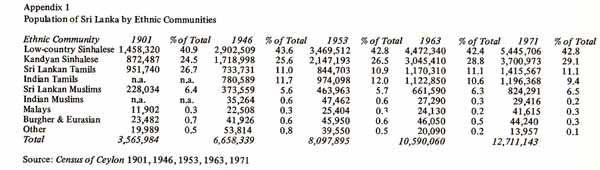
Appendix 2
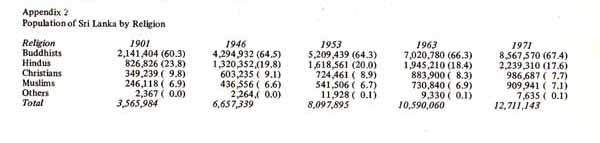
Appendix 3
Bandaranaike's 1955 Statement on Tamil Language Recognition
1. Legislature
Tamil may also be used in the Senate and in the House of Representatives, and
all laws will be promulgated in that language as well 2. Administration
Sinhalese will be the language of administration in
all courts, government offices rt and local bodies, provided that in the
Northern and Eastern Provinces. the language will be Tamil.
3. Education
The Medium of Instruction shall be Sinhala, provided that in the
Northern and Eastern Provinces it shall be Tamil.
Proviso 1 Every pupil should be encouraged 9but not compelled) t learn the
other language as a second language and if the parents of one third of the
pupils in any school desire to do so, the school shall be compelled to provide
the necessary facilities. Proviso 2
If in any school in the Northern and Eastern Provinces the parents of two
thirds of the pupils desire that the medium of instruction shall be Sinhalese or
in the case ' of a school in any of the other seven Provinces that the medium of
instruction should be Tamil, this shall be allowed. But in such a school Tamil
or Sinhalese, as the case may be, shall be taught compulsorily as a second
language to all the puph f in that school.
NB. A parent for this purpose shall be a registered voter tot Parliamentary
Elections.
4. General
All citizens shall have the right to transact official business in
Sinhalese or Tamil in any past of the island.
Transitory Provisions
There should be an immediate declaration of the
official language. But in the transition period, until the above policy can be
implemented, English may continue to be used. A Commission shall be appointed
forthwith to draw up a timetable setting out the dates for the change over and
to what extent, if any, English may continue to be utilised and also indicating,
where necessary, the steps to be taken to give effect to this timetable.
Appendix 4 Bandaranaike's 1957 Proposals for "Reasonable Use of Tamil"
The following statement was made by Bandaranaike in the House:
The House and the Country know that it has always been the policy of the Government Party that although the circumstances of the situation were such
that that Sinhalese language had to be declared the official language of this country,
there was
no intention in fact to cause any undue hardship or injustice to those whose
language is other than Sinhalese in the implementation of that Act.
I wish also to point out that the Government Party prior to the elections in
their manifesto gave the assurance that while it was their intention to make
Sinhalese the official language of the country, reasonable use of Tamil too will be
given. We had to till we saw what were the precise forms in which this recognition of the
Tamil language could be given effect to.
I am in a position, on behalf of the Government, to make a statement, in
general terms of course. The details will have to be worked out and discussed and
Members
of the House and others will be given the opportunity of expressing their
views in due course. There are certain matters that are already being done, for instance
taking effective steps to see that this reasonable use is given its proper place.
Administratively
all ready certain things are being done. For instance, in the realm of
education, it was always the position of the Government that they did not ban education in the
medium
of the Tamil language, naturally, they will have the right to go up to the
very summit of education in that medium.
The House and public will also remember that in a discussion we had with the
university authorities, it was decided that the Tamil medium should also be
used in examinations, that is, so far as those facilities are concerned where Swabasha is used, that the Tamil medium should also be adopted. It is the policy of the
Government that
position should be preserved.
Following from that position, there is the question of the Public Service.
For the
present, the practice the Government is following is that those educated in a
medium
other than Sinhalese should be permitted to sit for examinations in the
medium in
which they have been taught with only the proviso that once they are
appointed as
probationers they will naturally be required to obtain that knowledge of the
official
language which may be considered necessary for carrying out duties before the probationary period eventuates in permanent employment.
It may be that after some years the better course for those who sit for these
examinations would be to take some easy paper showing some knowledge of the official
language rather than wait till they are appointed as probationers to acquire that
knowledge. That
IS a matter that will receive the consideration of the Government.
The other question is that of correspondence and transaction of business.
That also
flows from the position that the Tamil language is recognised as the medium
of instruction. Those who are educated in that language will have the opportunity of
addressing letters, getting replies and so on in the same language. I am not going into
details. I am
merely expressing certain general lines on which the government will work out
a scheme.
The fourth question is in regard to local authorities, Regional Councils and
so on. The work of these bodies falls into two categories, namely proceedings at
their meetings
and the transaction of general business. Proceedings at meetings will be
governed by the
Standing Orders and Regulations in the same way as proceedings in this House
are
governed by our Standing Orders. With regard to the work of the local
authority vis a vis the Central Government, we feel that at least in certain areas in the
Northern and
F astern Provinees the local authority should have the option of doing the
official part of their work in Tamil if they so wish.
These are the four main heads, and of course there are subsidiary matters
that will
arise it is the view of the Government that a scheme in that way should be
worked out.
In other words, the policy that the Government intends to follow is that
while
accepting Sinhalese as the official language, citizens who do not know
Sinhalese should
not suffer inconvenience, embarrassment or any trouble as a result of that.
Some of my Hon. Friends opposite who hold an extreme point of view will think
differently There are extremists on both sides. We cannot decide these issues
on grounds
of extremisms whether it be on this side of the House or on that side. We
have to take a rational, reasonable attitude in these matters. Of course, Sinhalese has been
declared the
official language of the Country. The Government now proposed to take these
steps and everybody will have an opportunity to make suggestions.
I have only given the broad outline of what we intend doing.
Appendix 5 The "Bandaranaike Chelvanayakam Pact", 26 July 1957
Statement on the general principles of the Agreement:
Representatives of the Federal Party have had a series of discussions with
the Prime Minister in an effort to resolve the differences of opinion that had
been growing and creating tension.
At an early stage of these conversations it became evident that it was not
possible for
the Prime Minister to accede to some of the demands of the Federal Party. is
The Prime Minister stated that from the view of the Government he was not in
a position to discuss the setting up of a federal constitution or regional
autonomy or any steps which would abrogate the Official Language Act. The
question then arose whether 0' it was possible to explore the possibility of an
adjustment without the Federal Party abandoning or surrendering any of its
fundamental principles and objectives.
At this stage the Prime Minister suggested an examination of the Governments
draft Regional Councils Bill to see whether provisions could be made under it
to meet reasonably some of the matters in this regard which the Federal Party
had in view.
The agreements so reached are embodied in a separate document. Regarding the
language issue the Federal Party reiterated its stand for parity, but in view of
the position of the Prime Minister in this matter they came to an agreement by
way of an adjustment. They pointed out that it was important for them that there
should be a recognition of Tamil as a national language and that the
administrative work in the Northern and Eastern Provinces should be done in
Tamil.
The Prime Minister stated that as mentioned by him earlier it was not
possible for him to take any step which would abrogate the of ficial Language
Act.
Use of Tamil After discussions it was agreed that the proposed legislation
should contain recognition of Tamil as the language of a national minority of
Ceylon, and that four points mentioned by the Prime Minister should include
provision that, without infringing on the position of the official Language
Act, the language of administration in the Northern and Eastern Provinces should
be Tamil and that any necessary provision be made for the non Tamil speaking
minorities in the Northern and Eastern Provinces.
Regarding the question of Ceylon citizenship for people of Indian descent and
revision of the Citizenship Act, the representatives of the Federal Party put
forward their, views to the Prime Minister and pressed for an early settlement.
The Prime Minister indicated that this problem would receive early
consideration.
In view of these conclusions the Federal Party stated that they were
withdrawing their proposed satyagraha.
Joint Statement by the Prime Minister and Representatives of the Federal
Party on Regional Councils:
(A) Regional areas to be defined in the Bill itself by embodying them in a
schedule thereto .
(B) That the Northern Province is to form one Regional area
whilst the Eastern Province is to be divided into two or more Regional areas.
(C) Provision is to be made in the Bill to enable two or more regions to
amalgamate even beyond provincial limits and for one Region to divide itself
subject to ratification by Parliament. Further provision is to be made in the
Bill for two or more Regions to collaborate for specific purposes of common interest.
Direct Elections
(D) Provision is to be made for direct election of Regional
Councillors. Provision is to be made for a Delimitation Commission or Commissions for carving out
electorates. The question of M.P.s representing Districts falling within
Regional areas to be eligible to function as chairman is to be considered. The
question of the Government Agents being Regional Commissioners is to be
considered. The question of supervisory functions over larger towns, strategic
towns and municipalities is to be looked into.
Special Powers
(E) Parliament is to delegate powers and to specify them in
the Act. It was agreed that Regional Councils should have powers over specified
subjects including agriculture cooperatives, lands and land development,
colonisation, education, health, industries and fisheries, housing and social
services, electricity, water schemes and roads. Requisite definition of powers
will be made in the Bill.
Colonisation Schemes
(F) it was agreed that in the matter of Colonisation
Schemes, the powers of the Regional Councils shall include the powers to select allottees to whom lands within the area of authority shall be alienated and also
power to select personnel to be employed for work on such schemes. The position
regarding the area at present administered by the Gal Oya Board in this matter
requires consideration.
Taxation and Borrowing (G) The powers in regard to the Regional Councils
vested in the Minister of Local Government in the draft Bill to be revised with
a view to vesting control in Parliament where necessary. (H) The Central
Government will provide block grants to the Regional Councils. The principles on
which the grants will be computed will be gone into. The Regional Councils shall
have powers of taxation and borrowing.
Source: House of Representatives, Parliamentary Debates (Hansard) Vol. 30
col. 1309 1311.
Appendix 6
The "Senanayake Chelvanayakam Pact", March 1965
AGREEMENT Mr Dudley Senanayake and Mr S.J.V. Chelvanayakam met on the 24th
day of March 1965 and discussed matters relating to some problems over which the
Tamil speaking people were concerned, and Mr Senanayake agreed that action on
the following lines would be taken by him to ensure a stable government.
1. Action will be taken early under the Tamil Language Special Provisions Act
to make provision for the Tamil language to be the language of administration
and of record in the Northern and Eastern Provinces. Mr Senanayake also
explained that it was the policy of the Party that a Tamil speaking person
should be entitled to transact business in Tamil throughout the island.
2 Mr Senanayake stated that it was the policy of his Party to amend the
Language of the Courts Act to provide for legal proceedings in the Northern and
Eastern Provinces to be conducted and recorded in Tamil.
3. Action will be taken
to establish District Councils in Ceylon vested with powers over subjects to be
mutually agreed upon between the two leaders. It was agreed however that the
Government should have power under the law to give directions to such Ounces in
the national interest
4. The Land Development Ordinance will be amended to
provide that Citizens of Ceylon be entitled to the allotment of land under the Ordinance. Mr
Senanayake further agreed that in the granting of land under Colonisation
Schemes the following priorities to be observed in the Northern and Eastern
Provinces:
(a) Land in the Northern and Eastern Provinces should in the first
instance be granted to landless persons in the District; (b) Secondly, to Tamil
speaking persons resident in the Northern and Eastern Provinces, and (c)
Thirdly, to other citizens of Ceylon, preference being given to Tamil residents
in the rest of the island.
(Signed) Dudley Senanayake, 24.3 .1965
(Signed) S.J.V. Chelvanayakam 24.3 1965
Appendix 7
The 1966 Tamil Language Regulation, published in Government
Gazette 14653 of 2.3.1966.
1. Without prejudice to the operation of the Official Language Act 33 of
1956, which declared the Sinhala Language to be the one official language of
Ceylon, the Tam Language shall be used:
2. (a) in the Northern and Eastern Provinces for the transaction of all
Government and i public business and the maintenance of public records whether
such business is conducted in or by a department or institution of the
Government, a public Corporation or a Statutory Institution, and
(b) for all correspondence between persons other than officials in their
official capacity, educated through the medium of the Tamil Language, and any
official in his official capacity or between any local authority in the Northern
and Eastern Provinces which conducts its business in the Tamil Language, and any
of ficial in his of ficial capacity.
3. To give effect to the principles and provisions of the Tamil Language
(Special
Provisions) Act, and those Regulations, all Ordinances, and Acts, all Orders,
Proclamations, Rules, By laws, Regulations, Notifications, made or issued under
any written law, the Government Gazette and all other official publications and
circulars, and forms issued by Government, Corporations, Statutory Institutions shall be
published in Tamil.
Appendix 8
Tamils Fight for National Freedom
(A Memorandum submitted by the Liberation Tigers to the Seventh Summit
Meeting of Non Aligned Nations held in New Delhi, India March 7 15 1983)
The Honourable Chairman,
Respected Leaders of the Third World,
Distinguished Delegates
We wish to submit for your kind attention and urgent consideration a very
grave and :,~ potentially explosive situation in Sri Lanka. It is the plight of
the Tamil nation of four X million people and their legitimate struggle for
political independence based on the ;~ democratic principle of national self
determination. The Tamil nation was forced into this political path as a
consequence of nearly thirty five years of violent and brutal oppression practised by successive Sri Lankan Governments aimed at the
annihilation of the national entity of the Tamils. Decades of peaceful non
violent, democratic political struggles to gain the very basic human rights were
met with vicious forms of military suppression The intensified military
occupation of Tamil lands, the intolerable terrorism of the armed forces, the
implementation of racist and repressive legislations. the mass arrest and
detention of political activists all these draconian methods were employed to
stifle and subjugate the will of our people to live free, and stamp out their
legitimate struggle for justice. This ever unfolding thrust of national
oppression made unitary existence intolerable and finally led to the demand for
secession by the oppressed Tamil people.
You are certainly aware that in the contemporary conjuncture national
liberation struggles have assumed world historical significance. The right of
nations to self determination is the cardinal principle upon which many struggles
for national emancipation are being fought today. It is the principle that
upholds the sacred right of a nation to decide its own political destiny, a
universal socialist principle that guarantees the right of a nation to political
independence. The Tamil national independence struggle is fought on the very
basis of our nation's right to political independence.
To the community of world nations Sri Lanka attempts to portray itself as a
paradise island, cherishing the Buddhist ideals of peace and dharma, adhering to
a noble political doctrine of socialist democracy and pursuing a neutral path of
non alignment. Paradoxically behind this political facade lies the factual
reality, the reality of racial repression, of the blatant violation of basic
human rights, of police and military brutality, of attempted genocide. Master
minding a totalitarian political system with the collusion of U.S. imperialism,
the Sri Lankan ruling elite since 'independence' wielded their political power
by invoking the ideology of national chauvinism and religious fanaticism and by
actually practising a vicious and calculated policy of racial repression against
the Tamil People. It is a tragic paradox that dictatorial regimes like Sri Lanka
who stands indicted by world humanist movements for crimes against humanity
could parade on a world forum with the mantle of democracy and dharma. Our
objective is to expose this hypocrisy and place before you the authentic story,
the story of the immense sufferings as well as the heroic struggles of our
people who have no choice but to fight for dignity and freedom rather than
reduced to slavery and slow death.
Historical background The Tamils of the island of Ceylon (now called Sri
Lanka) constitute themselves as a nation of people. forming into a coherent
social entity with their own history, tradition, culture, language and economic
life. The nation is popularly called Tamil Eelam. Tamils have been living in the
island from pre historic times before the arrival of the Sinhalese from northern
India in the 6th century B.C. The Sinhalese people who constitute the majority
nation of ten million have a distinct language, culture and history of their
own. Historical chronicles document that the island was ruled by both Tamil and
Sinhalese kings. From the 13th century onwards, until the penetration of foreign
colonialism Tamil Eelam lived as a stable national entity with a state
structure and was ruled by its Oven kings. The Portuguese annexed the territory
in 1619 yet ruled it as a separate national entity, as the traditional homelands
of the Tamils. Dutch colonialism, which tallowed did not violate the national
and territorial autonomy, until British imperialism in 1833 brought about a
unified state structure amalgamating the Tamil and Sinhala kingdoms laying the
foundation for the present national conflict. Another significant extent in the
British imperialist rule was the creation of an exploitative plantation economy
for which a million Tamils from South India were brought as workers and settled
in the island. Constituting a crucial part of the Tamil Eelam national totality,
this huge mass of Tamil labourers who produce the wealth of the island yet
subjected to most sinister form of racial repression.
Dimensions of National Oppression
The Sinhala chauvinistic oppression against the Tamil nation began to
unfold its ugly soon after national 'independence' in 1948 when the British handed over
state power to the Sinhalese ruling elite. This oppression was not simply an
expression of racial prejudice, but a well calculated genocidal plan aimed at the gradual
and systematic destruction of the essential foundations of national community. The
oppression, there fore assumed a multi dimensional thrust, attacking simultaneously on the
different
structural levels of the national foundation, the levels of the conditions of
existence of a
nation, its language, education, culture, economy and territory. As part of
this genocidal programme formed the state inspired communal riots, which led to the mass
destruction
of life and property of the Tamils.
Half a Million Workers Disenfranchised
The first major onslaught of this genocidal oppression was directed against the Tamil plantation workers, who as
the only organised proletariat wielded immense political power which the
Sinhalese ruling class wanted to castigate. By enacting notorious citizenship
laws (Citizenship Acts of 1948 and 1949) the Sri Lankan Government
disenfranchised more than half a million Tamil plantation workers. This
repressive measure reduced these people to a condition of statelessness and
dehumanised them without any basic human or civil rights.
Planned Annexation of Tamil Lands
The most vicious form of oppression
calculated to destroy the national identity of the Tamils was the state aided
aggressive colonisation which began soon after 'independence' and now swallowed
nearly three thousand square miles of Tamil Eelam. This planned occupation of
Tamil lands by hundreds of thousands of Sinhala people aided and abetted by the
state was aimed to annihilate the geographical entity of the Tamil nation.
Repression on Language, Employment and Education
Sinhala chauvinism struck
deeply into the spheres of language, education and employment of the Tamils.
Championing the ideology of ultra nationalism, Mr Bandaranayake came to
political power in 1956 with the pledge to install Sinhala language and Buddhist
religion as the only official language and state religion of the island. His
first Act in Parliament, the Sinhala Only Act, put an end to the equality of
status enjoyed by the Tamil language and made Sinhala the only state language.
This infamous legislation had disastrous consequences. It forced the Tamil
public servants to learn Sinhala language or leave employment. In the decades
that followed all employment opportunities in the public service were
practically closed to the Tamils. They were gradually rooted out from positions
of power in the public sector as well as in the armed services.
Education was the crucial area in which the onslaught of racism deprived a
vast population of Tamil youth from access to higher education. A notorious
discriminatory selective device called "Standardisation" was introduced in 1970
which demanded higher merits of marks from Tamil students for university
admissions whereas the Sinhalese students were admitted with lower grades. The
present regime introduced a new scheme which turned out to be far more
discriminatory than the earlier one denying thousands of deserving Tamil
students the right to higher education, and created a huge army of unemployed
youth.
Economic Deprivation The thrust of national oppression that penetrated into
the spheres of language, education and employment had far reaching consequences
on the economic life of the Tamil speaking people as a whole. For more than
three decades all successive Sri Lankan Governments pursued a deliberate policy
of totally isolating Tamil areas from all the national development projects.
While the state poured all the economic aid into the South, while the Sinhala
nation flourished with massive development programmes, the nation of Tamil Eelam
was isolated as an unwanted colony and left to suffer the worst form of economic
deprivation.
Racial Riots and Massacre of Tamils The racial riots that constantly plague
the island should not be viewed as spontaneous outbursts of inter communal
hatred between the two communities. All major racial conflagrations that erupted
violently against the Tamil speaking people were inspired and master minded by
the Sinhala ruling regimes as a part of the grand genocidal programme.
Violent
anti Tamil racial riots exploded in the island in 1956,1958, 1961 1974, 1977,
1979 and in 1981. In these racial holocausts thousands of Tamils, including ns
omen and children were mercilessly massacred, millions worth of Tamil property
destroyed and hundreds of thousands made refugees. The state and the armed
forces colluded with hooligans in their barbaric acts of arson, rape and murder.
Instead of containing the violence, the Sinhala Government leaders made
inflammatory statements adding fuel to the fire. The violent riots of 1981
showed the genocidal character of this horrifying phenomenon. It was during
these riots the Sinhala police went on a wild rampage burning down the Tamil
City of Jaffna, destroying completely the public library with all its treasures
of historical learning, set fire to a national newspaper office and burnt to
ashes hundreds of shops. The alarming aspect of this state terrorism was that it
aimed at the destruction of the cultural foundations of the Tamil nation.
The cumulative effect of this multi dimensional oppression threatened the
very survival of the Tamils. It aggravated the national conflict and the
struggle for secession became the only and the inevitable choice.
Peaceful Campaigns for Federal Autonomy
Following the implementation of the Sinhala Only Act in 1956, the Tamil Parliamentary leadership organised mass
agitational campaigns demanding a federal form of autonomy for the Tamil nation.
The satyagraha (peaceful picketing) campaigns of 1961 was a great event in the
history of the Tamil freedom struggle. This civil disobedience campaign unfolded
into a massive national uprising, participated by hundreds of thousands of Tamil
people, symbolising the collective resentment of the whole nation against the
oppressive policies of the Sinhala rulers. Within a few months this successful
satyagraha campaign paralysed the whole government administrative machinery in
Tamil Eelam. Alarmed by the success of the Civil Disobedience Campaign the state
oppressive machinery reacted swiftly. Under the guise of Emergency and Curfew,
military terrorism was let loose on the peaceful satyagrahies. Hundreds of these
non violent agitators sustained serious injuries, and their leaders arrested.
Thus, state violence finally succeeded in silencing the non violent campaign of
the oppressed; the armed terror ultimately crushed the ahimsa of the Tamils. The
success of this violent repression encouraged the Sri Lankian state to utilise
military terror against all forms of democratic political campaigns of the
Tamils. Large contingents of armed forces were poured into Tamil areas and the
Tamil nation was finally brought under military siege.
The Demand for Secession
In 1972, a new republican constitution was adopted
which removed the fundamental rights and privileges accorded to national
minorities. This infamous constitution created the conditions for the political
alienation of the Tamils and cut a deep wedge between the two nations.
Confronted with steadily mounting national oppression, frustrated with the
failures of democratic political struggles demanding basic human rights, the
Tamil nationalist parties converged into a single movement (The Tamil United
Liberation Front) and resolved to fight for political independence on the basis
of the nation's right to self determination. At the general elections of 1977,
the Front demanded a clear mandate from the people to launch a national struggle
to establish sovereignty in the Tamil homeland. These elections took the
character of a referendum and the Tamil speaking people voted overwhelmingly in
favour of secession. Thus a new historical era m Tamil politics began, ushering
a revolutionary struggle for a national independence.
Armed Resistance and the Tiger Movement
The struggle for national freedom
having failed in its democratic popular agitations, having exhausted its moral
power to mobilise the masses for peaceful campaigns, gave rise to the emergence
of armed resistance movement in Tamil Eelam in the early seventies. Armed
resistance as a mode of popular struggle arose when our people were presented
with no alternative other than to resort to revolutionary resistance to defend
themselves against a savage form of state terrorism. The armed struggle,
therefore is the historical product of intolerable national oppression; it is an
extension, continuation and advancement of the political struggle of our
oppressed people. Our liberation movement which spearheads the revolutionary
armed struggle in Tamil Eelam is the armed vanguard of the national struggle.
The strategy of revolutionary armed struggle was formulated by us after a
careful and cautious appraisal of the specific concrete conditions of our
struggle, with the fullest comprehension of the historical situation in which
masses of our people have no choice other than to fight decisively to advance
the cause of national freedom. Our total strategy integrates both national
struggle and class struggle, interlinks the progressive patriotic feeling of the
masses with proletarian class consciousness to accelerate the process of
socialist revolution and national liberation.
The armed struggle of our liberation movement is sustained and supported by
wider sections of the Tamil masses, since our revolutionary political project
expresses the profound aspirations of our people to gain political independence
from the autocratic domination and repression of the Sri Lankan state. T<o
achieve the revolutionary tasks of national emancipation and socialist
revolution, our project aims at the extension and transformation of our
protracted guerilla warfare into a people's popular war of national liberation.
World's Conscience Condemns Sri Lanka
The development of Tamil liberation
struggle into a dimension of armed resistance of the people alarmed the Sri
Lankan repressive state. The Government responded with extreme repressive
measures against our people, using all means in its power to crush the freedom
struggle. Draconian laws were rushed through Parliament to proscribe our
movement, and the state controlled media is utilized to slander the freedom
fighters and all the political activists as "terrorists". Mass arrests of
innocent people, trials without jury, inhuman torture, death sentences have
become the order of the day.
The most notorious law is the Prevention of Terrorism Act which denies trial
by jurys enables the detention of people for a period of eighteen months and
allows confessions extracted under torture as admissable in evidence. Hundreds
of youths are being held behind bars and subjected to torture under this
draconian law. In a recent wave of repression, the Sri Lankan armed forces have
arrested several members of the Catholic and Methodist clergy and prominent
Tamil educationists and charged them under the Terrorism Act. This oppressive
measure has caused massive outcry in Tamil Eelam, Tamil Nadu, and all over the
world.
The Prevention of Terrorism Act has been universally condemned by the
world human rights movements, particularly by the INTERNATIONAL COMMISSION OF
JURISTS and by AMNESTY INTERNATIONAL as violating fundamental human liberties.
Amnesty International in an appeal to the Government of Sri Lanka has expressed
grave concern about those who were arrested under this law and held
incommunicado. The International Co,mmission of Jurists, in a report, has
condemned the state terrorism of the Sinhala armed forces unleashed against the
Tamils and has denounced the Prevention of Terrorism Act as a piece of
legislation that violates Sri Lanka's obligation under the international
convenant on civil and political rights.
An appeal to the World Leaders
Our liberation struggle, as an oppressed
nation fighting against the oppressor, constitutes an integral part of the
international struggle, the struggle of the revolutionary forces against the
forces of reaction, the forces of imperialism, neo colonialism, Zionism and
racism. Though each liberation struggle has its own historical specifity and its
unique conditions, in their essence they articulate a universal historical
tendency of the human aspiration for freedom from all systems of oppression and
exploitation in this context, Tamil Eelam national struggle is similar in
content to that of the Palestinian struggle or Namibian struggle or any national
struggle of the oppressed people based on their right to national self
determination.
WE THEREFORE APPEAL TO THE GOVERNMENT OF INDIA, WHO HOSTS THIS GREAT FORUM,
AND TO THE LEADERS OF THE THIRD WORLD TO SYMPATHISE AND SUPPORT THE FREEDOM
STRUGGLE OF THE EELAM TAMILS. IN THE NAME OF HUMANITY, LIBERTY AND JUSTICE, WE
CALL UPON YOU TO CONDEMN THE GENOCIDAL OPPRESSIVE POLICIES OF THE SRI LANKAN
GOVERNMENT AND TO RECOGNISE OUR PEOPLE'S RIGHT TO NATIONAL SELF DETERMINATION.
We, the Liberation Tigers, wish to express our support and solidarity to all
the revolutionary liberation struggle of the oppressed masses of the world.
POLITICAL COMMITTEE
LIBERATION TIGERS OF TAMIL EELAM
Appendix 9
Liberation Tigers of Tamil Eelam 20.7.1979
A LETTER OF PROTEST TO MR R. PREMADASA, THE PRIME MINISTER OF SRI LANKA FROM
THE LIBERATION TIGERS OF TAMIL EELAM
Dear Sir,
A very grave and explosive situation has arisen in Tamil Eelam as a
consequence of your Government's determination to stifle and stamp out, by
violent means, the legitimate struggle of the oppressed Tamil nation for
political independence. The intensified military occupation of Tamil lands, the
increased terrorism of the State police against the innocent Tamil masses, the
implementation of new repressive legislations that annuls the very freedom of
political agitations all such devious methods of totalitarian tyranny signify
that your Government has mounted a massive scale oppression to strangle the will
of a nation of people and silence their political aspirations. In view of the
fact that your Government has embarked on a policy of eliminating, by brute
force, a legitimate political struggle based on a democratic principle of
national self determination and that your Government has been using the name of
our revolutionary movement as a pretext to invoke such repressive measures and
to inflame the fires of Sinhala chauvinism, the Liberation Tigers are compelled
to counter such vicious allegations and insinuations.
The most important factor that we wish to state clearly and emphatically is
that we are not a group of amateur armed adventurists roaming in the jungles
with romantic political illusions, nor are we a band of terrorists or vandals
who kill and destroy at random for anarchic reasons. We are neither murderers
nor criminals or violent fanatics as your Government often attempts to portray
us. On the contrary, we are revolutionaries committed to revolutionary political
practice. We represent the most powerful extra parliamentary liberation movement
in the Tamil nation. We represent the militant expression of the collective
will of our people who are determined to fight for freedom, dignity and justice.
We are the armed vanguard of the struggling masses, the freedom fighters of the
oppressed. We are not in any way isolated and alienated from the popular masses
but immersed and integrated with the popular will, with the collective soul of
our nation. Our revolutionary organisation is built through revolutionary
struggles based on a revolutionary theory. We hold a firm conviction that armed
resistance to the Sinhala military occupation and repression is the only viable
and effective means to achieve the national liberation of Tamil Eelam. Against
the reactionary violence and terrorism perpetrated against our people by your
Government we have the right of armed defence and decisive masses of people are
behind our revolutionary struggle.
Why we are committed to Armed Struggle The Tamil political history of recent
times will certainly indicate to you that our people have exhausted all forms of
peaceful struggles, all forms of parliamentary agitations, all forms of
negotiations and pacts. For nearly a quarter of a century the Tamil nationalist
movement fought decisively encompassing a variety of forms of struggles from
peaceful picketings to mass hartals, from mass demonstrations to general strikes
all aspects of peaceful political practice have been expressed and exhausted.
The more the Tamil masses sought non violent methods to redress their
grievances, the more the Sinhala ruling classes sought violent methods of
military oppression and subjugation; the more they called for national
emancipation the more the military invasion, occupation and repression. It is
because of the heightened condition of this savage oppression, of the exhaustion
and frustration of peaceful agitations that prompted our movement to engage in
revolutionary armed resistance which we hold is a continuation of the political struggle of our oppressed people. The guerrilla warfare, the
form of the
popular struggle we are committed to is not borne out of blind militancy or
adventurism
but arose out of the historical necessity, out of the concrete conditions of
intolerable national oppression. Our actions and operations, as your Government
attempts to paint, are not indiscriminate bursts of irrational violence or
terrorism, they are acts of revolutionary violence of the oppressed against the
reactionary violence of the oppressor. We are waging a heroic struggle against
the oppressive instruments of the state, against those who try to hunt us down,
against those who plot to wipe us out, against those who betray us and against
those traitors and opportunists who betray the noble cause of our national
liberation struggle.
Who are the Terrorists? The first piece of draconian legislation enacted by
your Government was to proscribe the Tiger movement alleging that we are
dangerous terrorists threatening the very foundation of the so called national
unity and territorial integrity. Such a legislation was, in actual fact, aimed
not only to suppress the revolutionary armed struggle of the Tamils but also to
consolidate an unpopular bourgeois dictatorship against the possible uprising of
the oppressed Sinhala masses. The new Emergency Regulations aim to combat
terrorism, but in reality it is primarily motivated to crush and destroy the
Tamil national movement along with ad forms of popular class struggle against
the State. Such totalitarian legislations negate the very freedom of political
expression and contravene the basic principles of human right and liberty.
In the deluded eyes of your Government our movement appears to be a spectre
of terrorism and anarchy. In reality, who are these terrorists? We assert, and
we hold that we are right in our assertion, that it is the State police and the
armed forces and those who poison the minds of the innocent Sinhala masses with
racial fanaticism and chauvinism are the real terrorists. There has been
innumerable incidents of such acts of terrorism perpetrated against our people,
incidents of mass murder, looting and arson by racist terrorists aided and
abetted by the armed forces, incidents of shooting and killing of innocent
Tamil people, incidents of sadistic murders and barbaric torture by the police.
These violent acts certainly fad within the category of terrorism and these
terrorists are none other than the instruments of State oppression and the
reactionary forces of racism. It is upon these terrorist forces that your
Government has bestowed extra ordinary powers to ensure the peace and security
of our people. Therefore, it is beyond reasonable doubt that your Government's
objective is not to wipe out a nonexistent terrorism but to unleash actual
terrorism and violence to create panic among the Tamil masses. By such a high
handed act, the Sinhala ruling class aims to destroy the determined will of our
nation to fight for political independence. But the Government has failed to
comprehend the historical truth that the more a nation of people are oppressed
the more they become determined to fight back the oppression. By intensifying
oppression your Government will never be able to achieve its aims of enslaving
our people but will certainly open the prospective of prolonged popular armed
struggle, a strategic objective to which we are already committed to.
Civil Administration Partially Paralysed
Your Government has closed several
banks and the airport in the North placing the blame on our liberation movement.
A state of emergency has been declared claiming that criminal acts are on the
increase in Tamil areas. The Government's motive behind such strategy is well
known to our people. It is the calculated aim of your Government to place more
hardship and inconvenience on our people hoping that the Tamil masses might
feel the pinch and gradually turn critical of us and finally betray us. Such a
devious strategy, we are certain, win never work. It simply exposes the
impotency of your Government's civil administration which has been partially
paralysed. The declaration of the State of Emergency bares ample testimony that
your Government is totaUy incapable of exercising any form of civil authority in
the Tamil nation other than by military occupation and repression.
Acts of violence emanating from the most oppressed and deprived sections of
the
masses are not typical symptoms in the North alone. They are more pervasive
in Sri Lanka signifying the socio economic crisis your Government is confronted
with. This fact is amply illustrated by a statement made in Parliament recently
by the Minister of Justice that between January and April of 1978 there have
been 474 homicides and 214 incidents of robberies and burglaries throughout the
island. Your Government has been using the Tamil revolutionary youth as scape
goats for civil unrest that is boiling throughout Tamil Eelam and Sri Lanka.
The truth is that your capitalist regime is faced with a major crisis and the
down trodden classes are becoming impatient and disgruntled. The increasing
criminal violence is an external manifestation of the internal frustrations of
the masses. Unable to resolve the national economic crisis and the mounting
social problems, your Government is adopting the reactionary strategy of
intensifying the national oppression of the Tamils and invoking the Tiger
phobia. The Sinhala national bourgeoisie always descends to such dirty politics
of racism and chauvinism as a desperate means to turn the tide of Sinhala mass
resentment against the State, towards the Tamils. Such a strategy, we are
certain, will not work in the long run since the revolutionary proletariat in
Sri Lanka is becoming ideologically conscious of the dangers of chauvinism that
divide and immobilise the Sinhala working class.
We are fighting for a noble cause, a right cause, the cause of national
freedom of the oppressed nation Tamil Eelam. The revolutionary process towards
which we work to achieve national liberation and socialism will be long and
arduous. Yet, we are certain that no force on earth, however repressive it may
be, can stop us from the revolutionary struggle we are committed to.
LONG LIVE TAMIL EELAM
Chairman
Central Committee
Liberation Tigers of Tamil Eelam
Appendix 10. The World Tamil Diaspora (1979)
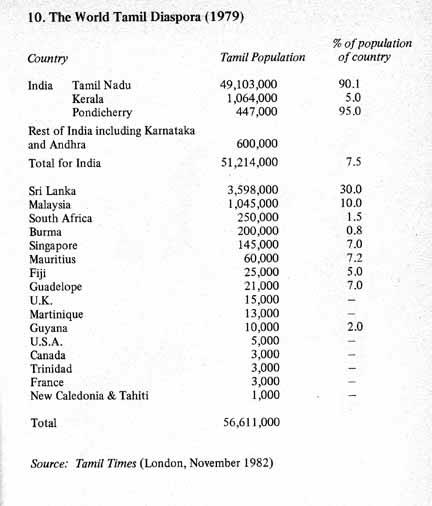
Select Bibliography
Books
Brooke Adams, The Law of Civilization and Decay, 1928.
A.C. Alles,
Insurgency 1971, Colombo, 1976.
B.H. Aluvihare, The Kandyan Conpention and
After, Colombo, 1941.
Amnesty International, Annual Reports from 1976 to 1982.
S. Arasaratnam, Ceylon, New Jersey, 1964.
S.D. Bailey, Ceylon, London, 1952.
S.W.R.D. Bandaranaike, Towards a New Era, Colombo, 1961. Speeches and Writings,
Colombo, 1963.
Frederick Barth, Ethnic Groups and Boundaries, Boston, 1969.
Robin Blackburn (ed ), Explosion in a Sub Continent, London, 1975.
Paul R.
Brass, Language, Religion and Politics in North India, Cambridge, 1974. Paul R.
Brass and Marcus F. Franda (eds.), Radical Politics in South Asia, Mass., 1973.
Buddhist Commission of inquiry, The Betrayal of Buddhism, Balangoda, 1956.
John
F. Cady, A History of Modern Burma, Cornell, 1958.
H.W. Codrington, A Short
History of Ceylon, London, 1926.
Sonia Cole, Races of Man, London, 1965.
E.S
Corwin, The Constitution and What it Means Today, London.
D V. Cowen, The
Foundation of Freedom, 1961.
John Davy, An Account of the Interior of Ceylon,
London, 1821.
William T. de Barry, The Sources of Indian Tradition, New York.
E
.B Denham, Ceylon at the 1911 Census, Colombo, 1912.
Colvin R. de Silva, Ceylon
under the British Occupation, Colombo, 1941.
K.M. de Silva (ed.), History of
Ceylon, Colombo,1973. Sri Lanka A Survey, London, 1977.
S.A. de Smith, New
Commonwealth and its Constitutions, London, 1964.
Karl W. Deutsch, Nationalism
and Social Communication: An Inquiry into the Foundations of Nationality, Mass.,
1953.
Karl W. Deutsch and W.J. Folz (eds.), Nation Building, New York, 1963.
L.S
Dewaraja, Kandyan Kingdom 1707 1760, Colombo, 1972.
A.V Dicey, Law of the
Constitution, London. B.H Farmer, Ceylon A Divided Nation, Oxford, 1963.
J.S.
Furnival, Colonial Policy and Practice, New York, 1960.
W. Geiger (trans.), Culavamsa, London, 1927.
Mahavamsa, London,1912. IS A R Gibb,lbn Battuta,
London, 1920.
Richard Gombrich, Precept and Practice Traditional Buddhism in the
Rural Highlands of Ceylon, London, 1971.
K Gough and H. Sharma (ed ),
Imperialism and Revolution in South Asia, New York, 1973.
Pierre Gourou, The Tropical World, London, 1953
B. Gunasekera, The Rajavaliya, Colombo, 1960.
Ananda Guruge (ed.), Return to Righteousness, Colombo, 1965.
International Commission of Jurists, The Rule of Law and Human Rights:
Principles and Definitions, 1966.
Robert Jackson, South Asian Crisis, London, 1975.
Sir Charles Jeffries, Ceylon The Path to Independence, London, 1962.
Transfer of Power, London, 1960.
Sir IvorJennings, Approach to Self Government, Cambridge, 1952. The British
Commonwealth of Nations, London, 1961.
Janice Jiggins, Caste and Family in the Politics of the Sinhalese 1947 1976,
Cambridge, 1976.
James Jupp, Sri Lanka Third WoHd Democracy, London, 1978.
Silan Kadirgamar (ed.), Handy Perinpanayagam A Memorial Volume, Chunnakam,
1980.
Robert Kearney, Communalism and Language in the Politics of Ceylon, Durham,
1967.
K.A.R. Kennedy and G.C. Possehl (ed.), Ecological Backgrounds to South Asian
Preh Story, New Orleans.
Elie Kedourie (ed.), Nationalism in Asia and Africa, London,1970.
Shelton Kodikara, Indo Ceylon Relations Since Independence, Colombo.
Hans Kohn, The Idea of Nationalism, New York, 1967.
Sir John Kotelawala, An Asian Prime Minister's Story, London, 1956.
V.l. Lenin, Collected Works, Moscow, 1966. Selected Works, Moscow, 1975.
E.R. Leach, Political Systems of Highland Burma, London, 1954.
E.F.C. Ludowyck, The Modern History of Ceylon, London, 1966.
G.P. Malalasekera, Pali Literature of Ceylon, Colombo, 1928.
Geoffrey Marshall, Constitutional Theory, Oxford, 1971.
Henry Marshall, Ceylon: A General DescHption of the Island and Its
Inhabitants, London, 1846.
P. Mason, India and Ceylon Unity and Diversity, London, 1967.
Alexander Meicklejohn, Political Freedom. The Constitutional Powers of the
People, 1965.
G.C. Mendis, Ceylon Today and Yesterday, Colombo, 1963. The Early History of
Ceylon, Calcutta, 1943. The Problems of Ceylon History, Colombo, 1966.
Kenneth R. Minogue, Nationalism, London, 1969.
Gunnar Myrdal, Asian Drama An Inquiry into the PoPerty of Nations, New York,
1968.
Jawaharlal Nehru, Discovery of India, Calcutta, 1946.
W. Nicholas and S. Paranavitana, A Concise History of Ceylon, 1961.
S.A. Pakeman, Ceylon, London, 1964.
H . Parker, A ncient Ceylon, London, 1909.
Denzil Pieris, 1956 and After, Colombo, 1958.
Ralph Pieris, Some Aspects of Traditional Sinhalese Culture, Peradeniya,
1956.
Satchi Ponnambalam, Dependent Capitalism in Crisis: Sri Lankan Economy
19481980, London, 1981.
C. Rasanayakam,Ancient Jaffna, Madras, 1926.
M.D. Raghavan, TheKarwasofCeylon, Colombo, 1961.
Walpola Rahula, History of Buddhism in Ceylon The Anuradhapura Period,
Colombo, 1956.
Peter Richards and Wilbert Gooneratne, Basic Needs, Poverty and Government
Policies in SriLanka, ILO, Geneva, 1980.
Michael Roberts (ed.), Collective Identities, Nationalisms and Protest in
Modern Sri Lanka, Colombo 1979.
Saul Rose, Politics in Southern Asia, London 1963.
Benjamin Rowland, Art and Architecture of India, London, 1954.
Bryce Ryan, Caste in Modern Ceylon, New Brunswick, 1953.
N.K. Sarkar, The Demography of Ceylon, Colombo, 1967.
Marshall R. Singer, The Emerging Elite A Study of Political Leadership in
Ceylon, Mass, 1964.
D.E. Smith, South Asian Politics and Religion, Princeton, 1942.
J .V. Stalin, Marxism and the National Question, New York, 1942.
A.J. Tresidder, Ceylon, Princeton,1960.
Jill and Leon Uris, Ireland A Terrible Beauty, New York, 1978.
Tarzie Vittachi, Emergency '58: The Story of Ceylon Race Riots, London, 1958.
L.G. Weeramantry, Assassination of a Prime Minister, Geneva, 1969.
I.D.S. Weearwardena, Government and Politics in Ceylon, 1931 1946, Colombo,
1951. Ceylon General Election 1956, Colombo, 1960. Ceylon and Her Citizens,
Madras, 1956.
K .C. Wheare, Constitutional Structure of the Commonwealth, Oxford, 1960.
Modern Constitutions, London, 1956.
N.D. Wijesekera, The People of Ceylon, Colombo, 1965.
D.C. Wijewardene, Revolt in the Temple, Colombo, 1953.
Harry Williams, Ceylon The PeaH of the East, London.
A.J . Wilson, Electoral Politics in an Emergent State, London,1975.
Howard Wriggins, Ceylon, Ddemmas of a New Nation, Princeton, 1960.
Arnold Wright (comp.), Twentieth Century Impressions of Ceylon, London, 1907.
Zelanicus (pseud.), Ceylon Between Orientand Occident, London, 1970.
Pamphlets, Leaflets and Articles
C.F. Amerasinghe, 'Legal Limitations on Constitutional Reform' in Ceylon
Journal of Historical and Social Studies, Jan June 1966. 'Legal Sovereignty of
the Ceylon Parliament', in Public Law, Spring 1966.
Amnesty International, Report of a Mission to Sri Lanka 19 75, London, 1976.
Sarath Amunugama, 'Ideology and Class Interest in One of Piyadasa Sirisena's
Novels:
The New Image of the Sinhala Buddhist Nationalist', in Michael Roberts (ed.) Collective identities . . .
S. Arasaratnam, 'Nationalism in Sri Lanka and the Tamils', in Michael Roberts
(ed.), Collective id entities . . . 'Ceylon Insurrection of April 1971 ', Pacif
c Affairs, Fall 1972.
N. Balakrishnan, 'Sri Lanka in 1974 Battle for Economic Survival',Asian
Survey, 2 February 1975.
Tissa Balasuriya, Sri Lanka 's Crisis of National Unity, Colombo, 1979.
Edith M. Bond, State of Tea, War on Want, London, 1974.
Stuart M. Bond, 'Civil Disobedience', in Journal of Philosophy, 1961.
Catholic Union of Ceylon, Companion to the Buddhist Commission Report,
Colombo, 1957.
John Christian, What is Catholic Action?, Colombo, 1964.
C.E. Corea, Communal Rights, Dehiwela, 1917.
A. Cox, 'Direct Action, Civil Disobedience and the Constitution', in Cox,
Howe and Wiggins, CiPil Rights, the Constitution and the Courts, 1967.
Harindra Corea, Freedom What Then?, Colombo, 1960.
C.R. de Silva, 'The Impact of Nationalism on Education: The Schools Takeover
(1961) and the University Admissions Crisis 1970 1975', in Michael Roberts
(ed.), Collective Id entities . . .
Colvin R . de Silva, The Failure of Communalist Politics, Colombo, 1958
Sri Lanka and the Tamil Liberation Struggle
K.M de Silva, 'Nationalism and Its Impact', in Sri Lanka Since Independence,
Colombo,1977. .
S.A. de Smith, 'Constitutional Guarantees', in McGill Law Journal, 1966b7.
K N O. Dharmadasa, 'Language and Sinhalese Nationalism: The Career of
Munidasa Cumaratunga', in Mod ens Ceylon Stud ies, July 1972. 'Sinhalese
Buddhist Identity and the Nayakkar Dynasty in the Politics of the Kandyan
Kingdom 1739 1815', in Michael Roberts (ed.), Collective Identities. . .
B.H. Farmer, 'The Social Basis of Nationalism in Ceylon', in The Journal of
Asian Studies, Vol. XXIV: 3, May 1965.
T. Fernando, 'The Elite Politics in the New States: The Case of Post
lndependence Sri Lanka', in Pacif c Affairs, FaU 1973.
Federal Party, Ceylon Faces Crisis, Colombo, 1957.
Clifford Geertz, 'The Integrative Revolution: Primordial Sentiment and Civil
Politics in the New States', in Geertz (ed.), old Societies and New Sfates, New
York.
Leslie Goonewardene, A Shorty History of the LSSP, Colombo, 1960.
John Halangoda, The Present Politics and the Rights of the Kandyans, Kandy,
1920. Rights and Claims of the Kandyan People, Kandy.
Fred HaUiday, 'The Ceylonese Insurrection', in New Left Review, Sept
Oct.1971.
C.R. Hensman, 'The Role of the Western Educated Elite', in Community,
Colombo, 1962.
International Commission of Jurists, Ethnic Conflict and Violence in Sri
Lanka, Geneva.
Kumari Jayawardena, 'The Origins of the Left Movement in Sri Lanka', Modern
Ceylon Studies, July 1971.
Robert Paul Jordan, 'Time for Testing for an Ancient Land Sri Lanka', in
National Geographic, Vol. 155, No. 1, January 1979.
Sir Ivor Jennings, 'Nationalism and Political Developments in Ceylon: The
Background to Self Government', in Ceylon Historical Journal, Vol.III, 1953 54.
Robert Kearney, 'The New Political Crisis of Ceylon', Asian Survey, June
1962. �'New Directions in the Politics of Ceylon', in Asian Survey, February
1967. 'Political Stress and Cohesion Ceylon', inAsian Survey, February 1968.
�'The Marxists and Coalition Government in Ceylon', in Asian Survey, February
1965 'Educational Expansion and Volatality in Sri Lanka: The 1971 Insurrection',
in Asian Survey, September 1975.
S.U. Kodikara, 'Communalism and Political Modernisation in Ceylon', in Mod
ern Ceylon Studies, January 1970.
N.S G. Kuruppu, 'A History of the Working Class Movement in Ceylon', in Young
Socialist, 1961 62.
V.l. Lenin, 'Critical Remarks on the National Question', in Collected Works,
Vol. 20. �'Right of Nations to Self Determination', Collected Works, Vol. 20.
�'The Socialist Revolution and the Right of Nations to Self Determination', in
Selected Works, pp. 157 167. 'Resolution on the National Question', Collected
Works, Vol. 24.
LSSP, The State Language Question, Colombo, 1955. With the Masses into
Action, Colombo, 1953.
Sean MacBride, 'Oppression as a Cause of International Violence', Minority
Rights Group, London, 1975.
L J. Maefarlane, 'Justifying Civil Disobedience', in 79 Ethics 24,1968.
�'Disobedience and the Bomb', in Political Quarterly, 1966.
John H. Martyn, Notes on Jaffna, Tellipalai, 1923.
Badiuddin Mahmud, Muslim Dignity Restored, Colombo, 1968.
Gananath Obeyesekere, 'Religious SYmbolism and Political Change in Ceylon',
in Modern Ceylon Studies, January 1971. 'The Vicissitudes of the Sinhala
Buddhist Identity through Time and Change', in Michael Roberts (ed.), Collective
Identities. . .
Kenneth Robinson, 'Constitutional Autochthony in Ghana', in Journal of
Commonwealth Political Studies, 1961.
Michael Roberts, 'The Rise of the Karavars', Ceylon Studies Seminar, 1968b9
Series, No.5.
Edmund Samarakkody, Ceylon Youth in Armed Uprising, Colombo, 1971.
Vijaya Samaraweera, 'The Muslim Revivalist Movement 1880 1915', in Michael
Roberts (ed.), Collective Identities . . .
W alter Schwarz, The Tamils of Sri Lanka, Minority Rights Group, London 1975
David Solbourne, 'Sinhalese Lions and Tamil Tigers of Sri Lanka', in the
frustrated Weekly of India, Bombay, 17 and 24 October 1982.
Anthony D. Smith, 'Ethnocentrism, Nationalism and Social Change', in
International Journal of Comparative Sociology, March 1972.
Donald E. Smith, 'The Dialectic of Religion and Politics in Sri Lanka', in
Sri Lanka Sincelndependence, Colombo,1975.
M.D. Silva, 'Sri Lanka: The End of Welfare Politics', in South Asian Review,
January
S.J. Tambiah, 'Buddhism and This Worldly Activity', in Modern Asian Studies,
January
W.A Wiswa Warnapala, 'Triumph of Competition in the Civil Service', in The
Ceylon Journal of Historical and Social Studies, Vol. 1.,1971.
L.A. Wickremaratne, 'Kandyans and Nationalism: Some Reflections', in The
Ceylon Journal of Historical and Soeial Studies, Vol. 5,1 & 2, 1975.
A. Jeyaratnam Wilson, 'Sinhalese Tamil Relationships and the Problems of
National Integration', Ceylon Studies Seminar Papers, No. 1 1968. 'The Tamil
Federal Party in Ceylon Politics', in journal of Commonwealth Political Studies,
July 1966. 'The Contribution of Some Leading Ceylon Tamils to the Constitutional
and Political Developments of Ceylon during the l9th and 20th Centuries', in
Proceedings of the First International Conferenee of Tamil Studies, Vol. 1,
Kuala Lumpur. 'Race, Religion, Language and Caste in the Subnationalisms of Sri
Lanka', in Michael Roberts (ed.), Collective Identities. . .
W. Howard Wriggins, 'Impediments to Unity in New States the Case of Ceylon'
American Politieal Seienee Review, June 1961.
|